R5 Festuscato: Over the Alps, part 1 of 3

Festuscato spent six months at home, getting ready to travel, which moved the calendar into 438. Britannia would be a long way.  He bought horses and put the entire troop on horseback first thing.  He made them ride every day, and encouraged them with the notion that they did not want to have to walk to Britain.  He got every man a spear, and made them practice stabbing at targets from horseback. He also bought a wagon load of arrows, and long swords like the barbarians used.  They had to practice with those, too.  He made it as much fun as possible, kept it competitive, and felt relieved to see Julius at the top of the class with Marcellus.  It would not have done to have the officers lagging behind.

After twelve weeks of what he called basic training, he started to push them.  In the second twelve weeks, he taught the basics of judo and karate.  He talked a lot about the vulnerable points.  He gave them round shields with dragons painted on them for their left arm while on horseback.  The shield protected their center, could be used to knock away an enemy spear, and yet they were small enough not to impede their horsemanship, such as it was.  Then he got creative and made them learn to fire arrows from horseback.  Not everyone mastered that, but the result was, after six months he had forty men ready to conquer the alps, and just in time.

Spring came due, and Festuscato gave Mirowen April first as an absolute deadline, “No foolin’,” he said.  True, he had properties throughout the Italian peninsula that she had to get squared away.  She had to make sure she had accountants to collect rents and pay taxes and in general watch things without skimming off the top.  She found gnomes, and Festuscato said it could not be safer at Gringots. She didn’t ask.

Come April first, Festuscato started itching to leave, and so did the men, believing that once they hit the road they could get some rest.  Father Gaius came riding up at the last with two fellow priests, Lavius, a large fellow, and Felix, a shy scholar and a far cry from their old friend Felix, the smooth-talking silk salesman.

“The Pope sends his blessing,” Gaius said, and handed over some papers to that effect. “Privately, he said you will probably save everything or break everything, being the scoundrel that you are.”

“I may save a soul or two, but I save my breaking for hearts.  Don’t tell him I said that.”

“No problem,” Gaius said.  “We are going with you.”

“What? Mirowen,” Festuscato put just the right amount of whine in his voice.

“I heard. Hello Gaius.  If you would follow me.”

“Good fathers,” Julius came up.  “Problem?”

“No.  The Pope sends his blessing and three tag-alongs. I assume they are headed for Britain.”

“The road, being what it is these days, I don’t blame them for tagging along where there is some chance of protection.”

“Why do you think I beat you and your men so badly these last six months.  At least now I feel we have a chance of reaching our destination.”

Julius looked serious.  “You don’t give yourself enough credit.”

“Oh?”

“You beat the hell out of the men.”  Julius grinned.

Festuscato responded with a straight face.  “Well, that should make the priests happy,”

There were always four, on rotation, that scouted and served out front on the point, and four who also served in the rear-guard position.  Four more drove or rode with each of the four wagons, which counted for sixteen men.  The wagons were the bulk of what kept them at a slow and gentle pace.  Oxen would only move so fast.  The first wagon carried weapons, tools and spare wagon parts. The second got stuffed with food, though every wagon had some emergency food and a barrel of water.  The third wagon had tents, blankets and whatever else would be necessary to make camp.  The fourth wagon carried Mirowen’s stuff, though to be honest, it was not all fluff stuff.  Among other things, she remembered to pack a good medical kit.

There were six men who rode on each side of the column, and rode out from the column when they could, to protect the flanks.  One side got led by Sergeant Marcellus and the other by Tiberius the archer, though he was not really any more experienced than the others.  The final four men stayed with their commander, Julius, and they got followed by Festuscato’s Four Horsemen of the Apocalypse. Those were, in fact, four elves who volunteered to make the journey to Britannia.

The ten passengers, as Festuscato called them, rode in and around the wagons.  Besides the three clerics, there were five from the household.  Mister March, an old man, wanted to go home to die.  Mascen and Eselt were a middle-aged couple who claimed to have no ties in Italy, but said they had family in Britain.  The fact that Mascen was a wagon-master and Eselt was a great cook made including them a real plus.  Two were house elves, the maidens Sibelius and Drucilla.  Festuscato was not thrilled with putting them in danger, but the Four Horsemen liked the idea, and Festuscato really had no option.

“We came to keep Mirowen from going human,” Sibelius said, in all seriousness.

“You are a bad influence, you know,” Drucilla agreed.

“And you are not the first to say that,” Festuscato admitted, with a sigh.

The last two so-called passengers were a fairy couple who spent most of their daylight hours scouting ahead or doing who knew what, as Festuscato thought.  They were Pinewood and May.  May claimed to be from Gaul.  Pinewood said he had been raised in the alps.  Festuscato appreciated the scouting and whatever knowledge they might be able to provide concerning the areas ahead, but he mostly left them to their own devices.  He also said nothing about Gerraint and Pinewood’s days to come.

They made good time overall.  By Mayday, they were already up into the hills beneath the mountains.  Festuscato hoped to cross the continental divide in early July, to give them two whole summer months to make it down the other side. By September, he wanted to be solidly in Gaul. and on route to a place where they could comfortably winter.

R5 Festuscato: The Cad in Ravena, part 3 of 3

“Galla Placidia,” Festuscato made it a show.  “You are looking as lovely as I remember.”

“Your memory must be faulty,” the old woman said, but she held her hand out for Festuscato to kiss her ring.  “Your governess, though, has not aged a day since we last met.”

“Alas, her people do not show their age in the same way as us mere mortals,” he sighed. “And this lovely child beside you?”

“My sister,” Valentinian stated the obvious

“Justa Grata Honoria,” Galla Placidia said, flatly.

Festuscato took the girl’s hand and kissed the back of her hand.  “The pleasure is all mine.”  He turned the girl’s hand over and kissed her palm before he let go. “Honoria is a lovely name.”  The young woman blushed and looked tongue tied. “But here, I am taking up your valuable time with pleasantries.  I understand you have important business in mind.”  He turned again to Valentinian.  “I am yours to command.”  He bowed again.

“Mother.”

Galla Placidia had a small packet of letters in her lap.  She wasted no time.  “Your father served the Empire well for many years in Britannia before we withdrew our legions from that island.  It was hoped that the free people might continue to prosper, but that has not been the case.  Indeed, they have reverted to petty, tribal squabbling as bad as reported in the memoirs of Julius Caesar himself.  This would be no concern for us, but the church has appealed for help, and we have caught wind of the fact that the Huns are preparing an invasion.  Your friend, Bishop Guithelm has written to us and to the Pope, and the Pope himself has appealed to us to do something. Therefore, we have determined to send you, young Lord Agitus, in your father’s place, to see if there is anything that may be done to protect and defend the church there.  Personally, I believe my concerns about you have proved true. You are a cad and a bad seed.  But you are also a man of rank, Vir Illustris, and have been generous to the state.  Therefore, an acceptable solution is to send you as far away from here as you can be sent.”  She grinned, cruelly.  “And wish you Godspeed.”

Festuscato stared at the woman with an absolute straight face.  “And yet you know I am honest, and as trustworthy as the most loyal lapdog.  And you know I am bright, and no fool.  I can assure you, if there is a way to resolve the troubles in Britannia, I will find it.”

“Yes,” Galla Placidia sighed and held out the letters.  “This I also know.”

Valentinian did not entirely follow the exchange.  Neither did Honoria.  She looked too busy swallowing Festuscato with her eyes and ignored the whole exchange. Licinia Eudoxia may have understood some of the dynamics, but she looked too busy being pregnant and getting uncomfortable having to sit for so long.

“Festuscato Cassius Agitus.”  Valentinian had been handed two scrolls by a counselor.  “Your imperial appointment is a two-edged sword.  I appoint you with the military rank of Comes Britanniarum. You may appoint whatever Dux Britannia or Dux Bellorum as you see fit.  I also appoint you Legatis Augusti pro Praetore for the free province of Britain. This is a consular appointment. You answer to no one but me.”

Festuscato took the two scrolls and thought a minute.  “I understand there is no commission to support these appointments. I will make this effort at my own expense, and gladly for your sake and for the Empire.  But between that and continuing to support you here, I ask that you go lightly on any new taxes you devise in my absence.”  He looked at Galla Placidia and she gave a slight nod of assurance.  “I also understand there are no legions to be spared, nor do I ask for any.  The people of Britain will need to find their own path to peace and a show of force from Rome might be the worst option.  But, the alps and certain parts of Gaul, despite Lord Aetius’ valiant efforts, remain treacherous.  May I take the Centurion Julius and his company of misfits to guard the way?”

“Please.  Be my guest.” Valentinian said, a bit quickly, but a glance at his mother assured him she had no objections.  “I only wish there was more we could do.”

“My Emperor,” Festuscato made another quick bow before his countenance changed and his words softened.  “My good friend.  I will endeavor to always bring honor to your name.”  He turned, and Mirowen turned with him.  Julius gave another salute and fell in behind before Valentinian bounded from the throne.

“Wait a moment.” They waited and Valentinian took Festuscato’s elbow and pulled him aside.  He whispered.  “What did you mean when you said your governess’ people don’t show age the way we mortals do?”

Festuscato glanced back, as if to be sure they were not overheard.  “She is an elf.  A house elf to be more precise.”

“No. Really?  No.”  Valentinian did not know what to say.

“Rule well. And love that baby girl.  I think your wife may need to stand up for a while.”

“Eh?” Valentinian looked.  “You may be right.”  He backed off and waved.

That evening, a messenger came for Festuscato.  The lady Honoria requested his presence to explain how he hoped to bring peace in such a faraway land.  Fortunately, Mirowen got busy repacking the wagon that barely got unpacked, so she was not there to stop him.  In the morning, Festuscato said he really had to go while it was still dark. Honoria reached for the back of his head and smiled, like she was not about to let him go.

“When times are hard on this road I travel, it is the memory of your smile that will help me carry on.”

“Mother was right,” she said.  “You are a cad.”

“Cad Illustris, first class,” he admitted.

“Oh, shut-up and kiss me again.”  And she pulled his head down to her on the bed while he covered them again with her blanket and thought he might never get betrothed, if he could help it.

************************

Next Monday:  Festuscato, Over the Alps.  Don’t miss it, and Happy Reading

*


R5 Festuscato: The Cad in Ravena, part 2 of 3

Festuscato cut the centurion off and put his hand out for the papers.  The man handed them over, and then Festuscato had to gently slap Mirowen’s hand and hunch over to keep Gaius from reading over his shoulder. He read quickly and handed Mirowen the papers.

“It seems we have an audience with the Emperor.  It suggests we may be sent to Britain, though I cannot imagine why.  So, tell me, when Mother says jump, does my old buddy Valentinian still ask, how high?”

The centurion smiled, but wisely did not answer that question.  Fortunately, food and drink started to arrive.

“Ah, good.” Festuscato said.  He helped set the trays down so the girls could scamper off to fetch more.  “You should bring your century up on to the property.  I suspect we will be a while, packing.”  He nodded toward Mirowen and winked.  The centurion understood.  Mirowen simply returned the gentle slap on Festuscato’s hand.  Festuscato ignored her and continued talking.  “Besides, I want to see the expression on Velleius Fulvia’s face when he sees I have my own century.  I bet he runs right out to get one.”

“It is a game they play,” Mirowen said, as she handed the papers to Gaius.

“I call it, neighbor see, neighbor do.”  Festuscato called, “Mister March.”

“Sir.”  The old man came out from the corner where he had been hiding in the shadows, listening to every word.

“See if you can open a keg of that special ale when the century gets settled.”

“Very good sir.”

Gaius handed back the papers.  “It definitely suggests Britain.”

“We will have to see who among the tenants and such might want to go home.”

Mirowen spoke plainly to the centurion.  “It will take at least a month to close up our affairs here and pack for the journey.”

The centurion nodded.  “The former regent suggested you might need two months.”

“Don’t say it.” Festuscato was not fast enough.

“Too late,” Gaius confirmed, and Mirowen took the full two months to get ready.

Festuscato spent the time getting to know Julius and his Sergeant Marcellus, usually in a martial way.  They had practice swords, rode with spears where they stabbed at targets, wrestled in the Greek style, and practiced with their bows.  Julius needed the work-outs.  He was in danger of becoming a lazy officer.  Marcellus seemed fairly young for a sergeant, in his early thirties, but a proficient soldier who privately appreciated Festuscato getting his centurion in shape.

Marcellus was short and broad-chested.  The men said he always won at wrestling.  Festuscato ended the man’s winning streak with a couple of judo throws and holds, and just enough aikido to keep the bear hug at bay.  With the sword and spear, they were all on more even ground, but Festuscato could ride like he became part of the horse, and the horse would respond and do things that some said they never saw a horse do before.

It started roughly six years earlier, at age sixteen.  Festuscato suddenly found the idea of hunting exciting.  He found his horse responsive to him in a way it had never responded before.  And he found his ability with a bow and arrow unequalled among men.  Mirowen said he even surpassed her, though he disagreed. He never saw anyone as good as her.

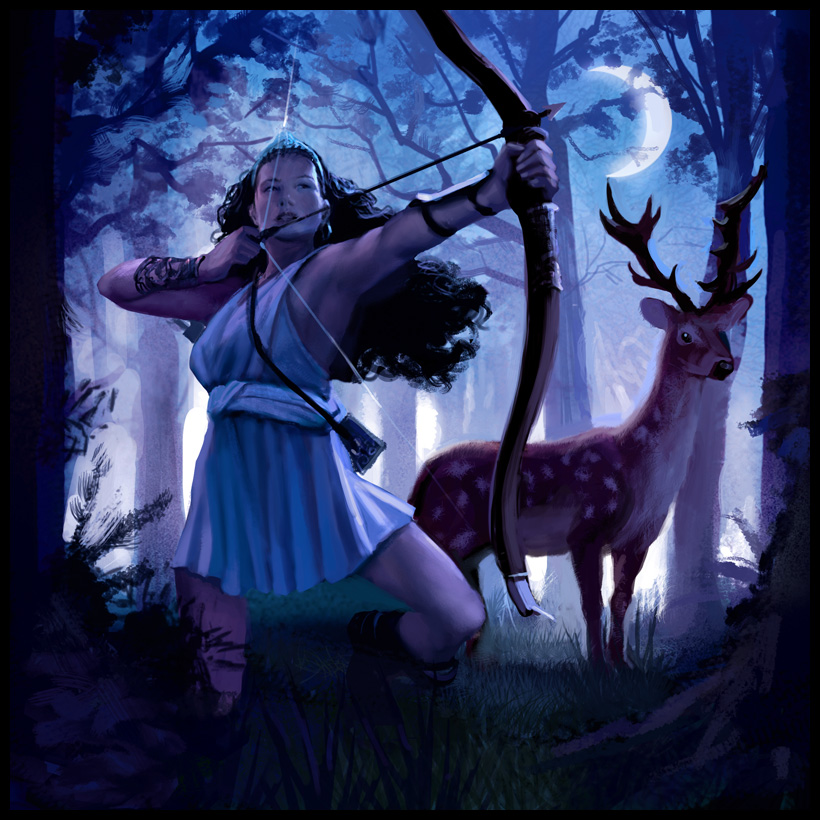
Festuscato pondered his sudden near superhuman abilities for a long time, until he remembered Diogenes and the Princess were what he called genetic reflections.  He understood that every life he lived had a genetic reflection somewhere in history, and he concluded that his female reflection must have been gifted, possibly by the goddess Diana herself, somewhere in the deep past when she turned sixteen.  He marveled at what he could do, and he was just reflecting her gifts. He could not imagine what she must have been able to do.  He tried to find her in the time stream, but she seemed cut off from him at present. That felt typical.  Out of more than one hundred and forty lifetimes, Storyteller’s estimate, he would probably only remember twenty or thirty in his lifetime.

The century had a man, Tiberius, who had been best with a bow.  Festuscato fired an arrow which knocked Tiberius’ arrow aside in mid-air. With hardly a breath, he shot a second arrow which struck the bull’s-eye dead center.  To be sure, Festuscato spent most of those two months working with the century, on their skills and getting them in shape.  Those forty men, hardly a century, claimed to be misfits and leftovers.  They weren’t by the time they marched into Ravena.

Festuscato got called to an audience with the Emperor as soon as he arrived.  Julius and Mirowen went with him, though Mirowen complained at not being allowed to unpack.  Julius saluted and introduced them.  Mirowen curtsied and stayed down until invited to rise.  Festuscato looked straight into the scowling face of the Emperor and defied etiquette as he spoke before spoken to.

“Valentinian, my old friend, how have you been?  I see you have grown well, and married, I understand.  Good or you.”

Valentinian’s face turned from scowling to curiosity.  “We have met before?”

“Of course. In the Curia in Rome.  I was nine and you were almost seven.  I remember that.  Almost seven.”  Mirowen’s hand reached up and pinched Festuscato in his side to get him to shut-up. In that moment, the scowl moved to Galla Placidia’s face, one step down from the throne, but the light came to Valentinian’s face.

“Festuscato. I knew that I knew the name Agitus.” He glanced at his mother as he stood. “Good to see you again.  Did you marry?  Is this your wife?  Please rise.” Mirowen stood and the scowl on Galla Placidia’s face got temporarily interrupted by a gasp.

“Alas,” Festuscato shook the Emperor’s hand.  “Mirowen remains my governess, though these days she prefers the name, housekeeper. She really spends most of her time trying to keep me on the straight and narrow.”  He winked at the Emperor.  “Not married,” he sighed.  “I’m afraid no young woman in Rome will have me.”  He turned to whisper.  “Though I have had a share of them.”  He returned to a normal voice.  “And this must be your wife.”  He went to the obvious seat at the right hand of the throne where a young woman fidgeted.

“Licinia Eudoxia,” Valentinian showed her off.

“Festuscato,” he introduced himself and offered a slight bow before he noticed she was seriously pregnant.  “But wait. Don’t tell me.”  He put one hand out and made noises that would make a carnival owner proud.  “I see. I see a little girl.”  He smiled.

“Are you a seer?” Licinia asked, with genuine interest.

“Sadly, I am a guesser, but I have a fifty-fifty chance of being right.”

Valentinian smiled and leaned over to his wife.  “If I remember right, I think Festuscato sees more than just about anyone.”

“Speaking of which, I must give my greetings to your mother.”  Festuscato looked at the Emperor who had a question in his eyes. “Must be polite,” he said, and Valentinian acquiesced.  Festuscato saw Mirowen with the former Regent.  Galla Placidia appeared to have tears in her eyes.  The young woman, obviously Valentinian’s older sister, comforted her, as did Mirowen.  Valentinian stood back to watch, expecting fireworks.

R5 Festuscato: The Cad in Ravena, part 1 of 3

In 438, the Emperor of the East, Theodosius published a work which said, this is what Roman law is, like it or lump it.  It read full of morals.  In 438, with only minor incidents, most recently concerning young women, Festuscato turned twenty-two and Mirowen, who had not aged a bit, said he no longer needed a governess, he needed a conscience.  She knew he was a good boy, but he liked to push the boundaries.  She said he never got over being a rebellious eight, quick to wrestle in the mud and come home smelling of stolen oranges.

In 438, Festuscato headed north into Gaul where the western empire started falling apart, despite the great work of General Aetius.  The how and why of that actually began in mid-summer, 437 with a message from Ravena.

Over twelve years, neither Festuscato nor Mirowen heard a thing from Ravena, the capital, where Galla Placidia ruled over her son and everybody else.  Festuscato sometimes thought about General Aetius and his several, brilliant victories, and his even more brilliant decision to stay in Gaul and not get involved in Roman politics.  Aetius and his Hun friends had backed Joannes, the loser, but he was not the sort of man to repeat a mistake.

Sometimes Festuscato thought about Bishop Guithelm up in Londinium.  The British folk called it Londugnum.  He wanted to go there.  Between Mirowen and what British house servants he still had left, he became fascinated with the whole notion of Britain, what Rome called Britannia.  He called it Gerraint land.

“So, tell me, Julia.  How many Britons does it take to screw in a light bulb?”

“I’m sure I wouldn’t know,” Julia squeaked and slipped down beneath the covers.

Mirowen stomped in, no knocking, no warning.  “Rise and shine,” she said and drew back the curtains.

“Is it noon already?”  Festuscato squinted at the influx of light.

“No.  It’s morning.  You remember morning, don’t you?”

“Oh yes, the bright time,” Festuscato said, and drew the covers over his head.  Julia giggled.

“Hey.  You have a message from the capital, and Gaius is here to visit.”  Mirowen pulled the covers part way back.  She did not pull them further because she did not want to see.

“I’ll be right down,” Festuscato squeaked this time, and thought how glad he was that he had not been betrothed to some Roman.

An hour later, Festuscato sauntered down the stairs.  “I think this one can go out the front door for a change.”  He held his hand out in front of his chest.  “She has such nice, big—”

“I don’t want to hear about it,” Mirowen pointed.  Gaius stood in his clerical garb.

“Forgive me father, for I have sinned.”

“So, what else is new?” Gaius responded.

“I will never get over you being a priest,” Festuscato said.  “Felix took up the mercantile business.  Lowest priced silk in the west.  And Dibs, poor fellow, took up the honorable profession of killing people. I hope General Aetius gave him a plum assignment.  But you…”

“Comes from Princess Mirowen forcing us to learn our letters, in Latin and Greek.  It was the only way to get you to learn,” Gaius said. “By the way, your philandering has reached the pope’s ears.  Every time he passes me in the hall, he just looks and shakes his head.”

“Glad to give the old fellow something to do besides count.  I mean, Xystus the Third?  He should be Xystus the Sixth, or maybe Tertius the Third.”

“Not funny, Festus,” Gaius said.  “But good try.”

“Ahem,” Mirowen coughed in her special way that got both boys quiet and listening. “Senator.  Your messenger is waiting.”  She pointed to the central court in the house.  Festuscato and Gaius moved along, but Festuscato could not help whispering.

“Probably a summons from the senate for missing too many meetings, or maybe for double parking.”

The messenger, a soldier, a centurion by rank, did not seem the normal messenger the senate would send, unless they were getting creative.  The man stood straight up and said, “Lord Agitus?”

“My, you look tired and hungry, I bet.  Sibelius. Drucilla.”  Festuscato called, and two remarkably young and beautiful women came immediately.

“Yes, Lord.” They dropped their eyes.

“Our guest has been kind enough to wait while I attended to business.”  Mirowen, Gaius and both girls stared at him.  “Well, bring him something refreshing to drink, and maybe some of those little ham sandwiches I showed you how to make.  Er, you aren’t Jewish, are you?  No?  Fine. Maybe whip up some scrambled eggs and sausage for me.  Business always makes me hungry, and try not to burn the toast.”  He turned to the centurion.  “I don’t know why they always have to burn the toast.  Now, you were saying?”

The centurion appreciated the females, and especially had one eye on Drucilla, which Mirowen noticed.  “Lord Agitus,” he began again.

“Oh, but I bet you were riding all morning,” Festuscato interrupted.  “Do have a seat.  We have few formalities in this house.  Sit.  Sit. That’s right.”  There were simple chairs, and a table with an umbrella for the outdoors which Festuscato had specially made.

“Lord Agitus.”

Festuscato took a breath to speak again, but Gaius touched his arm.  “Let the man speak,” he said.

Festuscato nodded. “I was having fun.  But I always listen to my priest, after my housekeeper, that is.  She is the scary one.”

“Like you ever listened to me,” Mirowen said and sat with the group.  “You have a name?”

“Julius, mum,” he said, with a smile for Mirowen before he turned to Festuscato with determination on his face.  “Lord. You are summoned to Ravena.  My century is here to provide safe escort.”

R5 Festuscato: Wild and Dangerous, part 3 of 3

After a while, Mirowen spoke to Festuscato, softly.

“Diogenes or no Diogenes, you are still too young.  Let Atias and Roan deal with Castinus.”

“I am young,” Festuscato admitted.  “Let them handle it,” he decided, but when he thought of his mother and father, he wanted to take it back.  He wanted to change his mind, but he didn’t.

MIrowen, whom Mister March and the others sometimes called Princess, took over the running of the household in Festuscato’s name.  She brought in some of her own people to fill the gaps left by those who died in the assault.  Of course, she made sure they maintained glamours at all times to appear as human as possible, and while the remaining British servants found them odd, they got along well enough.

Festuscato turned nine the following year and in October received the letter intended for his father.  He got commanded to attend a special meeting of the Senate where Valentinian III and his mother Galla Placidia would be present and introduced to the Vir Illustris as Emperor and Regent.

“But it will be nothing but long winded speeches and boring stuff,” Festuscato complained.  Mirowen made him dress all the same and stay clean all morning.  They rode to the Senate building, guarded by four men dressed as house guards.  Festuscato did not ask what kind of men they were.  To be honest, he did not want to know.

When they arrived at the Curia, the long-winded speeches had already begun.  The great bronze doors opened, and as they walked in, Festuscato hoped he could find a comfortable place at the back where he could take a snooze.  No such luck. The man on the floor paused while a man at the back announced him.

“Bring him here,” a woman at the front insisted, and Festuscato got ushered to where he stood in plain sight of everyone present.  “I heard about your father,” the woman said.  “I was not aware he had a son, but I am pleased you are here. And you have brought a companion, I see.”

“My governess,” Festuscato said, as Mirowen touched him and he offered a slight bow. Mirowen curtsied and spoke.

“I am Mirowen, daughter of Macreedy, King of the Long March hard on Wales and the Isle of Man in Britannia, and I am pleased to present Festuscato Cassius Agitus, son of Lucius Agitus, a fervent supporter of yourself and your son.  After Lord Lucius was so cruelly murdered, under the direction of Lord Festuscato, we did our best to continue to support you with whatever small contribution we could make.”  She stood demurely, eyes down, but Festuscato saw Galla Placidia raise her eyebrows.  The contributions had not been so small.

“We are grateful for your support, young Agitus, and you may count yourself in our favor. Come and sit yourself beside my son so we may have the two young men together.  And let your governess sit beside you, there.”  The woman pointed.  It was down one step, but an unparalleled honor.  Festuscato felt obligated to say something and hoped he did not say too much.

“You are gracious to your humble servant,” Festuscato offered another slight bow. “I am honored also to be in the company of so many illustrious men.  I will endeavor to keep my eyes and ears open for the impartation of wisdom, though at my age it will not be easy, isn’t that right?”  He looked straight at Valentinian who nodded vigorously before he looked at his mother.  Galla Placidia frowned on top of her smile as Festuscato and Mirowen took their seats, and Mirowen pinched Festuscato.  He knew better than to yelp, but the Regent saw and nodded, satisfied.

“Gentlemen. We will dispense with further acclamations and words of support for the moment out of deference to the young.  I will gladly receive your written words on behalf of my son, but presently we have business to which we must attend.” A man came to the Regent’s side and handed her some papers.  The next hour got taken up extolling the virtues and military prowess of one Flavius Aetius.  The man came in, flanked by two of the strangest looking men Festuscato had ever seen. They were Huns, but Festuscato did not know that at the time.

Aetius got honored and commissioned to be Magister Militum per Gallius; essentially, commander in chief of the Roman army in Gaul.  Festuscato had no idea who the governor of the province might be.  He never got mentioned.  But such were the times that only the military mattered, and specifically one who could defend the border.  Aetius would have to work well with plenty of German Fedoratti, some of whom did not like each other, and the border pressure would not stop.  Just fifteen years earlier Rome had been burned by the Visigoths, and that was not something anyone wanted to see repeated.

Festuscato tried really hard to keep his eyes open so Mirowen would stop pinching him. Valentinian noticed, and he stayed awake primarily by watching Festuscato droop his head and get pinched. Valentinian winced, but grinned every time it happened.  Finally Aetius with papers in hand, brought forth another man, one dressed in the robes of the church.

“Bishop Guithelm, Archbishop of Londinium, newly appointed.”  Aetius introduced the man, and they waited while the man came forward.

“Regent,” the cleric bowed his head and turned.  “Emperor,” he bowed again, and it all came with too much formality for Festuscato, who stuck his elbows on his knees to prop his chin up with his hands. “Lord Agitus.”  The man shouted and hurried over to hug the boy. Festuscato felt surprised for a second before he recognized the man.  He knew the man as the cleric from the house whose life he presumably saved. The Bishop told the whole story right there in front of everyone, and Festuscato turned as red from embarrassment as Mirowen’s ears turned when she got angry.

Aetius came to collect the Bishop, but took a long look at Festuscato.  “Come and see me when you are older,” he whispered.  “I can always use a good man.”

“Well, young Agitus,” Galla Placidia also looked again at Festuscato, but it seemed hard to read the expression on her face.  “And how old, in fact are you?”

“Nine,” Festuscato said, honestly enough.

“I’m seven,” Valentinian blurted out, but amended that with a look from his mother. “Nearly seven.”

“Quite the accomplished young man,” Galla Placidia’s words sounded a bit cold. “Perhaps we can call upon your wisdom to decide what to do about our other business.”  She waved a hand and a man got brought forward in what Festuscato could only call a fifth century straight jacket.  The guards who dragged him to the front let him drop to his knees and he cried out, unintelligible sounds of torment and tears.

“Help me,” the man shouted.  “They come in the night.  They come in the day.  Always accusing, invisible monsters, horrors, terrors, on the edge of my eyes, accusing, always accusing.  Murderer!” He screamed and spouted more unintelligible sounds before he quieted in his tears.

“Castinus.” Galla Placidia still had her eyes on Festuscato.  “He ordered the murder of your parents among others.  What do you say we should do with him?”

Festuscato felt horrified to look at the man whose mind had been utterly broken by madness. Surely, the furies themselves could not have done a more thorough job.  Festuscato looked once at Mirowen, but she would not look at him.  The Huns with Aetius appeared to be grinning beneath their hands.  Aetius looked curious at what the young man might say.  The Bishop appeared willing to wait.  Valentinian had his mouth open, staring.

“Put him out of his misery,” Festuscato fairly shouted, and looked at the Regent, tears in his own eyes.  “When a horse breaks a leg, you do not force it to suffer.  Why should we show less compassion on a man whose mind is clearly broken beyond repair?”  The Bishop nodded, satisfied with the verdict.  Aetius looked again, like this might have been an angle he had not considered. The Huns stopped grinning and nodded. Galla Placidia said nothing.  She waved her hand and the prisoner got escorted out of the Curia.

“General Aetius.” The Regent sought to change the subject. “You will provide safe escort for the Bishop.”

Aetius, the politician, responded.  “I so pledge to bring him safely to the channel in the far north.  However, after that, he will be on his own.  We have no presence in the free province of Britannia, nor can anyone guarantee his safety.”

“That will be more than gracious,” the Bishop said.  “And no one is on his own when Christ walks beside him.”

“Of course,” Aetius let out a small smile and gave a slight bow.

After that, it took a couple more hours of blither and blather, while Festuscato went back to fighting sleep.

When it was all over, Festuscato got invited to supper with Galla Placidia and Valentinian. It felt like more formalities, but the Regent appeared to want to talk with Mirowen, and that let Festuscato breathe. He tried to be good, but Valentinian seemed taken with him so he could not exactly escape.  He did not have anything against the boy, but Valentinian was not so bright, or maybe he lived so sheltered a life it became impossible to tell if he was bright or not.  Then, there was three years of difference, which probably would not mean much when they were thirty or thirty-three, but it felt like a big gap at six and nine.

Mirowen and their four guards found a place in town for the night.  Festuscato practically went to sleep before he hit the bed.  In the morning, they moved quietly out of town, Festuscato and Mirowen side by side and the four that Festuscato started calling the Four Horsemen of the Apocalypse right behind.

“What on earth did you talk about with that woman?” Festuscato asked.

“About children, mostly.  She seemed impressed that you were learning your letters and both Greek and Brythonic.”

“I’m learning Greek?”

“As soon as we get home.”

“Buggers,” Festuscato adjusted his thinking.  He decided having an elf for a governess had no advantages.  “Did she say anything nice about me?”

“She said you seemed too wild and rebellious for her son.  A bad influence, and maybe dangerous besides.”

“Well.  I’m glad she liked me.”  Festuscato closed his mouth.

************************

Next Monday:  Festuscato, The Cad in Ravena    Until then, Happy Reading

*

R5 Festuscato: Wild and Dangerous, part 2 of 3

Festuscato had no idea what year it was and honestly did not care.  Living just south of Rome in a time of warming, he did well to know what season it was.  Mirowen began to correct that, first by teaching him her British tongue, which he already knew some from it being spoken around the house, then eventually by making him sit and learn to read and write, not only in his native Latin, but in Greek.  When he got older, she forced him to converse in continental Gallic and Old German as well.

It turned to 423, a year when they apparently had a civil war going on.  Castinus, the bad guy, forced the appointment of a man named Joannes to be the new Western Roman Emperor.  Father wrote to the Eastern Emperor, Theodosius, and persuaded him to appoint someone else.  He appointed Valentinian III, a child, and his mother, Galla Placidia as regent until he came of age.  So, they had war between the west and the east, and Mirowen took local matters into her own hands.  She taught Festuscato and his friends how to shoot a bow and hit a target.  She taught them how to wield a knife and defend themselves.  Most of all, she taught them how to escape and hide when the odds were against them, so they could come back and fight another day.

Festuscato turned eight in 424, and the summer turned long and hot.  That was the summer Castinus, the bad guy, decided to eliminate his enemies in the senate, which was anyone who secretly supported Valentinian with money.  How he made his list, no one knew, but it appeared to be accurate; though some, like Festuscato’s father, were obvious.  Festuscato felt surprised when his mother made no objection to the boys learning to defend themselves.  Six months later, Festuscato’s father talked about moving the family to their estates by Ravena which sat well within Valentinian’s territory.  Sadly, he did not move soon enough.

A balmy afternoon arrived.  Festuscato and the boys lounged around the woods just down from the house, at the side of the house where the tenant houses could just be made out in the distance. The woods separated the lands and fields of Lord Agitus from his neighbor, Velleius Fulvia who was Senatorial rank, second class, Vir Spectabilis, and who said that was sufficient because he preferred the quiet life and had no serious interest in politics. Besides that, he was reported to be a miser who had no intention of buying a first-class invitation to the Curia.

Festuscato had met his neighbor several times, generally when he messed around in the man’s garden, and once when he painted “F C Rocks” on the man’s barn.  Of course, he had not done any such thing since Mirowen arrived.  He could not lose her, much as he tried.  She stayed, always there, somewhere, in the background, virtually invisible, watching. On the other hand, as he had thought, there were compensations.

“Gaius needs target practice,” he shouted into the wind.

“I do not,” Gaius said.

“Yes you do,” Dibs responded as Mirowen showed up from somewhere.  She had a scroll in her hand from the extensive Agitus library collection.  She had been reading all about Julius Caesar, and King Bodanagus, the better to know the human race, she often told Festuscato.

“I imagined you boys were going to laze away the whole day,” she said.  “Come.  The target is already up.  Let us get your bows and begin.”

“When do we get to practice on a moving target?” Festuscato asked quietly.

“Not this time,” Mirowen said, but she smiled because certainly a still target would only be good for the basics.

“Hey!” Felix noticed first and pointed.

“Velleius Fulvia,” Festuscato named the man who rode up to the front gate with several other men in tow.  “What’s up?”

“They look like clerics,” Gaius said.  Festuscato shook his head.  His father was a Christian, certainly, but he was not exactly a pious man.

“Maybe they are collecting for the poor,” Felix suggested.

“Not from Velleius Fulvia,” Festuscato and Dibs said at the same time.

“He’s a Humbug,” Festuscato explained.  “You know, a Scrooge.”  No one understood what he was talking about, but then he did not either, exactly.  They got their bows and plenty of arrows.

Festuscato and the boys mostly hit the target with their arrows.  Festuscato pushed himself to be the best, but Dibs got pretty good, too. Felix was not bad.  Gaius needed work, but Mirowen seemed wonderfully patient.

Suddenly, forty more men appeared on the road, and these looked like ruffians and brigands. They came to the house like an invading army.  The front gate and the front door proved no obstacles, and soon there were shouts and screams from inside the house.

“Boys,” Mirowen said sharply.  “Bring the bows and arrows.  Come!” She made it a command, and she took the boys back toward the edge of the little woods that edged the property on that side. Someone inside the house must have been watching, because shortly, twenty men came out of the side door and started toward the boys.

“Get all of the boys,” one man said.  “That way we are sure to get the son.”  They spread out and zeroed in on the trees, some with bows ready, but mostly with swords drawn.

“Stop!” Mirowen stepped out when they were still some distance away, but she was able to make herself heard.  “These boys are under my protection.”

The men stopped, but only briefly to laugh before they yelled and shouted and charged. They began to go down, one arrow per customer.  Then two other archers joined Mirowen and in almost no time, every man except one had died, and that one, mortally wounded, moaned on the ground.

Festuscato stepped up beside Mirowen and took her hand.  She had put away her bow, but had her long knife out in her other hand. The boys were a bit slower, but they followed along while the two men who had mysteriously appeared questioned the one man still living.  “Castinus,” the man freely admitted before he died.  Then the two men went into the house to finish the rest.

Dibs stepped up to Mirowen’s other side and complained.  “I didn’t even get to fire my arrow.”

Mirowen squatted, though Dibs stood tall for an eight-year-old.  “And pray you never need to,” she said.

“Those are an elf and a fairy.”  Festuscato watched the men.

“Lord Atias and Lord Roan,” Mirowen admitted.

“Wait.” Festuscato heard a scream come from the upstairs and ran after the men.  Mirowen and the others kept up, but inside the house it seemed all chaos.  A good dozen ruffians carried swords and drawn knives, and some of the sharp weapons had blood on them.  Festuscato was not put off by the blood, because he no longer stood there. Diogenes of Pella took his place, and he came dressed in the armor of the Kairos and had Defender, his long knife in his hand.  Excalibur, the sword, stayed on his back.

Diogenes called and knew his voice would be heard no matter the yelling and screaming in the house.  Atias and Roan attended him.  He sent Roan in one direction.  He sent Atias in the other, and he took the center and the open courtyard.  He killed a man in the foyer, and pulled his sword when he reached the court.

A man, a cleric came stumbling into the courtyard from a back room where he had been hiding. Two ugly fellows followed, clearly with murder on their minds.  Diogenes let Defender fly straight into the chest of one of the men.  The man fell, shock and surprise on his face, but his fellow saw something and swung his sword down toward the cleric and Diogenes, like he could not make up his mind.  It proved a wild swing which Diogenes easily parried, and Excalibur cut across the man’s belly all in the same motion.  The man collapsed and his insides greeted the tile flooring.

An arrow came from the upstairs balcony that overlooked the courtyard.  It bounced off the armor of Hephaestus and would not even leave a bruise, but it got Diogenes to look up and growl, a pure Macedonian growl. The man took a big step back before Mister March shoved the man off the balcony.  The man screamed, but it became a short-lived scream.

Diogenes called to Defender, and it vacated the man’s chest, shook itself clean of blood in mid-air and raced back to Diogenes’ hand.  Excalibur flew into the air, cleaned itself and sheathed itself across Diogenes’ back.

“All clear.” Diogenes heard the call from Atias and saw the man wave from the balcony opposite Mister March.

“Done,” Lord Roan added from some back room where he could not be seen.

“Festus,” Mirowen called, but it sounded like a searching call, not a cry for help call. Diogenes nodded and went away. Festuscato returned in his own clothes, with his own bow in one hand, but he held tight to Defender with his other hand.  He stepped up to the cleric.

“You okay?”

The cleric looked up, a handkerchief in his hand full of sweat from his brow.  “Yes, yes.  Where is the young man who fought so bravely?”  He looked around for Diogenes.

“This was the young man,” Lord Atias said as he came to the courtyard and put a hand on Festuscato’s shoulder.  “Young Agitus himself.”

“It was an exercise of great courage on the part of one so young,” Lord Roan said, as he appeared in their midst.

“More like an exercise of great stupidity,” Mirowen said, as she marched from the back followed by three boys who gawked at the dead.  “Mister March,” she called.

“Oh no,” Festuscato whined.  “You’re not going to spank me.  Aren’t I getting too old for that?”

“Son, you saved my life,” the cleric spoke and reached out to Festuscato for a hug. Festuscato took a good look for the first time at the dead men around him, and he thought to say something to the cleric.

“Forgive me, father, for I have sinned.”  The cleric just laughed and hugged Festuscato all the harder as the tenant farmers came pouring into the house.  They carried knives, cleavers, axes or whatever sharp farm implement they could carry and were prepared to do battle.  They were not slaves, more like serfs, but Lord Agitus had been good to them and they knew if they lost their bread and butter, they had nowhere else to go.

“Hold it!” Mirowen shouted, and the men paused. “Get your muddy, filthy shoes off the tiles and carpets.  You need to take the dead outside for burial, and be quick about it, before they stink up the house.  I’m going to have to get this house scrubbed from top to bottom.”  She put her hands on her hips and frowned.  The men looked to Mister March, but he knew what was what.

“You heard the Princess.  Get your shoes off and start collecting the dead.”  The men nodded and some tipped their hats.

Festuscato suddenly broke free of his hug.  “Mother? Father?”  He started to ask, but Mister March grabbed him and hugged him.

“Hush,” he said and shook his head over Festuscato’s shoulder.  Mirowen took over, and Festuscato began to cry.

Velleius Fulvia took that moment to come out of a cupboard.  “Is it safe?” he asked.  The cleric and the boys all laughed, loud.

R5 Festuscato: Wild and Dangerous, part 1 of 3

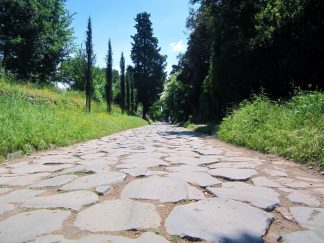
She appeared much too beautiful to be human.  Her black hair fell full but straight, and no doubt long beneath her red cloak and hood. Her features looked sharp, but her tears suggested a softness in her heart.  Behind those tears, she had the hint of eyes as blue and bright as the sky on a sunny day.  Her dress looked like silk, a soft pink held fast by a clasp of gold that sparkled with flashes of red in the sun, a splash of jewels to match the ruby on her ring. Mostly, she looked young, perhaps twenty-one, but that made the picture altogether curious and somehow wrong. There was no way such a rich and beautiful young woman should be walking, much less walking alone on the Appian Way.

Festuscato, all of seven, covered in mud and presently sitting in an orange tree by the side of the road, pondered this vision as well as a seven-year-old can ponder such things.  This girl should have had a dozen guards, and several servants and handmaids besides. And they should have been on horseback, if she was not in a carriage.  After all, it was just thirteen years gone since Alaric and his Visigoths sacked Rome.  And worse, father said Emperor Honorius recently died and he got angry because Castinus, the bad guy, was going to cause riots in the streets.  Festuscato did not follow all of that, but he believed his father.

Festuscato held his breath.  The young woman came over to the side of the road and sat quietly on the grass, in the shade, right beneath his tree.  Festuscato thought it was too perfect.  He quietly plucked a ripe orange, stretched his arm out and aimed as well as he could. Then he thought he ought to give fair warning.

“Bombs away,” he yelled and let the orange drop.  He missed by a good foot to the girl’s left, but the girl reached out with super speed and snatched the orange before it touched the ground.

“Thank you,” the girl said.  “I was a bit hungry.”

“Hey!” Festuscato wanted to protest, but he hardly knew what to say.  He scrambled down the tree and she stood to face him.  “How did you do that?” he asked.

“Magic,” the girl said with a grin, which suggested she might be having fun with him. She had the orange peeled in no time and offered one piece to him.  Festuscato shook his head.

“I am sick of oranges,” he said honestly enough, as a thought occurred to him and came bounding out of his mouth.  “Are you running away from home?”

The girl smiled. “I am a long way from home.  My name is Mirowen.  Do you have a name or should I just call you grubby?”

“I’m Festus. I’m an orphan and I’ve run away from home, too.  Like Greta, I’m going to have an adventure and save the world.”  Festuscato returned the girl’s smile, but on his face, it did not appear nearly as convincing.

Mirowen paused in her orange eating to look serious for a moment.  “How can you run away from home if you are an orphan who has no home?  I think you are going to have to work on your lying, not that I am recommending it.”

“Hey, Festus.” A boy down the street called and waved. There were three boys, all about the same age as Festuscato, and all just about as dirty.

“Hey!” Festuscato waved back.  “Come and meet my friends.”  He reached for Mirowen’s hand and she did not hesitate to give it to him, even if it meant being dragged down the street.  “Hey guys.  I want you to meet my girlfriend, Mirowen.”

Three boys stopped still and looked stunned.

“This is Felix, Gaius and Dibs.  Say hello, fellas.”

“Awe,” Felix mouthed and threw his hands out.   “How can you have a girlfriend?  You’re only seven.  I thought maybe it was your new nurse.”

“Nurse?  I don’t need a nurse.”  Festuscato protested.

“He’s had three so far,” Gaius said.  “He ran one off, got one to beg to be released from the duty, and one died, mysteriously.”

“I ate her,” Festuscato said, with a straight face.

“Awe,” Felix repeated the word and the gesture.  “Don’t listen to him.  He just likes to give Dibs nightmares.”

“I see,” Mirowen said with a glance at Festuscato.  She let go of the boy’s hand and smiled her warmest smile.  “Maybe you can help me.  I am looking for the home of Senator Lucius Agitus.  Do you know where that might be?”

“Why that’s – ow!” Festuscato stomped on Felix’s foot.

“I know where it is.  I can take you there,” Festuscato spoke quickly.  “But I have to warn you, the lady of the house is a witch in disguise, and the Senator likes to yell all the time, and loud.”

“I’ll be extra careful,” Mirowen said, and this time she took his hand.  “You boys coming?”  The three fell in behind, though they did not appear happy about it.

The house, truly a Roman mansion, was not far.  It sat up on top of a small rise and overlooked the Appian way for a good distance in both directions, though it was far enough in the countryside to be out of sight from the city.  Some of the tenant houses could be seen in the distance, out by the fields, and the house had one great meadow nearby where horses grazed lazily in the sun. Everything about the place said money, lots of money.

“Wait.” Festuscato stopped them outside the main gate.  “Let me check your ears.”

“My ears?” Mirowen sounded curious, but bent down a little toward the boy.  He pushed her luxurious hair back just far enough to touch the tips of her ears before he spoke.

“Just want to be sure your glamour is good.  Can’t have an undisguised elf about the place.”  Mirowen said nothing.  Her eyes got big and then very narrow as she stared at Festuscato.  “Oh, I know an elf when I see one,” he said.  “You are much too beautiful for a human.”  Mirowen heard the compliment, but it felt confusing. She turned to look at the boys following, but they merely shrugged, like this was not even close to the first time Festuscato said something strange.

Mister March came to the door and took one look at Festuscato, mud and all, before he remarked. “You are a brave fellow.”

“Most of the staff is Celtic,” Festuscato ignored the man and talked to Mirowen.  “Mostly from Britain.”

Mirowen looked up and spoke in some strange language.  Mister March answered, and they began a spirited conversation. Festuscato stayed quiet, but he tried to follow what he could by the words he knew and the hand gestures.  It did him no good, but they were shortly interrupted in any case by a woman’s voice.

“March, what is it?”  At the sound of that voice, Festuscato inched over to hide behind Mirowen.

“A young lady come all the way from Britain to speak to Lord Lucius,” March said.  As the woman came to the door, she took one look at Festuscato and shouted.

“Festuscato Cassius Agitus!”  That was enough to scold the boy.  “Take your sandals off and try not to touch anything.”

“I found him hiding up an orange tree and thought you might like to have him back,” Mirowen smiled.

The woman gave Mirowen the once over and apparently approved of her dress and deportment, sure signs of wealth and good breeding.  Then she spoke over Mirowen’s head, it being two steps up to the door. “You boys better go home.  I am sure your mothers will not be pleased.”

“Yes, mum. Thank you.  Mum.”  The boys spouted and ran off as quick as they could toward the tenant houses.

“You are from Britain?” The woman asked.

“Mirowen,” Mirowen gave her name and a slight curtsey which seemed the most graceful thing Festuscato had ever seen.  “My father, King Macreedy sent me with a troop for my protection, but we were set upon by Goths just outside of Rome.  I alone escaped.  What you see is all that is left of my small fortune, that and a word for Senator Agitus, though my letters are stolen and I cannot say what my father may have written.”

Festuscato closed his mouth.  The lie was masterful, and the woman, Festuscato’s mother, responded perfectly. “Oh my poor dear, do come in.”

“I found her all alone, crying.”  Festuscato said the truth, but Mirowen’s look urged him to be quiet and his mother snapped at him.

“You need to strip and get in the bath this instant,” she said, before she added in a very soft voice.  “Come and tell my husband all about it.  He spent many years in Britain in service to Rome.  I am sure we can arrange to help you out.”

Festuscato barely got clean and out to dry himself when Mirowen came in and announced she was his new governess.  “I told them my father sent me away for my safety and it might mean my life to return home.  On the other hand, I have a younger brother I have watched, my own mother being gone, and I would not mind watching you.”  She came to dry his hair and whispered.  “I am a house elf, you know.”

Festuscato nodded, but he would have to think about it.  He would never be able to sneak off again.  She would hear his every move.  Then again, there might be some advantages to having a house elf as a governess, not the least in the way she might be able to teach him to lie expertly.

Kairos Tales Preview

Beginning Monday, April 2, 2018

If you have read some of the Avalon stories that have appeared on this blog (available at your favorite e-book retailer), I thought it only fair that you get a look at several of the actual Kairos stories in their full form.  If you have not read any of the Avalon stories that have appeared on this website, that’s okay.  The stories here are self-contained with one exception:

The books (not presently available to buy) weave the partner stories like a fine tapestry.  For this blog, however, I have pulled the stories apart so you can read a whole Festuscato story, for example, without having to flip back and forth to Gerraint and Greta, or as the case may be, to Gerraint and Margueritte.  Hopefully, that will work well.  You can just ignore the rare references to what is happening in those other stories, knowing, that like the Kairos, you will get there, eventually.

This series of stories will begin posting on Monday, April 2, 2018, just in case you want to go into the archives and read from the beginning.  All weeks will have posts on Monday, Tuesday, and Wednesday = 3 individual, easily and quickly read posts per week to carry the story forward.  A good way to start the day.


Kairos

A Greek word meaning opportunity, the right time, a propitious moment, event time, or as the Kairos defines it, history.  It is the name the old titan Cronos gave to the polyploidy being he struggled to bring to life as a complete male and a complete female.  Knowing his time would soon be over, he imagined this complex “one being in two persons” would be his replacement.  When Cronos died at the hands of his children, the mere counting of days ended, and with the birth of the Kairos, history—event time began.

The Kairos might be called the god of history, though the Kairos prefers the term watcher over history, because unlike the gods of old, he or she is not immortal.  Instead, the Kairos normally lives as an ordinary mortal, male or female, sort of taking turns, and as such is subject to all the frailties of the species, while at the same time, being captured by the very events where he or she must inevitably act.

Not allowed to fully die, the being or spirit of the Kairos is taken at death and reborn somewhere else on the planet, where some important historical juncture looms on the horizon.  On bad days, the Kairos complains about being no more than a cosmic experiment in time and genetics.  On good days, the Kairos averts a disaster.

Taken out of the hands of the most ancient gods, and placed in the hands of persons unknown; it is her or his job to see that history turns out the way it has been written.  With access to future lifetimes, as well as past lives, the Kairos knows the way things are supposed to go.  But getting it to turn out right is not ever easy.  Fortunately, the Kairos is able to borrow lives from the past or future that often have the skills and knowledge to meet whatever might arise.  No guarantees, of course.

Stories

Kairos and Rome 5: Rome Too Far

R5) Festuscato: The Last Imperial Governor of Britannia.   9 weeks of posts
Festuscato Cassius Agitus is both a wealthy Roman senator and a cad.  Because of his indiscretions, the emperor’s mother has him sent to the abandoned province of Britannia to bring order out of chaos.  The people there appealed for help.  He can’t end the fighting.  Thus is the age.  But maybe he can bring the Gaelic people together long enough to face the real threats: Angles, Saxons, Jutes, Picts, Irish, and especially, the Huns.

R5) Greta: Over the River and Through the Woods.   23 weeks of posts

Greta, wise woman of Dacia under Roman rule, must go through the haunted, forbidden forest to reach the capitol in time to stop the rebellion.  The Masters buried some hundred-year-old rifles in that area, and Rome and all of history will be in danger if they are dug up; especially if they are discovered by the wicked witch.

R5) Gerraint: In the Days of Arthur, Pendragon.   10 weeks of posts

Gerraint, son of Erbin, with Percival and Arthur, romp through the early days of Arthur, Pendragon.  They fight off a rebellion and beat back the Saxons, Irish, Jutes and Picts, and rescue Gwynyvar.  Sadly, as the boys become men, the fighting never seems to stop.  And Meryddin, a fly in the ointment, appears to be on his own agenda.

Kairos and Rome 6: The Power of Persuasion

R6) Gerraint: Love and War   12 weeks of posts

Gerrain, son of Erbin wins Enid, his love before he is called to the continent to help Brittany stay free.  After a time of torment, Gerraint and Arthur continue to fight off Picts, Scots, Danes, and Angles, before the final battle of Mount Badon.  And still, Meryddin has his own agenda working, subversive in the background.

R6) Festuscato: The Dragon in Ireland   10 weeks of posts

Festuscato gets roped into providing safe passage for Patrick to get to Ireland.  Festuscato wants to see Patrick get started on a good foot, but that isn’t easy when the so-called king of the Irish is against you, not to mention the reluctant druids, the Irish pirates, and the Saxon intruders.  The boy and his pet dragon don’t help, either.

R6) Greta: To Grandfather’s House We Go   20 weeks of posts

Greta’s ward, Berry, and her sister Fae, along with Greta’s brother and Fae’s husband go north, looking for Berry and Fae’s father to bless their marriages.  They get trapped in the land of the lost, and the shattered pieces of the old god Mithras stand against Greta when she sets herself for a rescue mission.  Soon enough, the Iranian (Mithraic) tribes in the wilderness come to knock on Dacia’s door, which doesn’t have enough strength to stand against them.  And the Roman ranks are full of Mithraites.

Kairos Medieval 3: Light in the Dark Ages

M3) Festuscato: The Halls of Hrothgar   8 weeks of posts

After seeing to the safe withdrawal of troops from Britain, Festuscato, Senator of Rome, is shipwrecked on the Danish shore.  With his strange crew in tow, he finds his way to the halls of Hrothgar where a beast called the Grendal has come like a plague on the mighty.  Festuscato leaves nothing to chance.  He sends for Beowulf, but then he has to tread lightly to keep history on track.  He knows things will turn strange as the Grendal, the creature of Abraxas, cannot be harmed by any weapon forged by man.

M3) Gerraint: The Holy Graal   13 weeks of posts
Gerraint, son of Erbin feels his days of struggle should be behind him.  All he wants is to retire to Cornwall with Enid, his love.  But when ghostly hands carry a cauldron across the round table, he knows he has to act.  Arthur deftly turns all talk to the Holy Graal, but Gerraint knows he has to stop the older men from recovering the ancient treasures of the Celts and dredging up the past.  Christendom is only a thin veneer and if Abraxas is allowed to strip that away, history might be irrevocably changed.

M3) Margueritte: The Old Way Has Gone   18 weeks of posts

In the early days of Charles Martel, Margueritte experiences everything a Medieval girl might want: fairies, ogres, a unicorn, dragons, knights to love and daring rescues.  But it is Curdwallah the hag, the devotee of Abraxas, that haunts her dreams in the dark.

Kairos Medieval 4: Saving the West

M4) Festuscato: Senator of Rome   6 weeks of posts

After years of exploring Germania and the Eastern Roman Empire, Festuscato returns to the west, to Saxony and the land of the Franks.  There isn’t much time.  The Huns are moving.  Attila has his eye on the weakened western empire, and the Roman commander in the west, General Aetius, appears stuck in Rome, preoccupied with the Vandals in Africa.

M4) Gerraint: The Last Days of Arthur   6 weeks of posts

Lancelot has taken most of the young men to Brittany, and Greater Britain appears to be falling apart.  Arthur and Gerraint go to bring him back.  They make peace with the Franks, but Lancelot will not be moved.  Upon their return, they discover that Mordred has captured Cadbury and Gwynyvar with an army of Scots, Saxons, and traitors.  The stage is set for the last battle.

M4) Margueritte: The New Way Has Come   18 weeks of posts

The god Abraxass has moved the Muslim Sorcerer to keep Margueritte occupied so the Muslim army from Iberia can invade the north.  Margueritte has to help prepare Charles Martel for that inevitable time, and she must build heavy cavalry for the Franks, virtually from scratch.  What horrors will the sorcerer do to keep Margueritte out of the picture, and will she be too late to save the west?

************

A Brief Introduction

Hopefully, you are a rational and reasonable person in search of a good story, though not necessarily willing to break ranks with the relatively dead and sterile universe in which we presently and conceptually find ourselves.  And if you are not naturally given to flights of fantasy, you may be wondering how all this began.  Where did the idea for such a complex character come from?  If the Storyteller could be interviewed, the answer might be something as follows:

“I was sitting at my desk one day at work, staring out of the window, bored out of my mind, when I had a vision.  I think that was what it was.  At the time, I could not remember having had a vision before, but to be perfectly honest, that is the only word that fits the experience.  Anyway, without warning, I found that instead of sitting at my desk, I sat cross-legged in the grass at the top of a ridge, clothed in odd, but very comfortable Roman style chain armor, and holding a sword across my lap.  The sword felt heavy, and appeared sharp, too.  It all felt weird, but the sword and armor, the grass and all was not the weirdest thing.  As I looked down at the sword in my lap, I saw some obstructions to my vision.  You see, I was a woman, a young, and beautiful woman, I knew that much, with long, light golden brown hair that looked to me almost blonde in the bright sunlight.  I backed away instantly and found myself at my desk.  It all seemed too strange for me.  Like most men, I had regular ideas about women, but being one of them was definitely not on the list.  After that I got to work.  That daydream, as I called it, was not something I wanted to think too hard about and certainly not something I wanted to dwell on.

“The very next day, I sat again at my desk, not entirely bored for a change, because I was considering a topic which I always found fascinating.  I wondered about the idea of the Trinity, and I could not figure out how God could be one God in three persons.  I was one me in one person, and I thought that was difficult enough, but then I heard a voice in my head that said, “No, you are one you in two persons.”

“What?”  I said that out loud, I think.  I looked around, but I seemed to be the only one in the office at the moment.  Everyone else went out to the field.

“Woah!”  I did say that out loud.

Now, please understand, when I said I heard a voice, I did not mean an actual, audible voice.  I meant it came as something in my mind, only it was not just me imagining a voice or thinking some thoughts to myself.  I knew the voice was somehow external, though I could not tell you exactly how I knew that.  Anyway, I said, “What do you mean, one me in two persons?”

“Male and female,” the voice said.  “It is how you were made to be, even if you are only living as one gender at a time, as far as your present consciousness is concerned.”

“Wait a minute.  Who are you?  And what do you mean one at a time?”

“Chronologically speaking, yours is the one hundred and twenty-first life you have lived.  And there are future lives you will live as well.”

“You’re mad.”  I responded, by which I meant, I’m mad.  I concluded that this boring rut of a job had finally driven me off the cliff.  Here I go, falling, over the edge, I thought.  Er, no…  I don’t like heights.  Then the voice sort of took over.

“It is time for you to learn these simple truths about yourself, your many lifetimes and your making, because soon you will begin to experience your other lifetimes.”

“What?  You mean like that woman in the suit?”  I managed to interject that much.

“You will experience far more than that.  And you will find in the course of these experiences that your lives have been lived in partnerships of two or more, but not necessarily in chronological order.  I know that may be confusing for you, especially when you experience future lifetimes; but you will do well if you simply take and record each experience as it comes.  It will all come together in the end.”

“Experience the future?  What?”

“It may be that only you and your partner with you will experience every lifetime, but that is because it is your job to record the events of your many lives.  The other lives you live call you the Storyteller.  But then, you have another job to do in all of those other lifetimes.”

“A-ha!”  I did not actually get the words in, but I thought it loud enough.  “The catch!”

“Your job is to watch over history and make sure it comes out the way it has already been written.”

“A-ha!”  I repeated, and remembered last Sunday’s hymn about God working His purposes out.  I wondered, why me?

“God is working His purposes out.”  The voice knew my thoughts.  “But as you well know, the work is always done through agents of some sort, and mostly human agents.  The Source even emptied himself at one point to take on human flesh in order to act on his own behalf.  Why should history be any different?”

I did not have a ready answer for that one.

“As you experience these other lives in partnership, you will find that still other lifetimes may temporarily break through the natural barriers of time and into the life you are currently experiencing.  Then you will have access to certain skills and knowledge.”

“Wait!”  I practically shouted.  “Why should other lives break through?  Why should I need access to skills?”

“Because there is no telling in advance what skill set or knowledge or other help you may need at a given moment.”

“What?  No telling?  Does that mean you don’t know or that you won’t tell me?”

The voice paused for a minute before it resumed speaking.  “You know full well that the universe is not the dead empty your current culture believes it to be.  The universe is full of great varieties of life.  There are powers and principalities in the universe, and some of those are ambivalent at best toward humanity and human history, and some may even want to change history to serve their own ends.  The universe is full of powers, and as you know, some of them are not very nice.”

I swallowed.  Trying to keep history on track sounded like dangerous work.  Of course, I had no idea at the time, and no frame of reference to understand just how dangerous it could get.  I did have one more question, though.  “Why me?”  I asked.  “I’m nothing special.  In fact, I would say just the opposite.  I have not exactly lived a sin free life, and more importantly, I have just about failed at everything I have ever tried to do.  I am so ordinary in that sense, it even boggles my own mind.  And besides that, I am not a great writer.  Oh, I can tell a story all right, but my writing is rather pedestrian.  Again, it is just so ordinary, you might say.   So, why me?”  I asked, but the voice did not answer. It had gone, and after a while, I decided that maybe the fact that I was so ordinary was precisely why I was chosen.  I understood that someone who already had an inflamed ego and sense of their own importance and abilities would not have been a good choice.  No, not at all.

To be sure, that very night I did begin to remember some early childhood snapshots, as I called them.  Some came from my own life, and some came from the life of the Princes who was, and apparently is, my partner in this lifetime.  She is my time access partner, which is a bit like time travel and connects me to this keeping history on track thing that I am experiencing and remembering.  After that night, things just got stranger and stranger.”

Author’s Note:

I have done my best to keep to the record of the Storyteller as written, only trying hard not to let the facts stand in the way of a good story.  For that matter, some of the facts, like names, dates, exact locations and so on have been fudged a little to protect the innocent, in some cases, but more often because it would not be good to give the Masters, or any other enemies of history an exact roadmap of the activities of the Kairos.  Basically, don’t send me any letters saying such-and-such is historically inaccurate.  It won’t do you any good.

Happy Reading

*

Avalon 5.12 Bad Wine, part 5 of 5

The travelers got hauled in front of Solomon, no matter how much they insisted that they needed to see Korah.  They tied their horses out front, and armed up, just in case.  They left the Patton sabers wrapped at the back of their saddles, but they brought their gun belts, and Decker and Katie carried their rifles while Lockhart shouldered his shotgun.  Lockhart figured the locals might not even recognize the guns as weapons, though they said nothing about the knives the travelers carried on thier belts.

“Remember what the Kairos told us last time.”  Alexis spoke to everyone before they entered the audience chamber, and she focused especially on Lincoln and Katie.  “It would have been better to avoid seeing Solomon, but for Pete’s sake, keep you mouths shut.”  She shot the last at her husband who raised his hands in surrender.

The room looked overly large.  Solomon sat at the far end, in a comfortable looking chair, on a raised platform.  The travelers were used to that.  The unusual part was how many, mostly less comfortble chairs, sat up on the platform with him.  Most were empty, but a few were filled with what looked like advisors of a sort—or possibly close, personal friends, not one of whom looked under sixty.  To Solomon’s left hand, one chair got filled with a young girl, maybe fifteen or sixteen, and an Egyptian from her look.

The travelers looked around as they marched up front.  The guards and soldiers were inconspicuous.  Decker, Katie and Lockhart certainly noticed, and Decker probably counted them, but the others paid no attention, which was likely the idea.

Alexis saw one woman, an African looking woman, but with European features, which felt odd.  In fact, Alexis had an odd feeling overall, just to look at her.  The woman did not go about some duties.  She certainly scrutinized them with a knowing look, but Alexis had to move on before she could explore her feeling further, and when they reached the front, she forgot about the odd woman.

The travelers stopped several yards from the platform, and when Solomon waved his hand back and forth, they took the hint and spread out into a single line.

Solomon scrutinized the travelers, and spoke when he was ready.  “You are?”

“Robert and Katherine Lockhart.  Benjamin and Alexis Lincoln.  Elder Stow and his daughter, Sukki.  Mary Riley, that everyone call Boston, and Major Decker.  I assume you are Solomon, the Wise.  It is a pleasure to meet you.”

Solomon let out a slight grin.  “Some think not so wise, including sometimes your friend, Korah, who has been sent for.”  He stared at them again before he asked, “And where are you from?”

Lockhart looked at Katie, Lincoln and Alexis.  He figured if Solomon was half as wise as his reputation, he would see right through any lie he came up with.  So much for Alexis’ admonitiion, he thought, before he turned again to Solomon and answered, “The future.  And we are headed back there, slowly.”

Solomon smiled again.  “We are all headed slowly into the future.”

“But some more slowly than others.  And no, we cannot tell you about the future, and I probably should not have told you that much.”

“Sukki was born before the flood,” Boston blurted out.  “She is not technically from the future.”

The little Egyptian girl huffed.  “Suliman.  These people are boring.  Telling a strange tale that makes no sense does not make them less boring.”  Solomon looked at her, but let her ramble as she turned to the travelers.  “You see, in my hands I have Sekhmet, the lion, who is the real goddess.  I have seen her outside my window on the hot days when she has come into the shade of the wall.  She is my protector, and if you lie about things, and say you are from some imaginary place called the future, she will eat you.”

“She would not do that,” Kaie said.

The Egyptian girl huffed again, and spouted, “What do you know of the real gods?  How can you say that?”

“Sekhmet is our daughter,” Lockhart said, and with a glance at Solomon, added, “adopted, though I believe she adopted us as much as we adopted her.”

“We last saw her when we married,” Katie said, and took Lockhart’s hand.  “That was when the Philistines came from the sea and conqured the land you call Philistia.”

Solomon tipped his head, like he understood something.  “Both my father and King Saul before him struggled mightily to keep the Philistines from overrunning the whole country, and to make a lasting peace.”

“We could call her,” Lockhart suggested.

“But I am sure she won’t come here,” Katie interrupted.  “This place is given to worship the Most-High God—the God of the gods.  The old gods of this world have no place here.”

The Egyptian girl frowned.  “Liars.”

“I don’t think so,” Solomon responded.  “Even if they are not telling the whole truth.”  He scrutinized them once more before he said, “You should not hide yourselves behind such masks.”  He seemed to indicate Boston and Elder Stow, beside Sukki.

Boston looked briefly at Lockhart and Alexis before she removed her glamour of humanity.  The Egyptian girl shrieked and covered her eyes with her hands.  Elder stow looked only at Sukki and nodded.  They removed their glamours as well.  Even Solomon looked shocked at their appearance.

“We are of the elder race that once roamed these very lands,” Elder Stow said.

“Do not be afraid,” Alexis said.  “They are very nice people.”

“We all are,” Lincoln added.

“I am sure this is so,” Solomon said, as he watched the Egyptian girl slowly uncover her eyes, to stare.  “And you are traveling back to the future at a slighly faster rate?”

“Sorry,” Lockhart said, with a smile.  “Still can’t tell you about the future.”

“And you didn’t even say Back to the Future,” Katie said, and squeezed Lockhart’s hand.

“Lockhart,” a man’s voice sounded out from the back corner of the room.  “Have you been telling stories?”  The old man paused while he hobbled into the room, leaning heavily on a cane.  “Boston,” he said, and opened his arms for a hug.  Boston only glanced at Lockhart and Alexis before she raced into the hug.  Everyone smiled, except Lincoln, who asked.

“Korah?”

“Yes,” Solomon said, and he tried not to smile.  “And we haven’t had any stories yet.”

Boston whispered in Korah’s ear.  “You are old again.”

“Every lifetime,” he said, and leaned on her.

“We might tell something from the past,” Katie suggested.

“Like our encounter with Apophis,” Lincoln said.

The Egyptian girl shrieked.  “Please, no,” she said, and covered her eyes with her hands.

Solomon sat up and stroked the girl’s hair, like a doting grandfather, or maybe like a man might pet a faithful dog.  He asked a question while he pretended to be unconcerned.  “So, tell me about this black cloud that chased you into the city so you could not wait for the gate to be opened.  Why did you jump into the pool of Siloam?  Why is it waiting for you, even now, just outside the gate?”

The travelers hesitated, so the Kairos spoke up, now that Boston had helped him get to where he could sit down.  “Go ahead.  Tell us about the djin—the genie.”  He added that word for the men sitting there.

“My wife better explain,” Lockhart said, and he smiled at Katie while he slipped his arm around her.

Katie returned the smile and began.  She told how they entered the time zone, and the djin tried to kill them with the sandstorm. They made it to the city, only to find Ashtaroth, who threatened to sacrifice them in the altar to Moloch.  Boston called to Moloch, and he sent the djin somewhere unknown, and after seeing that they were hedged about by the gods, he sent them to the other side of the Jordan River.  “We set out this morning, after very little sleep, and even so, we almost did not make it to Jerusalem.  We fell into the pool from exhaustion and thirst, after all that time in the heat and desert sands.”

“A djin?” Solomon confirmed.

“A marid,” Korah said.

“Oh, but that is easy,” Solomon responded.  “I have some rejuvination juice right here.”  He stood, slowly for an older man, and picked up a clay jar with a lid that was not exactly like a cork, but near enough.  He lifted the lid, took a sip, and then called to the Egyptian girl.  He leaned on her as he walked, even as Korah continued to lean on Boston.  He took them all to a door that lead out to a balcony right next to the wall.  The cloud floated there, and Solomon called to it.

“Marid, I am Solomon.  I am king of this city and all the land you can see around you.  I have many Marid who are friends in my court.  I wish you no ill will, and I tell you, no harm will come to you here, as long as you do no harm in this place.  Here.  I have rejuvanation juice to toast your health and life.  Come join me in the toast.”

The cloud wavered, but did nothing.

“Come. this will strengthen you after your long hunt.  I drink some every day, but only a little so I don’t become too powerful.  This is stong drink.  You know, I have seven-hundred wives, and three-hudred concubines, and you can imagine at my age how much I need rejuvination.  Even so, all I need is a little of this magic elixir.  They say it can fully restore a person and all of his abilities—even magical abilities, though I have no such talents.
The cloud still appeared to hesitate.

“I see.  You fear the drink may be poison or something.  Here, let me show you.” He took a small sip, waited a moment, and hauled the Egyptian girl to his chest and kissed her, hard.  All the while he held out the jar.  “I am a bull now, ready to mate.  But first I drink to frendship with all the djin.  Will you try some, of course just a little.  No telling how strong you may become if you were to drink it all, or something so foolish…”

The black cloud rushed in, creating a wind it came so fast.  It squeezed itself down into the jug without so much as taking human form.  Solomon put the lid on top and smiled.

“That should keep it.”

A man stepped up with wax and a flame, like he rushed to get them as soon as the king stood.  He melted wax all over the top of the jug and all along the edge of the lid, effectively sealing it tight.  Solomon took off his ring, and while the servant held the jug, he made an imprint of his ring in the top.

“So we don’t forget which jugs have the djin, and which have the fresh wine,” Solomon said.  “That wine had a poor aftertaste, anyway…”  He let the Egyptian girl help him back to his throne.

“We can make love now?” the girl asked.

“Maybe later,” Solomon smiled for her as well as he could.  “Later, if I can stay awake.”

“That’s it?” Lincoln asked.

Korah nodded.  “As long as no one is stupid enough to break the seal, the djin should be held indefinitely.  Even if the seal is broken at some point, the djin will have to return fully to the desert world made for the genies, and heal, before he can do anything else.  And even the powerful and mighty marid cannot return to earth without help from someone on earth, so I would say, yes, that is it.  I do not expect it will be able to bother you any more.”

“But, that is it?” Lincoln asked again.  “But that was so easy—so nothing.”

“Yes,” Korah said, and paused to think.  “You feel let down after all that build up?  You wanted a magical duel, buildings blowing up, sparkas flying everywhere, that sort of thing?”

Lincoln nodded as Alexis answered.  “All I feel is relief.”

“Tell you what,” Korah said.  “Come to my place.  You can eat and rest for a time.  Ignore the boys.  They have the first garage band in history, but at least it is not electric.”

“You don’t want us to move on right away?” Boston asked.

“Lockhart?” Korah looked for him.  He saw him and Katie, still out on the balcony, kissing.

“Still newlyweds,” Elder Stow explained.

Korah nodded.  Solomon spoke.  “You owe me a good story, or two.”

Korah said, “No reason you should not take the chance to rest a bit.  The twenty-first century is still a long way from here.  The gnomes have your horses.  Eat, rest and relax for a bit before you return to the road and your journey… Back to the Future…”

“You said it,” Decker did not sound pleased.

“I know.  If I’m not careful, I’ll get hit with a cease and desist order.  Good luck finding me a thousand years before Christ.”

END of Season Five.

************************

Special preview post tomorrow.

Please stop by, and Happy Reading

*

Avalon 5.12 Bad Wine, part 4 of 5

The travelers found themselves in a pleasant grove of trees beside a river.  The horses all appeared unharmed.  They also appeared to have their equipment.

“My guess is the Jordan River,” Lincoln said.  “It was the way we were headed.”

“Good guess,” Boston said as she checked her amulet.  “We are about a day from where the Kairos appears to be.  We got a whole lot closer without having to move ourselves.”

“Any idea where the djin might be?” Lockhart asked.  Everyone shook their heads, including Boston, who spoke.

“The amulet doesn’t show the djin.”

“The other side of the Jordan River,” Alexis said, and sighed her relief.  Everyone got it.  When Moloch threatened to send them over to the other side, the way the gods talk about the other side of death, he did not mean to kill them.

“We need to find the Kairos as soon as we can,” Lincoln said.  “Hopefully before the djin finds us.”

“Agreed,” Lockhart said.  “But we need to rest, and heal, and so do the horses.  We take eight hours.  Two for each pair on watch.”

“I could put the screens back up, just in case,” Elder Stow suggested.

“No,” Lockhart said.  “The djin might more easily find us that way.”

“I don’t suppose we could stay long enough to hunt,” Decker asked.

“Bread crackers,” Katie said, with a shake of her head.  “Be glad it is not cold.  I don’t think even a fire would be wise.”

Decker did not argue.  He was military, and knew better than most the trouble any delay might cause.  Tents were teken back from the horses and went up.  Horses got some extra care, then Lockhart started the eight-hour watch.  He knew they would be sleeping after the sun rose, but not for long after.

###

“Still no sign of the djin?” Lockhart asked, as he tried to wake up.

“No.  Nothing,” Boston answered.  “It has been quiet since Sukki and I got up to watch.”

“The sun is well up,” Katie said, as she checked her saddle.  “We still have time to get to where the Kairos is?”  Boston nodded.

“And we go around Jericho,” Lockhart said.  He underlined that for Lincoln.

“We have not been there since that first time, way early in our journey,” Lincoln said.  “I am curious to see how it has changed, that’s all.”

“It is where I joined the others,” Elder Stow explained for Sukki, who nodded, but held her tongue, as usual.

“We ready?” Decker asked.  The others mounted, and they set off through the wilderness.

The travelers found a village and a well-worn path to Jericho.  They asked the way to Jerusalem, and got shown the cut-off that went around the outside of the city and pointed straight at the capital.  Soon, they picked up a better path, almost a road between Jericho and Jerusalem, and they made very good time.

“Much better than the first time we came through here,” Lockhart said, when they paused to walk the horses, to rest them.  “Back then, Old Salem was ruled by the Kairos whats-his-name as an independant city.”

“Yadinel,” Katie told him.  “The Elohim people lived there, but the Jebusites were on the verge of overrunning the city.”

“Now, David might be king,” Lincoln spoke up from behind, his nose in the database.  “But I suspect we will deal with Solomon.  It says here that Nathan was the student of Samuel, and Korah was the student of Nathan.  Korah has two students, Shemaiah and Ahijah.”

“Elijah?” Boston asked from behind Lincoln.

“Ahijah,” Lincoln corrected her.  “Elijah comes further down on the list.”

“So, Korah is a prophet?” Lockhart wanted to get it straight.

“No, technically, he is a musician.  So was Nathan.  Apparently, with some other Korahites, not named after the Kairos, Korah… they composed and play most of the temple music that made the Psalms into songs.”

“Korahites?” Alexis asked.

“Yes…” Lincoln paused to read before he spoke.  “They are levites, the ones who specifically carried all the sacred items all those years in the wilderness, including…” he paused to read.  “Including the Arc of the Covenant.”

“So, now that there is a temple, he has turned to music?” Katie said, like a question.

“So, what do we call him?” Lockhart asked.

“Can’t be Elvis,” Boston spoke up.  “Because we aren’t in Memphis… Egypt.”

“Rabbi, I think,” Lincoln said, and read some more.

“There were Rabbi’s this far back in history?” Boston asked.

“No, I don’t think it’s that kind of Rabbi,” Alexis said.

“Rabbi just means teacher,” Katie shouted back as Lockhart stopped the column.

“Mount up,” he said.  “We have really pushed our luck.  We need to get to Jerusalem, and whatever the Kairos, Korah is doing, I hope he can help us with the djin.”

“I hope we get there before the djin finds us,” Lincoln agreed.

###

“I see the gate,” Boston shouted from the back.  At four in the afternoon, they would easily get there before dark.  Even with that encouragement, everyone dragged toward the gate.  They, and their horses, were exhausted from a whole day of fighting the wind and sand, and then getting very little sleep in the night, and then riding all day without a stop.  They dared not stop for lunch.  They all felt hungry, sick of plain bread crackers.  Mostly, they sweated and were thirsty.  The idea of food and water, and maybe rest kept them going, but they had no speed in them.  That changed when Sukki shouted from the rear.

“I see a black cloud following us.  It looks like it is catching up.”

Everyone looked.  Lockhart shouted, “Ride.”

The road they were on seemed better than most they had seen.  Even so, they probably rode faster than it was prudent.  The wind began to pick up around them and blow dust into their faces, but Alexis pulled out her wand, and the wind detoured around them.  She did not have the power to counter the djin, but she could divert the wind.

Fire came up from the ground, like a living thing.  It shot at them, but Boston had her wand out already.  She could not delete the fire, but she could cause it to bend away from them long enough to pass by.

Decker and Elder Stow came in from the wings to cover the rear.  As the cloud came closer, lighting began to shoot out and explode on the ground where it hit.  The lighting tried to hit them, but Elder Stow had prepared his screens in advance for just this possibility.  He flipped the switch, and the lightning struck the wall of screens he made come up behind them.  It struck the screen and dissipated.  Otherwise, the djin had to fire his lightining too far in front of the group, or too far to either side to be effective.

The travelers galloped flat out where they could, and near that speed in every other place.  They looked like they might make it, but Boston shouted, and made herself heard, as elves can.

“The gate is closed.”

Elder Stow touched something on his screen device and sprinted his horse to the front.  They all understood if they stopped to ask permission to enter the city, the djin would catch them.  Elder stow did not ask permission, or even think clearly of the consequences.  Somehow, they all imagined if they got inside the city they would be safe.  Elder Stow pulled his weapon, adjusted the setting on the run, and fired.  Whatever small part of the door around the edges that did not vanish, exploded and caught fire.

The travelers raced into the city, and the soldiers and watchers in the gate dared not stop them.  Dead ahead, they saw a pool of water.  They rode into it, and after a moment, they got down into the water.  It felt glorious.

They all looked, of course, and noticed that the cloud of the djin stopped outside the city.  It almost seemed as if the wall kept him out.  It made no sense, that a wall could stop a cloud that could easily fly over top.  But something kept the djin out.

As the travelers, and their horses reveled in the water, the guards in the gate pulled themselves together.  After only a minute or so, the soldiers came.