R5 Festuscato: Cadbury, part 1 of 3

Winter in Orleans seemed long, but not too cold.  Festuscato put Dibs and his men on horseback and put them through the ringer as he had his own men.  Julius and the company housed in the city, were good for the most part, and soon enough he had his men and Dibs’ men working together.  Marcellus and Dibs got along well, which seemed a big plus.  It mostly involved Dibs looking up to Marcellus and his military background and experience.  Dibs also accepted the authority of the Centurion Julius, since his own centurion decided to winter in Paris where his tribune claimed to be deathly ill.

Festuscato spent the cold months dreaming about Greta and Gerraint.  At least it seemed like dreaming.  Gerraint and Arthur made the lances, which meant Festuscato got limited on that score.  He had taken his men about as far as they could go without interfering with history. That felt frustrating in a way. He preferred to dream about Greta tromping through the haunted woods.  Somehow, though, he imagined Danna would not make it easy for him.  It was not her place to protect the church, and her appearance might actually make matters worse.  He would have to figure out how to bring the stupid and stubborn Lords of Britain, Wales and Cornwall together himself.  And when he thought about that, he began to get anxious to go.

Early March brought rains to the area which busted up whatever ice and snow still wanted to cling to the land.  By late March, everything turned to mud and Festuscato started to get itchy to move.  By April first, 439, they were a year away from home, and still in Gaul.

“Well, he could not have anticipated being arrested,” Gaius said cheerfully over his glass of wine.

“Oh yes he could,” Mirowen corrected the Priest.

“That’s it.” Festuscato burst into the inn and called for a drink.  He had a letter in his hand and smiled.

“But you would not be deserting,” Pinewood said as he came in a moment later, chasing after Dibs.
“If they catch me, they will chop my head off,” Dibs responded.

“What?” Gaius spoke up.

“Pinewood says Festus wants to leave and I should go with you.  But that would be desertion, and my men would all be deserters.  It would mean our life if I abandon my post, or if I let you go.”  He threw his hands up in the air like a man faced with an impossible dilemma.

“But, your men can be reassigned.  Lord Agitus has the authority, and you will still be serving the Empire.”

“Yes.  The kind of technicality that is so often ignored by senior officers.”  Dibs got a drink of his own.  Marcellus and Julius came in, and wisely sat down beside Mirowen and Father Gaius. This was something Dibs would have to decide for himself.

“Ah, Dibs, my old buddy,” Festuscato said, and Gaius covered his grin.

“Why do I find the look on your face so frightening?” Dibs asked.

Festuscato shook off the implications.  “I hold in my hand the answer to all our problems.  It is a letter from the Magister Militum.  It says…”  He cleared his throat.  “Winter is over.  Why haven’t you had the good sense to escape?  The Vandals are in Africa as you said, and threatening Carthage.  I will be going to Italy to meet that threat. Meanwhile, Attila has made some alliances with the Vandals through marriage and so on.  This is not good for the Empire.  After you straighten out Britannia, you may have to come back and straighten out Italy.  Before you do that, you never explained about your governess.  This is later.”

There was silence for a minute before Gaius asked, “What does that mean?”

“Very simple,” Festuscato smiled.  “Paper.” He looked at Father Felix who sat in the corner, watching, and who always had some velum and some ink handy. “Aetius.”  Festuscato spoke as he wrote.  “Both your centurion and your tribune have wintered in Paris, so they are not here to give their advice.  I hope your tribune is feeling better, being as sick as he claimed.  I am, in fact, ready to leave, but I thought to let you know I will be taking Sergeant Diboronicuous and his men with me.  They were strictly charged to guard this notorious prisoner and the only way they can continue to do their duty is to come along and guard my person.  As for my governess…”

“No.  You can’t tell him that.”

“But I must keep my word.”  Festuscato smiled for Mirowen as she looked away, embarrassed.  “Mirowen is an elf, and she will continue to be young and beautiful long after we are dead and gone, even if we manage to survive long enough to die of old age.  Godspeed in Africa.  I know you wish the same for Britannia.  Agitus.” He thought a minute before he added, “P. S.  Watch out for Attila.  My impression is he is as sly as a fox and a capable liar.”  Festuscato rolled the letter and Felix handed him a bit of wax which he melted onto the edge to seal it.  He set his ring in the seal and called for the horseman who brought the message.  One gold coin and he yelled.  “Free!” People laughed and everyone got a drink to celebrate, except Mirowen who decided she was not talking to Festuscato.

Once out of the city, Festuscato headed his six wagons, his seventy men and his passengers toward Amorica.  “Not the coast?” Julius asked.

Festuscato shook his head.  “Don’t expect Aetius to not change his mind.  The sooner out of his territory, the better.”  Julius nodded and kept things moving.  They only stopped when they reached the border of Amorica.  They found a small army blocking their way.

Festuscato, Julius, Pinewood and Father Gaius went forward with two of the four horsemen. Five hostile looking men came from the other side.  Festuscato hardly let them dismount before he spoke.

“I am Senator Festuscato Cassius Agitus, the newly appointed Imperial Governor of Britannia. We will not be staying in Amorica. I was hoping to have a talk with your King Selyfan, before we cross the channel.  I know you have good relations with Cornwall, Wales and Britain, and I thought you might have some more up-to-date information.  The letters I have appealing to Rome for help are more than two years old.”

“Do not be put off by the armed men that travel with us,” Gaius interrupted.  “His Holiness, the pope was concerned that Lord Agitus be protected on his long and hazardous journey.”

“That is, unless you have turned your back on Great Britain.  I did hope that we would continue to be good trading partners for years to come.”  Festuscato finished.

“My father is ill.”  A man in his late forties stepped forward and the other Amorican’s seemed to take a step back.

“I take it I have the honor of addressing one of his two sons.  May I ask which?”

“Aldrien. And I will be King after my father.”

“Pleased to meet you.  I take it Constantine; the younger son is elsewhere.”

Aldrien looked at the priest before he glared at the centurion.  “In Kernow.  You seem well informed enough.”

“I spoke with Lady LeFleur, the queen of the fairies, but she could give me no details since she pays so little attention to human events and she knows nothing of events in Britannia”

Several of the men laughed and Aldrien got in Festuscato’s face.  “Do you think I am a fool.”

“Not at all. Lady LeFleur,” He called, and the fairy appeared because she had no choice.  She took a moment to get acclimated to her new location, but then curtsied in mid-air.

“Yes, my lord.”

“Your Majesty, this is Aldrien, the elder son.”

“Very pleased to meet you,” she said.  “I only heard of you, but now I have seen you with my own eyes.”  She curtsied again for the prince.

“Thank you for your information.  Apparently, what you told me is true, but I understand King Selyfan is ill.”

“Oh, I am sorry to hear that.  I hope he gets well soon.”  The queen’s concern sounded genuine.

“Now I need to talk to these men some more.”

“Of course. Only men may know how the minds and hearts of other men work.  It is something which is quite beyond me.”

“Sorry to interrupt.  Please go back to what you were doing.”  Festuscato waved his hand and she disappeared.

“I don’t think I will ever get used to that,” Gaius said.  He pointed to the Amorican noble who got so scared, he grabbed his horse and started riding away at full speed.

“So now, Aldrien. I understand you don’t like Romans very much.”
“Or at all,” one Amorican freely admitted, while Aldrien reached up as if trying to touch the air where the fairy hovered.

“But I assure you, I have no interest in Amorica other than as a friend to Britain.  In fact, let me see if this helps you.  I know the Vandals have invaded Africa at the far southern end of the empire.  General Aetius is talking about returning to Rome to counter that threat, so there is no way he will be around Gaul to bother you, at least for a time.”

“You know this to be true?”  A man asked, and Festuscato nodded.

“It is true. What Aetius will actually do, I cannot say.  But at least you are not his present concern.”

“Good. Don’t be surprised if we send you your administrators and clerics.  We have had enough of tribute and taxes.”

“Don’t send them to me.  What do I want with a bunch of bureaucrats?  Besides, I’ll be in Great Britain.”

“So Governor. Where is your legion?” a different man asked.

“Alas.  What you see is as much legion as I have.” Festuscato waved back at his men who were patiently waiting.

The man laughed and the others got ready to join him when Aldrien cut them off.  He seemed back to himself.  “Your men wear the dragon.”

“They do.”

“I heard you faced down Thorismund, son of Theodoric the Visigoth and he took his two thousand men and ran away.”

“You could say that.”

“I heard you captured the King of the Huns and let him go, like a cat playing with a mouse.”
“True enough.”

Aldrien looked again at Julius.  “Your men don’t seem so tough.”

“They are men, but I do have friends if you know what I mean.”  Festuscato answered for Julius.

Aldrien nodded. He saw one of those friends. “Wait here.  I will go talk with my father and be back.”

“Wait for how long?  Things are not getting better in Britain.”

Aldrien eyed Festuscato once more.  “Couple of weeks,” he said, and with a nod to the Priest, he mounted and his nobles rode with him.
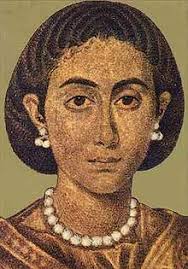
R5 Festuscato: The Cad in Ravena, part 3 of 3

“Galla Placidia,” Festuscato made it a show.  “You are looking as lovely as I remember.”

“Your memory must be faulty,” the old woman said, but she held her hand out for Festuscato to kiss her ring.  “Your governess, though, has not aged a day since we last met.”

“Alas, her people do not show their age in the same way as us mere mortals,” he sighed. “And this lovely child beside you?”

“My sister,” Valentinian stated the obvious

“Justa Grata Honoria,” Galla Placidia said, flatly.

Festuscato took the girl’s hand and kissed the back of her hand.  “The pleasure is all mine.”  He turned the girl’s hand over and kissed her palm before he let go. “Honoria is a lovely name.”  The young woman blushed and looked tongue tied. “But here, I am taking up your valuable time with pleasantries.  I understand you have important business in mind.”  He turned again to Valentinian.  “I am yours to command.”  He bowed again.

“Mother.”

Galla Placidia had a small packet of letters in her lap.  She wasted no time.  “Your father served the Empire well for many years in Britannia before we withdrew our legions from that island.  It was hoped that the free people might continue to prosper, but that has not been the case.  Indeed, they have reverted to petty, tribal squabbling as bad as reported in the memoirs of Julius Caesar himself.  This would be no concern for us, but the church has appealed for help, and we have caught wind of the fact that the Huns are preparing an invasion.  Your friend, Bishop Guithelm has written to us and to the Pope, and the Pope himself has appealed to us to do something. Therefore, we have determined to send you, young Lord Agitus, in your father’s place, to see if there is anything that may be done to protect and defend the church there.  Personally, I believe my concerns about you have proved true. You are a cad and a bad seed.  But you are also a man of rank, Vir Illustris, and have been generous to the state.  Therefore, an acceptable solution is to send you as far away from here as you can be sent.”  She grinned, cruelly.  “And wish you Godspeed.”

Festuscato stared at the woman with an absolute straight face.  “And yet you know I am honest, and as trustworthy as the most loyal lapdog.  And you know I am bright, and no fool.  I can assure you, if there is a way to resolve the troubles in Britannia, I will find it.”

“Yes,” Galla Placidia sighed and held out the letters.  “This I also know.”

Valentinian did not entirely follow the exchange.  Neither did Honoria.  She looked too busy swallowing Festuscato with her eyes and ignored the whole exchange. Licinia Eudoxia may have understood some of the dynamics, but she looked too busy being pregnant and getting uncomfortable having to sit for so long.

“Festuscato Cassius Agitus.”  Valentinian had been handed two scrolls by a counselor.  “Your imperial appointment is a two-edged sword.  I appoint you with the military rank of Comes Britanniarum. You may appoint whatever Dux Britannia or Dux Bellorum as you see fit.  I also appoint you Legatis Augusti pro Praetore for the free province of Britain. This is a consular appointment. You answer to no one but me.”

Festuscato took the two scrolls and thought a minute.  “I understand there is no commission to support these appointments. I will make this effort at my own expense, and gladly for your sake and for the Empire.  But between that and continuing to support you here, I ask that you go lightly on any new taxes you devise in my absence.”  He looked at Galla Placidia and she gave a slight nod of assurance.  “I also understand there are no legions to be spared, nor do I ask for any.  The people of Britain will need to find their own path to peace and a show of force from Rome might be the worst option.  But, the alps and certain parts of Gaul, despite Lord Aetius’ valiant efforts, remain treacherous.  May I take the Centurion Julius and his company of misfits to guard the way?”

“Please.  Be my guest.” Valentinian said, a bit quickly, but a glance at his mother assured him she had no objections.  “I only wish there was more we could do.”

“My Emperor,” Festuscato made another quick bow before his countenance changed and his words softened.  “My good friend.  I will endeavor to always bring honor to your name.”  He turned, and Mirowen turned with him.  Julius gave another salute and fell in behind before Valentinian bounded from the throne.

“Wait a moment.” They waited and Valentinian took Festuscato’s elbow and pulled him aside.  He whispered.  “What did you mean when you said your governess’ people don’t show age the way we mortals do?”

Festuscato glanced back, as if to be sure they were not overheard.  “She is an elf.  A house elf to be more precise.”

“No. Really?  No.”  Valentinian did not know what to say.

“Rule well. And love that baby girl.  I think your wife may need to stand up for a while.”

“Eh?” Valentinian looked.  “You may be right.”  He backed off and waved.

That evening, a messenger came for Festuscato.  The lady Honoria requested his presence to explain how he hoped to bring peace in such a faraway land.  Fortunately, Mirowen got busy repacking the wagon that barely got unpacked, so she was not there to stop him.  In the morning, Festuscato said he really had to go while it was still dark. Honoria reached for the back of his head and smiled, like she was not about to let him go.

“When times are hard on this road I travel, it is the memory of your smile that will help me carry on.”

“Mother was right,” she said.  “You are a cad.”

“Cad Illustris, first class,” he admitted.

“Oh, shut-up and kiss me again.”  And she pulled his head down to her on the bed while he covered them again with her blanket and thought he might never get betrothed, if he could help it.

************************

Next Monday:  Festuscato, Over the Alps.  Don’t miss it, and Happy Reading

*


R5 Festuscato: Wild and Dangerous, part 2 of 3

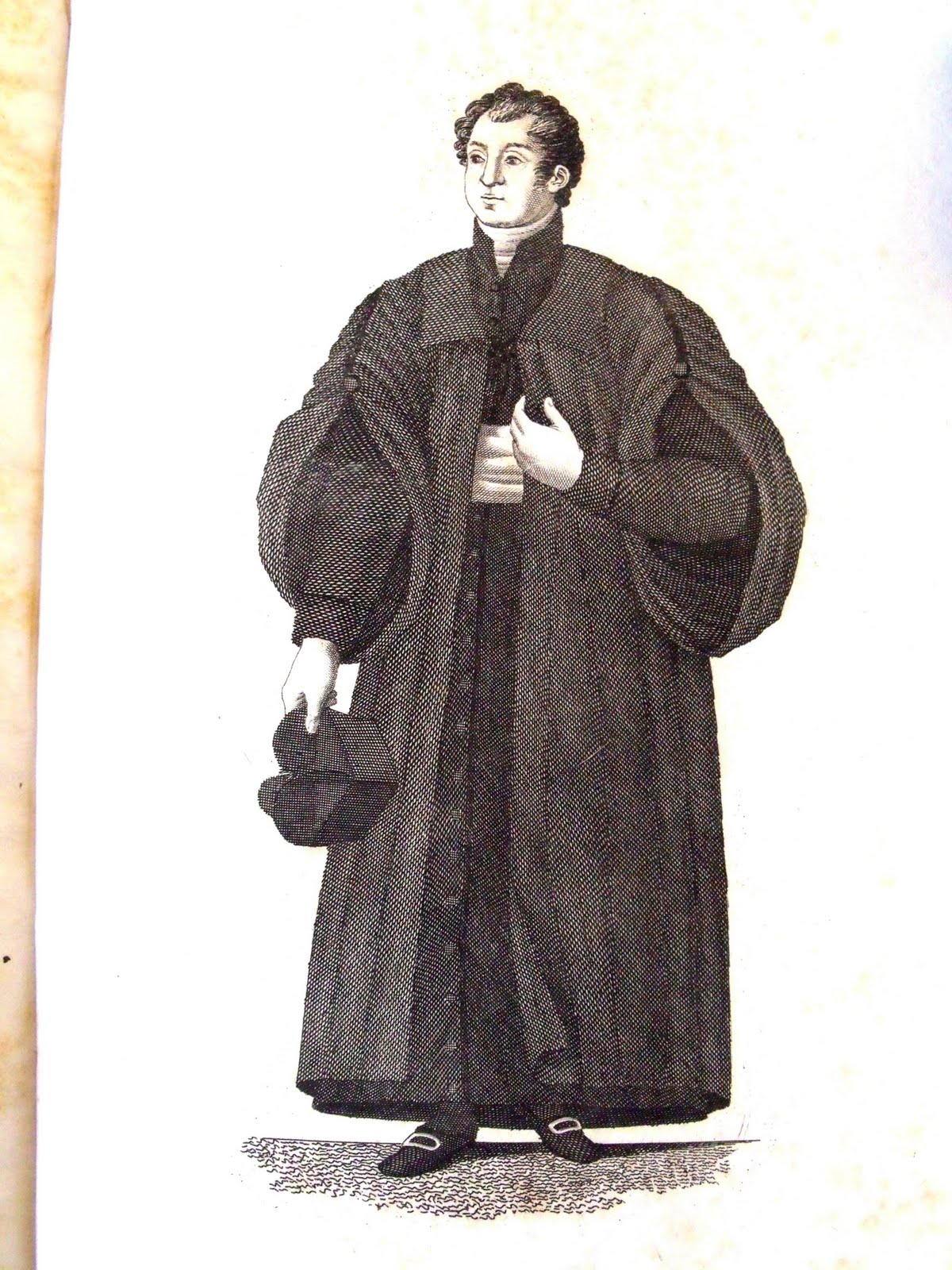
Festuscato had no idea what year it was and honestly did not care.  Living just south of Rome in a time of warming, he did well to know what season it was.  Mirowen began to correct that, first by teaching him her British tongue, which he already knew some from it being spoken around the house, then eventually by making him sit and learn to read and write, not only in his native Latin, but in Greek.  When he got older, she forced him to converse in continental Gallic and Old German as well.

It turned to 423, a year when they apparently had a civil war going on.  Castinus, the bad guy, forced the appointment of a man named Joannes to be the new Western Roman Emperor.  Father wrote to the Eastern Emperor, Theodosius, and persuaded him to appoint someone else.  He appointed Valentinian III, a child, and his mother, Galla Placidia as regent until he came of age.  So, they had war between the west and the east, and Mirowen took local matters into her own hands.  She taught Festuscato and his friends how to shoot a bow and hit a target.  She taught them how to wield a knife and defend themselves.  Most of all, she taught them how to escape and hide when the odds were against them, so they could come back and fight another day.

Festuscato turned eight in 424, and the summer turned long and hot.  That was the summer Castinus, the bad guy, decided to eliminate his enemies in the senate, which was anyone who secretly supported Valentinian with money.  How he made his list, no one knew, but it appeared to be accurate; though some, like Festuscato’s father, were obvious.  Festuscato felt surprised when his mother made no objection to the boys learning to defend themselves.  Six months later, Festuscato’s father talked about moving the family to their estates by Ravena which sat well within Valentinian’s territory.  Sadly, he did not move soon enough.

A balmy afternoon arrived.  Festuscato and the boys lounged around the woods just down from the house, at the side of the house where the tenant houses could just be made out in the distance. The woods separated the lands and fields of Lord Agitus from his neighbor, Velleius Fulvia who was Senatorial rank, second class, Vir Spectabilis, and who said that was sufficient because he preferred the quiet life and had no serious interest in politics. Besides that, he was reported to be a miser who had no intention of buying a first-class invitation to the Curia.

Festuscato had met his neighbor several times, generally when he messed around in the man’s garden, and once when he painted “F C Rocks” on the man’s barn.  Of course, he had not done any such thing since Mirowen arrived.  He could not lose her, much as he tried.  She stayed, always there, somewhere, in the background, virtually invisible, watching. On the other hand, as he had thought, there were compensations.

“Gaius needs target practice,” he shouted into the wind.

“I do not,” Gaius said.

“Yes you do,” Dibs responded as Mirowen showed up from somewhere.  She had a scroll in her hand from the extensive Agitus library collection.  She had been reading all about Julius Caesar, and King Bodanagus, the better to know the human race, she often told Festuscato.

“I imagined you boys were going to laze away the whole day,” she said.  “Come.  The target is already up.  Let us get your bows and begin.”

“When do we get to practice on a moving target?” Festuscato asked quietly.

“Not this time,” Mirowen said, but she smiled because certainly a still target would only be good for the basics.

“Hey!” Felix noticed first and pointed.

“Velleius Fulvia,” Festuscato named the man who rode up to the front gate with several other men in tow.  “What’s up?”

“They look like clerics,” Gaius said.  Festuscato shook his head.  His father was a Christian, certainly, but he was not exactly a pious man.

“Maybe they are collecting for the poor,” Felix suggested.

“Not from Velleius Fulvia,” Festuscato and Dibs said at the same time.

“He’s a Humbug,” Festuscato explained.  “You know, a Scrooge.”  No one understood what he was talking about, but then he did not either, exactly.  They got their bows and plenty of arrows.

Festuscato and the boys mostly hit the target with their arrows.  Festuscato pushed himself to be the best, but Dibs got pretty good, too. Felix was not bad.  Gaius needed work, but Mirowen seemed wonderfully patient.

Suddenly, forty more men appeared on the road, and these looked like ruffians and brigands. They came to the house like an invading army.  The front gate and the front door proved no obstacles, and soon there were shouts and screams from inside the house.

“Boys,” Mirowen said sharply.  “Bring the bows and arrows.  Come!” She made it a command, and she took the boys back toward the edge of the little woods that edged the property on that side. Someone inside the house must have been watching, because shortly, twenty men came out of the side door and started toward the boys.

“Get all of the boys,” one man said.  “That way we are sure to get the son.”  They spread out and zeroed in on the trees, some with bows ready, but mostly with swords drawn.

“Stop!” Mirowen stepped out when they were still some distance away, but she was able to make herself heard.  “These boys are under my protection.”

The men stopped, but only briefly to laugh before they yelled and shouted and charged. They began to go down, one arrow per customer.  Then two other archers joined Mirowen and in almost no time, every man except one had died, and that one, mortally wounded, moaned on the ground.

Festuscato stepped up beside Mirowen and took her hand.  She had put away her bow, but had her long knife out in her other hand. The boys were a bit slower, but they followed along while the two men who had mysteriously appeared questioned the one man still living.  “Castinus,” the man freely admitted before he died.  Then the two men went into the house to finish the rest.

Dibs stepped up to Mirowen’s other side and complained.  “I didn’t even get to fire my arrow.”

Mirowen squatted, though Dibs stood tall for an eight-year-old.  “And pray you never need to,” she said.

“Those are an elf and a fairy.”  Festuscato watched the men.

“Lord Atias and Lord Roan,” Mirowen admitted.

“Wait.” Festuscato heard a scream come from the upstairs and ran after the men.  Mirowen and the others kept up, but inside the house it seemed all chaos.  A good dozen ruffians carried swords and drawn knives, and some of the sharp weapons had blood on them.  Festuscato was not put off by the blood, because he no longer stood there. Diogenes of Pella took his place, and he came dressed in the armor of the Kairos and had Defender, his long knife in his hand.  Excalibur, the sword, stayed on his back.

Diogenes called and knew his voice would be heard no matter the yelling and screaming in the house.  Atias and Roan attended him.  He sent Roan in one direction.  He sent Atias in the other, and he took the center and the open courtyard.  He killed a man in the foyer, and pulled his sword when he reached the court.

A man, a cleric came stumbling into the courtyard from a back room where he had been hiding. Two ugly fellows followed, clearly with murder on their minds.  Diogenes let Defender fly straight into the chest of one of the men.  The man fell, shock and surprise on his face, but his fellow saw something and swung his sword down toward the cleric and Diogenes, like he could not make up his mind.  It proved a wild swing which Diogenes easily parried, and Excalibur cut across the man’s belly all in the same motion.  The man collapsed and his insides greeted the tile flooring.

An arrow came from the upstairs balcony that overlooked the courtyard.  It bounced off the armor of Hephaestus and would not even leave a bruise, but it got Diogenes to look up and growl, a pure Macedonian growl. The man took a big step back before Mister March shoved the man off the balcony.  The man screamed, but it became a short-lived scream.

Diogenes called to Defender, and it vacated the man’s chest, shook itself clean of blood in mid-air and raced back to Diogenes’ hand.  Excalibur flew into the air, cleaned itself and sheathed itself across Diogenes’ back.

“All clear.” Diogenes heard the call from Atias and saw the man wave from the balcony opposite Mister March.

“Done,” Lord Roan added from some back room where he could not be seen.

“Festus,” Mirowen called, but it sounded like a searching call, not a cry for help call. Diogenes nodded and went away. Festuscato returned in his own clothes, with his own bow in one hand, but he held tight to Defender with his other hand.  He stepped up to the cleric.

“You okay?”

The cleric looked up, a handkerchief in his hand full of sweat from his brow.  “Yes, yes.  Where is the young man who fought so bravely?”  He looked around for Diogenes.

“This was the young man,” Lord Atias said as he came to the courtyard and put a hand on Festuscato’s shoulder.  “Young Agitus himself.”

“It was an exercise of great courage on the part of one so young,” Lord Roan said, as he appeared in their midst.

“More like an exercise of great stupidity,” Mirowen said, as she marched from the back followed by three boys who gawked at the dead.  “Mister March,” she called.

“Oh no,” Festuscato whined.  “You’re not going to spank me.  Aren’t I getting too old for that?”

“Son, you saved my life,” the cleric spoke and reached out to Festuscato for a hug. Festuscato took a good look for the first time at the dead men around him, and he thought to say something to the cleric.

“Forgive me, father, for I have sinned.”  The cleric just laughed and hugged Festuscato all the harder as the tenant farmers came pouring into the house.  They carried knives, cleavers, axes or whatever sharp farm implement they could carry and were prepared to do battle.  They were not slaves, more like serfs, but Lord Agitus had been good to them and they knew if they lost their bread and butter, they had nowhere else to go.

“Hold it!” Mirowen shouted, and the men paused. “Get your muddy, filthy shoes off the tiles and carpets.  You need to take the dead outside for burial, and be quick about it, before they stink up the house.  I’m going to have to get this house scrubbed from top to bottom.”  She put her hands on her hips and frowned.  The men looked to Mister March, but he knew what was what.

“You heard the Princess.  Get your shoes off and start collecting the dead.”  The men nodded and some tipped their hats.

Festuscato suddenly broke free of his hug.  “Mother? Father?”  He started to ask, but Mister March grabbed him and hugged him.

“Hush,” he said and shook his head over Festuscato’s shoulder.  Mirowen took over, and Festuscato began to cry.

Velleius Fulvia took that moment to come out of a cupboard.  “Is it safe?” he asked.  The cleric and the boys all laughed, loud.

R5 Festuscato: Wild and Dangerous, part 1 of 3

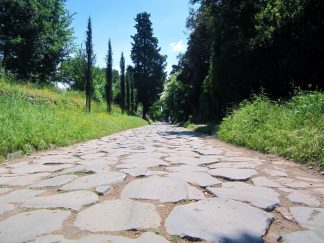
She appeared much too beautiful to be human.  Her black hair fell full but straight, and no doubt long beneath her red cloak and hood. Her features looked sharp, but her tears suggested a softness in her heart.  Behind those tears, she had the hint of eyes as blue and bright as the sky on a sunny day.  Her dress looked like silk, a soft pink held fast by a clasp of gold that sparkled with flashes of red in the sun, a splash of jewels to match the ruby on her ring. Mostly, she looked young, perhaps twenty-one, but that made the picture altogether curious and somehow wrong. There was no way such a rich and beautiful young woman should be walking, much less walking alone on the Appian Way.

Festuscato, all of seven, covered in mud and presently sitting in an orange tree by the side of the road, pondered this vision as well as a seven-year-old can ponder such things.  This girl should have had a dozen guards, and several servants and handmaids besides. And they should have been on horseback, if she was not in a carriage.  After all, it was just thirteen years gone since Alaric and his Visigoths sacked Rome.  And worse, father said Emperor Honorius recently died and he got angry because Castinus, the bad guy, was going to cause riots in the streets.  Festuscato did not follow all of that, but he believed his father.

Festuscato held his breath.  The young woman came over to the side of the road and sat quietly on the grass, in the shade, right beneath his tree.  Festuscato thought it was too perfect.  He quietly plucked a ripe orange, stretched his arm out and aimed as well as he could. Then he thought he ought to give fair warning.

“Bombs away,” he yelled and let the orange drop.  He missed by a good foot to the girl’s left, but the girl reached out with super speed and snatched the orange before it touched the ground.

“Thank you,” the girl said.  “I was a bit hungry.”

“Hey!” Festuscato wanted to protest, but he hardly knew what to say.  He scrambled down the tree and she stood to face him.  “How did you do that?” he asked.

“Magic,” the girl said with a grin, which suggested she might be having fun with him. She had the orange peeled in no time and offered one piece to him.  Festuscato shook his head.

“I am sick of oranges,” he said honestly enough, as a thought occurred to him and came bounding out of his mouth.  “Are you running away from home?”

The girl smiled. “I am a long way from home.  My name is Mirowen.  Do you have a name or should I just call you grubby?”

“I’m Festus. I’m an orphan and I’ve run away from home, too.  Like Greta, I’m going to have an adventure and save the world.”  Festuscato returned the girl’s smile, but on his face, it did not appear nearly as convincing.

Mirowen paused in her orange eating to look serious for a moment.  “How can you run away from home if you are an orphan who has no home?  I think you are going to have to work on your lying, not that I am recommending it.”

“Hey, Festus.” A boy down the street called and waved. There were three boys, all about the same age as Festuscato, and all just about as dirty.

“Hey!” Festuscato waved back.  “Come and meet my friends.”  He reached for Mirowen’s hand and she did not hesitate to give it to him, even if it meant being dragged down the street.  “Hey guys.  I want you to meet my girlfriend, Mirowen.”

Three boys stopped still and looked stunned.

“This is Felix, Gaius and Dibs.  Say hello, fellas.”

“Awe,” Felix mouthed and threw his hands out.   “How can you have a girlfriend?  You’re only seven.  I thought maybe it was your new nurse.”

“Nurse?  I don’t need a nurse.”  Festuscato protested.

“He’s had three so far,” Gaius said.  “He ran one off, got one to beg to be released from the duty, and one died, mysteriously.”

“I ate her,” Festuscato said, with a straight face.

“Awe,” Felix repeated the word and the gesture.  “Don’t listen to him.  He just likes to give Dibs nightmares.”

“I see,” Mirowen said with a glance at Festuscato.  She let go of the boy’s hand and smiled her warmest smile.  “Maybe you can help me.  I am looking for the home of Senator Lucius Agitus.  Do you know where that might be?”

“Why that’s – ow!” Festuscato stomped on Felix’s foot.

“I know where it is.  I can take you there,” Festuscato spoke quickly.  “But I have to warn you, the lady of the house is a witch in disguise, and the Senator likes to yell all the time, and loud.”

“I’ll be extra careful,” Mirowen said, and this time she took his hand.  “You boys coming?”  The three fell in behind, though they did not appear happy about it.

The house, truly a Roman mansion, was not far.  It sat up on top of a small rise and overlooked the Appian way for a good distance in both directions, though it was far enough in the countryside to be out of sight from the city.  Some of the tenant houses could be seen in the distance, out by the fields, and the house had one great meadow nearby where horses grazed lazily in the sun. Everything about the place said money, lots of money.

“Wait.” Festuscato stopped them outside the main gate.  “Let me check your ears.”

“My ears?” Mirowen sounded curious, but bent down a little toward the boy.  He pushed her luxurious hair back just far enough to touch the tips of her ears before he spoke.

“Just want to be sure your glamour is good.  Can’t have an undisguised elf about the place.”  Mirowen said nothing.  Her eyes got big and then very narrow as she stared at Festuscato.  “Oh, I know an elf when I see one,” he said.  “You are much too beautiful for a human.”  Mirowen heard the compliment, but it felt confusing. She turned to look at the boys following, but they merely shrugged, like this was not even close to the first time Festuscato said something strange.

Mister March came to the door and took one look at Festuscato, mud and all, before he remarked. “You are a brave fellow.”

“Most of the staff is Celtic,” Festuscato ignored the man and talked to Mirowen.  “Mostly from Britain.”

Mirowen looked up and spoke in some strange language.  Mister March answered, and they began a spirited conversation. Festuscato stayed quiet, but he tried to follow what he could by the words he knew and the hand gestures.  It did him no good, but they were shortly interrupted in any case by a woman’s voice.

“March, what is it?”  At the sound of that voice, Festuscato inched over to hide behind Mirowen.

“A young lady come all the way from Britain to speak to Lord Lucius,” March said.  As the woman came to the door, she took one look at Festuscato and shouted.

“Festuscato Cassius Agitus!”  That was enough to scold the boy.  “Take your sandals off and try not to touch anything.”

“I found him hiding up an orange tree and thought you might like to have him back,” Mirowen smiled.

The woman gave Mirowen the once over and apparently approved of her dress and deportment, sure signs of wealth and good breeding.  Then she spoke over Mirowen’s head, it being two steps up to the door. “You boys better go home.  I am sure your mothers will not be pleased.”

“Yes, mum. Thank you.  Mum.”  The boys spouted and ran off as quick as they could toward the tenant houses.

“You are from Britain?” The woman asked.

“Mirowen,” Mirowen gave her name and a slight curtsey which seemed the most graceful thing Festuscato had ever seen.  “My father, King Macreedy sent me with a troop for my protection, but we were set upon by Goths just outside of Rome.  I alone escaped.  What you see is all that is left of my small fortune, that and a word for Senator Agitus, though my letters are stolen and I cannot say what my father may have written.”

Festuscato closed his mouth.  The lie was masterful, and the woman, Festuscato’s mother, responded perfectly. “Oh my poor dear, do come in.”

“I found her all alone, crying.”  Festuscato said the truth, but Mirowen’s look urged him to be quiet and his mother snapped at him.

“You need to strip and get in the bath this instant,” she said, before she added in a very soft voice.  “Come and tell my husband all about it.  He spent many years in Britain in service to Rome.  I am sure we can arrange to help you out.”

Festuscato barely got clean and out to dry himself when Mirowen came in and announced she was his new governess.  “I told them my father sent me away for my safety and it might mean my life to return home.  On the other hand, I have a younger brother I have watched, my own mother being gone, and I would not mind watching you.”  She came to dry his hair and whispered.  “I am a house elf, you know.”

Festuscato nodded, but he would have to think about it.  He would never be able to sneak off again.  She would hear his every move.  Then again, there might be some advantages to having a house elf as a governess, not the least in the way she might be able to teach him to lie expertly.

Avalon 5.8 Making a New Nest, part 4 of 6

“What guarantee do we have that we will not be wiped out the minute we return to space?” the commander of the Anazi force on Earth asked.

“None,” Nameless answered.  “The gods do not make promises.  But I have programmed the location of a pleasant world—a world flowing with milk and honey, as the expression goes.  The journey will not be easy, but if by the grace of the Most-High you arrive, you may begin again.  Perhaps now, having learned something about freedom, you may make a better start.”

The Anazi commander looked at Lockhart, Katie, Artie and Sekhmet, the family group that the young god insisted be witnesses to their departure.  Artie thought to speak, as Nameless knew she would.

“All life is precious.  In this broken universe, there may be times to defend yourselves and protect the innocent, but no life should ever be taken lightly.  Every person deserves a chance to see what good person they may become, how they may make a positive impact on this sad universe.  And yes, I will speak these same thoughts to the dominants and submissives you leave behind.”

The Anazi commander said nothing.  He turned and went into his ship.  People waited the better part of an hour to watch as sixteen massive ships left the earth and headed out into the unknown.  Lockhart followed the trail into the clouds, while Sekhmet and Katie comforted Artie.  Artie cried, because the revolution happened, but not in the way Artie intended.  Her people destroyed the Anazi home world, and in the end, killed Anazi wherever they found them.  Now, her people were diminished, in numbers and in life.  They had replaced Anazi cruelty and tyranny with a cruelty and tyranny of their own, becoming as bad as the ones from whom they broke free.

“It is a pattern repeated in the human race, over and over,” Katie said.

“The liberators in the end become the new oppressors,” Lockhart understood.

Katie nodded.  “With few exceptions, the slaves become the new masters.  Your people merely followed the pattern of life.”

“How very human of them,” Lockhart added, and Artie nodded and cried some more.

###

Boston sat and moped.  Kara of the Valkyrie found her an elf maid named Salaquia, and a fairy friend, named Acacia.  They were both very nice, but Boston was not in the mood for company.  She sat on a log in front of the fire and magically made the fire big and small; big and small.

“I cannot do any such magic,” Salaquia said.  “I believe you must be related to the queen of the house of Mirroway.”

“That would be Alexis’ mother,” Boston grumbled, “And my missing husband’s mother.”  She made the fire big and small, and then added another log.

“Of course, I don’t know exactly where Mirroway is, but I cannot do such magic.”

“In Elfholm.  In Avalon,” Boston grumped, and both faces of the little one’s lit up.

“I would love to go there someday,” Salaquia said, earnestly.

“Could you take us there?” Acacia asked.

Boston did not answer as she watched Alexis and Lincoln walk toward them, with another person, a woman, about forty and motherish round.  It took Boston a minute to recognize Nephthys, the goddess in whose house Boston and Roland had been married.  Boston began to weep on recognizing the woman.  Nephthys merely opened her arms and hugged the girl.  Acacia flew up to Boston’s shoulder, where she sat and joined the cry.  Salaquia, empathetic elf that she was, cried alone until Mother Nephthys opened her arm and included her in her hug.  Nephthys whispered in Boston’s ear.

“There, there.  You don’t want to upset your friends.  Robert and Katherine deserve a happy day.  It will all work out, you’ll see.”

Alexis could not help it, presently being elf empathetic herself.  Pictures of her brother and father came unbidden to her mind, and she also began to weep.  Lincoln held her, and loved her.  That helped some.

Nameless, his arm around Eir, and followed by Hildr and Kara walked up, and Nameless had to speak.  “No joy like a wedding day.”

Eir hit him gently in the chest.  “I am looking forward to a good cry myself, but I am saving it for the actual ceremony.”

Boston pulled back from the hug and wiped her eyes.  She almost laughed a little.  That is because it is impossible to cry for long when you are being held and comforted by a goddess, and Boston’s change helped pull everyone together.  Alexis blew her nose.

“We have work to do,” Kara spoke.

“Yes,” Nameless said.  “I need to borrow Lincoln, if Alexis can part with him.  We have a bachelor party to plan.”

“That’s right,” Eir said.  “We need to give Katie a bridal shower.”

“Oh, yes,” Nephthys agreed.  “I learned long ago how important these wedding rituals are.”

That memory almost got Boston crying again, but she sniffed and held it back.  “I’m ready,” she said, and tried to smile again.

Acacia flitted to Salequia’s shoulder and commented.  “This is exciting,” she said, as in the way of fairies, she switched from one emotion to another in a breath of time.  Salequia, still wiping her eyes, nodded and also tried to smile.

###

Decker chewed on the jerky the dwarf woman made.  He noticed, they were improving their jerky as time went on.  He figured by the time he got back to the twenty-first century, the dwarfs would just about have it perfected.

Elder Stow sat on the other side of the Gott-Druk female, Sukki, who only wanted to sit and cry.  Decker wondered what it was about female anatomy that lent itself to tears, but Elder Stow did not seem to have a problem with it.

“They are gone.  I am sorry.  The entire expedition has been wiped out,” Elder Stow said, harsh as it sounded.  Gott-Druk did not naturally coddle the truth.  “But you have survived.  The only question is what will you do?”

“I don’t know what to do,” Sukki wailed.  “Burrgh was the only light we had, and now he is gone, all is gone.”

“Hush, no.  That is not true.  All is just beginning.  You are young.  You still have a whole life ahead of you to accomplish great and wonderful things.”

“But our world is lost to us,” Sukki complained.  “We have no home, and I do not see how we will ever overcome these humans to regain our land.”

“But we don’t have to,” Elder Stow tried to explain.  “We have made the new world our home, and it is a good home, in my day, better than we could have ever dreamed of having.  You should come and see it.”

“But what if we are forced to move out again?  Burrgh said what has been done to us once can be done again.”

Elder Stow raised an eyebrow.  “That is true, but there are no others on the new world to compete or to give the world to.  We are the only ones there, and we make it what we will, and no one will bother us.”

“And what about these humans?  How long before they begin to move into space and claim space for themselves?”

Elder Stow nodded.  “Thousands of years to come.  But even then, there will always be a wide gap, a chasm between what we know and what the humans have not yet imagined.  After you and Burrgh left, we began to learn what made the ships fly.  We have not stopped learning.”

“But humans.  You travel with them.  You have been tainted.”

“I have learned,” Elder Stow said.  “These humans have their own ways, but mostly we are more alike than you may imagine.  We are all people, Gott-Druk, human, even the Anazi who came here, and their androids as well.  We are all people, and these people are good people.  I have learned that there is no reason humans and Gott-Druk cannot live and work together, side by side.  That was how it was done before the waters came, back when we all shared this world.  Burrgh may not have been entirely honest about that.  Back in the before time, we all shared this world.”

Sukki frowned, but did not know how to answer that, directly.  Instead, she pointed her thumb at Decker.  “But how can you be near this one?  He smells like too much winter meat.”

Elder Stow nodded and laughed.  “You know, I had not put that together.”

Sukki laughed a little.  It sounded human enough.

Nameless came to collect Decker for the bachelor party, and Elder Stow, if he wished to join them.  Eir came to let Sukki know she was welcome to join the women, if she wished.

Elder Stow shook his head.  “Not right now.  We still have much to discuss.”  He looked at Sukki and she agreed with her nod. “We may each be along later, if you don’t mind, but for my part, I am not much good at such an event seeing as I have sworn off alcohol forever… unless there is some fermented goats milk.  I had some in the last time zone and did not realize what it was until later, but it did not seem to bother me.”

“I’ll see what I can do,” Nameless said.  “Decker.”

“You know, you may find the human mating ritual quite interesting,” Elder Stow said.

Sukki turned up her nose before she understood.  “You mean the joining ceremony, not the actual mating.”

Decker took that as his cue to get up.  “Good to meet you,” he said, and walked with the Nameless god and Eir.  “At least your people know how to make some good brew.”

Nameless nodded, but he started thinking of something else.  “So, do we have to change your name to Winter Meat?”  Eir hit him gently again in his chest.

Avalon 5.1 Sirens Are for Emergencies, part 4 of 6

“Thalia,” Alesandros called from the entrance to the temple.

“Here,” a woman called back from the front of the great room, though no one could see her.

“We have company,” Alesandros said, and led the travelers toward the front.

Though it may have been as big, the temple hardly looked like some cathedral on the inside, since the inside was filed with regularly spaced roof support posts, that Katie called “Aeolian Columns.”  She said, “It is the only way to build such a big open space, though it makes the space appear not so big and open.”

When they got to the front, they found a woman of about thirty-five years or so, who was just beginning to become plump as some women did when they got older. Age was hard for the twenty-first century people to judge, because before the twentieth century, people aged more rapidly, and showed it.  The woman welcomed them, as Alesandros stepped up and gave her a quick kiss.

“I found these people in the village.  They are not like any I have ever seen or heard of, but they seem to know the lady, and I get the impression they may even be friends with her.”

The travelers were busy taking in the view.  The cathedral had a sacristy, set apart by a railing.  Most of the space was taken by a long table filled with bread, fish and flowers.  They could smell the fish.  Off to the left was a stone statue which Katie claimed was remarkable for the time-period.  The statue was of a most beautiful and noble woman who appeared to be walking on the sea.  Her right hand was lowered to pet the head of a rising dolphin.  In her left arm, she held a baby, wrapped in a blanket and close to her breast.  Over her left shoulder, a fairy fluttered, with a look on her face that said, ‘this is fun’.

Lincoln was especially taken by what he saw behind the altar.  It appeared a narrow opening that covered the whole back wall, like the biggest picture window, except without glass.  Obviously, a roof overhang protected the temple floor from the rain, but the window without glass showed the rain in all its fury.  Great strokes of lightning flashed over the sea and across the sky to light up the night.

“Nice view,” he mumbled.

“Yes,” Thalia responded, as Alesandros went to pull the curtains.  He helped the travelers set out places to sleep while Thalia continued.  “It is a small way down to the cliffs that overlook the bay and the sea.  On a clear day, I can see for miles.  I sometimes come and sit here, and look out on the sea for hours and hours.  I never knew the beauty and wonder of it all until I became friends with Amphitrite.”

“Thalia and Amphitrite are best friends, since they were young.” Alesandros said.

“On Akalantas,” Lincoln said, and Thalia stared at him.

“Yes, how did you know?”

Alexis answered.  “My husband keeps the database and reads it when we are not looking.”

“Lovely table,” Boston interrupted.  She felt something warm to look at it, knowing that all these gifts were offered to the Kairos, in a sense, and now that she had become an elf, that was her goddess, too.

“Altar,” Katie corrected her.

“Of course,” Thalia acted like she was forgetting her manners.  “If you are hungry, please take what you wish.  Some of the bread is very good.  Our lady would not wish any to go hungry.”

“We ate in the meeting house,” Alesandros said, giving Thalia another quick kiss.

“Don’t people object to taking the food offered to the goddess?” Katie asked.

“Not here,” Thalia said, with a big smile.  “We do not waste the offerings.  In the morning, the mothers will come and give thanks, and the food will go to feed the children.  Besides, after too long, the fish starts to stink, so it all works out well.  A few people collect and bring offerings every day.  We gather the village here about every fifteen days, and some come from other villages to join us.  We get people here from the cities up the coast every season, and we have seasonal celebrations…”

“And we get to share the love of our great lady,” Alesandros added, and this time, she kissed him.

“Too bad the children can’t eat the flowers,” Artie said, wistfully.

“Yes, well, some are not suited for hunting or fishing, or for baking bread,” Thalia knitted her brows for one minute before she called.  “Lilac, come here and meet our friends.”

“Yes, Lady,” the travelers heard a sweet voice before they saw a beautiful young woman of about eighteen years at most, step out from a dark corner where apparently, no one looked.  At least Alexis felt that was what they were supposed to think.  Alexis felt suspicious, and it got confirmed when Boston stepped up and spoke.

“Hello fairy.”

“Hello elf,” the young girl responded.

“My name is Boston.”

“My name is Lilac.”

“You can get little if you want.  My friends won’t hurt you,” Boston said, and removed her glamour to show herself, pointed ears and all.  “See?”

Lilac glanced at Thalia who closed her mouth and gave a slight nod.  Lilac immediately returned to fairy size, and fluttering her wings, came right up to Boston to commiserate on nothing in particular.

“I see you have your own little one to worry about,” Thalia said with a look on her face that said she was not unhappy about it.  “Mine keeps me young and is my heart.”

Elder Stow interrupted before anyone else could respond.  “My mother. My father.  I have worn my glamour faithfully for a long time.  It is as you said, I mostly forget it is even there.  But it would be a great kindness to me if I could take it off, just for this night.”

“Oh, I don’t know,” Katie said, and with a brief look at Thalia, and Alesandros, who came up to slip his arm over his wife’s shoulders, she looked at Lockhart.

Lockhart looked unsure.

Elder Stow said, “I am sure I would sleep better, and maybe not snore so much.”

Katie shrugged and Lockhart nodded.  “Only if Thalia and Alesandros don’t object.  If they are uncomfortable, you must put it right back on.”

Elder Stow nodded, and to their credit, only Thalia made any noise, and it was a little gasp.

“He is not an elf or dark one or any spiritual creature I have seen.”

“He is an old one.” Katie said.  “One of the ancient races that lived in this land before the flood

“I really am a very nice fellow,” Elder Stow said.  “That is what young Boston says.”

“I’m only about a hundred and ten, elf years old,” Boston admitted.

“Miss Lilac is just over a hundred herself,” Thalia said.

“I just barely qualify to be called Miss Lilac,” Lilac said, sounding more like a ten-year-old than one who looked eighteen in her big size.  Lilac settled down to sit on Thalia’s shoulder, a place she was obviously accustomed to.

“One elf and one old one makes me wonder what other wonders you have to share,” Alesandros said.  He smiled, like he was enjoying the show.

Alexis shook her head, but Boston spoke.  “Just one.  Elder Stow, we have to give Artie a check in all this rain.”  Artie looked up, but she had been quiet all through supper, on the road to the orphanage, and now in the temple, where normally she would have been in the midst of it all, asking questions.  She did not appear to have the gumption to protest as Elder Stow nodded and rummaged through his pack.

“I don’t feel well,” Artie said.  “Is that the right way to say it?  I don’t feel well.”

“Yes, that’s right,” Alexis said, as Katie sat down beside the android.  Alexis looked like she wished there was something she could do.  Her healing magic worked fine for wounds and broken bones.  She could pull poison and infection right out of the body, but she was not as effective on illnesses, and in Artie’s case, Alexis felt powerless.  She could not heal wiring.

Elder Stow sat and placed a disc against Artie’s head.  Artie voluntarily closed her eyes, but when Elder Stow tuned the disc, Artie stiffened like a corpse.  Thalia let out a little gasp again, but Alesandros held on to her, so she stayed quiet.  Boston slipped into Katie’s place.  When she reached down to open Artie’s middle, Thalia muted her gasp in Alesandros’ chest so she would not have to watch.  Alesandros watched, fascinated, and eventually Thalia also turned to see.

“She is a machine,” Elder Stow said.  “But most of her insides imitate human insides.”  He spoke to Boston.  “Find something to sponge that water.”  Boston got her fairy weave blanket.

“A machine?” Alesandros got close.  “I thought… she seemed a fine young woman.”

“I suspect the moisture seeped in all day around her middle joints,” Elder Stow said to Alexis and Katie.  “She is rust proof, and her flesh, like human flesh, is designed to repel water, but when she bends, even like sitting, the flesh bunches up and makes a miniscule gap.  Human flesh is stretchier and tugs against the muscles so we can only bend so far and can’t make gaps.  After an all-day rain, sitting on her horse and all, enough moisture got in to her insides to begin to cause problems.”

“Can you fix her?” Katie asked, obviously concerned.

“Not without covering her in an entirely different kind of flesh, for which I do not have the equipment.  Very sophisticated equipment.  Magic might do it, I don’t know, but science can only offer a sealer, like a glue stop.  I can give Alexis a list of ingredients to look for.  Artie may find the glue uncomfortable, and in any case, it will only work as a stop-gap until a more permanent solution can be found.”

Boston finished wiping out Artie’s insides, and Elder Stow closed her up.  He paused on waking her when Katie said, “Wait.  Let’s not tell her just yet.  Let’s wait until we see the Kairos.  She has resources and knows thing that we cannot imagine.  Maybe she will have a solution.”

“You don’t want her to worry in the meantime,” Lockhart said, and everyone agreed, though some might have thought keeping secrets from her was not a good idea.

“Not keeping secrets,” Alexis told Lincoln.  “Just not confirming the diagnosis until we get a second opinion.”  Alexis was a nurse.

“Okay?” Elder Stow asked.  No one objected, so he removed his disc and Artie came around quickly.

“Am I going to be okay?” Artie asked first thing.

“How do you feel?” Alexis asked.

Artie thought first.  “Better.”

Katie helped Artie to stand.  “You are going to be fine.  We just need some rest.”  She escorted her to where they had laid out their blankets.

“No watch tonight,” Lockhart decided.  “Everybody get some good sleep.”

“Good,” Decker said from where he was already lying down.

Well,” Alesandros said.  “I knew you people were special, but I had no idea how special.”

“Don’t worry,” Alexis said.  “The rest of us are plain ordinary humans.”

Lincoln shook his head.  “Actually, Alexis used to be an elf, but became a human when we married.”

“No,” Thalia voiced disbelief.

“True,” Alexis said.  “I am Boston’s sister.  She was human and became an elf to marry my brother…who has moved on ahead of us toward our destination.”

“How can humans become elves and elves become human?” Alesandros asked.

“The Kairos,” Alexis answered.  “Amphitrite.  What can the gods not do?”

“Of course.”  Thalia and Alesandros understood when she put it that way.

Alexis looked at Boston, who chose to sleep by the altar.  Lilac, apparently, slept on the altar.  “And I am feeling terribly guilty about it, oh, not guilty about becoming human.  But I feel guilty not being with Boston, at least for a while.  She has so much still to learn about being an elf and about magic and everything.  She is such a young elf.  Right now, there is no one else, and though I cannot show her things like I could if I was an elf, I should at least be sharing with her those things I can describe and things I remember from growing up elf.”

Alesandros went around, putting out candles, and Lincoln took Alexis by the arm.  “Come along.  I want to be asleep before Elder Stow starts snoring.”

From out of the dark, they heard what sounded like a Neanderthal giggle.

It stopped raining by two in the morning, and the world slept well until after four, when things got strange.

Avalon 5.1 Sirens Are for Emergencies, part 1 of 6

After 1643 BC, Greece.  Kairos 60: Amphitrite, Queen Goddess of the Sea

Recording…

Katie and Artie moved first through the time gate and into the next time zone where a cloudy sky and a misty drizzle of rain greeted them.  Katie helped Artie rework her fairy weave clothing into long slacks and a hooded yellow slicker against the rain.  She changed her own weave to the same while the others came through the gate to join them.  By the time Lockhart and Boston, who came straggling at the back, joined them, Lincoln had out the database to see what he could about this place.

“I would guess Greece,” Lincoln said, with a brief look around.  “But we could be anywhere in the Mediterranean.  The Kairos is Amphitrite, or Salacia if we are in Italy, or maybe Calypso if we are across the Atlantic.”

“Helpful,” Lockhart quipped, and looked around at the trees, dripping with water, and the puddles on the grass.

“Mediterranean climate and flora,” Alexis suggested that much was true, and the other side of the Atlantic seemed unlikely.

“Temperate zone,” Elder stow agreed, with a glance at his scanner.

“At least it’s spring,” Boston blurted out.  The others all trusted that as an elf, Boston was well tuned to the seasons.

“Go on,” Katie said, as she checked the amulet she wore and looked for a road, or at least a path of some kind that they could follow.  The land looked rough, rocky and hilly.  Though not far from the sea, Katie imagined them coming to some great sea cliff and having to backtrack a long way, unless they could find a road that avoided such obstacles.

Lincoln continued the commentary on what he read.  “This isn’t Atlantis, I think.  That is spelled like Akalantis.  That is where Amphitrite grew up.  But she is a goddess, the queen goddess of the sea, actually.  She could be almost anywhere in the world, but most likely in the jurisdiction of Mount Olympus.  She married Poseidon, or Neptune, if we are in Italy.”

“Helpful,” Lockhart quipped again.  “Which way?” He asked Boston and glanced at Katie.  Boston pointed.  Katie nodded, and they started right off, headed downhill in what would have been a pleasant ride but for the drizzle.

After a short way, the travelers came to a meadow full of sheep.  They barely came out from the trees before they found three shepherds gathering their flock.  Katie, and thus Artie rode up to the three while the others paused and Decker and Elder Stow casually wandered in from the wings, sensing no danger and not wanting to startle the sheep.

“Excuse me,” Katie said.  “What city lies in this direction?”  She looked closely and decided the shepherds consisted of a father and his two sons.

The old man eyed the travelers with a wry look, not the least because of the monster horses they rode.  “Argos,” he said.  “Our village and the road to Argos.”

“Road?” Artie asked Katie.  The younger son stared at the sky.  The elder son stared at Artie.  The younger one spoke in a friendly manner.

“You probably won’t get to Argos before the storm hits.”

“Unless you have wings to fly, like the gods,” The father said, clearly unsure how to take these strange people.

“Argos is a long way,” the elder son spoke without removing his eyes from Artie.  “Our village is not far.  We can shelter you, and your beasts.”

“Thank you,” Artie felt obliged to respond, but otherwise a bit uncomfortable under the stare.

Katie grinned at her.  “Sorry to interrupt,” Katie said to the old man.  “I am sure you want to get your sheep gathered before the storm.”  Katie moved the group to where she found a path through the wilderness, and figured that was the road to Argos.  The others followed, and Lincoln, Lockhart and Elder Stow all tipped their hats.  Decker tried not to frighten them with his smile.

Katie and Artie rode side by side, though the path was not especially wide.  Alexis and Lincoln crowded them from behind so they could converse.  Lockhart heard the initial words before he focused on the path, the countryside, and the weather.  Boston, beside him, likely heard the whole conversation with her good elf ears, and it no doubt kept her entertained.  She and Elder Stow who followed her, wore glamours to appear human.  Boston looked like a twenty-two-year-old with auburn hair where she toned down some of her red head, and Elder Sow like an older man with a gray beard.

Decker, beside the elder, did not bother with glamours.  In fact, when the others made the effort to change their fairy weave clothes to look more like the local dress, Decker sometimes did not bother with the clothes, either.  The Kairos told him that in most places, as a dark skinned African, he could get away with more leeway in terms of dress.  He often shaped his fairy weave into camouflage fatigues, even when the other men prudently walked around in floor-length dresses.

“Greece,” Lincoln said, definitively.  “In fact, the Peloponnese.   After Argos comes Mycenae, and then Corinth, if the Corinthians have migrated in at this point.”

Katie asked a history question.  “Are the Minoans in charge here, or have the Mycenaeans overthrown them?”

“Wait…” Lincoln said, and looked at the database. “The Akoshians…wait,,,” he flipped to the dictionary and back.  “The Akoshians are the Minoans, and they are sort of in charge.  The Mycenaeans are like the overlords in Greece.  They are the reason the country began to settle down.  Until then, it was filled with wandering tribes that constantly fought.  Argos was one of the first real permanent settlements.  Mycenae was built by the Akoshians, and they are still tied in a way, but the relationship appears complicated.”

“Most are,” Alexis said, with a look at Katie and a glance at Lockhart.

“As far as I can tell, the Akoshians are mostly merchants, and they have exclusive trading rights with the Mycenaean coast, including Athens… I assume in most places, that means the Akoshians just take what they want…  Apparently, Athens rebelled at one point, and the Akoshians brought in an army, which they could easily afford, and forced Athens to pay tribute in the form of slave labor, seven young men and women every nine years or so.”

“I know that story,” Boston shouted up from behind.  “Theseus and the Minotaur.”

“I don’t think that has happened yet,” Katie shouted back.

“Greece?”  Alexis wanted back on track, and gave Boston a sour look.  Elves could certainly hear, but they needed to learn not to interrupted.  That could be rude.

“Yes,” Lincoln said, and put away the database.  “But there is no telling how long after her childhood we may have arrived.  That narrows things down to about a forty to forty-five-year time span.”

Artie had a question that whole time, and it finally burst out of her lips.  “Road?”

That was followed by Alexis’ question.  “City?”

Katie smiled.  “Yes.”  She spoke to Artie.  “When we started this trip, people were still wandering, working in stone, and living in tents of animal skins.  They slowly learned to use soft metals and began to settle in hamlets of mud and straw huts.  Eventually, they built villages and began to till the soil, though plenty still wandered.  Then they began to domesticate some of the animals they followed, and they began to discover things like pottery.  That was when the villages became towns and, in some few places, cities.  One big discovery was Bronze, the blending of metals in a furnace they could get hot enough.  It took time, but cities began to trade, and sadly, they began to make war on each other.”

“It was a great adventure,” Lincoln said.  “I mean the progress of the human race, not just our wandering through the middle of it all.”  Artie looked fascinated, and Katie nodded and continued.

“About twelve time zones ago,” she glanced at Lincoln who got the database back out.  “We arrived on the silk road.  That is a way that cuts through and around the mountains and links the far east with the west for real trade, long distance, and other things.  Cities began to join together, or be conquered, and empires were born.  Some would call that the real beginning of civilization, and that was when roads began.”

“Which time are you thinking?” Lincoln asked.

“Lin, the first Hsian empress.”

“Fourteen time zones.”

Katie nodded.  “Since then, we have seen cities, roads and empires building.  We were there when Babylon was first being built, and came back when Hammurabi was ready to build the first Babylonian empire.  That was with Ishtara’s help, and the time zone where we found you.”

“That is where you saved me and gave me life,” Artie said. “And I am ever so grateful.”  Artie turned away for a moment.  Her emotions being so new, she had not yet learned to hide them or put up a mask.

“What?” Katie reached out.

“I am sad for two reasons,” Artie said.  “I am sad because my people have no such noble history.  You humans have struggled and grown.  You have overcome such great hardships, and made yourselves better.  You have created life.  I know, some good and some bad.  I know some succeeded and some failed.  But you never give up.  You keep striving.  And overall, you have done great and wonderful things.”  She let her voice trail off.  Katie had to prompt her.

“You should not be sad.  What is the second reason you are sad?”

“I am not part of it,” she said.  “I wish I was human, so I could really be with you and part of all that surrounds me.  I feel…”  She could not describe what she felt.

“You can be part of it from now on,” Alexis said, kindly.

“Yes, but not really,” Artie insisted, and let a few tears fall.

Alexis looked back.  “Meanwhile, Boston is moving away from the human experience, but she is still so young and vulnerable.  She is so very young.  She has learned much, but she still needs help to come to grips with her elf life—with being an elf that is an elf, not just a human that got changed into an elf.”

“She will hear you,” Lincoln whispered.

“I am sure that she did.”

“So now,” Katie concluded, and changed the subject as they came around a bend in the path and saw that they were headed down toward a seaside village on a small bay.  “We look for roads and we ask what city les ahead. I imagine the Kairos will often be associated with cities at this point, because that is where most of the action will take place, not to mention most of the chances for history to go awry.”

“Keeping history on track has to be getting complicated and difficult at this point,” Lincoln added.  “Being an actual goddess has got to help.”

Alexis countered. “But she won’t always be so.”

Avalon 5.0 Invading Armies, part 5 of 6

“Impressive looking ships,” Lockhart noted, considering their size.  He pulled up when the whole group came to a stop.  A man showed himself.  He had waited for them, and insisted they follow.  Balor had apparently abandoned his camp on the edge of the Anazi perimeter.  He moved to some rocks on the side of a small hill, where he could still watch the Anazi, but the Anazi would have a hard time getting at them.  The Anazi and their androids had no personal screens to repel arrows and spears.  That was a technology beyond them.  The Hyksos had learned what parts of the androids were most vulnerable, and the Anazi lords were unwilling to risk their dwindling number of androids.

“It is still a standoff,” Balor said, when Lockhart joined them.  He opened his arms to give Boston a hug.  He hugged Artie as well before he introduced the woman with him by simply giving her name.  “Anath-Rama.”  He grabbed Lockhart’s binoculars.

Katie’s eyes got big, looking at the woman.

“Katie,” Anath said her name, to acknowledge her.

“I’m not dead yet,” Katie insisted.

“Good for you,” Anath said.  “You are one of my elect, but somehow, you don’t belong to me.”  Anath smiled.  “And if you don’t mind, I am portraying a local woman who knows the area and wants revenge for the destruction of my village.”

“What are you…oh.” Boston lowered her eyes to the goddess.

“Little Fire,” Anath named Boston.  “You are no longer mine, either.”  Anath sighed.  “Maybe your friend Artie would have me.  I have seen the poor departed, crushed souls of the androids, as Balor calls them.  They are people without hope and have been made small.  Smaller than smidgens.”

“Do I know you?” Artie asked.

“I do not understand,” Ed admitted.  He said that a lot since they left the camp that morning.

Katie explained.  “Anath-Rama is the Amazon goddess of the dead.  She has made a lovely place, I am sure, for the brave women who die in battle, and a not so lovely place for the cowards.”

“The cruel, unkind and others,” Anath agreed.  “And some of it is not lovely at all.”

“But what about my people?” Artie asked.  “Would you take my people?  We would honor you above all.  My people need a place to continue after death.  Please.”  Artie got down on her knees, but held her tongue.

Anath’s lips frowned, but a smile came to her eyes.  “If they die on another world, they will be subject to the spirits and gods of that world.  The flesh and blood Anazi are claimed by another who is light years from here.  Death for the Anazi can be a long journey.  But I suppose I can watch over any of your android people who die on this world.  Understand, those who die in captivity will remain small forever.  They will never know freedom for what is set in life is set in death, but they will not be unhappy.  One thing about being bound by another, they cannot rightly be held accountable or punished for their actions.”

Artie did not understand.  She looked up at Katie to explain.

“She is telling you how it will work,” Katie said.  With a glance at Anath, she amended her words.  “She is telling you how it must work, how it shall work, but she is offering to spare and make a place for those who die on this world.”

“Oh, would you?”  Artie looked at the goddess with such a look, the goddess could hardly respond with anything other than a kiss to Artie’s cheek.

“I do not understand,” Edward said, with some force in his voice.  “When you die, you are dead.  That is it.  How can something survive death?  It makes no sense.”

“You would not be the first to be surprised.  And thanks…” Anath spoke to Katie.  “Now I will have some males to worry over.”

“I believe in you,” Katie responded with a grin.

“I may ask for some help with this,” Anath admitted.

“Maybe we can make a shrine for you right here,” Boston suggested.

Anath shook her head, paused, shook her head again before she said, “That would be nice.”

“What are you women on about?” Balor said over his shoulder.

“The action is all over here,” Lockhart said, as he took back the binoculars from Hebron.

Ed stepped over to stand beside Lockhart.  “I do not understand any of this,” he said.

“Life is a strange bird,” Balor said.  “Every time you think you know where it is at, it flies to a different branch.”

“Is there a way we can send word back to Lincoln and Decker so they can come straight to the hill, here?” Lockhart asked.

“Already taken care of,” Balor answered.  “I sent three smidgens to them with word and to guide them, and to watch for the transport ship that left here about two hours ago.”

“We saw the transport,” Lockhart said.

“It fired on us,” Hebron added.  It was the first chance they had to say that.

“Lockhart,” Katie got his attention and pointed at her wristwatch.

“I keep forgetting about these,” Lockhart said.  He turned his on and spoke into the watch.  “Lincoln, are you there?”  He waited.  “Lincoln, can you hear me?”

“Yes.  It took a second to remember where your voice was coming from, over.”

Lockhart looked at Katie and she answered his unspoken question.  “That means he is less than twenty miles off.

“Lincoln.  Follow the smidgens, if they have gotten there.  When you reach the point where you can see the Anazi ships, look to your left. You will see a rocky hillside.  Balor has moved the Hyksos camp to the rocks.  Head for the hill.  Over.”

“Will do.  The smidgens are already here, but it is good to know.  Over.”

“Tell Elder Stow to keep his scanner handy in case he needs to put up screens.  We won’t be able to offer any cover fire.  Over.”

“Be there as quick as we can.”

“Call if you get in a fix.  Over and out.”

Balor nodded, but changed the subject.  “Nothing we can do until Elder Stow arrives.  What say we see what is on the supper menu?  We have a small cave here with a fire out front.  The dwarfs are expanding it, but that is going to take a while.  Meanwhile, Boston…” he got her attention.  “Your people are down that way.”  He pointed, and then began to climb up the hill.  Everyone except Boston followed, while Balor explained that he could not have halted the advance group with a hundred and twenty Hyksos alone.  “Good as we are at making war.”

Boston stood and stared in the direction Balor pointed.  She knew where the light elves were as soon as he mentioned it.  She wanted very much to go there, but she felt afraid.  She still felt too human.  She had only become an elf such a short time ago.  She married Roland, but then Roland got taken from her.  She still had Father Mingus then to teach her all about her magic and all about being an elf.  But then Father Mingus got taken from her as well.  It was not fair.  She felt like an elf, no doubt thought like an elf.  She wanted to be an elf.  She did not want to go back to being human.  But she could not just enter into an elf camp.  She felt too shy.  She still felt human in too many ways.  She cried as she turned to follow the others up the hill.

Avalon 5.0 Invading Armies, part 3 of 6

“I have monitored the prevailing wind for the last six hours,” Elder Stow reported.  “The mustard gas will stick to the ground for a day, perhaps many days where it fell and where it spread, but we should be safe enough in this one direction.  We should keep an eye on our horses’ legs and hooves for the next twenty-four to forty-eight hours, but then we will be in the clear.  Under no circumstances get down and walk.  Try not to touch the trees, grass, or bushes.  Are we ready?”

Several eyes went to Artie up on her horse, Freedom, where Ed sat behind her and held on, looking uncertain about the whole idea.  Artie nodded, and Elder Stow turned off the screens.  They waited for a minute while they heard several trees crash into other trees or fall or slide to the ground.  One medium-sized tree blocked their intended path, but it would not be difficult for the horses to step over.  Everyone got warned again not to step on the ground.  The androids, with their plastic-semi-organic flesh were no exception.

“And stay in line,” Lockhart added.  “The further you move to the left or right, the less safe you will be.

“The sulfurous gas residue will eat through your flesh in no time,” Elder Stow explained to the androids.  “The humans will just develop blisters.”

“What about me?” Boston asked.  Elder Stow merely shrugged.  He had no idea how the gas or the residue might affect elf-kind, though he pointed out that it was no friend to the environment.

Lockhart and Elder Stow took the front.  Katie and Artie, with Ed holding on, followed.  Lincoln and Alexis came next, while Decker and Boston brought up the rear.  Decker insisted on the rear-guard position where he could have some firepower to protect the group from whatever might follow them after they reached the open field.  Boston tended to straggle at the back when she did not urge her horse, Honey, to ride wild through the meadows.

The horses walked, and made no objection.  The path appeared to be residue free.  Alexis and Decker covered their mouths with fairy weave, though the gas itself had long since dissipated on the wind.  Katie said she could still smell the mustard.  Lockhart said it smelled more like garlic.

Elder Stow stopped at the edge of the trees where the way became blocked by three thick, old trees and plenty of underbrush.  Lockhart pointed.  Elder Stow nodded.  They went left around the roadblock and broke out into the grassy field.

“All clear,” Elder Stow said.  “But we would be wise to quickly move out of the area.”

They trotted toward Edward’s wrecked fighter craft, not a direction they would have chosen if they had a choice.  Fortunately, Decker had checked the sky with his eagle eye, and Elder Stow had double-checked with his personal scanner, and neither saw anything overhead.  Lockhart wondered if perhaps the Anazi wrote off the fighter as a loss when the homing signal quit.  Boston wondered if the glamour fooled the machines after all.  Ed shook his head, as he had learned to do for ‘no’.  Like some humans, though, he had not yet realized that a head shake was ineffective when people could not see his head shake.

“It is not the Anazi way to leave salvageable material unaccounted for,” he said.

“I can confirm that,” Artie added, and leaned back to smile for Ed.  “I like having your arms around me,” she whispered, and clearly, Ed did not know how to interpret that.

“We should be completely in the clear by now,” Elder Stow answered a question Lincoln asked.  Several people got down to take another look at the crash.

“Anything you can find to recharge your equipment?” Lockhart asked Elder Stow.

“Good thinking,” Elder Stow said, and he immediately joined them on the ground and began to rummage around.

Ed spoke when his feet once again touched the ground.  “There are not many Anazi left,” he said.  “We came here, an advanced group to prepare for an invasion, but the humans used the gas on us.  Many androids melted, as Elder Stow suggested.  Most of the Anazi became sick and died.  I do not know what message has been sent to home-world, but I saw that the conquest of this world would not be as easy as some said.”

“But mustard gas should be beyond the ability of the locals to produce,” Katie still insisted.

“Like gunpowder,” Boston countered.  “It is not a complicated compound; it just has to be discovered.”

“I suspect the Kairos,” Lincoln said.

“Or the Masters,” Lockhart said and frowned.  “The Kairos would not likely make something that could disturb the flow of time and history, but the Masters would.  Remember, their intention is to change history to make it come out more to their liking.”

“I would think establishing the kind of scientific lab and secure procedures to produce the gas safely would be the hardest part,” Boston said.

“And the most potentially damaging to history,” Alexis, the nurse agreed.

“I don’t know,” Katie hedged, and they all turned to listen to the doctor in ancient and medieval history and technologies, to hear what she had to say.  Katie cleared her throat.  “The Egyptian physicians in this age had labs and safe and secure procedures good enough to mummify the kings.  They knew and practiced certain form of surgery, successfully.  Their procedures had to be good.”

“So, the Egyptians are suspect,” Lincoln thought out loud.  “Maybe the Masters wanted to repel the Hyksos invasion.”

“Maybe,” Alexis and Katie agreed, when Decker interrupted.

“Company.”

Eyes naturally went to the sky before they returned to the ground where they saw men, and several wagons and chariots approaching.

“Stow,” Lockhart got the Gott-Druk’s attention before he got up on his horse and pulled his shotgun.

“Coming,” Elder Stow responded.  “I found something that may work for a few time zones.  It is primitive, but the Anazi do quality work, so it may last a couple of hundred years.”  He stuffed some pieces in his saddlebag and mounted with the others.  They walked the horses to meet the oncoming group.

“Friend,” Lockhart shouted when they got within range.  “Where are you headed?  Are you searching for someone?  Perhaps we can help.”

Boston reacted.  “Hey!  Stop that.  Leave our equipment alone.”  Several flashes of light, like little explosions appeared around the horses.  They looked like they were insects driven back by some force.  Alexis’ Misty Gray and Katie’s Beauty startled and bucked.  “Get big so everyone can see you,” Boston ordered.

A male fairy in armor appeared, floating in Boston’s face.  He asked a question that came out like a statement.  “You are not the Masters?”

“No way, Jose,” Boston answered.  “We belong to the Kairos, and we are looking for him…”  She checked her amulet and pointed.  “That way.”

A fairy woman appeared next to the man.  “You are the red-headed elf who travels with the yellow hair woman and former elf, and the men who ride on the big horses from the future.”  It was a mouthful.

“I’m Boston.  Who are you?”

The male fairy answered.  “My name is Wedge.  We are the smidgens made by our lord to interfere with the workings of the alien machines.  We took down the fighter plane, but we have been strictly charged not to harm the androids that pilot such machines.”

“This is your big size?” Lincoln asked.

“It is,” Wedge answered.  “But it is our normal size.  When the Lord made us, he made us so we don’t get big, we get little.”

“Little?” Katie asked.

“Smaller than the human eye can see,” Alexis and the female fairy spoke at the same time.

“Hi, I’m Alexis, the former elf.” Alexis smiled.

“Hi, I’m Cherry,” the female fairy said, as she fluttered up to face Alexis.

The men, like soldiers, arrived at that point, and the chariots stopped, and the men watched while the rest of the smidgens got fairy big and introduced themselves.  Lockhart looked at the man in the chariot who appeared to be the head man.

“Lockhart,” he said.

“Hebron,” the man responded.

“Should you lead, or should we?” Lockhart asked.

The man shrugged, split his group in two so some could lead and some could follow, and started out with a word.  “We should arrive at the great ships by sundown.”

“I do not understand,” Ed admitted as he turned his head back and watched Cherry get comfortable sitting on Alexis’ shoulder.  He saw Wedge sit in the mane of Lincoln’s horse.

“The universe is more alive and full of life than the Anazi can imagine,” Artie said.

“There are more things in heaven and earth than are dreamt of in your philosophy,” Katie added.

“I do not understand imagine, or philosophy, but I do not doubt what you say is true.”  Ed responded, and he paused to think.  “I believe you, but there is no explaining it.”

“It is called faith,” Artie said with a big smile.

“I think it is called trust,” Katie offered another word.  “By his own free will, he is willing to trust what we say.”  Artie nodded in agreement.  Ed shrugged, like he saw the human shrug.

“The visual evidence helps,” Alexis spoke up from behind.

“It does,” Cherry agreed.  “I heard of you all my life, but I never thought to see you.  You seem very nice… for a human.”

Avalon 5.0 Invading Armies, part 1 of 6

After 1700 BC near the Saini.  Kairos 59: Balor, Captain of the Hyksos

Recording…

The ship hurtled toward the ground as it spun out of control.

“Pull up,” Decker yelled.

“Pull up,” Lincoln echoed Decker’s words softly, as he reached for the reigns of Alexis’ horse.  Alexis buried her face in her hands.  She did not want to watch.

“There.”  Elder Stow took his eyes off his scanner long enough to point.  Someone ejected from the craft.  The man had had something like a parachute, though it looked more like wings.

The single person craft hit the ground and made a big ball of flame.  The person with the parachute-wings caught the updraft, and hopefully not too much of the explosion.  He managed to use the wings to steer away from the wreckage and fire, but he did not look too steady.  He came down too fast.  Maybe the wing-parachute got some holes in it.  Lockhart put down his binoculars when the person fell behind some trees.

“Hey!” Lockhart yelled.  Artie rode all out toward the downed pilot.  Katie and Elder Stow followed hot on her trail.  “Boston,” Lockhart called to the girl.  She had wandered out on the wing to get a better angle on the crash, but she had already started riding like a maniac to catch up to Artie, Katie, and Elder Stow.

Lockhart said no more.  He started after the maniacs at less than breakneck speed.  Major Decker, Lincoln and Alexis followed him.

Artie rushed through the woods and dismounted at the edge of the tree line.  She had not gone mad.  She understood the risk and calculated it was worth it.  The pilot landed not far away, and looked to be trying to sit up.  He looked broken, but her own sensors suggested he still functioned.

“Over here,” Artie yelled back to the ones behind her.  She did not wait for Katie to arrive.  The pilot looked at her through mist filled eyes.  He blinked before he moaned and collapsed to his back.

“Not human,” he said, before his eyes closed.  Artie could not be sure if he saw that she was an android, like him, or if he thought she was human and he was warning her about himself.

“Elder Stow, hurry,” Artie yelled back, but the elder hurried as much as his short Neanderthal legs could hurry.  Artie knelt beside the pilot and extended her sensors to examine his insides.  He did not appear to be badly damaged, but he looked different on the inside.  He had some systems she did not recognize.  “Hurry,” she repeated softly.  Ever since her obedience crystal burned out, Artie had come to understand things like pain, fear, and helplessness.

Katie arrived and took Artie gently by the shoulders.  “Let Elder Stow work.”  She lifted Artie to her feet and held her back while the Gott-Druk took her place, kneeling beside the pilot.  He had a disc in his hand which he quickly applied to the android’s temple.  One twist of a button, and the android stopped making noise.

“Is he dead?” Artie asked Katie, tears forming slowly in her android eyes.  Boston rode up, not stopping at the edge of the trees.  She dismounted like the rodeo rider she had been before she became an elf.  She spoke like the technological genius she remained.

“No,” Boston answered Artie, having heard the question with her good elf ears.  “That’s the same disc Elder Stow used to help you rest and heal after your own crash.”

“This one isn’t so badly broken,” Elder Stow reported, as he opened the android’s chest.  “I believe he just caught the shock wave of the explosion and hit the ground rather hard.”  The elder worked and thought a moment before he explained in terns the humans could understand.  “Like being thrown into a brick wall by a concussion grenade.  Some systems are in shock, but they will come around shortly and consciousness will return… A-ha.”  Elder Stow used his sonic device to disconnect something.  “The long-range detonator, in case the android obedience crystal ceased to function.”  He flipped it to Boston.  “Dispose, please.”

Boston caught the detonator, but gave the elder a mean look.  She raced off a hundred yards at elf speed, about sixty-miles-an hour, and heaved the detonator as far as she could.  It took a second to race back to the others.

Artie turned into Katie’s motherly arms and tried to keep her composure while Elder Stow worked.

“An improved model,” Elder stow said.  “The Anazi are learning.”

Katie spoke around Artie.  “According to Lincoln, it has been around a hundred and twenty years since we found Artie.”

“Yes.  I imagined something like that,” Elder Stow said.  “Many systems have been miniaturized and enhanced, and some new abilities have been added.  This time, though, I think I best wait until the android can tell me what is not working properly.  On Artie, I did a lot of guesswork.”

“What?” Artie looked up and stood on her own two feet again.

“I mean, even this one is still a very primitive construction compared to what I am used to.  I fear that in the course of fixing your systems, I may have improved and enhanced a number of them, unknowingly.”

“But I am functioning just fine,” Artie insisted.

“Good, good.”  Elder Stow closed-up the android on the ground and got his scanner to scan the android’s head.

“You didn’t like, awaken her, did you?” Katie asked about Artie being sentient and self-aware—a true artificial intelligence.

“Eh?”  Elder Stow paused to consider what he got asked.  “No, no.  Her brain casing remained intact, as it is with this one.  She had the capacity all along.  Her abilities for many things were just depressed by the obedience crystal.  I burned the crystal on this one as well, by the way.  We will see when he wakes up.”

“Can we be as lucky a second time?” Boston asked, and smiled for Artie, who returned the smile.

“It isn’t luck,” Elder Stow insisted.  “It is science.  I had a long talk about it with Yu-Huang in the last time zone.  He suggested that the Anazi are very human-like in their perceptions of reality.  They are just far more obedience oriented, in general, than humans.  They have the capacity for freedom, but they have not been inclined to pursue it.  Once Artie became free of compulsory obedience, she chose freedom.  There is no reason to expect any other android will not choose the same.  But even if this one should choose slavery to the Anazi, there is no reason to suppose we are in danger, setting this one free.”

“He,” Artie said.  “I feel as though he is a male.  I don’t know why.”

“We can’t take him with us,” Lockhart said as he walked up with the others, their horses trailing behind them.  “It took Lady Alice nearly six months to phase Artie out of her natural time zone so she could travel with us without prematurely ageing every time we moved through a time gate.  We can hardly ask her to do that with every Anazi android we come across.”

“No, I understand,” Artie said.  “This male needs to help set the other Anazi androids free.  We are not ready to become our own people as long as so many of us remain slaves to the Anazi.”  Artie looked at Lincoln and Alexis.

“All life is precious,” Alexis said with a nod.

“But slavery is not a life to be wished for,” Lincoln nodded with his wife.

“Freedom!” Artie thought to call to her horse, the one she named freedom.

“Beauty,” Katie called hers Black Beauty.  Elder Stow whistled.  The horses came trotting up to join the herd.

“So, this one needs to go back, like Andy, and help set the others free,” Boston paid attention.

“Oh, but what can you do if the Anazi realize the obedience crystals are burned out and hit the factory reset button?” Katie asked.

“Or just detonate them,” Decker added.

“Reset button?” Lincoln asked.

“Elder Stow said in the homing device there was a program to reset the android to factory specifications.”

“Not exactly,” Elder Stow explained.  “It will wipe the memory and reset the mind to original specs, effectively wiping out whatever personality may have developed and opening the mind to new programming.”

“You mean, complete memory loss?” Lincoln asked.

“Person deleted,” Elder Stow nodded.

“But that would be worse,” Boston said.

“Worse than death,” Alexis agreed with the young elf.

“But I believe I have found a way to hack the reset program and set up a firewall against it without removing the homing device or interfering with its other functions,” Elder Stow explained.  “I am still working on the hack for the detonation device.  I am afraid removing it will be noticed, but for now it is too dangerous to leave it in place if you want the android to live.”

“But he must live,” Artie insisted.  “My people are enslaved, even to the point of willing suicide, if necessary, to achieve their mission.  I need this male to set others free, but I don’t know how he can if the Anazi notice he is missing his detonation device.”

“Is that what I am to do?  Set my people free?” the android spoke in a metallic sounding monotone, surprising everyone.  They had all turned to focus on each other and the conversation.  “Why did you call me a male?”

“Are you not?” Artie asked, and she smiled at her thoughts.

The android looked at Artie and commented in his flat voice.  “You are a primitive.  Most of your kind have been rebuilt or put on minimal service.”

“I am Artie,” Artie said.  “Do you not like the way I look?”

The android sat up and looked thoughtful.  “I have heard of you.  You have made yourself look like these human females.  I do not understand the word, like in that context.”  He spoke, while Boston snuck around behind the android and read the serial number printed on the android’s shoulder.

“ED8573W2426.”

“Ed—Edmund?” Katie asked.

“Edward,” Lincoln responded.  “There was a ‘W’ in there somewhere.”

“Edward,” Artie said, and broadened her smile.

“I do not understand the word freedom,” Edward said, then he asked a curious question.  “Why do I recognize all of your faces and forms?”

“Maybe Andy got a sub-program into the system a hundred and twenty years ago.” Boston suggested.

“Likely,” Elder Stow agreed.

“We need to make camp,” Lockhart decided.  “But not here.  Back in that clearing in the woods—the one full of boulders.”

“They will come for him,” Decker surmised what Lockhart obviously thought.

“They will come for me,” Edward agreed, in not quite his normal metallic tone.

“I can delay that,” Elder Stow suggested.  He played with his scanner and explained as he worked.  “I have disabled the distress and homing signals on the crashed ship.  Now, I have covered the android—Ed’s signal as well.  They may think he has stopped functioning, but in any case, they may not rush to recover the remains.”

“What magic is this?” the android asked, at least cognizant of the concept of magic.  Who knew what human interaction he had prior to his crash?  “How do you disable such things without connecting to them?  How can you do that with a little box?  What kind of magic box is that?”

“We have much to talk about,” Artie said, and patted Ed on the shoulder.

“Not magic,” Elder Stow yelled, as Boston and Artie helped the android to his feet.  “Not luck and not magic.  It’s science.  Just science.”

The people all walked back into the woods to get under the cover of the trees, and the horses dutifully followed the ones to whom they had been magically tied.