Avalon 8.0 Confrontations, part 4 of 6

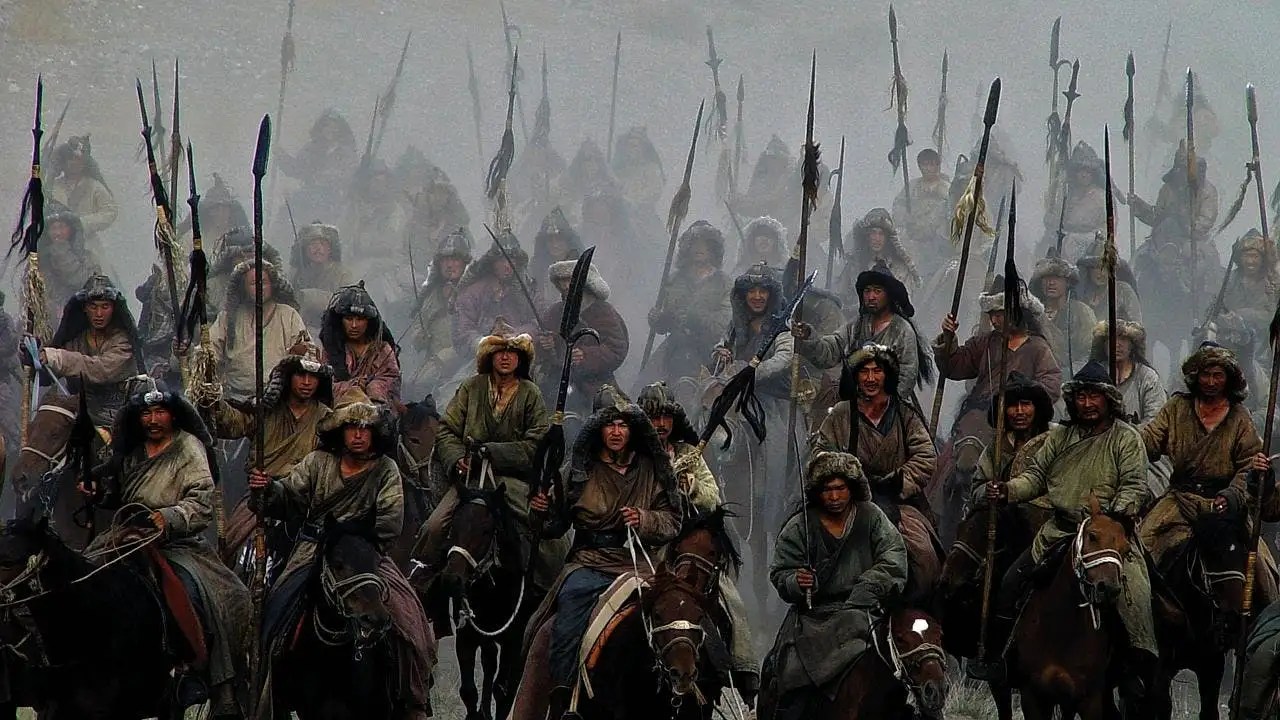
Lockhart studied the two armies as the travelers hurried to get out from between them.  “I can’t see any difference between the two groups,” he admitted.  “How do they know who to fight?”

“There are subtle differences,” Katie said.  “But they are both Huns.”  After a minute, she added, “I think the one on Elder Stow’s side is the bigger army.  Of course, that may not matter.  I haven’t seen this kind of battle, and the scholars describe how they think it worked but they really don’t know how it worked.  I can only guess.  The scholars mostly just report the winners and losers.”

After another minute, Boston said a bit too loud.  “What are they waiting for?”

“I don’t know,” Lockhart said, “But we better hurry and get out of the way.”  He hardly had to urge people to hurry.  Even Ghost, the mule, moved as quick as he could, the tension in the air being as thick as it was.

Finally, the travelers squirted out from between the two armies.  Still the armies waited, until the travelers were beyond harm’s way.  Then, all at once, with no discernable sign given, both armies charged each other across the road.  The travelers paused to watch.  It soon looked like a killing free-for-all.

“How do they decide who wins?” Lockhart asked the rhetorical question.

Decker shrugged.  “They will fight for a while, but they can’t keep it up at that level of intensity for long.  Shortly, one side will signal a withdraw, and the other side will also pull back.  They will rest for an hour, or maybe several hours before they form up and go at it again.  They will do this until sundown.  No one fights after dark.  Then one might sneak away in the dark, if they have lost too many men, or feel they are losing the battle.  If both still feel they can win, they will be right back at it at sunrise.”

“The thing is,” Katie said.  “If one side starts to withdraw, because maybe they are losing too many men and they need to regroup, if the other side is not ready to break, or maybe feel they are winning, the withdraw can become a full retreat, and in these days, retreat risks becoming a route, where it’s every man for himself.  In that case, the winning side will give chase, and they usually end up slaughtering the retreating army.”

Decker grunted.  “Unless the losing side escapes in the night under the cover of darkness, they will end up being slaughtered, retreat or no retreat.  Some commanders don’t know when to quit.  That can be a good thing, or really stupid, depending.”

“We need to move on,” Lockhart said.  They rode a little up into the pass before Lockhart called for them to get down and walk the horses.  That was when Katie shared a thought.

“I bet the two armies waited for us to get out of the way because the three witches on one side, and Elder Stow and Sukki on the other side put a real fear of God into them.  They waited until we were far enough away so we would not be caught up in the battle.”

Lockhart looked back at his group.  “I suppose that is very possible.”

###

In the afternoon, the travelers came to a narrow way in the pass.  Shale mountain cliffs pushed in, and the road narrowed.  They discussed stopping and building a camp before entering that strip.  Elder Stow had put away his scanner, but Lincoln had the relevant information in the database.

“The narrow spot is not that long.  It should open up again on the other side and we should be able to find a place to stop where we can watch, but not block the road.”

People went with Lincoln’s suggestion.  Ghost appeared to make it up to the high point without too much trouble, and as the saying suggested, it was all downhill from there.  The rest got down from their horses and planned to walk through, in case they came to a spot that got exceptionally narrow.

They got about half-way into the narrow place before men stood up and came out from behind the rocks.  The travelers found men in front and behind.  They became surrounded with spears.

“Don’t resist,” Lockhart ordered.

“Do they want us to pay the toll?” Lincoln asked. He read about that and may have mentioned it to the others a day ago.  He picked up a leather pouch in one of the villages they passed through and filled it with what he imagined was a generous number of coins.

The men said nothing.  They immediately began to strip the travelers of their weapons, including their gun belts. Decker was reluctant to let go of his rife, but he honestly had no choice.  When the men tried to grab the reigns of the horses, Alexis’ horse, Chestnut, and Boston’s horse, Strawberry, balked.  It took a minute to get them settled down.  Ghost refused to move at all.  Tony had to lead the mule by the nose, and he explained to the mule.

“We have to cooperate, or these men might make you into mule stew.”

They went to the end of the narrow place and got taken to a hut on the hillside near a shallow cave.  The travelers got pushed into the cave and a simple door got closed across the entrance.  Clearly, the cave had been used for sheep.  Katie pointed to the dry water trough, but the general smell of the place gave it away.

“I hope they take care of Cocoa,” Sukki said of her horse.

“I still have my things,” Elder Stow said.  “But what to do is the question.  There are about eight guards outside the door.”

“I have my wand and stuff in my slip,” Boston said.  “I haven’t done it much, but I could try going insubstantial enough to slip through the door and maybe check on the horses.”

“No,” Alexis said, firmly.

“Sukki could use some of her strength and break the door open,” Nanette was thinking.

“But then what?” Decker asked, and people quieted to think.

Katie finally asked, “Elder Stow, how many of those discs do you have where you can make us all invisible?”

“I have a whole pocket full of multi-purpose discs,” he answered.  “I just have to tune them to the invisible spectrum.”

“Do you have enough for all of us, our horses, Ghost and the wagon?” Alexis asked.

After a moment to calculate, Elder Stow shook his head, “No.”

“Maybe we should see what they want first,” Lockhart said, and people sat down to wait.  They waited for an hour while the sun started toward the horizon.

At last, they peered out between the gate railings and saw a small troop of something like soldiers arrive.  One man got down right away and marched with a swagger to the door.  The guards opened up, and he came inside with two rough looking men with swords drawn flanking him.

“So, these are the travelers,” he said.

“Are you charging a toll to let us move on?” Lincoln asked, and the man laughed in his face.

“Do you use money on Avalon?” he said.  “I never would have imagined that.”  He laughed again at his own thoughts.  “Besides, I have all your money, and everything else already, including all of your guns.”  He shook a finger at them.

“The Masters,” Katie said to identify the man.

“You have been noticed and interfered once too often.  I decided, instead of making more guns and powder for you to come along and blow up, I would just steal your guns.  After using you for target practice, we will make our guns, and model them after the ones you so graciously provided.”

“What do you hope to gain?” Katie asked.

The man paused to look over the travelers.  He did not seem to care if he told them or not.  “We sit at the center of the world between east and west.  The Alchon Huna already did me a favor by tearing down the Gupta in what you call India.  Now, after the Alchon Huna and the Nezak Huna beat themselves to exhaustion. we will move in.  I have men working on the Turks further north.  I expect they will join us for the riches they can gain.  We will invade Sassanid lands to break the back of the New Persians and reestablish the Kushan Empire.  Then we will cross the so-called Persian Gulf to Yemen and drive up the Hejaz to burn Mecca.  After that, only Constantinople far in the west and the Sui Dynasty far in the east will remain to pose a threat.”  He stopped talking and smiled.  “You get the idea.”

“Lord Bobo,” someone called from outside.

The swaggering man and his two guards left, and the gate got tied shut again.  Lockhart frowned and stuck his hand out.

“Elder Stow get out your discs,” he said.

“Boston.  You need to go invisible using one of Elder Stow’s discs, like the rest of us,” Alexis insisted.  “If you go elf invisible, we won’t be able to see you, and we will all need to keep in touch without having to talk.”

“That’s okay,” Boston said.  “Being elf invisible, as you call it, is still very draining.”

Alexis smiled for the girl.  “You’ll get used to it.  You know, being invisible and insubstantial at the same time is how the little spirits of the earth get around and do most of their work in the world.  You will get the hang of it.  Soon enough, it will become the most natural way to be.  Manifesting into a visible, physical form will feel awkward.”

“Not awkward,” Boston said.  “But like a second choice.  That’s what Roland told me.”  She flipped her emotions, as fairies and young elves do, from happy to sad in a blink.  “Roland said being physical still feels natural, and takes no effort, even if it is second choice.”  Boston let a tear fall.  “I miss Roland.”

Alexis gave her a hug.  “I miss my brother, too.”

Avalon 8.0 Confrontations, part 3 of 6

The next day, Lincoln made everyone gather around.  He said they would have to go by Kabul and Hadda to reach the Khyber Pass, the only viable way through to India.  “The thing is, after further reading, I think the capital of the Alchon Huns is north of the line, and the capital of the Nezak Huns is south of the line, and those two Huna groups at some point fight for dominance.  We need to squeeze between the two to reach the pass.”

“In other words,” Lockhart summarized.  “We are probably entering a war zone, so we need to keep our eyes and ears wide open.”

“Kind of like World War One,” Decker interjected.  “We need to sneak down no-man’s land between the German and allied trenches.”

People looked at Decker and turned their eyes to Tony.  They had been careful not to talk about what Tony might face when he got home.  Lincoln calculated that Tony left the future in 1905, but given his time living in the past, and now counting the expected travel time, he would probably get home in 1914, just in time for the war.  And they certainly did not want to name the war as number one.  But Tony just waved off their concerns.

“That’s okay,” he said.  “The Kairos told me.  I already have my Colt M1911, and a good trench knife.  I already figured the time gate will be near enough to the Kairos to be in the middle of something.  A world war is no surprise, and the fact that it is number one is honestly no surprise, either.  I used to read the newspapers back in 1905.  Europe is a mess.”  He shrugged.

The travelers breathed, and headed out, thinking, there were still plenty of things Tony and Nanette did not need to know about their future.

###

Shortly after they gave Kabul a wide berth, they returned to the road in time for Decker to come racing in from the wing.  “Boston.  Sukki.  Report.” Decker spoke into his wristwatch communicator as he reigned to a stop.  Elder Stow saw and pulled in close to hear.  The others had already stopped to wait.

“There is a whole army in a valley a half mile out,” he pointed.  “About two thousand horsemen.  No way they will chase us, but they might send a company, a hundred, or at least have scouts out watching the road.  They may have already seen us.”

“No,” Elder Stow said, as he joined the group from the other wing.  “I have the scanner set for our immediate area.  No one has been near to see us.  I did not pick up the army, however.  I can see I will have to expand the scan radius to at least half a mile.”  He looked at his scanner and turned his head in surprise.  Boston and Sukki came racing back from the point.  They looked like something was following them.  Suddenly, Boston stopped and leapt off her horse.  She pulled her wand and laid down a line of fire across the road.  The flames reached as high as her head, and the travelers saw a troop of Huns come screeching to a halt behind the fire.

Lockhart and Katie moved forward before they got down and walked ahead of the others.  Lincoln and Alexis moved up enough to hold the horses, but Sukki stopped right there, so she held Katie’s horse.  Boston came back and stopped at the front group, next to Alexis, while Nanette marched forward from the rear.  That left Decker and Elder Stow to guard Tony and the wagon.

One of the Huns stepped forward from his group.  He looked like a shaman.  He raised his hands, and while Boston’s fire already began to burn itself out, he appeared to lower his hands, and the fire quickly went out.  That got the attention of Alexis and Boston who stepped up behind Lockhart and Katie.  Nanette squeezed between the two women and whispered.

“If I had my power, I could remove them from the road.”  Nanette seemed unhappy about something and seemed to want to take it out on the Huns.

Lockhart quickly spoke over top.  “We are simple travelers.  We are headed for distant lands and have no interest in your troubles.  We will not interfere.  We will respect your land, and we will be gone, shortly.”

“I think you are not such simple travelers,” one big man spoke from horseback.

“You have a witch…” the shaman added.

“No,” Katie interrupted, and stepped to the side as she spoke, pointing behind herself.  “She is an elf.  These other two are witches.” Katie smiled.  The Huns did not smile, and the shaman began to move his hands like he got ready to employ a spell.

“Here,” Alexis said to Nanette, as she touched Nanette’s shoulder.  Boston touched the other shoulder but said nothing.  Nanette felt filled with power, more than she ever imagined.  She had the ability, but when the other earth was out of phase, and thus not leaking magic energy into our universe, she could do nothing.  She never imagined borrowing the power of others, and between Alexis and Boston, she had twice what she needed.

Nanette pulled her wand, and before the shaman could finish his incantation, he, and all of his Huns, got caught up in a whirlwind.  The wind became merciless.  It picked them up, horses and all, and flew them a quarter mile away, where it deposited them in an open field. Some got down quickly.  Some got thrown when their horses bucked.  Some got stepped on when the horses panicked.  The Huns also panicked.  The shaman, and a number of others felt so dizzy, they threw up.  None of them were in any condition to follow the travelers, or even report back to the army.

The travelers knew none of this.  All they saw was Nanette’s smile and all they heard was Lockhart’s words.

“Let’s move on while we can.”

###

The next day, near the same time, just shy of Hadda, Elder Stow reported an army on a hillside.  “About two thousand horsemen,” he said into his communicator, so everyone heard.

“Move in close,” Lockhart ordered.  “Decker.  Move in but keep your eyes open.  Boston, stay within sight.”  The road appeared flanked by meadows.  The only trees were up ahead, to the right of the road.  Elder Stow said the Huns were in the trees, so no one looked surprised when several men rode out of the trees and stopped near the road.  No one doubted there were many more still hidden among the trees.  Lockhart and Katie nudged their horses forward, but this time, they did not dismount.

“We are simple travelers.”  Lockhart spoke up.  “We are headed for a distant land.  We have no quarrel with you.  We will respect your land and soon be gone.”  He tried to smile.

One of the Huns answered.  “You do not look like simple travelers.  Give us your gold and silver.  We will search your wagon and take your horses.  Then you can leave.”

Katie imagined Elder Stow got up on the wrong side of the bed that morning.  Without asking permission, which felt very uncharacteristic, he floated out of his saddle.  Sukki floated up beside him and would not let him do whatever stupid thing he had in mind alone.

Elder Stow pulled out his sonic device and plugged it into his communication device.  It amplified his voice and added a nice echoing touch.  “You were asked nicely.  Now, you get one warning shot.  Leave the road and leave us alone or suffer the consequences.”  He pulled out his weapon.  Sukki noticed and raised her hands.  Elder Stow fired, and Sukki let her power flow from her hands.  They sliced off the tops of the nearest trees and set the trees on fire.  First Elder Stow, and then Sukki, fired into the ground in front of the trees and the ground exploded.

“That is your warning.  Leave us alone or next time we will aim at you.”  Elder Stow returned to his horse and Sukki returned to hers.  The Huns turned away without a word, and tried to walk their horses, but in fact trotted, and nearly galloped back to the trees, to disappear in the woods.

Elder Stow apologized to Lockhart and Katie when he rejoined the group.  “My mother and father, please forgive me if I overstepped my bounds.  I take full responsibility for my actions and those of my adopted daughter.  I overreacted and humbly apologize.”

“Try not to let it happen again,” Katie said, smiled, and let Lockhart speak.

“But in this instance, don’t worry about it.  No harm done.”  He turned to ride down the road and said no more about it.

###

The following morning, the caravan road they followed appeared to be in good shape.  Lincoln took a turn driving the wagon.  Alexis rode with him.  They crossed a plain that appeared wide open and plenty dusty, but in the distance up ahead, the travelers could see the mountains closing in.  They figured the famous Khyber Pass would be something like a gorge between two of those mountains, where the mountains did not quite meet.

The sun beat down, hot, but the travelers relaxed, believing if they got well into the pass on that day, they might find the Kairos around noon the next day.  Boston called it late spring, or early summer.  Alexis pointed out the flowers she saw.  When Lockhart called for everyone to get down and walk the horses, Sukki and Nanette paused to pick some flowers.  Tony paused with them to watch over them.  Those three first saw the dust stirred up in the distance.  Decker reported as much just moments later.

It looked like one of those armies they passed might be heading right toward them.  Lockhart did not panic, even when Elder Stow noted the dust storm on the other side of the road.  Lockhart told everyone to mount up.  He said they could walk and rest the horses once they got fully into the pass.  He felt a little afraid that these armies decided to fight over control of the pass, and they might follow them into the pass.

“We need to hurry,” Kate said, as the leading elements of the armies came within visual range.

“I don’t think Ghost can pull the wagon much faster in this sun, especially when we start heading up into the pass itself.”

Lockhart talked into his communicator, though he might have simply yelled back.  “Try to hurry Ghost along as well as you can.”

Decker and Elder Stow pulled in to flank the travelers in close order, while Boston dropped back to lead the procession.  The leading elements of the armies stopped a hundred feet back from the road on either side.

“Are they waiting for the rest of the army to catch up?” Nanette asked.

Decker shook his head.  “I don’t know what they are doing.”

As the travelers pushed forward along the road, right between the two enemies, the rest of those armies slowly caught up.  But still they waited.

************************

MONDAY

Two Hun armies will meet on the road to the Khyber pass, right where the travelers are desperately trying to get out of the way.  Until Monday, Happy Reading.

*

Avalon 8.0 Confrontations, part 2 of 6

Two men rode across the stream to confront the two travelers standing by the wagon.  They did not know one of the two by the wagon was a woman until they got close.  It got hard to see distance well in the failing light.  When they got down from their mounts and approached, they appeared surprised.  The man looked like a giant, and the woman, which they then noticed was a woman, looked as tall as them, and she had yellow hair.  Not what they expected.

“Hello friends,” Lockhart said, giving it his friendliest voice.  “This is a good place to rest if you plan to spend the night.  The water is fresh and clean, the grass is soft, and it does not look like rain tonight.”

The two made no response, so Katie added a thought.

“We would invite you to supper, but we only have one sheep, which is not nearly enough for your whole company.”

One man spoke.  “You are from Sogdiana?  You are Scythian?” he guessed.

The other man interrupted.  “You are merchants?”

“We are simple travelers from far away in the west,” Lockhart began.

“Beyond Persia.  Beyond Rome.” Katie added.

“I have herd of this Rome,” the first man admitted.

“You are Huna?” Katie asked.

“We are not Xwn scum.”  The man spat like Decker.  “My great-grandfather left the Kaghanate to seek out new pastures for our many people.  He crushed the Wusun and overran Sogdiana.  He fought the numberless Scythians before my father followed the Hephthalites into this land.  We drove many ahead of us and destroyed the last of the Great Yuezhi.  This land is good, but our people are many, so we seek to extend our pastures.  The Xionite people that came here ahead of us will serve us, and our name will be great in all the earth.”

“Turkic people, perhaps Shahi,” Katie identified the speaker.  “Tony will be glad to know that the Turks are already on the move at this early date.”

Elder Stow turned on his lantern, much stronger than the human lanterns that the travelers had and mostly left in their luggage.  It caught some twenty horsemen ready to cross the stream, down some distance where they no doubt thought they would not be seen.  Decker’s voice came through the watch communicators.

“We got enemy trying to circle around and get on our flank.  I would hate to have to kill them all.”

“Hopefully, they will have the good sense to return to their own camp now that they are seen.  Wait for instructions.  Out.” Lockhart responded.

“Did we mention the sorcerer in our camp?” Kate said, kindly.

“Who?” Lockhart asked.

“Elder Stow,” Katie answered, sharply.  “His gadgets are near enough to sorcery in this age.”

“Oh,” Lockhart got it.  “And the two witches.”

“What about Boston?” Katie asked.

“She is an elf,” Lockhart explained.  “That is different.  But what do we call Sukki?”

Katie huffed.  “I swear, Vrya and Ishtar made her practically a demi-god.”

Lockhart looked up.  The two Turks had mounted and were riding back to their camp without asking any more questions.  When Lockhart and Katie rejoined the group, Elder Stow spoke.

“My mother and father,” he said, referring to Katie and Lockhart as the mother and father of the group.  “I cannot set the screens against intruders tonight, but I have scanned the visitors and have their signatures.  I can set an alarm in the night in case any are tempted to come to our camp in the dark, even as I did back when my batteries needed charging, back before the god Vulcan made a cell charger for my equipment.”

“That would be good, but standard watch as well.”  No one complained.  It was their routine.  Tony and Nanette, new to this traveling business, watched from six, about sundown, to nine.  Lincoln and Alexis took the nine to midnight shift.  Lockhart and Katie watched in the middle, from midnight to three in the morning.  Decker, the no nonsense marine, and Elder Stow with his scanner took the dark of the night between three and six in the morning.  And Boston with Sukki watched from six through sunrise, until about nine, when everyone was up for the day and ready to travel.

Normally, the travelers did not expect visitors in the night.  People never used to travel in the dark, especially in the wilderness.  It was too dangerous.  But that night, around three in the morning, three Turks tried to climb over the rocks that sheltered the horses.  Elder Stow happened to be up when his scanner beeped.  He cut the sound right away, and while Decker woke the others, Elder Stow watched the men carefully with his scanner.

Lockhart, Decker, Lincoln, and Katie got their Patton sabers and waited.  They figured the Turks would not know what guns were so they would not be a good choice.  When the three would-be thieves dropped to the ground, they got surrounded.  Sukki held her knife, while Boston and Alexis held their wands.  One thief tried to move, and Alexis raised a wind that slammed all three back into the rock.  One hit rather hard and fell to his knees.

“Not smart,” Lockhart said.

One man, fast as a gunslinger, threw a knife at Elder Stow who just happened to walk up at that moment.  No doubt he thought the older man had to be the one in charge.  The knife bounced off Elder Stows personal screens, the one built into his belt that conformed to his body and moved with him but could not be expanded to cover more than one person.  Sukki momentarily looked afraid, before she got mad.  She grabbed the knife, bent it until it cracked.  She handed it back.

“You dropped this.”

The Turks made no more moves, and the two still standing decided to fall to their knees to join their companion.  Regret showed on at least two of those three faces.

“Get naked,” Lockhart said.  The Turks did not move.  “You heard me.  Get undressed.”  The Turks stood and slowly stripped down to their under things.  “I meant all of it,” Lockhart commanded.  He tapped one on the shoulder with the flat of his sword.  “Or I could cut it off you, but I can’t guarantee I won’t cut your flesh with it.”  The men finished undressing.  “Lincoln and Alexis, will you stack these things over on the rock at the end of the horse rope?  Yes, there.  You three, move.”

The three naked men walked to where the wagon was parked.  “Okay,” Katie said, having figured it out.  “You can walk back to your camp and give a message to your chief.”

“What message?” one found the courage to ask.

“You are the message,” Lockhart said.

“Git,” Boston raised her voice and waved her wand.  Three sparks, like electricity, zapped three naked butts.  All three men hopped and shrieked in surprise.  They hurried, but soon enough slowed down to a walk, while Elder Stow walked up holding his scanner.

“I will watch them,” he said.  “You all can go back to bed.”

Decker turned to Lockhart before Lockhart walked off.  “Better idea than what I had in mind,” he said, but he never did explain what he had in mind.

At five in the morning, about thirty minutes before sunrise, the Turks headed back up the stream from whence they came.  When the travelers got up and had their typical leftover breakfast, they packed up and started out.  They left the Turkic clothes and weapons on the rock, in case three naked men wanted to come back for their stuff.

###

The next day, the travelers avoided a few villages.  They stayed on track for the Khyber Pass which they knew was the way into India. The trail, which Katie imagined was what remained of the Silk Road, seemed good in some places, but not so good in others.  Tony, being from 1905 where he grew up driving mules and wagons, drove most of the way, and said he did not mind.  Sometimes Nanette or Sukki rode with him in the wagon.

Decker and Elder Stow stayed on the wings as they traveled.  They reported no problems and no more dusty columns in the distance.  Boston stayed out front, her elf senses on alert just in case.

That night, Lincoln got to read some about Sanyas, the ninety-eighth lifetime of the Kairos, the one who lived in this time zone.  “It says she got engaged at age three.  Her father, Yashodharman, if I said that right, was king of Malwa.  Aulikara Dynasty.  He died when she turned three, but he managed to engage her to Brahmagupta, a son of the King of Magadha’s younger brother.  They married when Sanyas came of age, which… it doesn’t say.  We can assume when she turned sixteen or so.”

“Wait,” Boston interrupted, which was good because she did not always pay attention.  “I thought we figured the time gate would be round Malwa.  They can’t be living there.”

“No.  And they are not living in Magadha, either.  They got sent to the frontier to defend against the Huns—the Alchon Huns that previously overran most of northeast India.  They got driven out before Sanyas was born, but they continue to raid.  So, the couple got sent to help defend the border, so to speak.  Sanyas’ older half-sister is Yashomati.  She is queen of Thanesar, married to King Prabhakaravardhana… That does it.  I can’t pronounce all these names.”

Alexis laughed.  “It does sound a bit like a poorly written piece of science fiction.”

Lincoln nodded, but Lockhart said, “I wouldn’t know about that.  I don’t read science fiction.”

“The thing is,” Lincoln continued.  “Thanesar is closer to Melwas, considering where we came into this time zone.  That means, she must presently be closer to us, doing what?  I have no idea.”

“Sanyas,” Sukki repeated the name.

“Actually,” Lincoln said, “Shan-eye-ash-ra-devi is what she is sometimes called.”

“I miss Devi,” Boston said.  “Our friend in India,” she explained to Nanette and Tony.  “And Varuna was very nice, too.”

“Devi is the word for goddess,” Katie said.  “The Kairos sometimes gets pegged by that sort of thing.”

“Really?” Lockhart joked, before he said, “No surprise there.”

Avalon 8.0 Confrontations, part 1 of 6

After 542 A.D. The Khyber Pass

Kairos lifetime 98: Sanyas, the Queen’s half-sister

Recording …

The campfire sent sparks into the cloudless sky while the sun slid behind the mountains.  The travelers would have another hour of daylight in the hills between the peaks, but the valley would be bathed in twilight before nightfall.  They had enough light for Alexis to finish cooking the sheep, or goat, or whatever animal it was that Decker shot.  Katie called it a Marco Polo sheep, but Lincoln looked it up and called it a mouflon.

“Afghanistan,” Lieutenant Colonel Decker said, and spat into the fire.  The seal-trained marine stared at the mountains.  “I recognize that ridge.  We are northeast of Kabul.”  No one doubted he did a tour in Afghanistan, and probably a couple of tours back when he was Captain Decker, special forces.

Nanette, who knew nothing about fighting in Afghanistan having fallen back in time from 1905, gently slapped Decker’s knee.  She loved the man.  She could not help it.  Aphrodite herself brought the two of them together as a last act before the dissolution of the gods some five hundred and seventy years ago, as Lincoln estimated things.  But she was trying to break his habit of spitting when he got his hands on some jerky to chew.  Spitting was not on her approved list of activities for a future husband.

“No spitting in the fire,” Alexis scolded the man.  She kissed her husband, Lincoln, who looked lost, reading in the database he carried.  It had all the relevant information on the time zones they traveled through as they slowly made their way back to the twenty-first century.  She basted the sheep-goat with some concoction of her own making and considered their predicament.  She was an elf who became human to marry Lincoln.  Her father could not handle that.  He feared she would grow old and die right before his eyes, so he kidnapped her and dragged her back to the time of her supposed happy childhood.  He tried to convince her to seek the Kairos and ask to be made an elf again so she could live her more reasonable thousand years and die well after he was gone.

Alexis looked at Lincoln.  The marriage would not have worked the other way around.  Benjamin would have made a lousy elf.

She basted and thought about when her father knew he got caught and would be in trouble.  He dragged her to the very beginning of history and pushed her into the chaotic void before human history began, hoping to get beyond the reach of those following.  All he did was screw things up.  The Kairos, the Storyteller, had to offer himself to the void in exchange for her.  Now, he is lost, and everything on Avalon is confused, and the time-connection between the many lives of the Kairos are out of sync…

“And we are stuck going from time zone to time zone, from one lifetime of the Kairos to the next, and it is a long way back to the twenty-first century,” she whispered to herself.  Of course, Boston heard with her elf ears.

“I don’t mind,” she said, as she pulled back her red hair into a ponytail.  “This way I get to see every life of the Kairos and love and hug every one that lived before my time.”  Boston pulled out the amulet that showed the way between time gates.  No doubt she wanted to check her direction for the morning.  After a moment, she moved to sit beside Lincoln so she could check her direction against the map in the database for that time zone.

Alexis sighed.  Her father disappeared, and likely died on their journey.  If so, at least he died before her.  Sadly, her baby brother Roland also vanished and is presumed dead, though don’t tell Boston that.  Boston went the opposite way Alexis went.  Boston was born human, though a wild child.  Lockhart called her a Massachusetts redneck.  She rode in rodeos, and hunted, including bear once in Canada, and grew up with brothers.  She was also a bit of a genius, getting her doctorate in electrical engineering by the time she turned twenty-three.  She already thought and acted pretty much like an elf before the Kairos agreed to make her an elf so she could marry Roland.  It felt doubly wrong when Roland vanished.

Alexis sighed and sat on the other side of Lincoln.  “What?” Boston asked and stuck her red head right between Lincoln’s face and the database.

“Nothing,” Alexis said.  It was better not to bring up Roland.  She changed her thoughts.  “I wonder how Elder Stow is coming along in fixing his screen device.  It has come in handy in the past.”

“Yeah,” Boston agreed and turned to nudge Sukki.  “How’s it going?”

Alexis considered Elder Stow, the Gott-Druk—the Neanderthal that traveled with them.  She remembered at the time of the flood, the Gott-Druk were given space flight, a great leap forward for a people who were just beginning to work in copper and bronze.  It seemed the only way at the time that the gods could save them from the global catastrophe.  That was maybe fourteen or fifteen thousand years before Christ.  Over those thousands of years, the Gott-Druk made the expected technological progress.  Elder Stow came from the same future as the rest of the travelers, other than Tony and Nanette, but he had all sorts of technological wonders on his person. He called them toys—mere trinkets such as a ship’s officer might carry.

Boston nudged Sukki again.  “Hey, Amazing Woman.  Earth to Sukki.”

Sukki turned her head.  “I think he has almost got it,” she said.  “Hush.”

Alexis thought how Sukki used to be a Gott-Druk, a very family-oriented people.  She came from those fourteen thousand years in the past, but spent all those millennia in suspended animation, or cryogenic sleep, or whatever it was called.  They found her about thirty time-zones ago, which was about two years ago, travel time.  Though Elder Stow agreed to adopt her as a daughter, she swore she never felt comfortable, being a Gott-Druk as part of a Homo Sapiens family.  She finally prevailed on the Kairos to make her human, as she said.  He—at that time the Kairos was a man—got a number of goddesses to do that, but the goddesses got a bit carried away.  They empowered Sukki like some sort of comic book superhero, and Boston wanted to give her a comic book name.

“Not Amazing Woman,” Alexis said, and Nanette agreed.  Alexis remembered that Athena at least gave Sukki a fundamental understanding of physics and astrophysics, so she could understand when Elder Stow and Boston got lost in all their technical jargon.

Katie and Lockhart stood.

“Where are you going?” Alexis asked. “Food is almost ready.”

“Just checking on Tony,” Katie said.

“Her elect senses are acting up,” Lockhart added, as they walked to where the horses were grazing.  Tony was there, brushing Ghost, the mule that pulled their pioneer wagon, sent with the horses back from the 1870s.  Tony had his eyes on the horizon, and Ghost kept nudging him for more attention.  Ghost turned out to be a big baby.

Lockhart said nothing.  As the Assistant Director of the Men in Black, he was the one charged with leading this unexpected expedition back to the future.  As a former police officer, though, he learned to wait until others revealed what was on their minds.  He doubly learned that lesson on this trip.  Charged with making the hard decisions, he learned to listen closely to the input of others.  He especially listened to his wife, and not necessarily just because she was his wife.

Major Katherine Harper-Lockhart, besides being a marine, and a doctor in ancient and medieval technologies and cultures, she was also an elect, a one-in-a-million warrior woman, who was faster, stronger, more agile, more capable in combat and tactics than most men.  She had a very refined intuition that could sense an enemy or danger to her home and family when the enemy was miles away.

“I’ve got that Rome feeling,” Katie said, and explained for Tony who had not been with them at the time.  “When we came into Italy shortly before Rome got founded, we found all the Latin and other tribes hating and fighting each other.  They all assumed we belonged to a different group, since we were strangers, so they wanted to fight us, too.”

Lockhart pointed up.  Something moved through the sky.  An alien ship of some sort.  It came overhead but did not stop.  Suddenly, it shot off to the east and quickly disappeared from sight.  “Our direction,” Lockhart said.  “Something to look forward to.”

Katie frowned but turned their attention back to the immediate problem.  Tony just pointed.  They saw the dust being kicked up in the distance.

“How many?” Lockhart asked.  Tony shrugged, but Katie paused to concentrate.

“About a hundred,” she said.

“Let’s get the horses in for the night.” Lockhart called for his horse.  “Seahorse!”  The horse looked up, but shook its head and stomped its foot like a child not ready to come in.  Katie’s horse, Bay, came right up.

“Like a faithful puppy,” she said, and doted on the horse.

The travelers camped in a rock hollow on the side of a hill, not far from the stream in the valley.  They stretched out Decker’s rope and had enough room to tie the horses and Ghost for the night, plus room for their tents and a fire.  They had to leave their wagon outside the entrance from the stream-fed meadow, but otherwise, they felt secure in what Katie called a good defensive position.  Katie, with her rifle, and Lockhart, with his shotgun cradled in his arms waited out by the wagon.  The others looked over the top of the rocks.

“I sense nomads, a scouting party, well prepared to fight, if necessary,” Katie said.  “I don’t sense it is a war party.”

“Tony said they are probably Huna people, though they might be Turks,” Lockhart responded.  Tony was a graduate student in antiquities in 1905 and might have been expected to know things like that.  Of course, Katie had her doctorate, so Lockhart asked, “Huna?”

“Huns,” she said.

“Great,” Lockhart said, sounding like Lincoln when he got sarcastic.  All he could picture was Attila and a hundred warriors coming to do a clean sweep of the area.  “You know, for people who are trying to not disturb history, we use these guns far too often.”

Katie could only nod as the Huns or possibly Turks stopped on the other side of the stream.

Avalon Season Eight Preview

Avalon

Season Eight

Aliens

M G Kizzia

Copyright 2022

************************

Avalon Season 8 Introduction

aval horses 1Season Eight brings the travelers into the common era where they find the Masters are actively trying to change history to come out to their liking.  At the same time, it is a difficult time in the heavens where several wars in space spill over on to the Earth.  The travelers have to defend the Earth before the space aliens break out in a nuclear war or worse.  Aliens are at least something the Men in Black understand.  Whether or not they can keep the Earth from being destroyed is the question.

************************

Table of Contents

8.0 Confrontations

After 542 A.D. The Khyber Pass

Kairos lifetime 98: Sanyas, the Queen’s half-sister

8.1 Rain and Fire

After 606 A.D. Yucatan

Kairos 99: Yamaya, the Serpent Queen

8.2 Trouble Big and Small

After 640 A.D. Byzantium

Kairos 100: Nicholas, not Saint Nicholas

8.3 Above and Beyond

After 697 A.D. The Breton March

Kairos 101: Margueritte, the Bride

8.4 Happily Ever After

After 755 A.D. Basel, Switzerland

Kairos 102: Mistress Genevieve

8.5 Hiding from Them

After 820 A.D. Wessex

Kairos 103: Elgar, the Defender

8.6 Standing Still

After 883 A.D. Norway

Kairos 104: Kirstie, Shield Maiden

8.7 Escaping

After 914 A.D. North Coast of Egypt

Kairos 105: Yasmina, Arabian Princess

8.8 The Bad Penny

After 979 A.D. The Black Forest

Kairos 106: Don Giovanni, Ringmaster.

8.9 Metal Men

After 1045 A.D. Normandy

Kairos 107: Blacksmith John.

8.10 Refugees

After 1111 A.D. Japan

Kairos 108: Taira no Hideko

8.11 Tax Collectors and Other Thieves

After 1180 A.D. Nottinghamshire

Kairos 108: Helen de Lovetot of Sheffield

8.12 Abomination

After 1245 A.D. between Kashgar and Aksu

Kairos 109: Sung-Ao, slave of Kublai Kahn

End

************************

Introduction to the Avalon Series

The travelers came to Avalon in the Second Heavens so they could be transported instantly through the Heart of Time to the beginning of history.  They went on a rescue mission, but things did not go as planned.  The Kairos—the Storyteller, had to jump into the void before history and became lost in eternity.  Now, to get home, the travelers must return the slow way, following the Amulet of Avalon that points the way from one time gate to the next.  They cross dangerous time zones that center around the many lives of the Kairos, the Traveler in time, the Watcher over history, a person who never lives a quiet life.

They have unlimited vitamins and elf crackers for their health, and unlimited bullets which are needed far too often.  They ride mustangs brought back from the old west, and wear fairy weave clothing that they can shape and change with a word in order to blend into the local culture.   By a special gift of the Kairos, they can understand and be understood no matter the local language.  Inevitably, they have to deal with thieves, brigands, armies and empires, gods and monsters, spirits and creatures, space aliens and the great unknown.  They try hard not to disturb history along the way.  That is not so easy.

To be sure, all they want is to get home in one piece, but they are not the only ones lost in time.  Some people lost in time might want to follow them, or even go with them.  Other people are not so friendly, and not everything lost in time is a person.  Some want to fight the travelers.  Some want to hunt them.

************************

CAST

Robert Lockhart is a former police officer, now assistant director of the Men in Black.  He commanded the rescue mission that left from 2010 and went from Avalon, through the Heart of Time, to the beginning of history.  He is now charged with leading this expedition through time, though he has no idea how he is going to get everyone home alive.  They have already lost Doctor Procter their guide, Mingus the kidnapper, and Mingus’ son Roland.

Major Katherine Harper-Lockhart (Katie) is a marine and an elect—a one-in-a-million warrior woman, with a doctorate is in ancient and medieval cultures and technologies.  She is torn between her duty to the marines and her desire to be part of this larger universe she is discovering, though since she married Robert, her path seems set.  She carries the prototype amulet once used to kidnap Alexis.

Boston (Mary Riley) is a Massachusetts redneck hunter, rodeo rider, and technological genius who finished her PhD in electrical engineering at age 23.  She carries the Amulet of Avalon, a sophisticated combination electronic GPS and magical device that shows the way from one time gate to the next.  She became an elf to marry Roland; but now Roland has disappeared, and may be dead, though she insists the Kairos managed to grab him at the last minute and brought him back into the future.

Benjamin Lincoln is a former C. I. A. office geek who keeps the database and a record of their journey.  He tends to worry and is not the bravest soul, but sometimes that is an asset.  His wife, Alexis, was kidnapped by her own father Mingus and dragged back to the beginning of history.  This prompted the rescue mission which got everyone stuck in the past with the time gates in the time zones as the only option to get home—the long way around, as they say.

Alexis Lincoln was an elf, Roland’s sister, who became human to marry Benjamin.  She retained her healing magic when she became human, but magic has its limits.  It could not make her father happy with her choices.  She was the one who got kidnapped and dragged into the deep past where she needed to be rescued.  Unfortunately, the Kairos had to surrender his life to the void so she could return from the void.  Now they are headed home the only way they can.

Elder Stow is a space traveling, technologically advanced Gott-Druk (Neanderthal) from the future who got thrown back into the past.  He is forced, at first, to make a truce with these ‘humans’ to join them in their journey.  He has since adjusted to the idea, and believes it is his only chance to get back to the future.  He carries highly advanced technological devices that he calls trinkets such as a ship’s officer might carry.  They do come in handy.

Sukki was a Gott-Druk (Neanderthal) from the before time. She was taken off planet to a new world at the time of the flood.  She joined a small group determined to return to Earth.  She is the sole survivor after thousands of years in cryogenic sleep.  The travelers take her with them, knowing she cannot survive in the past.  She prevailed upon the Kairos to make her fully human (Homo Sapiens) so she can fit in with her new human family but the goddesses who did the deed got a bit carried away and empowered her almost like a demigod

Colonel Decker is a trained navy seal, a marine special operations officer who will do all he can to keep everyone alive, even if it means shooting his way back to the twenty-first century.  He is a skeptic who does not believe half of what they experience.  An African American, he got gifted in the deep past by his eagle totem and can see beyond normal vision.  He also got threatened by Aphrodite when she promised to find him a wife.  At least he took it as a threat.

Nanette Jones got pulled into the past from 1905.  An

African American, she worked as Professor Fleming’s Administrative Assistant.  She only willingly left the professor to go with the travelers when the professor got diagnosed with cancer.  She has magic, rooted in telekinesis, when the Other Earth phases in and leaks magic energy into our universe.  A brilliant woman, she is in love with Colonel Decker, thanks to Aphrodite.  The Colonel, however, is resisting the goddess.  He was married once before and, as he sees it, he is reluctant to make that same mistake twice.

Tony (Anthony) Carter was Professor Fleming’s graduate student in Antiquities in Latin and Greek.  Also from 1905, he lived for seven years with the professor, Nanette, and a few other classmates in the days of Julius Caesar.  He joined the travelers because it seemed his only chance to get back home.  No one has spelled it out that he will likely get home in time for World War One, but he suspects.  And the fact that there will be a World War Two some years later does not surprise him.

Plus, as always,

The Kairos.  But that is a different person in each time zone.

************************

MONDAY

The confrontations begin.  Until then, Happy Reading

*

Coming Attractions

Coming Soon

The editing is moving along.  The formatting will not take much time.  The covers are ready.

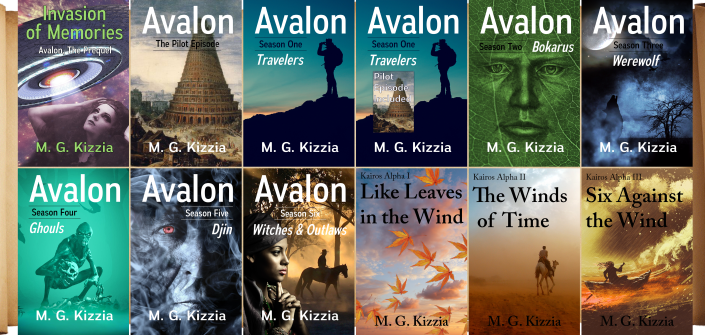
If you have visited this website in the last few years, you have had a chance to read stories of the Kairos, the Traveler in time, the Watcher over history including Greta, the wise woman of Dacia in the time of Marcus Aurelius, Festuscato Cassius Agitus who calls himself the last senator of Rome and is no friend of the Huns, Gerraint son of Erbin in the days of King Arthur, and Margueritte who is not a witch, but is a friend of Charles Martel. I hope you enjoyed these stories.  They will be edited, formatted, and covers will be made so they can go up for sale, soon.  But first, a trilogy of the Kairos origin stories will go up very soon (I hope).  Here are the covers.


What do you think?

************************

Avalon Stories available as of today

Avalon is a television series in written story form.  Please consider buying the books and supporting the author, and remember, reviews matter. Thanks.

I only have one general rule: that anyone who reads a story/episode, for example, from the middle of season three, they should be able to pick up on what is going on and basically how it all works.  If you want to start with the episodes that appear on my website, mgkizzia.com, and then want to go back and read the earlier adventures, that should be fine.  Of course, reading them in order will enhance the experience, but I hate accidentally picking up book two of some trilogy and being totally lost.  Especially for a TV show, a person ought to be able to come in the middle and still get a good story.


Look for the Avalon books, Season One Travelers, Season Two Bokarus, and Season Three Werewolf at your favorite e-book retailers.  Thirteen Episodes from the earliest days in each book detail the adventures of the travelers from Avalon.  Thrown back to the beginning of history, the travelers struggle to work their way through the days of myth and legend.  They face gods and demons, gothic horrors, fantastic creatures and ancient aliens in this romp through time.  They also quickly realize that they are not the only ones who have fallen through the cracks in time, and some of the others are now hunting them.


Avalon, Season Four Ghouls, Season Five Djin, and Season Six Witches & Outlaws brings the travelers face to face with the worst of all monsters: the human monsters.  As they move through the days before the dissolution of the gods, they get caught up in the rise of empires and the birth of great civilizations, but it isn’t what they think—a grand adventure of discovery.  It is never what they think.  It is dangerous around every corner, and troubles rise directly in their path.

******

Avalon Season Seven Wraith can be found in the archives of this website mgkizzia.com.  It was blogged from March 22, 2021 through September 1, 2021.  Season Eight Aliens will begin posting on April 4, 2022.  Most episodes are 6 posts, so the complete episode will be published Monday, Tuesday, and Wednesday over 2 weeks.  A few episodes are only 4 parts long and will be posted in a single week, Monday, Tuesday, Wednesday, and Thursday.

Avalon Season Nine The Masters will follow sometime in 2023 and be the end of the series being the third book of the third trilogy.  Editing, covers, and formatting for seasons 7, 8, and 9 are happening slowly, but hopefully all nine books of the Avalon Series will be ready for purchase by the end of 2023.

******

Look also for Avalon, The Prequel: Invasion of Memories, where the Kairos comes out of a time of deep memory loss and realizes he is the only one who has any hope of stopping an alien invasion.  To keep from being overwhelmed with the sudden influx of so many memories from so many lifetimes stretching from the deep past to the distant future, the Kairos tells stories from various times in his own life when he remembered who he was; the Traveler in time, the Watcher over history.

Invasion of Memories is both a collection of short stories and a novel of the Men in Black who struggle to prevent an invasion by the alien Vordan, a species given to shoot first, and that is pretty much it, just shoot first.

All of these books are reasonably priced at your favorite e-retailer.  You can find them under the author name, M. G. Kizzia.  Now, also available from Amazon in print-on-demand paper editions.

I hope you enjoy reading the Avalon stories as much as I have enjoyed writing them.  Reviews on the e-book websites are always appreciated, and if you wish to support the author by buying a copy, thank you.

Happy Reading.

— MGKizzia

*

TOMORROW

Tune n for a preview of Avalon Season Eight. The contents of all 13 episodes plus notes on the season, an introduction to the Avalon series if you have not read any up until this point, and introductory notes on the cast (characters).  This information will be on the website under the tab About Avalon so you don’t miss out.

*

M4 Margueritte: Toward Tomorrow

The Muslims went back over the mountains.  Charles gave his daughter Gisele away in marriage.  In fact, all the children seemed to be approaching that age.  Marta’s Morgan married first, and into a much better position than Marta ever imagined.  Lefee also married, a young knight subject to Count Michael of Nantes.  Larin turned seventeen in the spring of 733 and fell madly in love.  Sadly, Margo did not like the boy

Margueritte turned thirty-six in the spring of 733, and she began to understand what Gerraint said about ages being three to four.  Thirty-six for her was like forty-eight in the Storyteller’s day.  Life remained hard in the dark ages, even for a countess.  Her hair turned gray, her joints complained, and she could not sort the potatoes like she used to.  She did not have the option of going to the spa and having her hair and nails done and getting a message and pedicure.  God!  She at least made Roland massage her feet when he came home.  Sadly, he still was not home nearly enough.  And then she decided everything in her age seemed sadly this or sadly that.

Margueritte went home to the Saxon March in the spring of 733, and she imagined she moved for the last time.  She left Pouance and the castle to Walaric who pledged to serve Owien faithfully, and also pledged to have room for Jennifer and her children for as long as they wanted it.  The annex next to the chapel was hers, he said.  And besides, he joked that he would not want to make the queen of the fairies mad at him.

733 was one whole year of peace in Frankish lands, and Margueritte rejoiced.  Of course, in 734, the Frisians, who had already thrown out the Roman priests again, moved an army up to claim the bigger half of Roland’s land north of the Rhine.  Bertulf had nearly two thousand lancers by then with more on the way, and after the spring planting, he raised another two thousand footmen, and they held the line against the Frisians taking the whole thing, and even pushed the Frisians back in a couple of places.

When Charles arrived, he came angry.  He beat the Frisians senseless, and the Frisian king, Radbod got killed in battle.  He told the priests to wait a month while he tore down every pagan shrine in the country.  Then he gathered the Frisian nobles, replaced a few with more sensible men and warned them that they could all be replaced if they did not behave themselves.

“End of discussion,” he said.  Frisia became a Frankish province, and Charles marched up to Margueritte and Boniface with a word for the bishop.  “Your turn,” he said, and stomped off, still mad about something.

“I am not sure force is the way to win people to Christ,” Boniface said softly.

Margueritte agreed.  “Force is more of a Muslim thing.”

Boniface looked back.  “Martel is a hard man.”

Margueritte grinned.  “I would call him Hammerhead, but he would never forgive me.  Besides, I would not want to confuse him with the ogre of that name.”

Boniface let out the smallest smile and leaned down to kiss Margueritte’s cheek.  She kissed his in return, and they went their separate ways.

By 735, Charles had just about finished reorganizing Burgundy, replacing not only the duke with his brother, but replacing several counts and numerous barons with men who were mostly his supporters.  Then old Duke Odo passed away, and Charles had something similar in mind for Aquitaine.  He had been keeping to the south because he did not like what was happening in Provence.  They had a Muslim presence since 725, or some ten years ago, and they were calling for more.  It did not occur to Charles that they would call for Saracens because they were afraid of the hammer.

When Charles arrived in Tolouse, all he could do was yell, “What?”

Hunald explained.  “My father retired after the battle of Tours.  He turned the dukedom over to me with the full consent and acclimation of the nobility.  I have ruled for these past three years.”

“What?  What the hell is retired?”

“Something Lady Margueritte talked about way back when she was prisoner here.  She said it was best to pass on the reigns when you are still alive, so you can help teach and guide the next generation.  She said your own civil war was the result of your father not choosing and declaring his successor before he died.”
Charles thought about it, but he said something else.  “That girl makes more trouble than anyone I ever knew.”

“But she is worth it,” Hunald said, and Charles did not argue.  He had his hands on five thousand heavy-cavalry and began itching for the Muslims to start something, which he knew they eventually would.  In fact, even then, the son of Abdul Rahman sailed into Narbonne harbor with a large force.  He moved into Provence and built a strong garrison at Arles, and then forced the other cities of Provence to submit to him and garrisoned them all.

Charles moved down into Provence in 736, surprising the Muslims with his speed.  They did not expect him so soon, much less Liutprand, King of the Lombards in northern Italy, who moved up into the same area.  Liutprand made an alliance with Charles to remove the Muslim presence from the whole province and return the province to the Roman church.  He felt glad he joined Charles when he saw what Charles did at Arles.

Charles had fifteen thousand foot soldiers, almost half of whom were conscripts, and five thousand cavalry, far more horses than Liutprand normally saw.  Charles’ brother, Childebrand brought another ten thousand, mostly foot soldiers from Burgundy, but the Muslims had twice the cavalry, and closer to forty thousand foot soldiers.  Liutprand thought it would be no contest, until he saw Charles dismantle the Muslims with moves combining his heavy horse and footmen in ways even the Muslims never thought possible.  He utterly destroyed the Muslim army, and almost as an afterthought, he burned Arles to the ground.  Surely, they would rebuild, but it would never again be a stronghold for the armies of the Caliph.

“The greatest army ever seen since the Romans were at their peak, and Charles took it apart like he was playing with all queens and the Muslims had only pawns,” Liutprand described it.

Once Provence was liberated, and all the Muslim garrisons destroyed in all the cities, Liutprand got ready to go home.  He heard rumors of discontent at home, especially from one duke by the name of Spoleto, but Charles had not finished.

Charles moved like a war machine into Septimania.  He liberated the cities inland first, then turned on Narbonne. There he encountered a second army, newly arrived by sea for the relief of Arles and the strengthening of the garrisons in Provence.  They had no idea that Charles had already moved well passed that.  They also had no idea Charles had heavy cavalry.  They had imagined it would take the Franks at least a generation to develop heavy cavalry.

Once again, Charles took the Muslims apart.  He figured out how to use the heavy cavalry most advantageously with his phalanxes, or thick, chunky box things, as Margueritte called them.  Those Muslims who got back to Al-Andalus, limped home, and when it was all over, only Narbonne itself remained in Muslim hands.

Charles considered his options.  Assaulting the city would carry a great cost in Frankish lives, and he really wanted to be able to pass on some kind of army to his sons.  Putting the city under siege, on the other hand, would cost lives to sickness and dysentery, and take months if not years, given that Narbonne could be supplied from the sea.  He let it go. He set local men who could watch it, but for himself and his army, he went home.  He said he was going to retire.  He said he had sons to train.

Margueritte turned forty in 737 and felt her age.  Things in the county were peaceful and prosperous, and Margueritte had no reason to complain, but she wanted Roland home for good.  Her father had been home when they were growing up, but those days were full of peace and quiet.  She missed those days.  She missed her husband.  Even the child of her age, Gerald was fourteen, a page, and growing fast.

Roland did come home in 738.  He turned forty-seven, and Margueritte thought how gray and old he had gotten. She held on to him every night, and he was good to her, even when she began to have hot flashes and started into what she called mental pause.  Then in 741, Charles died from complication from the flu.  He passed on at the ripe young age of fifty-three. and Margueritte began to wonder about the future.

Absolutely everyone went to Paris for the funeral.  Carloman and Gisele were there and cried.  Pepin kept a stiff upper lip.  He turned twenty-six, only a few years younger than Charles had been when he contested for rule with Ragenfrid.  Weldig Junior, Cotton and the young one, her own Martin at twenty-four, were all there to support Pepin.  They were all growing up—grown up.  Even “wait up, wait up,” Adalman was there, twenty-one and married, and he already had a son he named Roland.

Margueritte thought it was a lovely name.  She always liked it, and she had forgotten all about Roncevaux pass and a certain Roland, Marquis of the Breton Mark, and what would happen there.

Pepin had married.  All the boys were, and Pepin’s wife would have a son, and they would name him after his grandfather, Charles, but that was in the future.  In the present, all she saw was how old everyone seemed.  Margo was forty-two.  Elsbeth was thirty-eight, and fat.  She finally succeeded with fat.  And well, she thought, it is time for the next generation to have a turn.

Jennifer was there, still looking young and vital like something from the fairy life did transfer to her human life after all.  She was a novitiate at Saint Catherine’s, since Mercy turned twenty-one and had a child of her own.  She said that she and Giselle had become friends again.  Margueritte felt glad, and in the end, it was with glad feelings that Margueritte went home again.  Roland went with her, and she held him every night until he died in 750.  Margueritte lived another five years and died wondering who she would be in her next life and wondering if she would ever get to see her children or grandchildren again.  But, she decided, she needed to pass on, because otherwise Charles, the grandson, would get to be far too old for her to be his lover.

END

************************

TOMORROW & WEDNESDAY

Previews of coming attractions.  Material I hope to put up soon on Amazon, Smashwords, and elsewhere.  At least toe cover art is ready.  Also, tune in for the introduction to Avalon, Season 8 which will begin posting on MONDAY.  Don’t miss it.  Until Tomorrow

*

M4 Margueritte: Tours, part 3 of 3

Danna picked up Abraxas and flew to the English Channel in the blink of an eye, and she threw him out over the water.  “Stay off my continent.  It will be death for you to return here.  I am sorry for my islands, but this is it.  Do not interfere with the people.  Do not impede their faith, whichever way they turn.  Find your courage and go over to the other side where your mother and father are waiting for you.  I will not give you forever.”

Abraxas floated in the air, afraid to touch the churning water of the channel beneath his feet.  He turned and flew toward the white cliffs, but before he arrived, Danna got back to Abd al-Makti, who cried and looked like his mind finally snapped altogether.  She blinked the man back to his Iberian home in Al-Andalus and turned to recall her men from the enemy camp.

The men came, some reluctantly, and Danna changed back to Margueritte and asked, “So how did you do?”

“Melanie is still one ahead of me,” Calista complained.  Melanie only grinned.

“Well, we will be going home, to my home.  Maybe you can find a Saxon or Frisian to slaughter, you bloodthirsty mink.”

Walaric walked up and waved the last of the men to safety.  “Peppin took an arrow,” he said casually.  Margueritte nodded.

“Boys,” she said, and the boys, the four men and two elves fell in behind her and Walaric and followed them down the hill.  “We are going to have to get him and any other wounded to Charles before we stop.”

“I’ll work it out,” Walaric assured her, and stepped off.

Margueritte found Duke Odo at the bottom of the back side of the hill where the horses were being held by the men.  The old duke did not look like he had enough strength left to climb the hill, but he smiled as hard as he could.  He gave Margueritte a kiss on the cheek, and men came and helped him up on his horse for the ride back to the Frankish lines.

###

Greta and Doctor Mishka spent most of the late afternoon and night patching up who they could.  Many Franks died and many more would not live long, but Peppin would live if the wound did not become infected, and it was always a big if in those days.

Tomberlain and Owien burst into Greta’s makeshift hospital tent early on and did not even blink on seeing Greta in place of Margueritte.  “We got Abdul Rahman,” Tomberlain blurted out, and did a little dance.

“He was trying to rally his troops,” Owien explained.  “His men were all deserting the line, and I don’t blame them.  We had them beaten.”

“Owien hit the man with a javelin,” Tomberlain interrupted.

“You pulled him from his horse,” Owien turned on his brother.

“We both stabbed him, together.  We got him together.”

“We did,” and the boys hooted, a very Breton sort of hoot.

“They did,” Roland said, as he came in.  “Any chance I can see my wife soon?  I want to scold her for even being here.”  Roland showed a very loving smile which kind of negated his words.

Greta stood and put a hand to his chest to push him back.  “Not just yet.  I can still save some of these men, and Doctor Mishka can save a few more.”

“Is she around?” Charles came in the tent and saw Greta turn into Doctor Mishka.  He had met the Doctor, but this was the first time he saw the instantaneous change take place.  “Remarkable,” was his word for it.

Mishka stopped and faced the man.  “So now you have earned the right to be called Charles Martel.”  She started to clean one man’s shoulder wound as they talked.

“Many of the men call him that already,” Roland admitted.  “Ever since you, or Margueritte said it back in Saxony.”

“I would think more like an anvil,” Tomberlain said.  “The Saracens did the pounding, and we took it and were not moved.”

“Wrong image,” Mishka said.

“I like the hammer image,” Owien said.

“Me too,” Charles said quietly.

“So, Charles Le Martel it is,” Roland said.  “But now, what can we expect tomorrow, or tonight for that matter?”

Mishka spoke up first.  “In my opinion, they will argue all night.  Abdul Rahman did not strike me as a man who appointed a second in command, so it is not clear who will take over now that Rahman is dead.”  Mishka paused and gave Charles a hard stare until Charles got it.

“Roland,” he said.  “If I were to die, Roland will take over the army.  Everyone knows that.”

“Very good,” Mishka continued.  “Though not for Margueritte, I suppose.  But in the morning, I see three options.  Either they will attack again, though that is least likely, or they will retreat to look for a better place to hold the line, or if some commanders sneak away, they may grab whatever treasure they have left and leave altogether.  Pray for the third choice.”

“Yes,” Charles said and rubbed his hands.  “I saw the treasure you collected from the camp.”

“And the people we set free, so they won’t become slaves or end up in some harem.  The people are what matter most.  Never forget that.  Which reminds me, Carloman did his duty.  And no, you may not knight him until he is twenty-one.  Don’t break that rule.  No exceptions.  Pepin and the boys were kept out of it.  They were only allowed to watch and are very upset by that.  Too bad.  And your daughter Gisele is going to marry if you are there to give her away or not.  He is a fine young man.”

“Yes, I was thinking—”

“Don’t.  Don’t think.  She will marry her young man who will win his spurs, if he has not already after today, and she will live in a fine manor house with servants to help her, and she will have children and be happy, and let that be the end of the discussion.”  Mishka stepped around and kissed Tomberlain, Owien, Roland and Charles on the cheek.  “That is from Margueritte, and that is all you get.  Now go away.  These men are supposed to be getting rest and you are just spreading germs everywhere.”

They went, and Owien asked Tomberlain, “What are germs, anyway?”

“Hey, lady,” Peppin called from several men away.  He had been sitting up, listening.  Like all those in the know, he used the term the little ones used when he was not sure of her name.  “Lady, you forgot to tell him about Hunald.”

“Hush,” Doctor Mishka said as she examined Greta’s handiwork on Peppin’s leg.  “He will find out soon enough.”

Later that night, about an hour before dawn, Lord Larchmont came with a report.  The Muslims were escaping, and they did not look to be united in their retreat.  Yellow Leaf thought the Berbers started it, but Birch said it was the Syrians.

Mishka nodded and sent a mental message to all her little ones on the field and in the hills.  They could follow and harass the enemy, but not engage them.  They could take any strays, and any who couldn’t keep up, but otherwise they were to encourage the enemy to go all the way back over the Pyrenees.  If they stop short, they are not to attack, but come and tell her.  Understood?”  Mishka got the general response from a thousand or more that they understood well enough.  Whether or not they would keep her commands was a different question, and unlikely.

After that mental message, Mishka went away to avoid the inevitable migraine, and Margueritte came back, feeling as fresh as the morning.  Except for a couple of hours the day before, she had been away, like off sleeping, and others took her place most of the day.

Margueritte told Larchmont to take a seat on her shoulder and went to Charles to tell him what she learned.  She suggested Hunald and the men of Aquitaine with her horsemen from the march follow the enemy, at a distance.  They wanted encouragement to vacate Frankish lands altogether, and that included Vascony.

“Yes,” Charles started thinking again—a good trait for a general who just came awake from a sound sleep.  “It seems I will have to replace some of those Vascon nobles for their cowardice in the face of the enemy.”

“The Basques won’t like that,” Margueritte warned, but then Roland and Hunald came in, and Margueritte made sure they understood that Larchmont and his men would be keeping an eye on the retreating enemy.  “They will keep you informed of the progress, so you don’t get ahead and stumble into them.  If they stop and gather themselves in Bordeaux or Vascony, like they want to hold on to some territory, you need to get Charles to make them think again.”

“We can pick off some strays, maybe?” Roland thought out loud.

Margueritte shook her head.  “Any strays will be dealt with, and don’t send your own scouts out.  To be honest, some little ones have a hard time telling one human group from another.”

“Yes, I remember,” Hunald said, fascinated by Larchmont.  “I was at Pouance, if you recall.”  Margueritte recalled, but just then, Roland wanted some of her attention before he rode off again, and she wanted some of his.  They emerged around nine o’clock when everyone said the Muslims were not coming again.  Charles’ men scouted the abandoned camp, and indeed, they had packed up their goods and left.  Roland and his thousand, and Hunald and his men from Aquitaine followed, and the rest headed back up the road to Tours.

Charles pulled off the road at Saint Catherine’s de Fierbois.  Margueritte brought the nuns.  Three nuns came this time, and the same old priest who now had to be near eighty, even older than Duke Odo.  The nuns had the box, and the stone came up easily enough.  Margueritte said Charles might still need the sword, but he said he had plenty of swords, and Caliburn saved his life, and that was enough.

“You said there is another who will need this, from under the stone of five crosses,” Charles remembered.  Margueritte nodded, but when she got the box and placed the sword in its brown leather sheath into the box, she saw one of the nuns crying.  Margueritte recognized the woman right away.  They had been close.  Charles took a minute before he spoke her name.

“Giselle,” he said.  “My daughter’s name.”

“Lady,” Giselle wept.  “I can never make up for what I did to you.”

Margueritte put the box with the sword in the floor, and the men laid the stone gently on top and sealed it, so no one would suspect there was something beneath that spot.  Then Margueritte spoke.

“You have no need to make up for what you did,” she said.  “I forgive you.”

Giselle cried all the harder, but Margueritte hurried herself and Charles out of the sanctuary.  When they returned to the road, Charles asked if she really forgave the woman.

“I want to, but it is hard.  But I really want to.”

Charles seemed satisfied.  “It is good to know you are human after all,” and he said no more about it.

************************

MONDAY

There are loose ends to tie up and tomorrow to consider.  But tomorrow always remains a mystery, even to the Kairos, the Traveler in time, the Watcher over history.  Until Monday.  Toward Tomorrow Happy Reading.

*

M4 Margueritte: Tours, part 2 of 3

The Princess, dressed in her armor and weapons, the cloak of Athena streaming out behind, rode all the way from Tours on good, old Concord.  Margueritte was well enough to ride, but her side still got sore when she rode far and fast.  The Princess thought when this was over, the old horse needed to be put out to pasture and Margueritte should get a gentle mare for her age.  She suggested the name Concordia.  Margueritte said she would think about it.

When the Princess arrived on the hill overlooking the enemy camp, she called a halt while the men were still hidden by the rise.  Walaric and Peppin went up the hill with her and Calista, and the four men assigned to keep Margueritte safe, no matter what she looked like.  Other men held their horses, out of sight.  Abdul Rahman just then left the camp, and the Princess saw that the camp would be minimally defended.

“You should have the element of surprise, and the men left in the camp are probably not the best, but watch out for special, well-trained troops he may have left around his own tents.  You don’t need to kill them all, but you might.  Just keep in mind, the main idea is to liberate their human captives and as much treasure as you can.  When you hear the signal, you must return to the hills, so listen for it.  The signal will mean our ruse is working and the enemy is returning to protect their treasure.  Now, wait until I tell you to start.  Go on.”

“What will you be doing?” Walaric asked.

“I have a date with a sorcerer,” she said.  “Don’t worry.  I will be in good hands.”  As Walaric and Peppin walked back to join the men, Danna, the mother goddess of all the Celtic gods took the Princess’ place.  “Melanie,” she called.  The elf maiden Melanie appeared and fell to her knees.

“Great Lady,” she said, and lowered her eyes.

“You and Calista need to watch and protect us from any of the enemy that may be tempted to escape the camp and head for this hill.”  Danna called in all her little ones from the hills on both sides of the camp.  They were not allowed to enter the camp, but they were allowed to keep men from escaping the camp by going overland.  “Gentlemen,” she turned on her four guards who trembled in her presence.  “Focus on the enemy camp,” she compelled them.  “Calista and Melanie may need you to back them up.”

Abdul Rahman finished exiting the camp, though it would be a couple of more minutes before all his men made it to the gentle tree covered rise that lead up to where the Franks were waiting.  Danna used that time to call Odo and his horsemen.  They came to her as surely as Melanie came.  They appeared instantly and had no power to resist her call, and she turned to Odo and stilled his heart, because he was an old man, and she was afraid for him.

“My dear friend,” she said.  “This was your idea.  I thought you might like to be in on it.”

Duke Odo did not recognize the person talking to him, but he looked behind the hill and saw Peppin, Walaric and a thousand horsemen ready to ride, and he smiled.  He saw the enemy camp and nodded.

“Boys,” Danna called again and clapped her hands.  Pepin, Weldig Junior, Cotton and Martin appeared on foot, their horses in the hands of the men behind the hill.  Martin immediately complained.

“Mom!”  It did not matter that Danna was not exactly his mom.  He knew who she was.

Danna let out a little smile.  “I admire your courage,” she told the boys.  “But at sixteen and seventeen years old, you may watch, but not participate.  Squires only, and older.”

“Not fair,” Weldig Junior groused, but their feet got planted beside Margueritte’s four guardsmen, and they were not going anywhere.  Danna gave the signal, and a thousand men of the Breton March attacked the Muslim camp, Walaric, Peppin and Duke Odo in front.  Once they passed by, Danna called again and clapped once.

“Abd al-Makti.”

The sorcerer came, saw her, and screamed.  He babbled.  “I did not know.  He lied to me.  He said you were just a woman of the Franks.”  The man looked so afraid, Danna thought he might die right there for fear of what she might do to him.  In fact, she took away his magic, so he fell to his knees a wept, an ordinary human being.  Then Danna let Margueritte return, and Margueritte spoke calmly, as Danna made sure Abd al-Makti’s ears were open, and he would hear.

“Long ago, a man named Julius Caesar came to conquer this land.  The Gallic people of the land tried to fight, but only one king successfully stood up against the power of Rome.  That was me,” she said, and took a deep breath.  “In that day, in that lifetime, I was a man named Bodanagus.  But I went to Caesar to talk peace because peace is always better than war.  My love, Isoulde, was killed in the fighting, and I hardly had the strength to go on without her.  But even as Caesar and I talked, we were interrupted by the gods of Aesgard.  You see, the time for dissolution was near.  The gods would be going over to the other side.  But Odin wanted to defend his German and Scandinavian people so they would have time to become the people they are even now becoming, centuries later.  It was Odin and Frig, Syn and even Loki who empowered Bodanagus to keep other men with other cultures and traditions from pouring over the border and ruining what Odin set in motion.”  Margueritte paused. not sure how much Abd al-Makti, or anyone standing there understood.  It did not matter.  She felt compelled to finish the story.

“I am the life in all of time that is the perfect genetic reflection, say, the perfect female version of King Bodanagus.  As he was empowered to protect the Germanic people, so I reflect the gifts given to him.  You see, I am not a witch. I simply reflect in a small way the gifts of the gods.”

Margueritte turned to where a dozen Muslims were trying to escape the bloodshed in the camp.  As suspected, some made for the hills, and Calista and Melanie were running out of arrows.  Margueritte raised her hands, and something like blue lightning poured from her eyes and fingers, but unlike the Taser effect it had on Franks, or even fellow Bretons, to knock them unconscious, this looked more like real lightning, and the dozen Muslims burned to ash and charred remains.

“And I simply reflect his gifts in a small way,” Margueritte confessed.  Abd al-Makti wailed, trembled, and covered his eyes.  “Iberia is full of Germanic Visigoths.  North Africa is full of Germanic Vandals.  I could sweep the land clean of Islamic usurpers, right up to the border of Egypt, and there are other things I could do in Egypt and the Middle East.  But I won’t.  Why?  Because men need to fight their own battles.  You claim Allah is the one true god and Mohamed is his prophet.  I will show you what kind of men have taken up your cause.  They are men filed with greed for riches, lust for power, covetousness for land, and hatred unto the death for anyone opposed to them—even the innocent, including women and children.  Let me show you the kind of people you have.”

Margueritte called Larchmont and his men.  She traded places again with Danna as she spoke to the fairies.  “You must whisper in the ear of Abdul Rahman’s men and commanders that their camp is attacked, and they are losing their slaves and their riches.  If they want to go home rich, they better come and defend their camp.”  Danna made the fairies temporarily invisible and sent them on their way.  “Greedy men,” she said.  “And now the end.”

Abd al-Makti screamed again and threw his hands to his head.  It felt like someone was walking around in his mind, and Danna was, before she mumbled.  “He really isn’t that smart.  He ran away when you sent men to assassinate Margueritte, and failed, but he neglected to remove the connection.”  Danna raised her voice and called, more than she ever called before, and it was one word.  “Abraxas.”

Danna’s voice roared through the Muslim camp like a whirlwind.  It raced south, crossed the Pyrenees, and echoed throughout Iberia.  People, especially of Celtic descent, looked up at the sky and wondered.  The call crossed over at the straights of Gibraltar, bounced off the Maghreb, crossed the Nile and landed in Damascus, where Abraxas worked to save the Caliphate from the Abbasids.  Abraxas vanished from there, and appeared on a hill south of Tours, and once he stood on Danna’s soil, he could not move.

Danna tuned out everyone else and stared hard at the goatee face.  “Bastard son of Morrigu, my self-centered daughter-in-law,” she said.  She glued his presence to that spot and went away so Amun Junior could take her place.  You are hereby banished from Africa, Egypt, and the Middle East right through Persia and up to the Aral Sea and Lake Baikal.  If you return to interfere with the people there, it will be your instant death.  Amun has spoken,” he said, and went away so Amphitrite could take his place.  Abraxas strained to get his feet free, and sweated, a little-known commodity among the gods.

Amphitrite imagined Abraxas might be cute to some girls, like Galatea, in a wicked, skinny, black hair, goatee sort of way.  She could see Janus in him a little around the eyes—that two-faced moron and back stabber when he got drunk.  “As Amphitrite, called Salacia in Rome, wife of Poseidon, called Neptune by his grandfather Saturn, I stand as the last of the Olympians, or near enough, and I banish you from all the lands of Olympus, and from the Mediterranean.  In fact, I banish you from all my waters around the globe.  Drink milk, wine, ale, tea, but let pure water, salt or salt-free, be poison to you, and to step on Olympian land will be instant death.”

“Please,” Abraxas started to cry.  “I am fire and water.  You cannot take the water from me, or I will burn and die.”

“Steam,” Amphitrite called it.  “Also called hot air.  So be it,” Amphitrite said, and Danna returned to have the final word.  “Nameless gave you a chance when he banned you from the lands of Aesgard.  You could return, which would be suicide, or you could find the courage to do what you should have done centuries ago.  Give up this little bit of flesh and blood and go over to the other side.  The time of dissolution is long past.

“But —”

“Quiet.  I have now taken from you every place on this planet where you might have staked a claim other than this land, the land of the Celts, the land of my children.”

“Please.  I have nowhere else to go.”

“Why should I give you a third chance. Will you go over to the other side?”

“I will.  I swear it.”

“In an elf’s eye,” Danna said. “But this is it.  There will be no fourth chances.”

M4 Margueritte: Tours, part 1 of 3

Abdul Rahman stopped in the gap before the forest, where the road ran between the hills.  He seemed a bit surprised to find an army blocking his way, but he did not think much of it.  He had little respect for the military prowess of what he considered the Germanic barbarians.  Certainly, the Visigoths fell quickly enough, and the Vascons cowered as he passed by.  He came over the mountains with fifty thousand men, and even after two bloody battles and the siege of Bordeaux, he still had forty thousand who could fight like fresh troops.

Abdul Rahman al-Ghafiqi had fifteen thousand men at that point, out in the province, killing locals and taking everything of value they could, including humans who would serve as slaves.  He found the white Visigoths made acceptable slaves and saw no reason why the Franks might not be the same.  So, he waited, and felt more concerned about the coming cold weather than he did about facing a Frankish army.  He counted his gold, and that warmed him, as his men counted their loot and thought about blonde barbarians waiting on them and meeting their every desire.

“The cavalry will run them over, as they ran over Duke Odo, twice,” he said.  His scouts told him the Franks had no horsemen to speak of.  Abdul Rahman raised his eyebrows a little when his men reported campfires in the hills on both sides of the road.  But he still did not fret.  He imagined the Franks might equal his numbers after all, but that would not help them if they were spread out through the hills.  True, it would prevent him from circling around behind the enemy, but he did not plan to do that.  He planned to plow right through the Franks and head straight for the riches of Tours.

Abdul Rahman stayed for six days in the same spot.  He waited for his men to come in from the surrounding area and waited to see if the Franks would be foolish enough to charge his position.  He rather hoped they would, that this Charles would lack the patience the other Germanic people he faced had lacked.  But Charles stood his ground, and his men, used to the cold October winds and rain, made no complaint.

By the third evening, Abdul Rahman called for the madman.  “What do you make of the fires in the hills,” he asked.

Abd al-Makti’s eyes got big, and he muttered nonsense for a minute before he shouted, “Spirits in the night.”  He looked like a broken man and laughed like one as well.  “The hills are full of ancient and powerful spirits, and they are against us.  They are all against us.  I have the power to drive them off, but when I grow tired, they come right back.  They always come right back.”

“I cannot deny what he says may be true,” one of Abdul Rahman’s generals spoke up.  “We send scouts into the hills, and they do not come back.  We send a troop, and they believe there are Frankish soldiers in the distance, drinking and laughing around the fire, but they ride to the firelight and find nothing there when they arrive.  There is not even an extinguished fire.  It is like they are chasing after ghosts.”

“Spirits,” Abd al-Makti repeated.  “It is her doing.  The spirits obey her.  The witch.  The spirits obey her wicked bidding, and they are against us.”

Another man stepped up, one from Septimania.  “I have heard this mad man speak of a woman since the day he arrived in Narbonne,” he said.  “I have never discovered the identity of this witch, but apparently, she is with the Franks.”

“Witchery from the Franks would not surprise me,” Abdul Rahman said.  “But I am not a superstitious man.  We ride in the name of Allah, by the Holy Prophet.  We will be strengthened, and the victory will be ours.  Bring me some of the Franks from the hills,” he ordered, and for three more nights, men went out, and while they saw the fires in the distance, they never found one, and sometimes the men never returned.

By the sixth evening, Abdul Rahman’s men were up to full strength of forty thousand.  Roland, Lord Birch and Charles all judged that the Saracens would attack in the morning.  They got their men ready, and Odo came up with a plan to ride around and attack the Muslim camp with his horsemen, and any that Charles could spare.

“I cannot spare any,” Charles said.  “But the idea does have merit.”  He had no idea that before the light dawned on the seventh day, Margueritte, Calista, Walaric and Pippin lead a thousand of their veterans on horseback from Tours and traveled by secret elf ways to the battlefield.  It would still take them most of the morning to arrive, but Larchmont’s messenger told her what Odo proposed, and Margueritte also thought the idea had merit.

Abdul Rahman sent his heavy cavalry first thing to clear the road.  True, they had to ride up hill and through trees so they could not build up to a good charge, but they were experienced at moving through all sorts of unfavorable terrain, and they quickly came to the Frankish line.  The Frankish archers hardly slowed them.

The Franks, to the great surprise of the Muslim cavalry, stood like a stone wall.  As horses crowded against each other, the men on their backs became easy targets for Frankish spears and javelins.  The Franks were supposed to break and run away, like all barbarians did, but the Saracens instead began to fall in great numbers.

One Muslim commander held back to judge where Charles would most likely be.  He led a concentrated charge on that spot and almost broke through.  For a few brief moments, Charles got exposed.  Three men on foot, one of whom was the commander, having lost their horses, faced Charles, and thought the day was won.  Charles pulled Caliburn and easily sliced the first man across the middle.  The second man, the astute commander, parried Charles’ sword, so Charles did what he had been told and thrust—an utterly unexpected move.  Caliburn sank deep into the man’s chest.  The man knew instantly that he was dying, but he grinned as his hands grabbed the sword.  His fingers and thumbs got cut off, but he yanked the sword right out of Charles’ hand as he fell.  The third man smiled, thinking he had Charles trapped, but Charles called.

“Caliburn,” he said, and the sword vacated the commander’s chest and flew back to Charles’ hand.  The third man, wide eyed, turned and ran away as Tomberlain, Roland and a dozen veterans came to drive off the rest.  To be sure, Ragenfrid’s elder sons, Bernard and Adalbert were in the front of the line to rescue Charles.  The Franks closed-up the gap, and that one man running away started the retreat.

With his heavy cavalry beaten back, Abdul Rahman realized that this would not be as easy as he supposed.  He took nearly an hour to think about it, while Charles, Roland, Tomberlain, Owien, Wulfram and all of Charles’ commanders and sergeants, and eventually all of the Frankish nobility shouted.

“Hold the line.  Archers to the front.  This isn’t over. The battle has just started,” and many encouragements to get the men ready.  Hunald also picked up the yelling, and it helped his men.  The men of Aquitaine were shaking and might have broken if not for the courage of the Franks beside them.

This time, Abdul Rahman thought to send his light cavalry.  He had fifteen thousand to send, and he figured they would wend their way up the hill and through the woods better than the heavily burdened cavalry he normally depended on.  Many of the light cavalry were Berbers who rode smaller, more agile horses, almost ponies, and they did not need as much ground to get up a good charge.

The Franks, however, were just beyond bowshot of the trees.  While the light Muslim cavalry had practiced at shooting bows from horseback, they could hardly draw a bead on the enemy when the minute they popped their heads out of the trees, they got shot.  This kept them from even getting started in any sort of charge, until one commander forced them forward.  They were not going to ride in and out of range and hit the Franks with volleys of arrows, at least not without being hit in return, so they drew their swords and attacked.  Again, the Franks were unmoved, and while these smaller horses did not get tangled up the way the big horses got in each other’s way, the toll on the Muslims became even more devastating.  Wulfram had been right as far as it went all those years ago.  In circumstances, such as close quarters, the man on foot had the advantage in being able to move, bob and weave.  Plus, these lighter cavalry men also had lighter armor, where the Franks had solid armor, mostly chain, that could stand up to many sword thrusts and even arrows.

It did not take long before the Muslim light cavalry called it quits and went back down the hill to rest.  Abdul Rahman gave them an hour and felt astounded that any barbarian army could stand up to such an awful beating.  He was not aware, though his commanders were, that Rahman’s forces were the ones getting the worst of the beating.

Abdul Rahman put his armor on and had his horse saddled.  He intended to end this and planned to throw everything he had at the Frankish line, including nearly ten thousand men on foot, to follow the horses.  That would leave only two thousand to guard the camp, but he was not thinking at that point about guarding the camp.  He got angry and stomped around like his personal honor was impugned.  How dare these Christians stand in the way of the armies of the Prophet.  He would crush them and kill them all.  As he mocked the barbarians for being impatient, one might say he became equally guilty of arrogance.  Pride, after all, is the first sin, and Abdul Rahman had plenty of it.