R5 Gerraint: The Road to Londugnum, part 2 of 3

They crossed the Thames at the ford of the ox where a fort first got constructed by Constans, son of Constantine, the first Pendragon.  Ambrosius, son of Constans was the one who defeated the usurper Vortigen and got proclaimed Pendragon before he got poisoned, and his brother Uther took the reins of the War Chief.  The fort had been built to protect the easy ford across the Thames and keep the road to Londugnum open, but in recent years they were doing well to keep themselves from being overrun.  The fort got burned once by Saxon raiders since Uther passed away in battle.  The local Lords made a temporary alliance to drive the Saxons back and rebuild the fort, but it became then more of a British outpost than a real line of defense.

The river crossing at Oxford was as easy as reported, and they spent the night feeling secure behind strong walls.  The Bishop visited the local Monastery, and stayed with the monks with strict instructions that the group not leave without him.  In the fort, the squires had little time for pleasantries.  They had to care for all the horses and equipment and only finished in time to eat and pass out from exhaustion, while their Lords stayed up drinking and talking about nothing important.

In the morning, Gerraint felt surprised that along with two guards, which was all the fort commander said he could spare, they picked up three new young Lords.  Kai and Bedwyr were the youngest at twenty-one and twenty-two.  Loth seemed the old man of twenty-five.  By contrast, Pelenor, Peredur and Ederyn were in their thirties and fought for Uther when they were squires and young Lords.  Of the three, Ederyn was perhaps the youngest at about thirty.

First thing, Pelenor, flanked by Peredur and Ederyn, strictly charged the three young squires to guard the Bishop at all costs. Arthur asked about Meryddin, but got assured the Druid was more than capable of taking care of himself. Gerraint looked at young Arthur and wondered what exactly the relationship might be between him and the Druid, but he held his tongue.
The group stopped for lunch before noon, and used some of Percival’s pots and pans.  Even so prepared, it became a three or four-hour ordeal, with the squires doing the lion’s share of the work.  Gerraint had something to say, but quietly to Arthur so as to not insult his masters.

We have been moving this slow since Caerleon. I don’t know how we can be expected to hold our lands against encroachment at this pace.  If the Romans moved this slow, Boadicea would have kicked them right off the island.”

Arthur looked like he had not thought of that. “We have been on the road from Leogria for three weeks, a distance people might have walked in six days.”

“We have been a whole month,” Gerraint agreed. “I could move a whole army in less time.”

“I could join your army,” Percival said, and Gerraint paused to lay a hand on the boy’s shoulder.

“For better or worse, you are part of Arthur’s army, and I have a feeling I may be too, someday.”  Gerraint paused then as he caught a brief and unusual glimpse of things to come.  “This land needs a friendly dragon,” he concluded.

“And the lion,” Arthur said, kindly.

“I’m going to paint a cross on my arms,” Percival said.  “You can forget the lemming.  I don’t even know what one looks like.”

“A good choice,” the Bishop said softly.  As usual, he had been listening in and keeping his own counsel.

At that awkward point, when lunch started being packed and people started preparing to move out, a dozen horsemen appeared on the road ahead.  They charged the group, but then, whether they thought better of it or decided the odds were too even, they turned and rode off.

“Saxon raiders.”  Peredur said it out loud.

Pelenor said, “Mount up,” and all the men hurried.

Ederyn alone thought to remind the squires to protect the Bishop, and then the men rode away in pursuit of the enemy.

Gerraint immediately grabbed the Bishop’s hand and started to drag him into the woods.  “Get under cover,” he yelled.  Percival, who was still young enough to trust his elders, grabbed his pot-helmet and followed.  Gerraint found a sword in his hand and gave his long knife to Percival.

“What are you doing?” Arthur yelled at them and scoffed.  “We have to clean up.”

“It is obviously a trap,” Gerraint yelled back, and eight or nine Saxons took that moment to come out of the woods.  Arthur ran and pulled his own knife, which might have been a pretty good hunting knife, but not much against a sword.

The boys and the bishop backed up while most of the Saxons went for their supplies to see if they might find anything of value or at least useful.  Two of them went to take care of the boys and the cleric.

Gerraint looked big for fourteen, being five and a half feet tall, which made him as big as any number of men in those days.  He held his sword with two hands, at the ready, so at least it appeared as if he knew how to use it, even if he did not have much practice with it yet.

“A good-looking weapon.”  The Saxon who faced him grinned and showed only a couple of missing teeth.  “I’ll just have that.”  He drew a weapon that also took both of his hands, but only because it looked huge. He grinned again and swung straight for Gerraint’s legs.  Gerraint parried and barely held it off, but they heard a loud crack and the Saxon said, “Maybe not such a good weapon after all.”
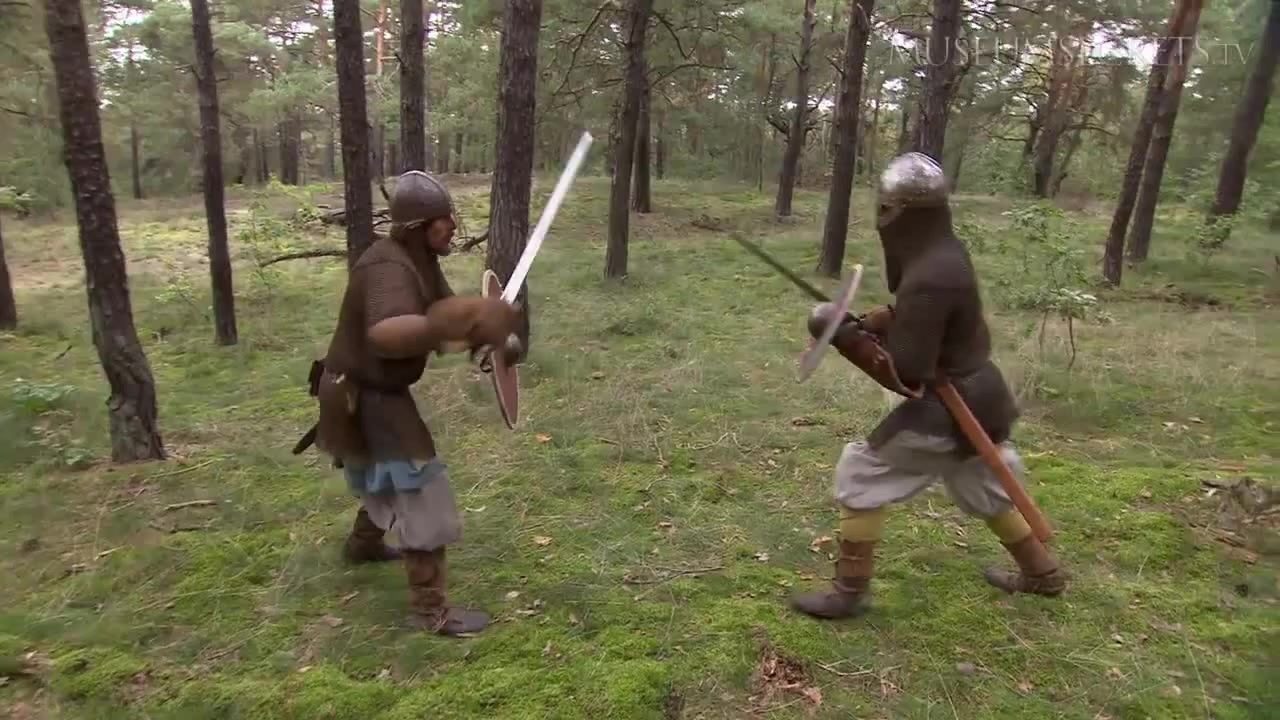
“It is Salvation.”  Gerraint named his sword as he took a step back.  It was one sword which was not too heavy for him.  The Saxon grinned again and swung at his legs from the other side, the Gerraint parried easily with a strong backswing and the crack sounded louder than before.

“One more swing and you will be disarmed,” the Saxon said, and he lifted his broadsword to prepare a swing at Gerraint’s head, but as he lifted his heavy steel, the top half of his sword fell away. Salvation had shattered the Saxon’s more primitive steel

The Saxon looked dumbly at his useless weapon, and Gerraint did not hesitate.  He thrust the point of his sword through the Saxon’s neck, just above the armor, and it stuck out a little from the back.  Gerraint yanked on his sword with all his strength, and it came out as the surprised Saxon’s head lolled forward and his body collapsed to the dirt.
R5 Festuscato: The British North, part 1 of 3

Guithelm, Archbishop of Londugnum made a special trip to the docks to catch Festuscato before he slipped away again.  Father Gaius and Father Lavius came with him, along with several other clerics and a number of monks from the monastery near Bishopsgate.  Festuscato took Guithelm aside and explained what he was trying to do. Gaius, who butted in, became astounded, because Festuscato never explained.  But Gaius had figured out most of it, and the rest sort of made sense in a convoluted Festuscato sort of way.  After that, Festuscato introduced the Archbishop to the gathered Lords from Cornwall, Britain, Wales and Amorica—those that were planning on resettling on British soil—and left the Bishop in Constantine’s good hands while he went back to his observer status.

He still played observer when they left Londugnum two days later and headed north toward York. When they stopped for the night, he stepped into Constantine’s tent with a thought.  “You have three thousand men from Cornwall and Wales that missed all the action against the Huns,” he remarked.  “And with your son and his men, a number of Jutes and some Saxons, that makes over four thousand men, more than equal to the reported army of Wanius, even if your troops have no horsemen with them.  They are two or three days ahead of us.  So, what were your orders when they get to York?”

Constantine paused before he frowned.  “I am getting discouraged.”  He called several men of the three hundred and wrote several letters to his son and the other leaders of the advance troop, outlining his expectations concerning positions around York and eyes on the Norwegian shore.  “I was just thinking to get them there.  I don’t think I will ever get the hang of this.”

“You will,” Festuscato encouraged the man, but he stopped the letter carriers.  “But a suggestion.  You have good men in Julius, Cador, Ban, Hywel and Hellgard the Jute. That covers the basics.  Maybe Weldig of Lyoness, Gregor the Saxon, Hywel’s Welsh friend Anwyn, and Emet who is from York who knows that land might be added.  I thought you might call them in and get all of their thoughts first before making a decision, even if you end up where you began.”

Constantine frowned again.  “No, I will never get this.”

“You will,” Festuscato encouraged again.  Then he felt glad he only had to call for a vote one time.  Emet, with Hywel’s backing wanted to tell the advance group to at least test Wainus’ defenses.  Cador and Julius argued for them to take up strong positions and let Wainus worry about the testing.  Festuscato turned to Constantine, who he instructed in how to approach things if they had a disagreement.

“Set up and wait for us, and cut York off from the countryside is what I was thinking,” Constantine said.  “But I want to be fair about this.  Raise a hand if you support Cador and Julius in their plan.”  Everyone raised their hands except Emet and Hywel.  Even Anwyn’s sheepish hand went up as he shrugged for his friend Hywel.  “I would say that is a clear majority.  Listen Emet. I know you are deeply concerned for your family in York.  We are all concerned with you.  But I think an attack at this point might cause Wainus to do something stupid.  I want to make the best try to get your family back, alive.  Are we agreed?”  Every man there said yes and offered hands of support for Emet, and the meeting broke up. Constantine ended up sending the letters he had written before he readied himself for the critique. Festuscato came straight to the point.

“I would say, normally, it is best not to give your opinion before a vote.  Some may be swayed to vote in your direction even if they don’t agree.  There are ways to guide things by your questions without giving away the answers. Above all, you must appear to value everyone’s contribution equally, and in this case, you did that well.”

“Nope.  I will never get the hang of this.”

“Yes you will.”

When they arrived at York, Constans had a hard time holding back the men.  The town looked burned, and parts of the fort as well, and the three thousand men who missed the action before were anxious for a fight.  Constantine doubled the number of men around York with a thousand British and a thousand Amorican foot soldiers, and more than two thousand horsemen which included some Jutes and Saxons.  Some of the Lords figured Wainus had to be shaking scared.  Some went to check where an assault on the town might be most effective.

It became quite a band of men who rode out to meet with Wainus and the Pictish Chiefs. Festuscato, Julius and Constantine brought Constans, for his education.  Ban, Cador and Hywel represented their people groups, and Emet came for York.  Hellgard the Jute and Gregor the Saxon had groups of their own to represent, and then the Four Horsemen were not going to be left behind.  Festuscato thought fourteen might not be the best number, but better than thirteen.  Wainus brought seven Chiefs down from the fort and seven more men in an honor guard. With Wainus, that made fifteen, and Festuscato thought of it as deliberate, just to be obnoxious.

Constantine did not spend much time on pleasantries.  “You have until noon tomorrow,” he said.  “To lay down your arms and surrender, unconditionally.”  He said nothing about what would happen if they did or did not surrender.  He waited for the question.

“We hold the high ground,” Wanius said.  His British was not very good, but understandable.   “Maybe you do have twice our number.  You will break on our rock and wash away.”

“What do you hope to gain by your death?” Constantine sounded so reasonable.

“I will gain by my life.  We will take the Northland that you British have abandoned.  We will own the people, the land, and the cattle on all the hills.”

“Reason and common sense don’t appear to be working,” Constantine shook his head and turned to the assembly.  “Any suggestions other than threats.”

“Allow me,” Festuscato stepped up.  “Wainus, let me explain things to you.  You see these men?  They represent the Welsh, British, Cornish, Jute, Saxon, and Romans too.  They are, everyone of them, a Lord with thousands of followers.  Outside of the Scots and Picts, my whole island is here against you.  Did I tell you this is my island?  It is by Imperial Decree, and we have just taken those upstart Huns and we threw them off my island.  Now, do you see this man?  I have appointed him high chief of my island and war chief.  Do you know what a war chief is?  He calls, and the whole island comes to him to join together, to fight together, to squish any upstart bugs that want to get ahead of themselves.  Are you with me so far?  My island.  And the whole island is united against you under the war chief.  Do you know what I mean, united?  Good…

“Now, you have three choices.  You can pledge your allegiance to the high chief and war chief of Britannia and make amends for the damage and destruction you have caused.  Or, you can refuse to join these other fine men, but you must pledge to go home and live in peace, again, after making amends.  Or, you can die.  It seems to me you have no other choices.  But if you fight, understand that even if you later try to surrender, there will be a price to pay.  Now, I suggest you go back up to the fort and think about it.”

“It is too late for peace,” one of the chiefs said, and shook his head sadly, but he turned and the others turned with him, one by one.  Wanius did not get a chance to say anything else, because his back-up deserted him.

“What did he mean, it’s too late for peace?” Emet felt concerned and the others all felt for him.

R5 Festuscato: The Hun in the House, part 2 of 3

The Huns arrived about mid-morning the next day, and were wary, but having seen no sign of the enemy other than a couple of scouts that they readily killed, they imagined their ruse worked.  They headed north before they turned west again.  They wanted to give the impression they were headed for Wales, but they cut again to the south when they were well hidden by the trees.  They knew right where the ford was as Festuscato surmised.  They either explored out the river or coerced the locals into revealing the location. In either case, there were men waiting, and Julius moving up from behind.

When the Huns arrived, Hywel perhaps jumped a bit soon.  A thousand arrows blackened the sky, and Huns fell before they backed out of range.  The Hun commander sent men twice to charge the open area that lead to the ford, but the trees around were thick, and they did not get very far.  On the second charge, he sent a hundred men west to try and get on the Celtic flank, but they were cut down quickly.  Pinewood and Deerrunner figured the Huns would try a run around the end, and were prepared, hidden by glamours in the tall grass. Surely the Huns were frustrated, but that condition did not last long.  Julius and his men attacked from behind, and the Huns scattered.  They only had one way left to escape, and that was east, back to where Megla studied the ford.


Megla came to the ford of the ox and the scouts out front found the way blocked.  Megla knew the big and boisterous army of the Celts would still be two days out at their current rate of travel.  He needed to know how many men he faced.  He thought to stay upriver, and follow the water to Londinium without crossing over.  There were swampy areas and other rivers to cross, but none so deep as the Thames.  Unfortunately, that way appeared blocked by the Saxons.  In fact, there were more Saxons in that place than he had seen for quite a number of years.  So he and his men eyed the defenses on the other side of the river and decided in the end the only way across would be a frontal assault.  He would trust his men to get him through, and he imagined once he got to Londinium he might be safe.  There, he could call up the Hun army.  Britain was going to take more effort than he thought, but ten thousand men ought to do it, or twenty thousand if necessary.

Pinewood brought the bad news to Festuscato when he relaxed with Constantine and Ban over a cup of Ale.  Pinewood came in dressed like a hunter, with a green cloak and tall, mud colored leather-looking boots.  He showed the dragon tunic beneath the cloak, so Ban thought nothing of it. Constantine looked twice, but only because the man was not Amorican and he did not recognize him as one of the Romans.

“Megla is preparing to assault Constans at Oxford, probably in the morning.  He is a brave young man, but his thousand will not be able to repel the Huns or prevent their crossing, even with my support.  I recommend you order him to withdraw to the monastery grounds to defend the monks and let Megla pass.  There are enough soldiers left in Londugnum, so with the sailors and ornery humans they should be able to prevent Megla from entering the city.

“We need to get to the horses.”  Festuscato put down his cup.  “Pinewood, tell him to do that very thing.”  He looked at Constantine who nodded.

“Tell him his father orders it.”

“Horses?” Ban asked as Pinewood bowed and stepped from the tent.

“He is a teenager, or near enough,” Festuscato said.

“Since when does a young man do what his father tells him?” Constantine asked, and after a thought, Ban nodded

It became a race through the late afternoon and the night, with the foot soldiers left in the hands of Baldwin of Exeter, Anwyn the Welshman, and Kenan, a British Lord from the Midlands near Caerleon.  They were to come along as fast as they could while the horsemen rode ahead. Constantine had gathered an additional two hundred men on horseback in his travels along the British lowlands between the Thames and the coast, but half of them were on plow horses and mules, so not much good.  They were mostly farmers, with the British Lords in that area, and their families, killed by Megla.  For the Roman influenced Celts, it was not so easy to decide which among the elders should take the leadership position.  Roman-British Celtic leaders were more or less elected, though sons often followed in their father’s footsteps.  The Saxons remained more tribal in nature.  It seemed much easier for the Saxons to choose a new chief, though he sometimes had to fight for the position.  Most of the Saxons who had settled on the southern coastland survived Megla’s cruelty in much better condition.  But then, they were not going to come out and fight for the British lords.

Festuscato knew they were not going to arrive at dawn.  The road alone became enough to make it slow going in certain places. But they would not be too late. He did not worry until Pinewood returned in the dark with another message.  It got his full attention because fairies did not go around much after sundown.

“A thousand Jutes under Hellgard are crossing the river in the dark near the swamps where the river turns, below Megla’s position.  They will be able to come up behind Constans and squeeze him between the Hun and the German.”

Fetuscato called up Constantine and explained.  Constantine looked about to shout, but Festuscato spoke first.  “We don’t know that Hellgard may be friendly at this point.  Megla did not spare the Jutes, Angles and Saxons from his sword.  Like the British who joined us, the German’s may be looking for a little revenge.  Pinewood, set up a delegation to get Hellgard’s attention and ask his intentions. Be prepared to fly and bring Costans back to the monastery grounds, but if he plans to support the British at Oxford, tell Costans and help coordinate the defense.”

“You ask a lot of my people,” Pinewood said.

“No.  I ask too much.  I am sorry.  I have no business asking you to get involved in a transient human event.  But you have the option to say no, honestly, and with no ill effect.”

Pinewood nodded slowly.  “I know this is true, and that is why we will help as much as we can.”

“Fair enough, and thank you.”

Pinewood left, and Constantine had a comment.  “You seem to have a remarkable relationship with the creatures, er, people of legend. How is this so?”

“I was made their god almost five thousand years ago, but that is a very long story,” Festuscato said, and spurred his horse up to the point.

The whole troop walked their horses when the sun began to lighten the horizon. Festuscato, Constantine and King Ban mounted without a word.  Now they had to ride, and the men joined them.  They rode flat out, not caring in that moment if their horses collapsed at the end of the trip.  They had three hundred men to add to the defense, or at least two hundred with the nags and mules trailing behind.

The sun looked fully up when they arrived, and most of the fighting was over.  There were over a thousand Huns taken prisoner, disarmed and on foot.  Hellgard looked covered in blood, but none of it seemed to be his own.  Constans and Vortigen were all but dancing.  Vortigen lost his helmet and Constans had a shallow cut in his arm, but they did not even look tired.

“Youth,” Constantine said as he got down, and Ban nodded in agreement.

Festuscato looked across the ford and saw Aidan the Lord from the British highlands, and Eudof from north Wales, his lieutenant.  They waved.  They hustled down the thousand and some odd foot soldiers, following right behind Megla the whole way, and they fought to prevent Megla from escaping back to the north. He also saw Deerrunner, whose people got there ahead of Julius, and he knew they filled the gap at a crucial point and made Megla’s doom certain.  He returned the wave, but wondered where the Druid Cadwalder was.

Festuscato stepped up to Hellgard when Pinewood arrived dressed as the hunter. Festuscato’s Four Horsemen accompanied him and Constantine.  Festuscato put out his hand and shook Hellgard’s hand before he spoke.

“Lord Agitus,” Hellgard said.  “I have heard about you.”

“Thank you,” Festuscato said, but then he paused to hear what Constans started saying.

“Lord Pinewood told me Hellgard, King of the Jutes was coming to reinforce our position, so we stayed where we were and passed that information down the line.  In the morning, Megla found twice the numbers he expected, and it became a real battle to hold the ford.  The Huns are smart.  They sent some men to test our line first.  When we surprised them, they ran and Megla tried to return to the north. His way got blocked by the British Highlanders, and I think he charged us out of anger and frustration.  Some broke through, and it looked like they might overwhelm our position.  Many of the Huns got down from their horses and they used our own walls against us, but just then, boatloads of Saxons showed up in the river and came ashore behind the Huns.  That was when the Huns began to surrender.”

“How many escaped?” Festuscato asked and pointed down the road toward Londinium.

“I don’t know,” Constans said, like a man who did not realize that might be important.

“I don’t know,” Vortigen echoed.

“My eyes were on the battle,” Hellgard admitted.

“About five hundred,” a big Saxon with an eyepatch said and he came up to join the group. “Gregor,” he gave his name with a big smile, but that was all he said before he got interrupted by one of Deerrunner’s elves who came racing across the water and up to Festuscato.

“Lord, the Huns are coming, Lord Julius driving them on.”

Festuscato looked to Constantine, and the man started to yell.  “Constans, get those prisoners on the road, away from the ford, face down and guarded.  Get the rest of your men behind the barriers.  Ban, take the monastery side.  Hellgard, the riverside.”

“You heard him,” King Ban yelled at his men and waved them toward the monks.

Hellgard paused only to look at Festuscato smile before he began to yell at his men to take cover.  Constantine looked at the Saxon, but Gregor spoke first.

“We hide real good,” he said, and he grinned an elf-worthy grin before he also began to yell.