M4 Margueritte: Tours, part 2 of 3

The Princess, dressed in her armor and weapons, the cloak of Athena streaming out behind, rode all the way from Tours on good, old Concord.  Margueritte was well enough to ride, but her side still got sore when she rode far and fast.  The Princess thought when this was over, the old horse needed to be put out to pasture and Margueritte should get a gentle mare for her age.  She suggested the name Concordia.  Margueritte said she would think about it.

When the Princess arrived on the hill overlooking the enemy camp, she called a halt while the men were still hidden by the rise.  Walaric and Peppin went up the hill with her and Calista, and the four men assigned to keep Margueritte safe, no matter what she looked like.  Other men held their horses, out of sight.  Abdul Rahman just then left the camp, and the Princess saw that the camp would be minimally defended.

“You should have the element of surprise, and the men left in the camp are probably not the best, but watch out for special, well-trained troops he may have left around his own tents.  You don’t need to kill them all, but you might.  Just keep in mind, the main idea is to liberate their human captives and as much treasure as you can.  When you hear the signal, you must return to the hills, so listen for it.  The signal will mean our ruse is working and the enemy is returning to protect their treasure.  Now, wait until I tell you to start.  Go on.”

“What will you be doing?” Walaric asked.

“I have a date with a sorcerer,” she said.  “Don’t worry.  I will be in good hands.”  As Walaric and Peppin walked back to join the men, Danna, the mother goddess of all the Celtic gods took the Princess’ place.  “Melanie,” she called.  The elf maiden Melanie appeared and fell to her knees.

“Great Lady,” she said, and lowered her eyes.

“You and Calista need to watch and protect us from any of the enemy that may be tempted to escape the camp and head for this hill.”  Danna called in all her little ones from the hills on both sides of the camp.  They were not allowed to enter the camp, but they were allowed to keep men from escaping the camp by going overland.  “Gentlemen,” she turned on her four guards who trembled in her presence.  “Focus on the enemy camp,” she compelled them.  “Calista and Melanie may need you to back them up.”

Abdul Rahman finished exiting the camp, though it would be a couple of more minutes before all his men made it to the gentle tree covered rise that lead up to where the Franks were waiting.  Danna used that time to call Odo and his horsemen.  They came to her as surely as Melanie came.  They appeared instantly and had no power to resist her call, and she turned to Odo and stilled his heart, because he was an old man, and she was afraid for him.

“My dear friend,” she said.  “This was your idea.  I thought you might like to be in on it.”

Duke Odo did not recognize the person talking to him, but he looked behind the hill and saw Peppin, Walaric and a thousand horsemen ready to ride, and he smiled.  He saw the enemy camp and nodded.

“Boys,” Danna called again and clapped her hands.  Pepin, Weldig Junior, Cotton and Martin appeared on foot, their horses in the hands of the men behind the hill.  Martin immediately complained.

“Mom!”  It did not matter that Danna was not exactly his mom.  He knew who she was.

Danna let out a little smile.  “I admire your courage,” she told the boys.  “But at sixteen and seventeen years old, you may watch, but not participate.  Squires only, and older.”

“Not fair,” Weldig Junior groused, but their feet got planted beside Margueritte’s four guardsmen, and they were not going anywhere.  Danna gave the signal, and a thousand men of the Breton March attacked the Muslim camp, Walaric, Peppin and Duke Odo in front.  Once they passed by, Danna called again and clapped once.

“Abd al-Makti.”

The sorcerer came, saw her, and screamed.  He babbled.  “I did not know.  He lied to me.  He said you were just a woman of the Franks.”  The man looked so afraid, Danna thought he might die right there for fear of what she might do to him.  In fact, she took away his magic, so he fell to his knees a wept, an ordinary human being.  Then Danna let Margueritte return, and Margueritte spoke calmly, as Danna made sure Abd al-Makti’s ears were open, and he would hear.

“Long ago, a man named Julius Caesar came to conquer this land.  The Gallic people of the land tried to fight, but only one king successfully stood up against the power of Rome.  That was me,” she said, and took a deep breath.  “In that day, in that lifetime, I was a man named Bodanagus.  But I went to Caesar to talk peace because peace is always better than war.  My love, Isoulde, was killed in the fighting, and I hardly had the strength to go on without her.  But even as Caesar and I talked, we were interrupted by the gods of Aesgard.  You see, the time for dissolution was near.  The gods would be going over to the other side.  But Odin wanted to defend his German and Scandinavian people so they would have time to become the people they are even now becoming, centuries later.  It was Odin and Frig, Syn and even Loki who empowered Bodanagus to keep other men with other cultures and traditions from pouring over the border and ruining what Odin set in motion.”  Margueritte paused. not sure how much Abd al-Makti, or anyone standing there understood.  It did not matter.  She felt compelled to finish the story.

“I am the life in all of time that is the perfect genetic reflection, say, the perfect female version of King Bodanagus.  As he was empowered to protect the Germanic people, so I reflect the gifts given to him.  You see, I am not a witch. I simply reflect in a small way the gifts of the gods.”

Margueritte turned to where a dozen Muslims were trying to escape the bloodshed in the camp.  As suspected, some made for the hills, and Calista and Melanie were running out of arrows.  Margueritte raised her hands, and something like blue lightning poured from her eyes and fingers, but unlike the Taser effect it had on Franks, or even fellow Bretons, to knock them unconscious, this looked more like real lightning, and the dozen Muslims burned to ash and charred remains.

“And I simply reflect his gifts in a small way,” Margueritte confessed.  Abd al-Makti wailed, trembled, and covered his eyes.  “Iberia is full of Germanic Visigoths.  North Africa is full of Germanic Vandals.  I could sweep the land clean of Islamic usurpers, right up to the border of Egypt, and there are other things I could do in Egypt and the Middle East.  But I won’t.  Why?  Because men need to fight their own battles.  You claim Allah is the one true god and Mohamed is his prophet.  I will show you what kind of men have taken up your cause.  They are men filed with greed for riches, lust for power, covetousness for land, and hatred unto the death for anyone opposed to them—even the innocent, including women and children.  Let me show you the kind of people you have.”

Margueritte called Larchmont and his men.  She traded places again with Danna as she spoke to the fairies.  “You must whisper in the ear of Abdul Rahman’s men and commanders that their camp is attacked, and they are losing their slaves and their riches.  If they want to go home rich, they better come and defend their camp.”  Danna made the fairies temporarily invisible and sent them on their way.  “Greedy men,” she said.  “And now the end.”

Abd al-Makti screamed again and threw his hands to his head.  It felt like someone was walking around in his mind, and Danna was, before she mumbled.  “He really isn’t that smart.  He ran away when you sent men to assassinate Margueritte, and failed, but he neglected to remove the connection.”  Danna raised her voice and called, more than she ever called before, and it was one word.  “Abraxas.”

Danna’s voice roared through the Muslim camp like a whirlwind.  It raced south, crossed the Pyrenees, and echoed throughout Iberia.  People, especially of Celtic descent, looked up at the sky and wondered.  The call crossed over at the straights of Gibraltar, bounced off the Maghreb, crossed the Nile and landed in Damascus, where Abraxas worked to save the Caliphate from the Abbasids.  Abraxas vanished from there, and appeared on a hill south of Tours, and once he stood on Danna’s soil, he could not move.

Danna tuned out everyone else and stared hard at the goatee face.  “Bastard son of Morrigu, my self-centered daughter-in-law,” she said.  She glued his presence to that spot and went away so Amun Junior could take her place.  You are hereby banished from Africa, Egypt, and the Middle East right through Persia and up to the Aral Sea and Lake Baikal.  If you return to interfere with the people there, it will be your instant death.  Amun has spoken,” he said, and went away so Amphitrite could take his place.  Abraxas strained to get his feet free, and sweated, a little-known commodity among the gods.

Amphitrite imagined Abraxas might be cute to some girls, like Galatea, in a wicked, skinny, black hair, goatee sort of way.  She could see Janus in him a little around the eyes—that two-faced moron and back stabber when he got drunk.  “As Amphitrite, called Salacia in Rome, wife of Poseidon, called Neptune by his grandfather Saturn, I stand as the last of the Olympians, or near enough, and I banish you from all the lands of Olympus, and from the Mediterranean.  In fact, I banish you from all my waters around the globe.  Drink milk, wine, ale, tea, but let pure water, salt or salt-free, be poison to you, and to step on Olympian land will be instant death.”

“Please,” Abraxas started to cry.  “I am fire and water.  You cannot take the water from me, or I will burn and die.”

“Steam,” Amphitrite called it.  “Also called hot air.  So be it,” Amphitrite said, and Danna returned to have the final word.  “Nameless gave you a chance when he banned you from the lands of Aesgard.  You could return, which would be suicide, or you could find the courage to do what you should have done centuries ago.  Give up this little bit of flesh and blood and go over to the other side.  The time of dissolution is long past.

“But —”

“Quiet.  I have now taken from you every place on this planet where you might have staked a claim other than this land, the land of the Celts, the land of my children.”

“Please.  I have nowhere else to go.”

“Why should I give you a third chance. Will you go over to the other side?”

“I will.  I swear it.”

“In an elf’s eye,” Danna said. “But this is it.  There will be no fourth chances.”

M4 Margueritte: Tours, part 1 of 3

Abdul Rahman stopped in the gap before the forest, where the road ran between the hills.  He seemed a bit surprised to find an army blocking his way, but he did not think much of it.  He had little respect for the military prowess of what he considered the Germanic barbarians.  Certainly, the Visigoths fell quickly enough, and the Vascons cowered as he passed by.  He came over the mountains with fifty thousand men, and even after two bloody battles and the siege of Bordeaux, he still had forty thousand who could fight like fresh troops.

Abdul Rahman al-Ghafiqi had fifteen thousand men at that point, out in the province, killing locals and taking everything of value they could, including humans who would serve as slaves.  He found the white Visigoths made acceptable slaves and saw no reason why the Franks might not be the same.  So, he waited, and felt more concerned about the coming cold weather than he did about facing a Frankish army.  He counted his gold, and that warmed him, as his men counted their loot and thought about blonde barbarians waiting on them and meeting their every desire.

“The cavalry will run them over, as they ran over Duke Odo, twice,” he said.  His scouts told him the Franks had no horsemen to speak of.  Abdul Rahman raised his eyebrows a little when his men reported campfires in the hills on both sides of the road.  But he still did not fret.  He imagined the Franks might equal his numbers after all, but that would not help them if they were spread out through the hills.  True, it would prevent him from circling around behind the enemy, but he did not plan to do that.  He planned to plow right through the Franks and head straight for the riches of Tours.

Abdul Rahman stayed for six days in the same spot.  He waited for his men to come in from the surrounding area and waited to see if the Franks would be foolish enough to charge his position.  He rather hoped they would, that this Charles would lack the patience the other Germanic people he faced had lacked.  But Charles stood his ground, and his men, used to the cold October winds and rain, made no complaint.

By the third evening, Abdul Rahman called for the madman.  “What do you make of the fires in the hills,” he asked.

Abd al-Makti’s eyes got big, and he muttered nonsense for a minute before he shouted, “Spirits in the night.”  He looked like a broken man and laughed like one as well.  “The hills are full of ancient and powerful spirits, and they are against us.  They are all against us.  I have the power to drive them off, but when I grow tired, they come right back.  They always come right back.”

“I cannot deny what he says may be true,” one of Abdul Rahman’s generals spoke up.  “We send scouts into the hills, and they do not come back.  We send a troop, and they believe there are Frankish soldiers in the distance, drinking and laughing around the fire, but they ride to the firelight and find nothing there when they arrive.  There is not even an extinguished fire.  It is like they are chasing after ghosts.”

“Spirits,” Abd al-Makti repeated.  “It is her doing.  The spirits obey her.  The witch.  The spirits obey her wicked bidding, and they are against us.”

Another man stepped up, one from Septimania.  “I have heard this mad man speak of a woman since the day he arrived in Narbonne,” he said.  “I have never discovered the identity of this witch, but apparently, she is with the Franks.”

“Witchery from the Franks would not surprise me,” Abdul Rahman said.  “But I am not a superstitious man.  We ride in the name of Allah, by the Holy Prophet.  We will be strengthened, and the victory will be ours.  Bring me some of the Franks from the hills,” he ordered, and for three more nights, men went out, and while they saw the fires in the distance, they never found one, and sometimes the men never returned.

By the sixth evening, Abdul Rahman’s men were up to full strength of forty thousand.  Roland, Lord Birch and Charles all judged that the Saracens would attack in the morning.  They got their men ready, and Odo came up with a plan to ride around and attack the Muslim camp with his horsemen, and any that Charles could spare.

“I cannot spare any,” Charles said.  “But the idea does have merit.”  He had no idea that before the light dawned on the seventh day, Margueritte, Calista, Walaric and Pippin lead a thousand of their veterans on horseback from Tours and traveled by secret elf ways to the battlefield.  It would still take them most of the morning to arrive, but Larchmont’s messenger told her what Odo proposed, and Margueritte also thought the idea had merit.

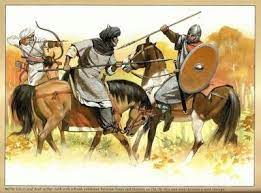
Abdul Rahman sent his heavy cavalry first thing to clear the road.  True, they had to ride up hill and through trees so they could not build up to a good charge, but they were experienced at moving through all sorts of unfavorable terrain, and they quickly came to the Frankish line.  The Frankish archers hardly slowed them.

The Franks, to the great surprise of the Muslim cavalry, stood like a stone wall.  As horses crowded against each other, the men on their backs became easy targets for Frankish spears and javelins.  The Franks were supposed to break and run away, like all barbarians did, but the Saracens instead began to fall in great numbers.

One Muslim commander held back to judge where Charles would most likely be.  He led a concentrated charge on that spot and almost broke through.  For a few brief moments, Charles got exposed.  Three men on foot, one of whom was the commander, having lost their horses, faced Charles, and thought the day was won.  Charles pulled Caliburn and easily sliced the first man across the middle.  The second man, the astute commander, parried Charles’ sword, so Charles did what he had been told and thrust—an utterly unexpected move.  Caliburn sank deep into the man’s chest.  The man knew instantly that he was dying, but he grinned as his hands grabbed the sword.  His fingers and thumbs got cut off, but he yanked the sword right out of Charles’ hand as he fell.  The third man smiled, thinking he had Charles trapped, but Charles called.

“Caliburn,” he said, and the sword vacated the commander’s chest and flew back to Charles’ hand.  The third man, wide eyed, turned and ran away as Tomberlain, Roland and a dozen veterans came to drive off the rest.  To be sure, Ragenfrid’s elder sons, Bernard and Adalbert were in the front of the line to rescue Charles.  The Franks closed-up the gap, and that one man running away started the retreat.

With his heavy cavalry beaten back, Abdul Rahman realized that this would not be as easy as he supposed.  He took nearly an hour to think about it, while Charles, Roland, Tomberlain, Owien, Wulfram and all of Charles’ commanders and sergeants, and eventually all of the Frankish nobility shouted.

“Hold the line.  Archers to the front.  This isn’t over. The battle has just started,” and many encouragements to get the men ready.  Hunald also picked up the yelling, and it helped his men.  The men of Aquitaine were shaking and might have broken if not for the courage of the Franks beside them.

This time, Abdul Rahman thought to send his light cavalry.  He had fifteen thousand to send, and he figured they would wend their way up the hill and through the woods better than the heavily burdened cavalry he normally depended on.  Many of the light cavalry were Berbers who rode smaller, more agile horses, almost ponies, and they did not need as much ground to get up a good charge.

The Franks, however, were just beyond bowshot of the trees.  While the light Muslim cavalry had practiced at shooting bows from horseback, they could hardly draw a bead on the enemy when the minute they popped their heads out of the trees, they got shot.  This kept them from even getting started in any sort of charge, until one commander forced them forward.  They were not going to ride in and out of range and hit the Franks with volleys of arrows, at least not without being hit in return, so they drew their swords and attacked.  Again, the Franks were unmoved, and while these smaller horses did not get tangled up the way the big horses got in each other’s way, the toll on the Muslims became even more devastating.  Wulfram had been right as far as it went all those years ago.  In circumstances, such as close quarters, the man on foot had the advantage in being able to move, bob and weave.  Plus, these lighter cavalry men also had lighter armor, where the Franks had solid armor, mostly chain, that could stand up to many sword thrusts and even arrows.

It did not take long before the Muslim light cavalry called it quits and went back down the hill to rest.  Abdul Rahman gave them an hour and felt astounded that any barbarian army could stand up to such an awful beating.  He was not aware, though his commanders were, that Rahman’s forces were the ones getting the worst of the beating.

Abdul Rahman put his armor on and had his horse saddled.  He intended to end this and planned to throw everything he had at the Frankish line, including nearly ten thousand men on foot, to follow the horses.  That would leave only two thousand to guard the camp, but he was not thinking at that point about guarding the camp.  He got angry and stomped around like his personal honor was impugned.  How dare these Christians stand in the way of the armies of the Prophet.  He would crush them and kill them all.  As he mocked the barbarians for being impatient, one might say he became equally guilty of arrogance.  Pride, after all, is the first sin, and Abdul Rahman had plenty of it.

M4 Margueritte: Banners of Christendom, part 3 of 3

Charles moved at the beginning of September.  Abdul Rahman had groups of men looting and pillaging all over western Aquitaine.  He met Odo at the river Garrone and defeated Odo a second time.  Odo limped north and begged Charles for help.  Charles moved and expected to meet the Wali at some point in early October.  He noted that Abdul Rahman’s men had not moved into eastern Aquitaine, had avoided Tolouse, and had not come up to Bourges, but the rest of the duchy was being burned.

Margueritte and her family, and all the horsemen and footmen they could muster went to Tours.  She made a note of the flags and coats of arms on display.  Flags and painted shields became yet another relatively new thing, not well displayed in the past, if the lord even had a flag to display.  Then there were tunics with symbols worn over the armor so men could better tell the good guys from the bad guys.  But they were becoming the Middle Ages, leaving the old Roman world well behind, like ancient history, and making a new way of living and doing business.  Margueritte felt saddened by the fact that she could not build any public schools for all the children of the Franks, and Bretons for that matter, but she dared not.  She had introduced enough innovations and was already in danger of going too far.  Besides, the first university of sorts would not be built until Charlemagne and that monk, what’s-his-name, got around to it.

When Charles arrived in Tours he was impressed by her turnout, but he said something that Margueritte had forgotten.  “Do you think this is what that assassin meant when he mentioned the battle of Tours?”

Margueritte shrugged.  “It may be, and he said he wanted to change the outcome.  Too bad he did not say how the battle came out.”

“I know,” Charles agreed.  “And it has bothered me for these ten or so years.”

“Not yet.  The ten years are not up.”

“And I know this too.  I am fully convinced of the great potential of your heavy cavalry, but they are still like a half-cooked meal.  You need to keep them here with yourself in reserve.  If my veterans break, we may need them to defend Tours.”

“Between Tomberlain, Owien, Wulfram, Walaric and Peppin, we have over a thousand veterans, though not veterans who fought with a lance.”

“Keep them here.  I will take your footmen, and Tomberlain, Owien, Childemund and Wulfram.  You keep Walaric and Peppin with you.”

Roland came into the tent and Margueritte turned on him.  “You put him up to this, didn’t you?” she accused.

Roland wanted to say no, but he nodded.  “You are still weak from your wound.  The battlefield is not where you belong.”

Margueritte frowned.  “But maybe I do belong.  I have no doubt Abd al-Makti has come out of his isolation and is with Abdul Rahman.  In fact, it has been confirmed for me.  No doubt Odo’s men were affected by the man’s sorcery, and I fear your men, veterans though they be, may be affected in the same way unless you have some extraordinary protection.”  Margueritte got as blunt as she could.

“I will overlook the aberration in your defense of Pouance.  You once said we humans have to fight our own battles, and this we have done.  My men need to stand on their own feet or not, as God will decide.”

Margueritte looked down before she nodded.  “You are right.  The Almighty will decide.”

“Besides,” Roland added, though he almost started it up again.  “I suspect Abd al-Makti was behind your attempted assassination in the Vergen forest.”

“You need to live long enough to finish training the men,” Charles said, thought for a second, and added, “And hopefully a long and happy life.”

“Abd al-Makti was behind the attempt, but not for the reasons you think.  The man is a scholar, not a general.  For all his time hanging around armies and military men, I doubt he has learned anything and has no idea how it works, and he does not care.  He is a man who is so enamored with his own bits of power, he does not have room for such a strange subject.  He has others to do that work for him.  No, it is simple.  He has been told I am a danger to the plan, and for that reason he has tried for years to remove me or have me removed from the playing field.  The attempted assassination was desperation on his part.  But will he warn Abdul Rahman about our cavalry?  I doubt he could tell heavy cavalry from plow horses or describe the difference between a sword and a sheath.”

Charles’ hand went to his side.  “Caliburn served me well,” he said.

“And this battle may be the reason I gave it to you,” Margueritte said, and she took Roland out from the tent to have a little private time before he rushed off again to war.

Two days later, Charles, Roland and all their officers and lords, including Tomberlain, Owien and Count Amager of Tours, sat around a great fire with the Bishop of Tours who came to offer a blessing for the troops. That done, they sat and relaxed, and took an early lunch.  They would be moving out in the morning.

“It would be wonderful to know God’s will in all of this, to hear his voice, but that would be too much to ask,” the bishop said.

“I would like to know what pit of Hell these Saracens came from so I can put them back where they belong,” Charles suggested.

“To actually hear God’s voice would certainly be something,” Count Amager said.

Roland saw Margueritte come up to talk a moment with Tomberlain, and he spoke up.  “I don’t see why that should be so special.  I talk to God every morning when I wake up, and God talks to me and reminds me of everything I need to do that day, and how I need to set a good example for my children and the people in my care, how I always need to consider grace and mercy, and justice, and how peace is better than war.  Let me tell you, talking to God sends shivers down my spine.”  The others looked at him with staring, open-mouthed expressions.  “Yes,” he continued.  “What is most remarkable, however, is how much God sounds like my wife.”

The men paused before the laughter broke out.  Their eyes turned toward Margueritte, who had turned and heard enough.  She felt a response was necessary, so she said, “In the immortal words of my sister, Elsbeth,” and she gave Roland her best raspberries before walking off.  Of course, the men merely laughed harder.

###

When Charles moved down from Tours, he put Saint Catherine’s behind him and took a position off the road to Poitiers.  He set his men behind a wood at the top of a slight rise and waited.  Charles had ten thousand men in his army, and another five thousand veterans from various campaigns.  He also had five thousand conscripts whom he sent off to gather the necessary food stuff from the countryside, and while twenty thousand was not the largest army in the world, he was confident that his was the best

Abdul Rahman would have to travel up the road with his main force if he wanted to get at Tours and the abbey of Marmoutier, which was Saint Martin’s.  The abbey was said to have riches beyond dreams, which it did not have, and Christian relics, which the Muslims loved to destroy.

“He could sidestep in this area and go across country,” Wulfram pointed out.

“We need to hope he does not,” Charles said.  “There is no better position for what we are facing between here and Tours.”

“Let me see if I can do anything,” Roland said, and he left Charles’ tent to talk to Margueritte’s people.

Since our Lady is in Tours,” Birch spoke.  “She said it would be best to help you here, but it is for you to decide how we may best serve.”

Roland considered the elves, brownies and kobold, the hundreds of gnomes and dwarfs, and the goblins who waited his command.  Hammerhead the ogre even brought his whole family to help, if they could, and there were trolls and hobgoblins and others that he had never seen, but he knew them all, being married to Margueritte.  It became a heady experience, but he felt a deep, abiding love for every one of them and he hated the idea that any of them should be hurt. Then he had a thought.

“Can you make yourselves appear to be Frankish soldiers?” he asked.

“What did he ask?”

“He wants us to pretend to be human beanings?”

“Eww,” the little ones objected.

“It’s a terrible idea, Lord,” Grimly said.  “You ask a lot”

“Just pretend,” Roland said.  “To trick the enemy is all.  I thought you liked to trick people.”

“What us?”

“No, never.”

“Wouldn’t dream of it,” the little ones said.

“Well, just do it,” Roland responded.  “And here is what I want you to do.”  He explained his plan, and they understood right away.  Roland thought, for people who did not like tricking people, they took to the idea without a second thought.

“Right Lord,” Luckless said at last.  “Now where do you want us when the battle starts?”

“Nowhere near the battle,” Roland answered, and some of the dwarfs and some others threw a fit, until a hobgoblin named Ringwater stepped up with a proposal.

“Since you are forcing us to do terrible, nasty tricks on the Saracens, the least we can do is set a haunting in the woods to scare them when they move through to attack the Franks.”

“As long as you don’t have to stay in the woods,” Roland said.  “Margueritte would be very upset if I let any of you folks get hurt.”  The little ones all nodded and smiled at how much they loved their goddess and how much she loved them.

Roland finished by sending Larchmont’s men to scout the Muslims and keep Margueritte informed as to their progress. The very next day, Larchmont himself came in with Duke Odo, Hunald and five thousand men of Aquitaine.  Charles shook his head, but since this was their land, he could hardy tell them to go away.  He set them on his right where the hill went steeply up.  He figured there they would be less likely to break and run

The men of Aquitaine made the old duke stay at the back of the formation.  Hunald took command and placed two dozen horsemen around the duke.  They were to whisk him away if the Muslims broke through the line.  Charles said the Muslims were not going to break the line, so he had no need to worry.

“We have been practicing for this very engagement over the last ten plus years,” he said.  “I think we know our business by now,” but he had some private concerns.  He figured he could count on fifteen thousand men, while the men from Aquitaine and his conscripts could help, but he could not count on them.  Abdul Rahman came up the road with twenty-five thousand men in tow, and Charles figured they were all battle-hardened veterans.

************************

MONDAY

Tours.  There is a battle to be fought.  Until Monday, Happy Reading

*

M4 Margueritte: Banners of Christendom, part 2 of 3

Charles built his permanent army around his veterans, but then he had to pay them so they could support their wives and children, most of whom moved to Reims, so they could be there where the army quartered for the cold months.  Charles also worked his men sometimes in the cold months.  He knew what was coming, and in 732 it came.  Europe and even Rome trembled, but Charles felt vindicated.  The only thing he did not guess correctly was, instead of coming out of Septimania, the Muslims brought their massive army right over the Pyrenees from Iberia.

In March of 732, Margueritte got a letter from Duke Odo, and another from Hunald, even as they were appealing to Charles for help.  “Here is the way it went,” Margueritte said over supper.  “The old duke, and he must be well into his seventies at this point, he made an alliance with one Uthman ibn Naissa, a Berber ruler in Catalunya.  He feared the Muslims, that they would try again, and at his age he did not imagine he had the strength to fight them off again.”

“I am understanding something about age these days,” Peppin said quietly

“But he won the battle of Toulouse.” Walaric said, while Tomberlain and Owien sat silent to listen.

“Handily,” Wulfram added.

“But there were circumstances, like the Muslim commander got lazy and did not set a good watch during the siege, and Duke Odo came on them unprepared, and took them by surprise.  He cut them down before they could mobilize their cavalry, and the odds of all that working a second time in his favor are like none.  But according to Hunald, Duke Odo thought an alliance with the rebellious Berber would put another friendly land between himself and the Emir of Al-Andalus.  Apparently, Odo gave his daughter Lampagia to the Berber as a bride.”

“You mean a bribe,” Margo said quietly, and Margueritte nodded.

“But it all came down in 731, last summer,” she continued.  “Charles came out of Bavaria to march up to face the troubles in Saxony, but Odo did not know that.  He feared Charles would attack him for making the alliance.  The agreement with Charles was Odo could rule in Aquitaine, but he would defer to Charles on dealing with any outsiders.  So Odo kept his army at home while Charles marched through Burgundy, up along his border.

“Meanwhile, the Wali of Cordoba…  Wali is like a governor-general, like the Romans used to have a Magister Millitum for a province.  The Wali, a man named Abu Said Abdul Rahman ibn Abdullah ibn Bishr ibn Al Sarem Al ‘Aki Al Ghafiqi, brought his first line troops against the Berber.”

“There’s a mouthful of a name,” Elsbeth said.

“Worse than a name for a Beanie,” Jennifer interjected.

Margueritte nodded.  “And it seems the Berber, without help from Odo, got killed.  Hunald says his sister probably got sent to some harem in Damascus.  But now Odo is between Charles and the Muslims, the old rock and the hard place, and he doesn’t know what to do.  And now the Muslims have an excuse to cross the Pyrenees and take Odo’s land, and the Duke does not see any way to stop them.  Hunald says Abdul Rahman brought his army over the mountains, in early February, and he fears the Vascons will not resist, and Abdul Rahman will overrun Tolouse this time, and they won’t be able to escape.”

Margueritte stood and put down her papers, while Owien asked the operative question.  “What can we do?”

“Go home and train your young men, as planned.  Tomberlain has the Sarthe area.  Peppin has the Mayenne.  Owien, you have the Mauges, south of Angers, south of the Loire, while Wulfram has the north and east, between the rivers and Baugeois.  Walaric, I want you here in Pouance and to work with Captain Lothar on all the men from Segre and Haut.  I will write to Count Michael and Count duBois to be sure they are ready.  We follow Charles.  We have to wait and see what Odo and this Abdul Rahman do.  But be prepared to come on short notice.  No one under eighteen, and no first-year students, but you will need to bring as many as you can, footmen as well as horsemen.”

“Where?”  Tomberlain asked.

Margueritte thought a minute.  “Tours,” she said.  “We will all pay Amager a visit.  From Tours, we can head wherever we need to go in Aquitaine, and we can see what men he might add to our numbers.”

###

It became a warm June before Margueritte got another letter from Aquitaine.  Odo got badly defeated around Bordeaux, and now the city was under siege.  Margueritte sat down and wrote to Charles, who stayed in Reims.  What was he waiting for?  Odo would not be able to fend off Abdul Rahman by himself.  It became a scolding letter, and she would have to think about it before she sent it.  She went for a ride.  Concord had gotten old, at eleven years.  A ride for him became more like a walk.  Calista rode with her, but no one else bothered them.  They went out into the Vergen forest, on one of those trails Festuscato marked out years earlier.  This one came near the main road to Vergenville, and Margueritte eventually turned her horse to the road.

“I don’t know what to do,” she admitted.

“I don’t know if you have to do anything,” Calista said.  “Of course, I don’t know how humans work, exactly.  I know what you have told me about Islam, and it sounds terrible and dangerous, but I have heard from some of your little ones living in Iberia, and they say it isn’t so bad.  Of course, that is from an elf perspective.  I don’t know how humans work, exactly.”

“You said that,” Margueritte sighed and she saw Calista whip out her bow.  An arrow from some foe hidden among the trees struck Margueritte in the side, and she had to cling to her horse.

“Quickly,” Calista helped get the horses off the road and helped Margueritte get down and sit, leaning against a tree.  Calista fired an arrow, and quickly fired two more, and Margueritte had a stray thought.

“Poor Melanie.  You are going to get ahead of her.”

“No, Lady.  She got six Saxons and two Thuringians back east.  I am still six behind.”

“Wait six and two is eight.”

“Yes, Lady,” Calista let loose an arrow and announced, “Five to go.”

The arrows trying to get at them stopped, and a half-dozen Saracens charged.

“Hammerhead,” Margueritte yelled the name that came to mind, even as she once yelled the same name close to that very place, so many years ago.  The ogre came, and so did Birch, Larchmont and Yellow Leaf.  Only Luckless and Grimly were missing, but they had duties to attend back in the castle.

The Saracens did not last long.  This time, one made it back to his horse to ride off, but Larchmont and Yellow Leaf went after him, so he did not get far.  Fairies can fly much faster than any horse can run.

Calista complained.  “Thanks.  Melanie is still three ahead of me.”

Margueritte tried not to laugh.  It hurt too much.

“Lady.”  Hammerhead picked her up, gently, and Margueritte tried not to throw-up from the smell.  She closed her eyes and thought about flowers while Hammerhead carried her to the Breton gate.  The guards on duty balked at letting in the ogre, but they knew Birch, and Margueritte, of course, in the ogre’s arms.  They also knew Calista and the two horses she brought that shied away from the ogre.

“Open up, and be quick,” Birch said.  He stood in his big form and looked like a true Lord.  They opened but kept well back as Hammerhead brought Margueritte to the house.  He laid Margueritte down and backed off so men could carry her inside.  Hammerhead remembered he was not allowed in the house, so he sat by the oak sapling and the bench and waited.

Elsbeth and Tomberlain held Margueritte’s hands and called for Doctor Pincher.  He came and scooted everyone from the room, but let Jennifer stay.  Margueritte lost a lot of blood, but he said she should recover.

“It will be a few weeks in bed and several more of low activity.  We will have to watch to be sure she does not get it infected.  Keep it clean and clean cloths,” he said, and Jennifer said not to worry.

After those three weeks, as Margueritte first stood and thought about trying to go downstairs, Roland came roaring into the castle with twenty men on horseback.  They were all older men, traditional horsemen, Childemund among them, but they had all seen the lancers fight the Saxons and Thuringians, and they were anxious to get their hands on such weapons.

Roland held Margueritte and carried her down the stairs.  He became so cute and attentive, Margueritte almost got tempted to stay injured for a while.  Soon enough, though, she was able to sit for supper in the Great Hall, and she spoke from the end seat, where her father used to sit.  She wanted Roland to take the end seat, but he would not hear it.  He took her mother’s old seat so he could cut her meat, if she needed his help.

Jennifer sat on Margueritte’s left, opposite Roland and next to Tomberlain and Margo.  Owien and Elsbeth sat next to Roland.  Margo kept Walaric’s wife, Alpaida next to her.  Alpaida was still not entirely comfortable with the fairies, elves, gnomes, and dwarfs that occasionally popped up around the castle, though she had no complaints about Lolly’s cooking.  Walaric sat next to his wife, and Wulfram sat beside him.  On the other side, Childemund sat next to Elsbeth and Sir Peppin, and Captain Lothar sat across from Wulfram.

Tomberlain stood and toasted his family, and he counted everyone at the table like family because they had become that close.  Then Margueritte asked a question that started everything.

“What is Charles playing at?  He knows he has to come out and fight while there is time.  Odo cannot do it alone.  He should have gotten the message from Bordeaux.”

“He wants Odo taken down some before moving.  And I agree, it is a dangerous game.  Odo may lose entirely, and Abdul Rahman may be emboldened by the victory.”

“We will be ready,” Owien said.

“But we fight for Charles,” Tomberlain reminded him.  “Right now, we have to wait until he calls.”

“He may be waiting for winter,” Wulfram suggested from the far end of the table.  “These Saracens are used to the hot weather.  I was thinking they have not experienced the kinds of winters we have.”

“I just hope he does not wait too long,” Peppin said, and he nudged Childemund who looked up with a dumb look on his face.

“What?  I’m just enjoying this apple pie that Lady Elsbeth did not make.  I am attacking it, and the pie is going to lose.”

M4 Margueritte: Banners of Christendom, part 1 of 3

Jennifer did not say anything for a while.  They watched the changing of the guard on the Paris gate, and some young men who were struggling with wooden practice swords and shields.  A wagon load of hay came in the Breton gate and headed for the barn, and then Jennifer spoke.

“It must be beautiful over by the Rhine,” she said.  “I’ve never been there.  Father brought us over from the new world because he felt called.  He said you were calling him, by the way.  I don’t know.  It was a long journey, but we came to Amorica, and Queen LeFleur welcomed us, so here we stayed.”

“Are you glad you stayed?”

Jennifer nodded.  “I am glad for everything, but I miss Aden terribly.  I know human life is short, and I am prepared for that, for myself, but I never thought to lose Aden so young.”

“Not so young,” Margueritte said.

“Mercy is just eleven.  She has had Sylvan for company for a long time.  I am glad she has Brittany and Grace here, and Walaric’s daughter Gertrude, who is twelve and more company for Brittany, I suppose.”

“What do you think of Walaric’s wife?”

“Alpaida?” Jennifer thought a moment.  “She seems very nice.  I can’t believe she is talking about getting pregnant.”

“I know.  I can’t believe Margo and Elsbeth are pregnant.”

“I believe it about Elsbeth,” Jennifer said.  “She lost one young.  That must have been hard.  But she says she never felt better than when she was with child.  I don’t understand that.”

“Peeing in the bed in the middle of the night, rashes and a butt bigger than a horse,” Margueritte shook her head and Jennifer covered her mouth as she laughed.

“But tell me about the Rhine,” Jennifer changed the subject.

“Well, Ingrid calls her home Wesel.  It was Horegard’s father’s name, who I never met.  But the river is about like the Loire, too wide and deep to cross without a boat.  Ingrid is building a bridge across the river there and plans to build a walled village on the other side, where the Lippe River meets the Rhine.  She says she can’t resist, now that she knows there is a bunch of undeveloped river land there that is claimed by the County.”

“But you are building a place, too.”

“Another castle,” Margueritte nodded.  “And they are cutting great blocks of stone for the walls and towers.  It is on as close as the area gets to a hill and overlooks the Rhine and all the county land that Horegard probably did not even know belonged to him.  You see, the March around Wesel, that is south and west of the Rhine stops several miles from the Meuse.  But on the other side, it is bordered mostly by rivers.  The Issel River forms the north border until it meets the Bosch.  That is where the county bubble begins as I call it.  North of the Bosch, east of the Dinkel, south of the Vechte, and then west of the Issel until you reach the place where it turns away from the Rhine.  Draw a straight line to the Rhine, and that is quite a bit of land.”

“A big bubble,” Jennifer nodded, but she could not really picture it.  “But are there not people living on all that land.  It seems to me the human race is moving in everywhere.”

Margueritte nodded.  “More people of old Frankish descent than you might imagine, But Saxons moved into the eastern part decades, maybe a century ago, and the Frisians filled up the western part.  It has been difficult claiming the land, and some Saxons and Frisians who were not Christians or not willing to acknowledge Roland and pay their taxes were moved.”

“It sounds like terribly hard work.  And how did those people take to being moved off the land?”

“No reaction yet.  They understood the rules well enough so there was no misunderstanding.  And I think it is not that many years since Charles whipped the Saxons and the Frisians, so maybe there is not enough support to go to war over it.  I hope anyway.”  Margueritte smiled for her friend who had truly become like a sister.  “You could come visit, and I could show it all to you.”

Jennifer shook her head.  “When I was Little White Flower, I could not keep still.  I wanted to go everywhere and see the world.  My father brought us all the way across the ocean because he had to move.”

“The little ones are like the wind,” Margueritte agreed.  “They carry the seeds and drive the animals to new places and help them adapt to new environments.  They fall with the rain and snow, and push the heat up from beneath the ground, and keep the earth balanced, green and growing. They keep the world turning, and the human race has no idea.”

Jennifer nodded to all that she said but continued her thoughts.  “But since I have become human, I find home is the place I most want to be, even though I cry in the night for missing Aden.”

“And you still have young ones,” Margueritte pointed out.

“Yes, but in ten years or so, when Mercy is happily married, I think I may visit Saint Catherine’s de Fierbois.  My faith is not what it should be.  I feel the nuns there may be what I need, perhaps for many reasons.”

Margueritte said nothing to argue or talk her out of it.  Mercy was eleven.  Jennifer would have plenty of time to make her own decision.

Three days later, Childemund arrived from Paris and complained.  “What happened to my quiet little farm?”  Then he asked, “Got any apple pie?”

Margueritte took him to where he could help himself, and then opened her letters.  Roland’s got opened first, and Jennifer, Margo, Elsbeth and Owien, and Alpaida were all there waiting for her to read the letters out loud, so starved were the people in those days for any such news.

Margueritte read quickly, and her face turned red from anger.  She tore open Charles’ letter and got confirmation.  Then she spoke.

“The minute I left, the minute I left!” she repeated the words.  “An army of five thousand Saxons crossed the Dinkel and began rampaging though county lands.  Bertulf quickly raised all he could get on short notice, while Theobald waited for men from Cologne and as far away as Tournai and Metz.  Bertulf had five hundred foot soldiers and five hundred lancers, mostly squires, but only those who had three or so years of training, and that included the older men.  He did not want to risk recruits on horseback.”  Margueritte let out a loud, “Grr,” and slapped the papers to her knee.  Owien took them to read for himself as Margueritte continued.

“Roland says Bertulf and the lancers drove an army ten times their size right back across the Dinkel.”  The women looked happy and Elsbeth applauded, but Margueritte made them pause.  “Wait.  They found ten thousand more Saxons and Turingians massed on the other side of the river.  Facing fifteen thousand men, Bertulf withdrew and affected a strategic retreat all the way back to the Rhine, where he crossed over to my castle and prepared to make a defense.  Fortunately, it was not much later Roland showed up with Charles and the whole Frankish army.  Right now, Charles is driving the Saxons back.  And according to Roland, he intends to crush the Thuringians, maybe as far down as the Main River.”

“But that is good news, isn’t it?” Margo asked.

“They will probably have to stop when the weather turns.  And if Charles thinks I am going to take on the work of patriating a bunch of stubborn, two-faced Thuringians, he has another think coming.”

“Roland says it was Oswald, the elf King in the area that said the Thuringians were behind it all,” Owien reported.  “Maywood confirmed it.  He says they egged on the Saxons, calling them cowards and such.”

“The minute I left!” Margueritte repeated.

“Your reputation as a witch scared them,” Elsbeth said with her best, sisterly smile.

“I am not a witch,” Margueritte yelled.  She felt obliged to respond with appropriate volume to the sisterly dig.

“Charles says he is impressed with what your lancers can do, and Roland says he is trying them in different settings and, I quote, drooling like a boy presented with a new toy.”

Goldenrod flew in the nearest window and came straight to Margueritte.  “We got mail?  I like mail.”

Owien finished reading and handed the letters to Margo.

“And where are the girls?” Margueritte asked.

“Sorry.  They had to go around the long way,” she said, even as the young girls burst through the front door.  The young women, Morgan, Lefee, Gisele and Larin came a few minutes later.

###

Margueritte sat down right away and wrote long letters to Roland and Charles.  She told Roland she missed him, and he knew where she was.  She would be returning to Wesel in the spring of 733, but she hoped to see him before then. She also said if he did not knight Bertulf right then and there, and probably several others as the campaign moved into Thuringia, she would just have to do it herself.

She told Charles that she would gladly work his suggestions into her training regime, but she did not expect a forty-five degree turn in full charge would work.  She would think of something, and meanwhile, how dare he take half-trained men and especially boys into a war like that.   He could have them to play soldier in 734, and not before.

Margueritte reminded Charles that these were still summer soldiers, who planted in the spring, came to train in the summer, but went home in time for the harvest.  True, they took their horses and equipment with them, and they were encouraged to continue their training and their learning over the fall and winter.  In some cities, like Cologne in the east and Laval in the west, the young men often gathered to continue their training together, but they were still summer soldiers.  She was glad he had found them disciplined.  They needed to be on horseback.  He needed his permanent foot army to be equally disciplined, but he knew that.

Charles brought his army to Reims after dealing with the Thuringians.  Reims was a city in Neustria, but near the Austrasian border, and not too far from Burgundy.  From Reims, he could bring his army out and be anywhere in Frankish lands, short of Provence and Vascony in less than a week.  But until Charles built his army and kept it together and quartered it for the winter, he, like every other Germanic king and lord, had to settle for summer soldiers.  Armies in northern Europe went home in the face of winter.  They might come out to fight as early as mid-March, but if the issue was not decided by mid-October, it would not be decided that year.  In general, it was not a good way to build an army.  No telling if the farmer could use his sword, or if he might run away at the first sight of the enemy.

M4 Margueritte: A Few Words, part 3 of 3

They heard a noise from the far door.  An old nun dropped her mop and her bucket and shouted.  “An angel.”

Tulip instantly got small and shot for Margueritte’s shoulder where she could hide in Margueritte’s hair.

“Relindis.  I saw the angel you were speaking to, and the angel vanished.”  The old woman ran off before the other could stop her.

Margueritte stood.  “I’m going to fetch some tea,” she said.  “Tulip, why don’t you sit on Relii’s shoulder and play with her hair for a while.”

“Yes, Lady,” Tulip said, and she zipped to Relii’s shoulder and whispered something in her ear that made Relii laugh.

With tea and little snacks, the afternoon seemed not so bad.  Tulip made a home on Gisele’s shoulder, and Gisele made no more complaints about being forced to travel for the rest of the trip.

The next morning, they began the journey up the Meuse River to Verdun. In Verdun, they picked up the old Roman road which they followed all the way to Paris.  It had gotten in terrible disrepair is several places, but for the most part, it still pretended to be a road.

They stayed three days in Paris, and Margueritte got visited by everyone, including the archbishop, who declared at this point she was as near to a queen as the people had.  Margueritte rolled her eyes.  She had enough on her plate, and besides, Roland would never go for it.

In Paris, they said goodbye to Tulip, and it became tearful, but Margueritte called Goldenrod and told her to tell Jennifer they were in Paris and would be home in a week or ten days.  She told Goldenrod that she would call her to join them in the morning, but Goldenrod still got surprised when it happened.

“Now, Goldenrod.  You need to get big so the girls can see you and recognize you in your big form.”

“Do I have to?”  Goldenrod flitted gently back and forth like a leaf caught in the wind, a very different reaction than they got from Tulip.

“Yes, dear.  You have to, please.”

“Okay.” Goldenrod changed her mind, and stood to face Brittany and Grace, looking for all the world like a fourteen-year-old girl.  Brittany and Grace were delighted at the prospect of having a fairy near their ages.  Margueritte later explained to Gisele.

Goldenrod is actually seventy-seven years old, but they age so slowly, it is hard to tell.  They also mature slowly, so Goldenrod is about like a twelve or thirteen-year-old as far as her maturity goes.  Sorry to saddle you with three pre-teens, but hopefully they will help with Gerald.”

“Not likely,” Gisele said, but she smiled.  “But your lady friend, Calista has been a great help.”

“Then you should know,” Margueritte said, with a sly elf grin.  “Calista is an elf.  Don’t be fooled by the glamour she wears that makes her appear human.”

“Lady,” Gisele returned the smile.  “If anyone else said that I would call them mad, but in your case, I suspected it was something like that.”

The Paris Road did not seem in bad shape.  Margueritte guessed Tomberlain or his men worked on it, at least the section through Maine.  The road went north of LeMans, but they came through Laval and stopped in Craon where they visited Peppin’s family.  The family sergeant looked old and worn, but he said good things about Tomberlain’s rule over the county, and good things about Owien as well, and that helped Margueritte relax.

“My chief concern in all of this is to have a thousand heavy cavalry to send to Charles by the due date of 734.  If I can raise a second thousand in the east, all well, but this side of the nation has had several years head start.”

“Don’t worry,” Peppin assured her.  “We may have twice that by 734.  We have a thousand already who are fully trained, as well as we can get them without testing them in battle.  They are beginning to train other young ones.  The work is spreading out.  Pouance is not the center it used to be.”

In fact, Pouance seemed almost quiet for May.  Several of Wulfram’s men and several from Peppin in Craon were there, and a Captain Lothar had the castle and town well defended, and the young ones who came well in hand.  There were more than a hundred young men there, but there were also nearly fifty older men from that area trying to catch up with the new way of doing things.

“Count Michael down in Nantes, and Count duBois in the north are both training their own men, and the Counts Tomberlain and Owien have training going on in LeMans, Laval and Angers, so you see, it isn’t just here,” Captain Lothar explained as they came up to the Paris gate.

Goldenrod could not contain herself by then.  She squirted ahead and hugged everyone on the cheek, Jennifer twice, and then she disappeared by the kennels.  The gate was open of course, to welcome Margueritte, Lady of the castle, and Margueritte felt some Goldenrod impatience herself and could not wait to jump down from her horse and run to hug Jennifer.  She hugged Marta and Maven and would have hugged Lolly if Lolly had not been busy scolding Luckless for being away for so long.  Grimly sauntered over to the stables where Pipes and Catspaw were waiting, and he settled right back into their company without so much as a word.

Morgan, who was nineteen, and engaged, and Jennifer’s Lefee at eighteen were there to welcome and hug Gisele.  “And Larin will be here any day,” Lefee said, cheerfully.  “The gang back together.  You remember Larin, don’t you?”

“Yes, the little one who kept following us around.” Gisele said.

“She is fifteen now, and thinks she is all grown up,” Morgan said with a roll of her eyes.

“I remember being fifteen,” Gisele responded with a laugh.

Weldig Junior and Cotton were there for the boys, and Pepin and Martin wasted no time getting reacquainted, though they did not hug so much as punch each other in the arms and slap one another’s backs.  They were all pages, and Captain Lothar said he would gladly put them to work and keep them busy.

Carloman was a bit left out, until Jennifer stepped up and handed him a book.  It was Bishop Aden’s book on Greek.

“He would want you to have it,” Jennifer said, and Carloman hugged her and offered his sympathy at her loss.

Jennifer’s Mercy was eleven.  Marta’s Sylvan was ten.  They looked hesitant as Brittany and Grace cane up to them and stopped.  But Grace could not hold herself back.  She and Mercy hugged and cried like they were four years old all over again.  Brittany did not mind someone to hang out with other than her sister, but she did not want to be stuck with the ten-year-old.

“Lady, Lady.”  Goldenrod came rushing up.  “Puppy Two remembers me.  He does.”

“Of course he does.  It has only been eight days,” Margueritte said.

“It has?” Goldenrod wondered, like she thought it was forever, but then her mind moved on and she flew over to sit on Brittany’s shoulder and hear what the girls were talking about.

Calista came up with Gerald, and Jennifer, Marta and Maven all fussed over him, and Lolly promised him special honey treats.  Gerald looked up at his mother with an expression that said this might work out after all.  Walaric had a boy who would be eight in July, so at least Gerald would not be alone.

They went into the house and settled sleeping arrangements.  Apparently, Jennifer sent for Owien and Tomberlain as soon as Margueritte got within range.  She expected them to show up any day, and then things would be naturally hectic again.

“Well, at least they finished building the castle,” Margueritte said.  “I no sooner left this mess than I went over to the east and started a new mess.  I don’t think there will ever come a time when I am not building something.”

Tomberlain arrived first with Margo and the children, and plenty of men at arms, all on horseback, though most were still rather young.  Owien and Elsbeth and their children arrived the next day, and their men looked just as young.  Tomberlain picked up Peppin and some older men along the way, and Owien brought Wulfram and his men, so as Jennifer predicted it became a madhouse around the castle.

Margueritte sat on the bench that used to be beside the old oak, and once sat in the middle of the triangle of buildings that made up her childhood home.  Now the triangle, with the old chapel and annex across the road, and a good bit of land cleared from the forest and the edge of the fields had all been surrounded by a great wall of stone joined by seven towers.  The chapel looked the same, but all the buildings that surrounded the courtyard were new.  Her greatly expanded home appeared unrecognizable.  The barn, moved near the farm gate, looked brand new, and bigger than ever, and it had a long stable attached.  Down by the farm gate itself there were new pens for the hogs and sheep, and the new kennels where Puppy Two started getting old, and great forges for the smiths that worked and lived in the old tower, a tower she hardly recognized since it had been renovated and attached to the wall.

Margueritte turned her head around to where the old oak once stood at her back.  It had been dug up and an oak sapling planted in its place.  It took well to the soil and would no doubt grow into a great tree, but it would be a generation before it offered any shade on a hot summer day.  Margueritte cried a little.  Her mother loved that old tree.

Margueritte turned her eyes back to the chapel and passed over the barracks for the castle guard that sat against the wall beside the Breton gate.  Jennifer came out of the chapel, and Margueritte slid over to give her room on the bench.

************************

MONDAY

Time has moved on.  Tours is threatened.  Charles need to bring the army.  Christendom is in the balance.  Until next time, Happy Reading

*

M4 Margueritte: A Few Words, part 2 of 3

Three days after Gerald turned six, the day the last of the local snow melted, Margueritte packed everyone, got up on old, faithful Concord, and set out.  Gisele bravely rode in a wagon with Brittany, Grace and Gerald.  Carloman, Pepin and Martin had horses of their own.  Walaric was going home to the Breton border where he confessed his wife and children had not seen him in five years.  His troop got filled with most of the border men he brought when Margueritte came to the Saxon March in 726.  They were all going home.

“Drogo, my number one, the man knighted by Roland when he came with Pepin, Carloman and Gisele, is more than qualified to take over the training of the squires,” Walaric explained.  “With the Baron Theobald and his brothers, Cassius and Geoffry, they will build a whole army of horsemen.  What is more, the baroness Ingrid’s daughters have their new husbands involved in the work.”

“Clara in Tournai and Thuldis in Metz,” Margueritte nodded.  “And Clara has already said her daughter will not marry any man unless he is knighted.”  The medieval world progresses, Margueritte thought.

“Well, you have your Sergeant Bertulf watching the lands on the other side of the Rhine, and your Oswald and Maywood have both pledged to watch over the area.  Plus, Luckless has Lolly’s family on the watch in the hills, and Grimly has gathered a whole tribe of gnomes under Chief Horshank, and they will help with the animals, as may be.”

“Sounds like you have everything figured out,” Margueritte said.

“They are your resources, but I try to be thorough.”

“And what do you think about all these resources?”  It could be a lot for ordinary humans to take in, and she never really asked the man.  She just stuck him with a bunch of little ones and let him figure it out.

“Well,” Walaric took a moment to consider the issue.  “Most of the men and boys have no idea that such is the case.  Luckless got very good about making sure everyone kept quiet and people generally did not find out the truth.”  He paused to think again.  “It is a strange world you live in, but in truth, it has made life kind of interesting.”

“That is what Julius used to say.”

“Julius?”

“A Roman.  He lived three hundred years ago.”

Walaric grinned.  “I’m glad I keep telling people you are not a witch.”

“Are you happy to be going home?” Margueritte changed the subject, and Walaric nodded.

They stopped the night at Aduan’s house, at the edge of the march, near the town of Aldeneik.  Aduan’s eldest boy, Dombert, who had just turned eighteen, said hello to Gisele, but he talked all about the virtues of a young lady named Bertrand.  It took Margueritte a few hours to figure out that Bertrand was the daughter of Hildegard, Count Adelard’s daughter-in-law.  Margueritte remembered the awkward dinner party that she and Sigisurd and Boniface attended in Count Adelard’s home.  Hildegard and six-year-old Bertrand said nothing during the meal and kept their eyes lowered the whole time, while Hildegard’s son, Poppo, made rude noises and threw his food.  Poppo was a page now, and as annoying as ever.  Margueritte felt glad that Captain Ragobert was one who would not put up with any funny business.  Then Margueritte thought she really needed to keep her twentieth century expressions to herself.

Aduan’s daughter, Corimer turned fourteen and she could not decide who she wanted to eat with her eyes, Carloman or Pepin.  Fortunately, Pepin and Martin escaped before dark, and Aduan’s youngest boy, Lavius, a twelve-year-old, followed them to the barn.  Lavius complained about wanting to be a page, and how terrible it was that he had to wait another two whole years, and how if he was made page to squire Dombert, his brother, that would stink worse than rotten eggs.

“I think the rule is you can’t be page or squire to a member of your family,” Pepin said.  He had memorized everything.

“Still, it would be funny,” Martin said, and Martin and Pepin ran off laughing, with Lavius chasing them.

The trip from Aduan’s to the town of Aldeneik took less than two hours.  Margueritte remade Hildegard’s acquaintance and met Bertrand all grown up.  Bertrand, a lovely young woman, thrilled to take Gisele shopping, and she wanted to talk about Dombert, and no doubt Childebear.  Meanwhile, Hildegard curtsied to Margueritte, went right to the ground in the market square, which embarrassed her.

“Countess,” Hildegard said loudly, and Margueritte could not help returning the curtsey, even if it was not so deep.

“Viscountess,” she said, but not so loud.

People heard all the same, and they quickly scrambled to put out their best, and at reasonable prices.

“I think I may find what I want today in the market.  I hope you don’t mind.”

Margueritte did not mind.  “Have we come out of our shell and become our own woman now?”

“We have,” Hildegard said.  “We had no choice.  The count is so feeble these days, and most of the time he has no idea who I am or thinks I am his maid, and Thierry will not leave Charles’ side long enough to come home.”

“So, we are making all the decisions these days.”

“We are.”  Hildegard said with a little smile, before they got interrupted by the shopkeeper.

“That’s how royalty talks, now you get back to work.”

“We are going,” the boy imitated, and ran.

“We are not amused,” Margueritte whispered.  “I always wanted to say that.”

Hildegard ignored her, looked at the linen on the stand, and checked the colors against the sun while she resumed the conversation.  “I have men clamoring at this point to be knighted.  Apparently, you started something.”

“Tell them it isn’t that simple.  They must prove their loyalty to the king, that is Charles, and to their country. They must prove their bravery in battle.  And they must show true Christian character by their acts of charity.  Gerraint says they must live up to the Christian ideals, to support the church, help the poor, defend women and orphans and so on.  If they qualify, and that is a big if, then the count can confer knighthood, but only on his own subjects.”

“The count can’t confer anything these days.  I doubt he would even remember who the men are.”

“Then Thierry.”

“But he won’t come home.”  Hildegard looked sad for a minute and Margueritte slipped an arm around her shoulder.

“I haven’t seen Roland but for a dozen weeks in these last five years.  Would you like me to write to Charles?”

“No.  I’ll be fine,” Hildegard said, as she wiped her eyes.

“Well, then the countess may do it.  Your act would do it, subject to your husband so to speak, but it is not something I recommend if it can be avoided.  I don’t normally think it is a good thing to have women reward men based on their ability to kill other men.”

“Yes, I see what you mean.  I’ll have to think about that, but I am pleased that by your qualifications, I can take most of the men off the list already.”

“Not Christians?”

Hildegard shook her head.  “Not exactly loyal or brave.  I don’t see them riding off to fight in support of Charles any time soon.”

Margueritte nodded and said, “I like that shade of yellow.”

“Our finest work,” the shopkeeper said, quickly.

Margueritte spent the afternoon in the abbey, visiting Relindis after acknowledging her sister Herlindis, of course.  Margueritte made Gisele, Brittany and Grace go with her while Calista kept Gerald and Carloman tried to keep Pepin and Martin out of trouble.  The girls protested, Gisele in particular, because she wanted to hang out in the market with Bertrand.  She came but pouted until Margueritte whispered that Relindis was a witch.

“You shouldn’t tell such things,” Relindis said, as she brought them into the mess hall where there were plenty of chairs to sit and talk.  “I am trying to be good.  The monastery finally got finished and dedicated this last year, and I have minded my prayers and my duties without complaint since then.”

“And so, you deserve a little reward,” Margueritte said.  “Tulip,” she called, and the fairy appeared.  “I have an old friend of yours,” she said, while Brittany and Grace clapped their hands in excitement.

Tulip remembered Relii right away, and Relii swallowed hard.  “I had forgotten.”

“So had I,” Gisele said.  “I never saw the women.  Lefee said her mother used to be a fairy, but I could not see it.”

“Lady Jennifer,” Tulip said.  “She used to be Little White Flower, and I heard she was very nice.”

“She is nice,” Gisele said.

“And you remember Lefee?”  Margueritte asked.

“Oh yes,” Gisele said.  “And the housekeeper’s daughter, Morgan, and the little one.  What was her name?”

“Larin.  She was Margo’s and Count Tomberlain’s daughter.  She should be about fifteen by now.”

“Still young,” Gisele said.

“But not so young when you are twenty-eight and she is twenty-five and you both have young children running around your feet.”  Margueritte smiled.  “It is all a matter of perspective.”  She turned to Relii and Tulip who were remembering when they met.  “Tulip,” she interrupted.  “Would you like to travel with us for a while.”

“Oh, yes,” Tulip said.  “That would be lovely.”

“You would have to ride with the girls here.  Could you do that?”

“Yes, if they would like me to.”  Brittany and Grace squealed in anticipation.

“Yes,” Gisele said, softly.

“That includes riding with a seven-year-old boy, Gerald, my youngest.”

“I don’t mind.  And Martin will be going with us?”

“Yes.  And Tulip, this is Gisele.  She is the daughter of Charles, the Mayor of the Franks.”

“Really?” Relii and Tulip both looked.  “I didn’t know Charles had any children.”

“Oh, yes,” Margueritte assured her.  “Her twin, Carloman is right now watching Martin and her younger brother Pepin get into trouble.”

“And I have two younger sisters,” Gisele said.  “Aude is fourteen and Hiltrude will be thirteen soon, and a younger half-brother, Grifo.  He is almost five.  He is Swanachild’s son.”

Margueritte interjected before Relii or Tulip could speak.  “Now Tulip, if you want to come with us, you will have to promise to hide around humans, and if you can’t hide, you may have to get big for a bit.  I think you should get big now so the girls can see what you look like.”

“Yes, Lady,” Tulip said, and she got big, and she appeared very beautiful, as all fairies should.  Gisele drew her breath in, and Relii spoke.

“I had forgotten.”

Tulip turned to the nun and scolded her.  “Now Relii.  Your memory is not that bad.”

M4 Margueritte: A Few Words, part 1 of 3

So, 730 became a busy year, and not just because Charles finally started to form his permanent army.  When he took back some of the church land, the church got up in arms.  Priests and bishops called him a thief, and said he was stealing from Christ himself.  One would think he was as guilty as Judas.  Margueritte wrote to Charles.

Do not be intimidated.  The good Bishop Aden, whom you know, says a bishop needs enough land to meet his daily need and no more.  Beyond that is the sin of greed and covetousness.  A bishop is an overseer.  He watches over the priests and the flock in his care. As long as he can feed himself and have a little something to share with the poor, let that be enough. As long as you are not telling him what to preach, he has no reason to complain.

Margueritte could practically hear Charles say he would like to be able to tell some of the priests what to preach.

Margueritte sent for Boniface, and he gladly came.  He heard terrible things about Charles on route, but after Margueritte explained things, he wrote many letters to bishops, to several archbishops, and even to the Pope, defending Charles’ actions.  Boniface may have been the first to point to Islam and say Christendom, by which he meant Europe, needed a champion.  The church backed off, but Charles, who had been the darling of the church until then, fell from grace for a long while.

730 was the year Aden died.  Jennifer’s letter said he was in Kernev, sharing the gospel, and some believers in the old ways rose-up and stabbed him until he died.  King David caught and executed the men, but now Jennifer felt all alone.  Lefee is sixteen and only interested in boys.  Cotton is thirteen, but he will be starting as a page next year (in the summer of 730), and Mercy is nine, and sweet, but she misses her best friend Grace.  If you could come home for a while, I miss you, Lady.  It is so quiet around here since the work has all moved to Angers and Lemans.  Pouance still belongs to you, by Owien’s decree.  Marta, Maven, and I have done our best to keep it, but you can visit any time.  My love, Jennifer, Little White Flower. 

Margueritte talked to her people.

Luckless said he actually missed Lolly.  Grimly said he wanted to go home.  Besides, they both said the men had taken over the forges, and the pages and squires were handling the barn and the stables just fine.  That was how it should be.  The horses certainly knew what to do, so Grimly got homesick.  Margueritte knew that no matter how long she stayed in the Saxon March, Luckless and Grimly would have stayed faithfully with her.  She felt a bit saddened to think that they would never volunteer what they were feeling.  She certainly could have known what they were feeling if she thought about it, but she did not.  Her general rule was to not violate the thoughts and feelings of her little ones, but it might not always be a good rule.

Margueritte took a moment to see what Calista and Melanie were feeling.  Both were content and would follow her wherever she went.  They loved the children, even the older girls who could only think of boys, and the older boys who could only think of girls.  Calista said that was the way it was supposed to work with humans, since they lived such short lives, but Melanie had other thoughts.  King Oswald, the local elf king, married Laurien, who became concerned about Oswald’s friend, Ridgemont, because he lived alone.  Melanie thought she might rectify that problem, though she had only seen Ridgemont that one time, and she had no idea if he returned her feelings.  Melanie would not waste away for wanting the elf.  Her feelings would fade in time if she never saw him again or if he did not share her feelings.  Margueritte could not stop herself from taking a look, and she got the impression that it might work, so she made a decision.

“Melanie,” she said.  “I am entrusting you with protecting Ingrid, Aduan and Sigisurd while I am away.  And their girls and boys and young children, too.  I know it is a lot, but I cannot leave in good conscience without knowing they are safe, and without Roland here, I don’t know who else I can turn to.  Walaric and Ragobert will keep the squires training, and Bertulf, with Theobald, Cassius and Geoffry will variously keep tabs on the land and taxes and such, but the women and children are my chief concern.  I have spoken with Lady Laurien and agreed Oswald’s friend Ridgemont will keep watch on the house and the Rhine, and fetch help if there is serious trouble.”

Melanie looked at Margueritte and with a straight face asked, “Do you think he will like me?”

“What?”

“My lady.  You are not a good liar.”

“I hope he loves you,” Margueritte said and leaned over to kiss the elf’s cheek.  Melanie began to cry.

“My lady, you have been so good to me, and I love you so much, my goddess.”

“And I love you,” Margueritte said as she stepped away with Calista, while Melanie cried harder in her happiness.  Sigisurd and Aduan were there to comfort Melanie as Margueritte went into the house.  Calista followed, and had a tear in her own eye, empathetic as elves are.

Margueritte packed as 730 came to an end.  Brittany turned twelve in mid-November and became a full-blown pre-teenager, concerned with her appearance, self-centered, ignoring adults, and inclined to giggle when she got around boys that she thought were cute.  Grace turned eleven just before the new year, and while she did not want Brittany to get ahead of her, she still had room in her to keep one hand on Gerald, who was six and would turn seven in March of 731 when they headed west toward Little Britain.

Martin finally turned fourteen early in December and became officially old enough to serve as a page.  Of course, the technicality of being thirteen and a half had not stopped him from serving and being with the pages all summer.  He made friends with Dodo and the gang, and Pepin got right there with him, and to be honest, they did not cause too much trouble that summer.  Martin and Pepin balked at being separated when Margueritte announced they were going to Pouance and would return in two years.  It was not so bad when Margueritte told Pepin he would be going with them.

Gisele, on the other hand, pitched a fit.  Margueritte saw the strong-willed character come out in full force as Gisele reminded Margueritte that she was not her mother and could not order her around.  Margueritte shocked Gisele by not responding to her stubborn anger with equal anger and shouting.  Instead, Margueritte spoke in a very calm and reassuring voice.

“You are right.  I am not your mother.  I am your guardian, the one your father selected, and I will give you a good home, and watch over you, and care for you, and love you as I loved my good friend, Rotrude, until you are fully grown at twenty-one, or happily married.  And then, your husband better be good to you, or he will feel your mother’s wrath, even if I am the one to do it.”  Margueritte smiled, stepped up and gave Giselle a kiss on the cheek.  “Now, get packed.  We have a long way to go.”  And she left.

Twelve-year-old Brittany came in wearing a new dress, or some jewelry, or a scarf, or something different, and she said, “What do you think?”  She seemed oblivious to Gisele who sat on the edge of her bed, staring at the wall.  Gisele reached for the girl.

“You look beautiful,” she said, hugged her, and cried.

Gisele was seventeen, six months older than Ingrid’s son Childebear, but that did not seem to matter.  They spent a lot of time together and the term “two years” got bandied about regularly.

Margueritte ignored them and turned her attention to Carloman.  He was Gisele’s twin, seventeen, and would not be elevated from page to squire until the end of the summer of 731.  He seemed to want to get on with it, not because he had interest in becoming a squire.  He was mediocre at everything except his schoolwork.  He ate history and the written word for breakfast, while he picked up his sword and went through the motions.

Margueritte put her hand gently on Carloman’s shoulder.  “Sadly, this is not an age that honors great learning.  Scholars will be appreciated at some points in the future, but now, not so much.  You need to trust me that I know something about the far future, but normally I have no idea what is happening in my lifetime, or for fifty or a hundred years out.  I suppose that is because that portion of history is not actually written yet.”

“Yes, I keep telling people you are not a witch.”

“Please, they already tried to burn me at the stake once for witchery.”  Margueritte shook her head.  “But what I wanted to say is for some reason, I happen to know that way up north in an Anglish monastery, a monk named Bede has finished, or is finishing a book titled Historia ecclesiastica gentis Anglorum.  I could send for a copy if you would like.”

“Yes please.  I would like that very much.”

Margueritte walked to the door.  “I know your father can be a hard man, but he really wants the best for you and for the Franks.  He and Roland and I agree on that.  We want to keep the Frankish people peaceful, prosperous, secure, and safe from all the threats from the people that surround us.  He is pushing you to take up arms because this is the age for armies and battles, not scholars.  But remember, you have a younger brother who has taken to arms like a duck takes to water.  When your father passes on, you might consider a way to protect and encourage the scholars, and the great men of the church like Bede and Boniface, and the Adens of the world, and let your brother lead the armies in battle.  Just something to think about.”  She left.

M4 Margueritte: Settling Home, part 3 of 3

As if on cue, which is the sort of timing the little ones often exhibit, Luckless came from one direction and Grimly came from the other.  Luckless complained first.

“We are going to have to tear down that primitive blacksmith forge and build a proper one from scratch,” he said.

“Lady,” Grimly had something to say.  “We better get started building those stables right away.  Even though it is June, the way you humans build things, the cold weather will be upon us before we have a place to keep the horses warm and healthy.”

“And the barracks,” Walaric said.  “Some word of what you have been doing in Maine and Anjou has reached here, and all the ones we talked to on the way will send their young men soon enough.  I’m surprised some of them did not get here ahead of us.”

“It sounds like real work,” Cassius said.

“It will be, but the real work will be in the learning and teaching.  I brought a nest egg to get the work started, but we have to get our surveyors out starting yesterday so we can get the population settled and properly taxed.”

“I already know how to fight and ride,” Theobald caught up with the conversation.

“Good.  I was hoping as much,” Margueritte said. “So, you can help teach the young ones.”

“That is not what I meant.”

“Baron needs to set a good example,” she said and smiled.

It took until the following spring before the family really began to understand what this was all about and how this was going to work.  Gerald turned two, and then Margueritte turned thirty in the spring of 727, and she felt too old to have a two-year-old.  Theobald spent Margueritte’s birthday complaining that he would never get good with the lance.  Cassius teased him.

“Easy for you,” Theobald said.  “You are younger and carefree.”

“What about Geoffry?” Cassius rubbed it in.  Geoffry was a natural, and Theobald just frowned.

Mama Rosamund died that summer, and the family mourned, but Margueritte made sure to assure Ingrid that the house was now hers, and Ingrid still complained.

“Subject to you, of course, and my stupid brother.”

“And to Charles and the king, of course.  But you are a good person and will do good for the people on your land and under your care, and your brother and I will love you even when you feel like yelling.”

Ingrid walked away, confused as usual.

In 728, some of the first young ones really seemed to be getting it.  The number of true heavy horses that could reasonably carry the weight of all the armor and weapons remained small, but the herd grew under Grimly’s care, and Luckless found local dwarfs and a couple of dark elves to work under cover in the night, and the stockpile of weapons, armor and shields also grew.

Early on, Aduan proved to have a real talent for silk screening, as Margueritte described it.  She made the figure of a black eagle that impressed everyone.  The large version went on the flag that hung outside the barracks, which were really more like dormitories for the youth.  An annex where the teachers lived and held classes got built beside it, connected by a hallway.  Another flag flew outside the growing fortress, several miles upriver, on a hill overlooking the Rhine.

Aduan made a pattern of smaller eagles, and three in a red stripe ran diagonally down yellow-colored shields.  Aduan wanted to do a dragon, but Margueritte said no, she already did the dragon.  Instead, she made a design of simple red and white stripes for the lower Rhine, no animal images, and shortly decided on one horizontal white stripe across about a third of the red shield.  When she changed the bottom third of the shield to blue, she said it looked more Dutch, even if no one knew what she was talking about.

By 729, Margueritte felt confident enough in her men, mostly the older men, to cross the Rhine and reclaim all the land that got named in the original grant of Dagobert.  There were old Frankish families on the land, and plenty of new families since Charles came through and beat back both the Frisians and the Saxons.  But there were also plenty of Frisians and Saxons on the land, some of whom came back after Charles and his army left the area.

She gave no choice to the Franks, and for the most part that seemed fine.  They would rather answer to a Frankish overlord than be subject to either Saxons or Frisians.  For the Saxons and Frisians, she made it simple.  Acknowledge Roland, settle down and build a village, build and support a church, pay taxes and supply men when called to fight.  Do that, and they were welcome to stay on her land.  Refuse any part of the deal, and they would be given a peaceful escort to the border as soon as the surveyors laid it out.  Most stayed.  Some, both Saxons and Frisians, left.  A few started trouble but quickly discovered that a fight was not a good idea.  A very few paid with their lives.

Margueritte selected a man named Bertulf to be her sergeant at arms.  He worked right there from the beginning, with Ragobert and Walaric, both teaching and training the men, and he picked up the lance like he had been born to it.  He had a good and cheerful disposition, and always respected her and her family, though he learned to give Ingrid her space.  He also had a good eye for men and understood when to press them and when to back off.  He was the main reason Margueritte became successful with the Saxons and Frisians living on her land.  Margueritte praised him when they finally crossed back over the Rhine, not far from Ingrid’s home.

Three days passed before Margueritte left the house, and almost before she left her bed, and then it was only to saddle her horse and take a ride in the country.  Calista went with her but parted when they returned.  Calista made for the house.  She said she wanted to check in on Sigisurd’s little ones, and Gerald, just to be sure.

Margueritte smiled for Calista’s and Melanie’s loyalty to the children, and went on to the stables, but stopped short.  Martin was there and in a fight with a boy who looked older by a couple of years, and bigger.  Martin got in a good punch and the boy went down, and Margueritte thought that might be a good time to intervene.  Some of the other boys standing around, saw her ride up and made the combatants pause.

“Martin?” Margueritte said, and she could not quite keep the scolding out of her tongue.

“He started it,” Martin pointed.

“Lady, we have work to do, and we don’t need children looking over our shoulder,” the boy said.  Martin looked like he wanted to take another swing at the word, children.  “Lady,” the boy repeated and made a poor attempt at a bow. He probably did not know who she was.  This might have been his first summer, and she had been away all summer.

“And what did you learn?” Margueritte asked a surprise question.  Martin and the boy stared at each other like they did not know how to answer.  Margueritte helped them.  “Martin.  You should never let words rule your fists.  You know that words can never hurt you.  And you.”

“Dodo, son of Grimald of Cologne, your ladyship.”  The boy looked prepared to be scolded

“Dodo, son of Grimald, you should learn not to antagonize your enemies unless you want a black eye.”  The boys laughed but stopped suddenly when Ingrid came around the corner with Aduan’s Dombert and her own Childebear on her heels.  They were both sixteen and had paged for a couple of years, so were no strangers to stable fights.

“Margueritte,” Ingrid acknowledged her before she lit into the boys.  They were supposed to be cleaning the stables, not fighting.  She should give them a whole week of kitchen duty.  She should give them a whole week of laundry duty.  And Martin, “You have been told to stop hanging around the pages and getting into trouble.  It has been all summer with you.  Go up to the house and get cleaned off, er, with the countess’ permission, of course.”

Martin looked ready to shuffle off grumpily, even as Dodo figured out that he was in a fistfight with the viscount of the whole march, when Martin suddenly shouted, “Father!”  Margueritte turned and saw Roland ride up, three riders following him.

Margueritte smiled and wanted nothing more than to lean over and give him a kiss.  He had only visited a few times in those years, and never for more than a few weeks at a time.  She would have said something, but Martin shouted again.

“Pepin!”

Pepin returned the shout.  “Martin!” and Pepin bounded from his horse so the two boys could hug.  They had not seen each other in years, but nothing had changed.  Margueritte noted the other two riders were Carloman and Gisele, Charles’ eldest.  Roland quickly mentioned that Margueritte had two new recruits, and she felt something needed to be said right from the beginning.

“Pepin and Carloman.  You will report to Walaric whom you should remember from the battle of Pouance.  He will assign you to page for a squire and assign your duties according to the order of the day.  You will do your duties without complaint, you will learn something worth learning, and you will receive no special treatment for being Charles’ sons.  Is that clear?”

“Yes mum,” Pepin said with his eyes as wide as they could get.  “She hasn’t changed a bit,” he added softly and nudged Martin.

“Perfectly clear,” Carloman said as he got down and took his and Pepin’s horses into the stables where Grimly waited.

“And Gisele, why are you here?”

“Now that I am sixteen, Father’s new wife does not have room for me,” she said, sadly, and looked twice at both Childebear and Dombert.

“Swanachild doesn’t mind Aude and Hiltrude,” Roland explained.  “They were young enough to learn to call her mother, but Gisele rubbed her the wrong way from the beginning.  Strong willed.  Charles said he has had enough of the boys fighting and the cat fights, and you’re a girl, maybe you can talk sense into the child.  He says all Gisele wants is boys, and her other choice is a convent.”

Margueritte nodded.  “Clara is twenty-one and just married.  Her sister Thuldis is eighteen and has the same problem.  Boys everywhere.  This is Boy Central, you know.”  She turned to Gisele.  “Would you like to meet the girls?  They can tell you all about it.”

“Yes please,” Gisele said.

“Ingrid?” Margueritte asked.

“I might as well,” Ingrid said.  “I have the experience.  Get down from the horse and come on up to the house.  I’ll introduce you.”

Gisele slipped down from the horse and watched the boys watch her before she turned and followed Ingrid.

“You were never like that,” Roland said.

“Martin, up to the house and get cleaned off.  Pepin scat.  You can catch up later.”  Margueritte turned to Roland.  “When I was sixteen, I already knew what I wanted.”

“And did you get what you wanted?”

“Not when one or the other of us keep going away,” she said, and they dismounted, and Roland held her for a good long while before he took the horses into the stables.

************************

MONDAY

Margueritte has a few words as too much time is spent apart from Roland…  until Monday, Happy Reading.

*

M4 Margueritte: Settling Home, part 2 of 3

“Let Ragenfrid live.  Charles, have you talked to him?  He is not just beaten in battle.  He is a defeated man.  He knew this was his last chance.  The men will not come to his call again.  He poses no threat, and can do no harm, unless you turn him into a Martyr.  There are still plenty of nobles in Neustria, and some in Austrasia who wonder about you taking your father’s place.  They may not be looking over your shoulder, but they are watching.  They are afraid you might turn into a tyrant.  You kill Ragenfrid and it will be like a festering boil on the nation.”

“How do I let a rebel live and not appear weak?”

“An act of Christian charity.  A statement that says Franks should not be fighting Franks, that the nation needs to be united against the external enemies that threaten us all.  Then take back the treasure of Austrasia that your father gained, that Plectrude stole and used to pay off Ragenfrid at Cologne.  That will hurt him worse than anything.  Then draw up a Plectrude agreement, and tell him if he is good, and his sons prove themselves in loyalty, bravery and Christian virtue, they may be allowed to inherit his land and home.”

“You know, Maine and Anjou are not signed off yet.  I all but promised Wulfram a title,” Charles said.

“Excellent.”  Margueritte did not react the way he expected.  “Give him to Count Owien to be baron over the portion of Owien’s land that happens to include Ragenfrid’s home.  Let Wulfram collect Ragenfrid’s taxes with the rest of his barony.  Wulfram can be the bad cop and Owien can be the good cop, and together they can watch over Ragenfrid and keep him in line, and the kingdom does not have a festering boil, and the lords in Neustria and Austrasia will not doubt that you want peace and unity in Frankish lands and are concerned about outsiders.  If you explain it the right way, they may even help you with your army.”

Charles let out a small laugh again.  “Your logic is so flawed I hardly know where to begin.  But I like the part about the Austrasian treasure and holding his sons’ inheritance over his head.  I suppose a Plectrude-like peace may be possible.”

“Charles, please let him live.  You don’t want all your nobles thinking you are a cruel tyrant.  There has been enough killing.  Make peace.”

“Enough,” Charles turned to walk away, but Margueritte stopped him.

“I saved the third thing, the most important thing for last.”  Charles paused and Margueritte had to speak up.  “It concerns Rotrude.”

Charles came back without a word.

“Charles,” Margueritte put her hand on his and showed all her sympathy in her eyes.  “Her lungs are filing with fluid and there is nothing anyone can do.”

“Pneumonia?”

“No, Charles.  Lung cancer, and she has only a short time to live.”

“Are you sure?” Roland asked.

“Greta examined her, and Doctor Mishka concurred.”

“Doctor Pincher?” Roland asked.

“Everyone examined her and agreed.  I am so sorry.”

Charles nodded.  “All the doctors in Paris agreed.  I will take her home.  You have two counts to worry about now, and I expect my heavy cavalry in ten years, no less, and no excuses.”  He left, and Margueritte grabbed Roland and made him go with her up to their room.

###

Margueritte did not get the full ten years.  Six years after Ragenfrid’s rebellion, in 730, Charles finally began to build his permanent standing army.  He filled it with veterans from his many battles, and then he had to pay for it.  To that end, the treasure of the Caliph, taken from Duke Odo of Aquitaine, and the treasure of Austrasia, retaken from Ragenfrid, went a long way to get things started the first few years, but he could not sustain the army without regular help.  He repossessed numerous church lands that he had given away when negotiating with Boniface all those years ago.  There was a row in the church.  At one point, the Pope threatened to excommunicate Charles.  Margueritte intervened directly with Boniface, and Boniface intervened with the Pope.  Boniface well understood what Charles was trying to do and given all the barbarity he had seen in Germanic lands, he did not blame him, and in fact supported Charles in the way Charles always supported him.

The spring after Ragenfrid’s rebellion, which is to say early March 725, Margueritte had her last child, a boy she named Gerald.  Martin turned eight and a half by then and not particularly interested in babies, though he said he was glad to have a brother.  Brittany turned six and a half, and Grace turned five and a third, and all they could talk about, and fight over, was the baby.  Some days were hard.

Of course, Owien and Tomberlain stayed home for a few years to settle all of their properties and appoint honest men to watch over various parts of the land.  Margo had another child, and Elsbeth had two more, almost as close together as Brittany and Grace, and she started to look plump, though Margueritte would never say so out loud.  Lucky for Elsbeth, the elder of the two was a girl, and the younger was a boy, so their rivalry would not be quite as sharp as the rivalry between Brittany and Grace.

It did not take too long, though, before Owien and Tomberlain gathered their men, as many as they could muster, and marched off to join Charles on the frontier.  That happened about April 727, the same month but a year after Margueritte got Walaric, some volunteers among the men, two clerics who knew surveying, and a bundle of mixed Frankish charger and Arabians and headed out for the Saxon march.

Horegard had passed away in 723, about the same time Margueritte lost her baby.  But Rosamund was still around, and though she had become very old, she greeted Margueritte with open arms and a warm smile.  Aduan and Cassius were happy to see her.  Geoffry looked happy as well, and Sigisurd shouted with joy.  She had two children of her own by then and never felt happier.  Theobald was nice, as he had always been nice in their limited contacts, but Ingrid got cold.

“I thought you went away,” Ingrid said.

“I did, but in a short while I fear I may be mistress of all this land, and I need to know what it entails.”

“What right do you have to this land?  You did not work it and slave over it for all these years.  You can’t come in here now and just take it.”

“We are women,” Margueritte said in a very flat voice.  “Like it or not, the land already belongs to Roland as the eldest son.”  Ingrid spit, but Margueritte continued.  “But one reason I want to survey the land is because I have seen the grants of the king, and there is more land than you probably imagined.  I want to know where to build the fortress where Roland and I and our children will live, and how would you like this house and the surrounding fields.”

Ingrid paused and smirked.  “What is the trick?”

“No trick.  How would you like a title, like say, baroness?  That would make Theobald the baron.  Of course, there will be taxes, to help build roads and keep men at arms against the Saxon border, and to help the poor, and support the church, but it should not be enough to inconvenience you, and you could levy a small tax yourself on the villages and land holders in the barony, as long as you help the poor and not make more poor.”

“Wait, wait.  Why would you do this?  I don’t understand.”  Ingrid looked confused.

“We are family.  Why would I not do good for family?”

Ingrid shook her head and went away, baffled by what she heard, but the others crowded around, and Margueritte had to assure them.  “Yes, yes I mean it.  You can look at the maps yourselves, later.  Yes, Aduan.  We can get you a nice home and some serfs to keep the fields, the house, and keep you fed.  Maybe you would like to live near Relii.  Yes, Geoffry.  I won’t leave you and Sigisurd out, but please, let me get unpacked.  The surveying work has not even started.  Let us first see what we are talking about.”

Rosamund hobbled over to the wagon, and so missed most of what got said, but Calista and Melanie were there with Gerald, Brittany and Grace, and the girls were complaining about bumps and bruises even though in June the road seemed fairly clear.  Rosamund fussed over Gerald, and Gerald liked being fussed over, so Margueritte knew they would get along great even if Gerald was being spoiled rotten.

Margueritte took Geoffry and Sigisurd aside and whispered like they were the oldest and dearest of friends.  “Meanwhile, I have picked up a terrible case of elves.  Shh!  Her comes one now.”

“Lady,” Calista stepped up and frowned.  “You know elf ears don’t miss much.”  Calista pointed at her ears, but they presently looked like regular human ears because of the glamour she wore.  She made friends with Geoffry and Sigisurd, something elves do easily, and Margueritte grinned an elf worthy grin and moved on.

“Captain Ragobert.  Please show Walaric’s men where to set up camp.  Same as last time?”  she said the last like a question as her eyes turned to Theobald.  He stared into space, no doubt thinking about being a baron of means.  Margueritte thought maybe in six or seven hundred years, but not so much in the eighth century.

“What?”  Theobald snapped out of it.  “Yes.  Ragobert, you know where to camp.  Same as last time.”

“Very good,” Ragobert responded as Walaric walked up.

Margueritte introduced the knight as one knighted by Charles himself.  She explained how a knight needed to be loyal to the king, brave in battle, and a paragon of Christian virtue.

“Sorry that I am still a sinner in need of a savior like anyone else,” Walaric excused himself.

“He and his men are the main reason I came here,” Margueritte said.  “They are going to teach you and all of your men to ride, and to lance, and fight and become the pride of the Frankish lands.  And we are especially interested in young men, sixteen to eighteen-years-old, that we can train from their youth, and yes, that means we will have to do some building around here.”