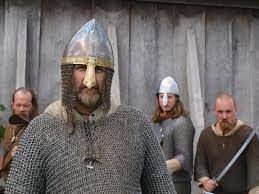
Things finally heated up in 870. The Danes occupied Reading, a town on the border between Berkshire and Mercia. Both sides claimed the town, but presently, the Danes owned it. Athelred began to gather his army. The Danes waited. Given their failures in Wessex, this time they waited to see what Wessex would do first.
Ethelwulf, the ealdorman of Berkshire caught a foraging party sent out from Reading. The Danes were about half Ethelwulf’s numbers, but they fought well even if the outcome was inevitable. The battle took place near Englefield and Ethelwulf had a great victory there. King Athelred was greatly encouraged as he and his younger brother Alfred brought up the main portion of the army to join Ethelwulf and attack Reading. They hoped to drive out the Danes and remind the Danes that the West Saxons were not to be trifled with. It did not go as planned.
Athelred still did not know how to lay a town under siege, and he refused to listen to anyone like Elgar who knew how to do it properly. There were weak points and some actual holes in Athelred’s line of encirclement. The Danish commanders took advantage of that. They burst out of the gates and counterattacked. The West Saxon siege lines fell apart and Athelred’s army ran for their lives. Ethelwulf, the victor at Englefield just a few days earlier was killed. Athelred and Alfred escaped, but only with Elgar’s help.
Elgar took the two of them and much of the army by secret elf paths that the Danes would never find. They moved further in a sort time than humanly possible and soon got out of range of the Danish patrols. Athelred complained the whole time. Elgar simply replied, “Shut up,” and after a short time Alfred said the same thing.
The Danes wanted to follow up their victory at Reading. They arrived at Ashdown and divided their forces, planning to send half their army east toward Kent while the other half moved on Hampshire and the west. They were surprised when the West Saxon army arrived, mostly intact. Athelred copied the Danish formation, dividing his army between himself and Alfred. Then Athelred went to church, and some have thought he wanted to get God on his side.
“God knows the end from the beginning,” Elgar told Alfred. “He already knows who will win the battle. While it is good to submit to God and accept the outcome God decides, there is no way Athelred is going to bribe God or convince God to be on his side. I don’t think God is interested in taking sides when sinful men have a mind to kill each other. Our place is to fight just as hard as we can, to do our duty faithfully, but then to accept however the Lord decides to work things out. You cannot argue with God, and if he has decided one thing, you cannot change his mind. Faithfully do your part, do your duty with all of your might, but leave the outcome in God’s hands.”
 Alfred understood. He prepared his half of the army to face the enemy and waited. He waited a long time, but Athelred never came out from his devotions, and finally Elgar’s men in green reported movement in the Danish lines. The Danes had camped along the ridge so they had the strong position. If they remained patient, the West Saxons would have had to charge uphill. But they got tired of waiting.
As the Danes came down, at least Alfred was ready. He charged, and Elgar had to use his little ones to keep the other Danish division from out flanking Alfred’s men. The division of Danes that faced Athelred’s men had to hastily fortify their camp against the uncanny marksmanship of the enemy. Meanwhile, Athelred continued to bargain with God.
Alfred won his battle. The Danes were defeated, and the other Danish division withdrew from the battlefield rather than remain to be picked off by arrows, one by one. It did not become a rout, but Alfred’s men, and the men from Athelred’s camp that joined them, continued to find pockets of the enemy that they chased well into the night. Athelred did not know where to go from there. He claimed a great victory, though he missed it, and because of that most of the Danish army survived.
The Danes first moved their army to the east rather than Hampshire and the heart of Wessex. They knew all about Weland and how he burned Winchester and that really angered the West Saxons. Besides, they hoped to pick up fresh men that currently held the northeast from London to Canterbury. Two weeks after Ashdown, Athelred and Alfred caught up with the Danes at the king’s estate of Basing. The battle was hard fought, but in the end the West Saxons had to withdraw. It was a victory for the Danes but a costly one as it turned out only the West Saxons got fresh men from Kent, Surrey, and Sussex; about two thousand.
Someone among the Danes figured out they were being followed and tracked. Elgar suspected Abraxas told them, but he decided not to find out. The Danes backed up. They went through Englefield and followed a zig-zag pattern up to Reading. They hoped to lose whoever was tracking them, but Pinoak and his fairy troop would never be fooled.
When the Danes got to Reading, they stayed for a month to lick their wounds. Athelred and the West Saxons did the same and appreciated the breather, but even Athelred understood the war was not over. At the end of February the Danes snuck out of the town under cover of darkness. Pinoak and his people were right there to watch. Athelred moved north while the Danes moved south and they met at a place called Meretun.
Meretun was another hard fought so-called victory for the Danes. They were losing for most of the day but managed to regroup at one point and pulled it out. The casualties on both sides were atrocious. Heahmund, the militant bishop of Sherborne died. He eventually got replaced by a man named Athelheah who seemed more concerned with the conduct of the church rather than the conduct of the army. Athelred was also badly wounded in the fighting. The Danes claimed the victory, but to be clear, the West Saxons pulled back when Athelred was wounded and could no longer fight.
He was carried all the way down the Dorchester Road to Wimborne where he finally gave up the fight and died of his wound. He was buried there, and that left Alfred as the last of the five sons of King Athelwulf. Athelred had married, and had two sons, but they were both infants. Alfred was young at twenty-three, but he was at least full grown and actually a bit older than Athelred had been when he took the crown.
 While Alfred, Elgar, and Osweald of Dorset buried Athelred, the Danes thought to strike. Uncle Osric led the men of Hampshire, Wiltshire, and Berkshire to battle. Osric lost, but he did enough damage to the Danes to keep them from rampaging through the land. By the time Alfred arrived with men from Dorset and Somerset, he found the Danes at Wilton in Wiltshire. They managed to push well into Wessex, but they had failed to even reach Hampshire.
The battle was fierce. Once again it got counted as a Danish victory, but by then both sides were exhausted and hardly able to continue. It was an easy thing to arrange a meeting between the two sides. Alfred paid the Danes to go away, having the example of Burgred who paid off the Danes in Nottingham.
“Hopefully, this will give us enough time to rest and rebuild our forces for when they break their agreement,” Alfred explained.
Elgar, having turned fifty-one felt he was too old to argue. On the way home, he thought to stop in Athelney to check on the fortress there.
 Storyteller Tales & Thoughts