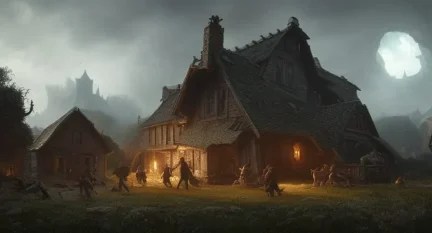
In October of 997, in Verona, when the circus was on its way home, Giovanni turned eighteen. For one moment he felt all grown up, but then his father got sick and he felt lost.
Corriden stepped up to take the ringmaster’s place. Giovanni did not think that was a good idea. Corriden was the strongman and as stubborn, some would say as strong in his mind as he was with his muscles. He had no flexibility. If Berlio the Magician and his wife-assistant Priscilla were not ready, he would announce the man anyway if he was next. Then everyone would have to wait until Berlio got ready. It would drag the show. In fact, the whole show dragged because Corriden did not understand that the ringmaster had to be quick on his feet. Sometimes a joke would be enough. Sometimes the harlequin, who was sort of the chief clown, was an integral part of keeping the momentum flowing. He might come and do some handsprings, or maybe tell the joke. Sometimes all the clowns could help out. They had a couple of short routines they could use as filler. Sometimes, the ringmaster could skip the magician for Constantine, the tightrope walker and then after Constantine have Berlio perform. But no. Corriden had his set order and his little papers with the written introductions that he read like a true hack actor and that was that. Worst of all, he thought it all went well.
After Verona, even the ones who supported Corriden, and initially that seemed like most of the circus, thought it best to let the younger Giovanni give it a try. Giovanni stole another line from the future to go with the Greatest Show on Earth line. He said into the megaphone, “Ladies and gentlemen, and children of all ages. Welcome to the Don Giovanni Circus, the Greatest Show on Earth. We begin with the traditional and magnificent circus parade.” The music began. Everyone in the circus paraded except the cooks who had to watch the fires. Everyone walked decked out in their fanciest, frilliest, most colorful outfits including the horses and the dogs. That day, the people had confidence and put on their best performances. They said the younger Giovanni was a natural.
Corriden griped and yelled a lot, but the only thing Giovanni cared about was his father. Don Giovanni senior did not get better. In fact he got worse.
When they got back to Venice, they got the best doctor in town to come and look at him, but the doctor was as stumped as the doctor in Verona, and the doctor in Padua. He said, “Maybe it is due to something he ate.”
Giovanni did not buy that explanation. “It has been too long. If it was something he ate it would have passed through his system by now.”
 “Perhaps,” the doctor said. “But I don’t know what else it might be.”
“It seems more like slow poison,” Giovanni voiced his suspicion. “Do you know any drugs that could be used that way?”
The doctor paused and looked at his patient. “Some drugs. Some natural things, too, like certain flowers and such. The problem is we have no way of identifying what it might be, so we have no idea what the cure might be.”
Giovanni thanked the doctor when the cook came in with some broth and said he must eat so he can to keep up his strength. Giovanni also thanked the cook before he pulled up a chair. He spoon fed his father what his father was willing to slurp down, but Father finally waved off more. He spoke. His voice sounded weak. This was not the father who yelled at ten-year-old Vincenzo to clean the stables.
“You go,” he said. “You need to live your life and not worry about me. I think I will sleep for a while.”
Giovanni nodded in general agreement, but he worried. “Titania has been by a hundred times and says she wants to sit by your door in case you need anything.”
Father smiled, almost chuckled, and mumbled, “The bearded fat lady.”
“And Baklovani the wolfman has been by almost as much.”
Father nodded a little. “They are good people. Never forget that. Deep down they are good people.”
Giovanni knew that. “I’ll go and let you rest.” He walked out the door and saw Titania hovering around the cooking tent. He called to her. “Titania. I’m going out to stretch my legs a bit. Would you mind keeping one eye open in case Father needs something.”
“Yes I will,” she said in the sweetest little voice which no one would ever guess would come out of such a big woman, especially one with a beard.
“Did he eat the broth?” the cook asked.
“Some of it,” Giovanni said, and turned away. He decided he needed some comfort at the moment. Madam Delfin lived in the first town up the road, the one with the docks where the ships from Venice came in. She was twice his age, but her husband died and she inherited it all, having no children. She was always good for a tussle, but she had a motherly streak about her at times which made it a shame that she had no children. The thought crossed Giovanni’s mind that maybe he needed Madam Delfin to mother him a bit and tell him everything would be all right.
Roughly four in the morning, he heard Damien, one of Corriden’s hangers-on yelling his name in the streets. He got up, and though Madam Delfin tried to hold on to him, he made it to the window.
 “Damien,” he yelled. The man rode to beneath the window.
“It is your father,” Damien shouted. “Someone broke into the house and your father got stabbed. They ransacked the house. Hurry.”
Giovanni turned but got grabbed. Madam Delfin got in one last kiss before she let him go. He threw on his clothes, ran down and saddled his horse in no time. He rode like a wild man, even when he turned off the road and into the swamp.
The house was a wreck. They would not let him see his father at first. He was dead, stabbed several times, and Giovanni cried before he got angry. He went to the desk and opened the bottom drawer. The money was gone. He looked up at Baklovani and Constantine the tightrope walker before he shrugged. He removed the false back to the drawer and saw the money was gone from there as well.
“Unless Father took the money out from there for some reason,” he mumbled.
After he put the desk back together, he cried some more, maybe until sunrise.




 Storyteller Tales & Thoughts