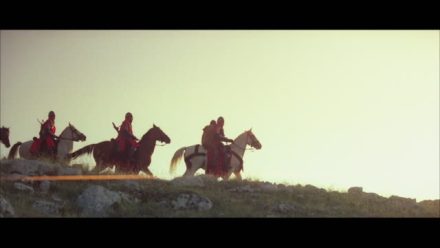
Edgar and his young son Eanric succeeded in overcoming the last Welsh stronghold in Somerset, the fortress of Watchet. King Beorhtric made Edgar ealdorman of an undefined Somerset because he was already doing the job of defining and defending the border with Hwicce to the north and Devon to the south. Beorhtric spent all of his time trying to hold on to his crown in the face of Mercian aggression. He honestly had little time to spend worrying about the western frontier.
When King Beorhtric died and Ecgbert returned from Gaul and the court of Charlemagne to take the crown of Wessex, his attention was all against Mercia and focused east on Kent where his father Ealhmund used to be king. He readily confirmed Beorhtric’s charters making the bishop of Sherborne responsible for the faith west of the Selwood, Oslac as ealdorman of Dorset, and Edgar as ealdorman of the still loosely defined Somerset shire. Edgar did not live long after that, but Ecgbert confirmed the son, Eanric, Elgar’s father, and made it, or at least suggested that the title might be hereditary as long as the family gave good service on what was considered the frontier.
When Elgar turned five, his older brother Eanwulf accompanied father who joined his men of the marshes to the army of the king. King Ecgbert crushed the Mercians at that time and Eanwulf got to know the slightly older son of the king, Athelwulf. They got along and became friends. The following year, Athelwulf led the army into Kent where he threw out the Mercian appointed king and took the crown. Athelwulf became the subking under his father Ecgbert and ruled in the east, in Kent, Sussex, and Surrey.
Most Saxons in Somerset were freemen and most owned a bit of property, which they farmed. That was fine in times of peace, but to be clear, Anglo-Saxon culture was a warrior culture. The men learned and knew how to fight, and they taught their sons to follow after them, and to be sure, the British people who were still free and still owned their land followed the Saxons in learning the art of war even as they followed the Saxons in battle. When the Danes came to Anglo-Saxon land in the 800s, they came to fight, raid, and eventually to invade and conquer. Some think the Anglo-Saxon kings and ealdormen fought at a disadvantage because their armies were full of conscripted farmers and tradesmen, but in truth, when the Saxons got to the battlefield and it was time to fight, they knew the business and fought like warriors. They could go just as berserk as any Viking on the field. It would be years, another century or two before the Anglo-Saxon warriors became full time Anglo-Saxon farmers.
With the power of Mercia broken, King Ecgbert and his son, Athelwulf got the kingdom of East Anglia, or at least Essex and the kingdom of Northumbria to acknowledge Ecgbert’s status as overlord of all the Anglo-Saxon kingdoms but apparently, that did not translate into the larger world because certainly the Danes saw England as a land divided among several squabbling kingdoms who did not have the unity to stand against being raided and eventually invaded. That was one of the things Elgar had to face when he came of age. In fact, it began when he turned sixteen.
 “Father. Where are we going?” Sixteen-year-old Elgar rode behind his father, beside his two friends from Somerton. Osfirth, the Saxon was just fifteen. Gwyn, the Brit would turn seventeen first. They all wanted to know where they were headed because they rode to the northwest, toward the coast and Exmoor, the wilds of the shire, a direction Elgar and his friends never went. There were stories about strange things that happened in the wilds of Exmoor.
Eanwulf, who rode beside father, turned his head back to answer them. “Carhampton. It is a nice town. I’ve visited once when Father had me run the border and check on the defenses there. It is where my friend Odda lives. You remember Odda?”
Elgar nodded. Odda was one of the younger ones in Eanwulf’s gang. He must have married and moved to the border, or Father moved him to watch the border. Elgar had more questions. “But why are we and the king and this whole army going there? Have the Welsh broken the border?”
“Danes,” he said. “Danes have landed there and taken the town. We need to take it back and push them out of our land.”
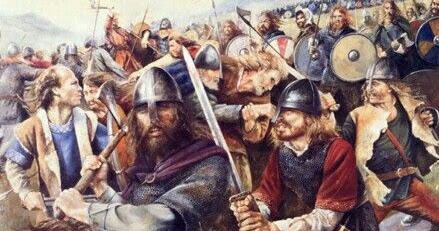
That was all the boys were going to get out of their elders. They had to wait until they got there, but when they arrived, they were not permitted anywhere near the actual battle for the town. They were kept back with the king’s company where they could not see much, but what they could see allowed Elgar to give color commentary.
“You can see there are more Danes present than were expected. This is not just a raiding party like we have heard about. No one expected them to come out from behind the stockade and face the army. But I can see the sides are about even. The king brought his personal retinue and picked up a few from Wiltshire and Hampshire, maybe Sherborne while on the way to Somerton, but most of the army is from Somerset and maybe Dorset, and many did come out, but they did not expect to face so many Danes.”
“Not so,” Osfirth objected to Elgar’s assessment. “I think we have more than they have.” He had his hand up and pointed with his finger like he was counting.
“No, look beyond the two lines.”
“Where?” Gwyn asked and craned his neck.
“There, by the gate,” Elgar answered. “There are about a hundred, maybe two hundred men there not in the line.”
“Why are they not in the line?” Osfirth asked. “Are they afraid to fight?”
Elgar looked at Osfirth like he went stupid. “They would not come all this way from Daneland unless they intended to fight. No. They are holding some men in reserve so when the lines begin to break and our line is all tired out, they will charge in, fresh troops anxious for the kill and it will probably be enough to completely break our line.”
All eyes turned to the battle as the lines met. The king’s men who listened in to what Elgar was saying paid close attention. One even said, “Now,” when the Danish line seemed to falter. The Danish commander waited a bit longer, until the Danish line straightened itself out again. He trusted his men. He had good men. Then he pressed in with the fresh troops, and as Elgar predicted, the West Saxon line fell apart.
The king and father Eanric were able to save plenty of their men. Unlike some such engagements, the Danes did not pursue their defeated foe. Elgar noted that they did not have the horses or horsemen to do that. Instead, they went back into the city while the king and Eanric set a camp two-days distance from the enemy and sent out riders to gather more men.
 Elgar got called into the king’s camp to tell what he surmised about the battle. Some guardsmen overheard him and told the king. Father and Eanwulf were both there standing among the officials, looking stern, the same basic look on each of their faces. Elgar almost laughed to see it, but he kept his composure and stuck to what he saw and what he figured. He had not yet worked out the ideas of a coastal watch or strengthening of the ports and the walls around coastal cities and towns such as Genevieve did, or the idea of a rapid deployment force like the one Gerraint worked out with Percival and King Arthur. He stuck with what he perceived concerning the battle and felt glad his father and big brother did not say anything negative.
Elgar and his friends were sent home after that, but it did not matter. The Danes must have assumed the West Saxons would be back and in much greater numbers, so they collected their loot and returned to sea. There were other fish to fry.
 Storyteller Tales & Thoughts