
It took half the night to ferry the men and horses across the Hudson. Colonel Morgan chose to spend the next day in Kingston, and some of his riflemen even helped the locals with their rebuilding projects. The British did a pretty thorough job of burning the town.
The travelers did not mind, apart from the cold and snow. Ghost and the horses certainly did not mind a day off. The horses and soldiers were fed well in Kingston. The travelers discovered that some of the people who were on the British side, or at least uncertain about the revolution came to the American side when their homes were burned.
“Most people are fickle and don’t care until they are shocked and dismayed when it becomes personal,” Decker said.
“A bit cynical,” Tony said, but Decker shrugged.
The following morning the travelers and colonials started down the long road to the Delaware River. Colonel Morgan again explained himself.
“We keep the Gunk between us and the British. We take the road to Homans Eddy and cross over on the ferry. Once in Pennsylvania, we move away from the Delaware and head south to Valley Forge.”
“Move away from the river?” Katie asked.
Colonel Morgan nodded. “Since the British took Philadelphia, they took ownership of the Delaware to the Delaware Bay where they can ship in plenty of supplies and reinforcements. My reports say in the meanwhile, they have been sending companies up the Delaware as far as Trenton, maybe further.”
“The Gunk?” Lockhart asked.
“Shawangunk Mountains,” Colonel Morgan answered.
“Shawangunk Ridge,” Lincoln called it at the same time.
Lockhart still shrugged.
Colonel Morgan folded his map. “I think the British scouting up and down the river is what convinced Congress to let General Washington camp at Valley Forge. They hope he will minimize the damage the British may do to the Pennsylvania countryside over the winter and spring.” Colonel Morgan stepped to his horse. Lunch was over.
Twenty-five miles was a good day as the column traveled up and down through the south end of the Catskills. When they reached Homans Eddy, they were surprised to hear gunfire across the river in the few buildings there.
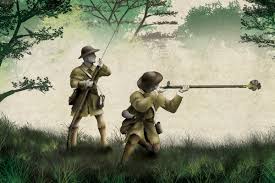 “Homans Eddy got so-called because it is where the river narrows,” Colonel Morgan told Tony, Nanette, and Sukki. “It gets narrow, but deep. There is some ice along the riverbanks, but not anything I would step on. I can see the landing where the ferry arrives, but it is obviously not running at present.”
They got interrupted by Captain Price and the Green Mountain Boys followed him. One of William Talbert’s men fired his rifle. The captain spoke while the rifle went off.
“Colonel. Is there a way we can cross the river? It sounds like a firefight over there.”
“No, but the river is narrow enough here. Get some men up in those trees and shoot at anything in red, or any loyalist, if you can tell who is who. You can keep your company here for the rest of the day and see if you can find a way across. There are some farms, I think the Homan farm and maybe a small settlement downstream on the New York side. They might help you cross over. You know the route through Pennsylvania. We may meet up there. I’ll take the regiment north and cross at Skinner’s Falls tomorrow morning. We will likely stay there the rest of the day in case you follow us, but on the following day we will leave whether you are there or not. Even if you have to come behind us to Skinner’s Falls, your company without the wagons and women should be able to catch up to us on the north-south turnpike.”
The captain agreed, but then William Talbert offered a thought. “My men and I can stay, and you can keep your command together. General Washington is not expecting us, and we could use the target practice.”
“No.” Colonel Morgan’s word was loud and clear. “Get your men back in the formation. We are headed north.” He signaled one of his officers and checked the sun to gauge the time. “Get the men started up the river road toward the Skinner place. I’ll catch up shortly.”
Decker and Nanette listened in with Sukki and Tony, and as soon William Talbert moved out of earshot, Decker got the colonel’s attention. “You don’t want to get rid of Talbert and his crew?” he asked.
Colonel Morgan shook his head. “I don’t honestly trust him. Half of his men are Canadians down from Quebec. I am not convinced they would shoot the right people.”
Decker nodded and handed the Colonel his scope so the man could get a closer look at what was going on across the river. “No,” Decker said in as strong a way as Colonel Morgan’s word. “You cannot borrow it for Captain Price or your men. Lockhart says we are not supposed to get involved. I pointed out that Katie got us involved with the Mohawk, but Lockhart said that was to prevent unnecessary killing. There is nothing we can do about people who are already shooting at each other.”
“Fair enough,’ Colonel Morgan said and went to Captain Price to set a few more ground rules before he got the travelers to catch up with the column. “I do want to get there before dark, if we can,” he said.
They arranged with the Skinner family to cross the river in the morning. It took all morning and cost one of the two gold sovereigns Lincoln had squirreled away—a gift from Lars. They made camp and waited the rest of the day, but when Captain Price did not arrive that day or in the night, they packed up and left on that next morning.
 They stayed as close to the river as they could and got all the way down to Homans Eddy on the Pennsylvania side. They discovered Captain Price managed a river crossing downstream from a village of sorts. He came up behind the red coats, native Seneca, and loyalists. The defenders were militia, but some militia men were persuaded by the half-dozen red coated British and stayed out of it. Most of the attackers were loyalists, ten from much further west, and three Seneca guides and scouts. The Patriots, about twenty good townsfolk, had a barricade that stretched between a house and the Church. They were hard pressed. The loyalists had the big barn and farmhouse in the south, and they appeared to be mostly hunters and fur trappers hardened by life on the frontier. With their natives, the frontier marksmen were slowly gaining the upper hand. The advent of Captain Price’s company of riflemen tipped the scales in the Patriot favor, and the fighting was soon over.
“I have four red coats, two loyalists, and three Seneca tied up in the church,” Captain Price reported.
“Good, good,” Colonel Morgan said, and asked, “What do you plan to do with them?”
Captain Price opened his mouth, but quickly caught on. “I intend to turn them over to my commanding officer to determine their deposition.”
Colonel Morgan nodded. “An admiral idea. The natives we can release if they promise to not raise arms against the colonies again. The red coats and loyalists we will take with us to turn over to my commanding officer.”
“Most of the loyalists ran away into the wilderness when we arrived,” Captain Price admitted.
“Understood,” Colonel Morgan said. “Less baggage for us to carry.”
“I can keep my scanner on to see if they turn up as we move on to the valley of the forge,” Elder Stow said.
“Valley Forge is the name of the town,” Tony corrected the Gott-Druk.
Colonel Morgan simply nodded. “Much appreciated, but I would be surprised if they stopped running this side of Fort Duquesne.”
“I understand now why you wanted to move away from the Delaware River,” Lockhart said.
Colonel Morgan nodded. “Red coats on the river. It does not take much to stir up trouble among the citizenry. About a third of the population in some places seems determined to stay out of it, but nearly half are patriots or support the patriot cause. The rest, maybe a quarter or twenty percent of the people have sympathy if not loyalty to the King, and some of them will fight with the British. Every town on or near the river is a potential hornet’s nest and the British seem determined to whack that nest.
************************
MONDAY
There is trouble at Valley Forge. Washington’s headquarters is attacked from all sides. Until Monday, Happy Reading.

*
 Storyteller Tales & Thoughts