Medieval 5: K and Y 8 The Saxon Hag, part 1 of 2

Kirstie

Yrsa proved her worth early on when they stopped in a port on Jutland to replenish their supplies. She could communicate with the Jutes and Danes in a way that sounded like a native. The crew understood most of what the Danes said, and could respond, but not exactly, and they sounded like foreigners. Yrsa got better cooperation from the village chiefs.

They had some rough weather along the Danish coast and needed to stop again near a village of Nordalbings by the delta of the Elbe River. They needed to repair their sail among a few other small things. The village men turned out on the second day, but Yrsa also spoke Old German like a native and convinced the villagers to leave them alone. They would be moving on and leave the village in peace.

By the time they reached the Frisian coast at the delta of the Weser, no one was really surprised that Yrsa was also fluent in the Frisian tongue. Frode even said that now he understood why Kirstie brought the girl. The Frisians blocked the ship with fishing boats. They were mostly fishermen and farmers with farm implements, not really soldiers prepared to fight, but they were a bit of an army.

Kirstie dressed herself in fairy weave and shaped it to imitate the blue dress she had seen on a rich woman in Danish lands. Yrsa only wore fairy weave and imitated Kirstie’s dress but insisted on hunter green. The men were good and did not whistle at all, even when they saw Yrsa in a dress. Kirstie leaned on the rail and spoke to Captain Stenson while the men lowered the longboat.

“Interesting,” Kristie mentioned to Captain Stenson. “By this date the people along the coasts assume any longship means trouble.” They raised a white flag and rowed the longboat out to the big fishing ship the Frisians indicated. Four men, the rowers, stayed in the longboat while Captain Stenson, Frode, Kirstie and Yrsa climbed to the deck. They found a dozen men decked out in more military garb, and one knight who spoke for all the locals. The knight and his soldiers looked surprised to see the women, though less surprised when Yrsa translated everything.

Kirstie and Captain Stenson discussed it, and the captain spoke appropriately. “I am Captain Rune Stenson, a simple trader. sailing my ship with trade goods headed for Bremen. We will sail up the Weser River, and after we have made whatever deals we can make, we will return this way to the sea. We have no intention of bothering you or your people. You can see the flag we fly” It showed an R, n, and crooked t over the picture of a stone. “That is me, Rune Stenson. Sten in our tongue is the word for stone. This way when you see my ship you can be assured that we come in peace.”

“And what do you have to trade?” The knight sounded skeptical.

“Grain, and bundles of furs and fine leather from the north. We are not rich men.”

“And I should trust you?”

Kirstie butted in front of Captain Stenson and interrupted, as was becoming her tendency. “Do you have a name, or do we call you Mister Person in Charge?”

“This is my land, given to me by the king to protect the land from your kind.” He stared at the girl before he softened and said, “I am Sir Waldo of Deventer.”

Kirstie smiled, stepped up to grab and shake the man’s hand before he could object. Later, she imagined she was channeling Lord Festuscato, Last Senator of Rome, a life she lived in the centuries between Greta and Margueritte. “I am Lady Kristina of Strindlos, and I would rather be your friend than your enemy. I mean, look at me. I mean you no harm. Besides…” she pointed generally toward the fishing boats. “You have a bunch of farmers and fishermen, not fighters. I am sure you would rather save them to bring in the fish and work in your fields. There is no reason we should fight.”

Sir Waldo stared at the girl and frowned, but just a little. “Bremen?” he asked and pointed toward the river. He might let them through to bother the Saxons if they promised to leave Frisia alone.

“Yes, sir,” Kirstie answered. “It is a big town that might be interested in our goods. But look. I am willing to make a pledge of friendship or maybe call it something for safe passage up the river. Let me give you this piece of amber. I found a couple of pieces right by my house and I thought surely the Lord was smiling on me.” Sir Waldo raised an eyebrow, and Kirstie said plainly. “I am a Christian.” She pulled out her little wooden cross.

He did not exactly believe her, but he saw no reason to waste his men fighting a merchant ship. He looked at the amber in his hand and spoke. “Lady Kristina of Strindlos.” he remembered. “You may pass, and I may even hope you do well in Bremen.”

Kirstie grinned. “Lady,” she said. “Back home they mostly just call me a girl, not a lady, except my companion Yrsa. She calls me Lady.”

Yrsa translated and added, “Yes I do.” She bowed to Kirstie and said, “Lady,” in both languages.

Sir Waldo smiled for the first time. “And a fine young woman, I am sure.”

Kirstie returned the smile and added a small curtsey, though it felt a bit awkward. “Thank you, Sir Waldo. The Word says kindness is a virtue, and sometimes we entertain angels unaware. I also hope we make some good trades.” She hustled Rune and Frode to the longboat and thought to wave as they rowed back to their own ship, as any young girl might.

Captain Stenson turned on her when they got out of earshot. “You need to let me bargain for my own ship.”

“Sorry,” Kirstie said. “I just thought getting out of a tight spot without bloodshed was good, and I thought an innocent young girl might get a better response than harsh words.”

“I am sure that is true,” Frode said, and Captain Stenson reluctantly nodded.

When they climbed back aboard the ship, Yrsa immediately changed her fairy weave back into leather-like slacks and a leather tunic over her plain shirt. She picked up her bow and arrows and sat on her bench without a word.

“So, young lady,” Captain Stenson began, ready to make some snappy remark but shut his mouth when Kirstie called and became clothed again in her armor, her sword and knife at her side, her long knife across the small of her back, and her battleaxe diagonally across her back, reaching up to her shoulder beneath her shield.

“I guess I’m not made for dresses,” Kirstie said.

Frode countered. “I think you and Yrsa are made for dresses just fine.”

Kirstie made a face at him and took off her weapons so she could sit and help row up the river.

Finding the Weser River was the easy part. Being able to get up the river to Bremen without drawing out a real army was a bit tricky. They passed more farms and a Frisian hamlet in the delta. They had to stop in Bremerhaven, the first German town when word got there before the ship arrived. They had the ship searched. Captain Otto, the head man in the dock wanted to confiscate the cargo as soon as he discovered what they carried. Yrsa had to translate for the men and related what Captain Otto said. Captain Stenson and Frode got ready to start a fight, but Kirstie, dressed in her dress, stepped between the men, and totally interrupted, again.

“You don’t want to do that,” Kirstie stood up to the man. “These goods are for trade and for sale. Are you making an offer to buy these things?” Yrsa translated into the Old German tongue.

Captain Otto frowned at what he considered to be a child. He looked at the anger on the faces of Rune and Frode, turned his head to look at the two dock workers beside him and the twenty soldiers he had on the dock, along with the many dock workers there who stopped whatever they were doing to watch. He decided to speak to the child and explained in his most condescending manner. “There are taxes and docking fees that need to be paid, and since you have no coin of the realm, we will take and sell your goods. After the taxes, fees, and all have been paid, we will give you what is left.” He smiled for the girl, looking like the drunk uncle at the Christmas table that no one wanted to hear from, until the girl asked him an unexpected question.

“Are you a Christian?” The man paused and looked confused before he nodded. “And does the Lord condone stealing?”

“It is hardly stealing from pagan unbelievers.”

“It is stealing, but in any case, I am also a Christian, and you would be stealing from me.” Kirstie pulled her wooden cross out from beneath her shirt. “Thou shalt not steal is one of the ten commandments.”

One of the dock workers whispered to his captain, “She is right.” Yrsa heard and translated the words out loud. Kirstie continued.

“Rune and Frode. You need to go into town and find the guild masters that might be interested in our wares. At least the jewelers, the bakers, and the candlestick makers for the beeswax, and maybe the smiths and the tailors for the hides. Ivory is good for the pommel of a sword. See what they offer, and if it is not a king’s ransom, tell them we will go down to Bremen. I am sure we will get a good price there.”

“The guild masters?” Captain Stenson asked.

“Of course,” Kirstie answered. “Who have you been selling to?”

“Whoever was in…”

“…never mind,” Captain Stenson said. “Come on.”

Medieval 5: K and Y 7 Buying a Ride, part 2 of 2

Kirstie

Kirstie sat, so the men sat. She dressed in slacks and a simple tunic that covered the shape she was developing at her young age. The men came dressed in what may have been their best. They bathed and maybe even washed their hair. They wanted something from her and were willing to make the effort of a good appearance. Kirstie smiled at the thought of them making the effort.

“So, tell me,” she began. “How did your voyage work out?”

Captain Stenson looked at Frode before he began the story. “On our first trip, we followed the land south, thinking the men needed a good beginning and we did not want to get lost at sea,” Captain Stenson explained. “We had furs, grain, mostly wheat, and several bundles of down and feathers. We should have made a good return on all that. We visited Kupang, our own main trading center, but we lost most of our grain in the king’s tax. We gained some silver for the feathers but could not find an interest in our furs and hides, which was mostly what we had. We thought to try the Danish center of Ribe. Back when I sailed with Captain Birger, I recalled they were interested in the fur trade.”

“We headed for Jutland,” Frode interrupted. “We sailed two days down the wrong side of the peninsula before we turned around.”

“One day,” Rune insisted. “We figured it out after the first day.”

Frode shrugged. “We backtracked and went around.”

“Anyway,” Captain Stenson continued. “We found Ribe was willing to take our goods, but we hardly got their worth. We did not fail on the trip, but we hardly made any profit.”

Frode looked like he was going to complain so Kirstie interrupted. “What did you take on your second trip? I am guessing the men contributed all the furs and feathers they had for the first trip.”

“No,” Captain Stenson said. “We have brothers and sons who continued to get furs and hides over the year we were away. Trade is very much a family business. We had some grain again, though this time mostly barley, but most of what we had was bundles of carded wool from my family and Frode’s family. We thought to visit the Oyskjeggs thinking the island must have very cold winters.”

“Orkney and Shetland Islands,” Frode explained.

Captain Stenson frowned. “We landed in Danelaw, in Northumbria where they have flocks of sheep covering every hillside.” Kirstie nodded. She understood why so many of her people turned from honest trade to taking what they wanted. They simply did not have the trade goods for a good exchange.

Frode groused. “We unloaded our wool in East Anglia for practically nothing.”

“We crossed straight over the sea,” Captain Stenson said with a hard look at Frode. “We thought to hit the Danish coast but landed in Frisia near Utrecht. They came out armed against us, and we ran. Eventually we found a Frisian fishing village and the men all but rebelled. We went into the village and took a few things. A couple of good plows and farm implements, and some glassware.”

“They paid us off to go away.”

“We left our leftover wool, fur and hides there. Some good leather, so we did not actually steal their things,” Captain Stenson said. “At least I like to think of it as a trade.”

“I understand in Iberia and North Africa, quality furs like beaver, ermine, and fox pelts go for a premium price,” Kirstie said.

“But that is so far away,” Captain Stenson countered.

Frode looked at the ground. “I honestly would not know how to get there.”

“So, what do you have this time?” Kirstie asked. “Obviously, you came to me because you are getting ready for the next trip. I know right where to go if you have the right goods to trade.”

Rune and Frode looked at each other again, and Frode spoke softly. “We were wondering if you could maybe teach me what your father taught you… What?”

Kirstie simply shook her head. “I am going. I would not be the first maiden to go on a trading expedition. Besides, you will need the goods I bring to trade. Did you forget?” Kirstie called, and her slacks and tunic became instantly replaced by the armor of the Kairos with her sword at her side, her battleaxe and shield at her back, and her long knife across the small of her back. “Yrsa,” she called while Captain Stenson and Frode got over their shock.

“Lady?” Yrsa came from the other room dressed in fine leather with two knives at her side and her bow and arrows at her back. She looked ready for war. She also appeared as the elf she was, having neglected her glamour of humanity.

“You need to dress,” Kirstie said.

“Sorry,” Yrsa said and applied her glamour to appear human. Yrsa and Kirstie worked this out in advance to remind the men without frightening them too badly.

Captain Stenson started to think. “We need to take both of you?”

Kirstie stood and got the men to stand. She said little as she and Yrsa took them to the barn. She showed them what she gathered in preparation for this day. “Three large jugs of the finest honey, compliments of the Fairies of the Glen.” She unscrewed the lid of one jug and let them stick a finger in to taste the sweetness before she carefully closed it tight again. She showed them the beeswax to go with the honey before she pulled back a horse blanket and spoke. “Three pairs, six walrus tusks of good ivory, a gift of the dwarfs of the mountains. They said there is plenty more, but I would not let them kill any of the beasts. These are from walruses that died of natural causes. They are from older beasts, and you can see where a couple of them are chipped and this one is missing the tip end. Walruses, you know. They fight each other like men fight each other.”

“This is worth a fortune,” Frode mumbled, but Kirstie was not finished.

“And last,” she said and removed another blanket to reveal a basket of amber. “From Lord Amber and the elves of the woods. This is a one-time deal, but these things go with Yrsa and I, and they go where we need to go.” She paused to let the men calculate how much silver they could get for what they were looking at. “Yrsa and I will be sailing with you, and Frode, I will teach you what I can while we are on the way.”

Captain Stenson did not ponder long. “So, where are we going?” he asked, though he looked at Yrsa and wondered how such a good-looking eighteen-year-old girl might do on a voyage.

“Bremen, in Saxony,” Kirstie answered, and when they got on the ship, she made Yrsa sit in front of her where she could keep an eye on the elf maiden and wondered much the same thing as the captain.

Medieval 5: K and Y 7 Buying a Ride, part 1 of 2

Kirstie

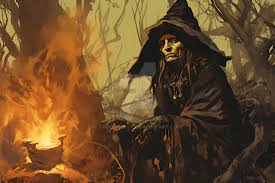
Kirstie got word through the elf and fairy grapevine that a hag was seen in Saxony, around Bremen on the Weser River. She imagined she guessed right. She would have to direct Rune’s ship to the Frisian shore and up the Weser to find the hag and put her out of business.

She looked at her hands and thought about the fire and the water that killed the hag of the Vanlil. She could start a fire by merely pointing at the wood and thinking about it. She could project a light from her hands, like two flashlights on a dark night, and could make herself glow in the dark if she wanted. Then, she could shoot the fire from her hands, or put the heat and light together, like some alien heat-ray. She only tried that once, but the result was a pile of ash where a tree once stood. Kirstie remembered when Fryer visited her, he turned a whole copse of trees into ash just by his mere presence.

She also thought about Njord’s visit. It did not seem like much at the time, but since then she found she could stay underwater for an indefinite amount of time. It was like she was breathing underwater, and she could see and even hear underwater just like she was on land. That was about the best she could describe it. What is more, she always felt warm in the water, even when it had ice by the shore. On cold and blustery winter days, she often threw herself into the ice water of the fjord to warm up. She could swim fast as a dolphin, almost like flying through the water, and she could call to any fish that were nearby. She could actually tell the fish to jump into her boat, so she always had a good catch of fish and without having to cast a net or fishing line. It felt strange that she could do these things, but she figured they were gifts and more than she needed. She knew that basically she needed the fire and the water to kill whatever hag she encountered. Kirstie pictured herself setting the hag on fire with the fire in her hands and then putting it out with the water she carried inside. That would do it, and it would be enough, as Grandfather Njord and Father Fryer said.

When Kirstie turned thirteen, she first wondered why the Norwegian hag went all the way to Jamtaland in the first place. She must have been a Norwegian from Northumbria in the British Isles; the only place Abraxas was permitted to go. She must have done a kind of reverse immigration, but she could have landed at Hof or Upphaugr on the coast in the first place and worked on the people there to invite Abraxas to come across the sea to their homes. Why travel all the way to Jamtaland where she had to invade and fight her way to the sea?

Kirstie imagined she figured it out when she thought of the hag in Bremen, and when she remembered Margueritte, a life she lived in Brittany some two hundred years earlier. Margueritte fought her own hag and found the hag gained power over the people when the celts and their druids were confronted with Father Aden and his Christians. The people became confused and no longer certain what to believe. That was when the hag stepped in with word of Abraxas, a god of the ancients, but a living god to be worshiped.

The people of Hof and all the Trondelag worshiped the gods of the Aesir and had no confusion in their mind. Likewise, the Vanlil—the Jamts worshiped the Vanir. but then they took in many Aesir worshiping exiles who claimed that some of the Vanir had become Aesir. That happened as a result of a war in the lifetime of Faya, daughter of Fryer. Kirstie remembered being Faya briefly when Fryer came to visit. Faya, as an outsider, found a way to make peace and bring the two waring houses of the gods together. That happened ages and ages ago, but the Vanlil, just now learning about that, must have thrown their minds into confusion, not knowing what to believe. They became fodder for the hag and the worship of an actual living god, Abraxas.

Kirstie thought about the hag in Saxony. There were certainly plenty of Saxons in the British Isles for Abraxas to choose from. He no doubt sent the woman back to Saxony, but then she needed to find a place where the people still clung to the old gods and the old traditions but were being confronted with the Christian world. The Storyteller life she lived in the future told her about how Charlemagne slaughtered some four thousand five hundred Saxons between Verden and Bremen. The Saxons there were in rebellion against the empire and thus against the Christian faith the empire promoted. Now, all these years later, more confusion. Another opportunity for Abraxas. Kirstie remembered Margueritte’s friend, Boniface did great work among the Saxons and Frisians alike, but sometimes and in some places the old ways died slowly.

That must be it, she thought to herself. He needs to find a people who don’t know where to turn so he can offer stability if they turn to him. Sadly, that did not help her get to where she needed to be. But then she turned fourteen, and Rune and Frode returned from a second trip. Captain Harrold sailed into the docks a week earlier and the people mourned for the crew members he lost. When Rune came home, several men deserted his ship to sail with Captain Harrold Harroldson, including Kare and Thoren.

Captain Stenson and Frode finally came to visit Kirstie in her house, not exactly carrying their hats in their hands, but near enough. She had ale and snacks prepared and sat them in her living area. “The ale is from the special recipe of Bjorn the Bear. Tell me what you think. I know he enjoyed it while he lived.”

“Bjorn the Bear?” Frode asked, knowing the name well.

“He taught me to handle my weapons, especially the battleaxe. I understand he was an expert who killed many men.”

Captain Stenson drew a long face. “I do not doubt you know how to defend yourself. Bjorn the Bear was an expert, as you say.” He looked around the room before he thought of what to add. “But it will take more than just knowing how to defend yourself to sail in a longship.”

************************

MONDAY

Kirstie needs to secure her ride and then get to Saxony to confront the hag. Until Monday, Happy Reading

*