
Medieval 5: Genevieve 4 Troubles Averted, part 2 of 3

In the last couple of days before the wedding, at the very end of April, the Bishop of Basel moved the priest from his rooms in the church so Genevieve could have them to prepare for her wedding. Things got hectic and Genevieve reached the point where she could not think straight. Good thing she had Margo, Nelly, and Edelweiss looking after her.

Mother Ingrid, Ursula, and Gisela got invited to the wedding. Genevieve fretted about that along with everything else, but they decided not to come. They gave plenty of excuses. Genevieve felt glad they would not be there, but then she felt guilty about feeling glad.

The day before the wedding, Genevieve felt sick. She feared her wedding dress would show the baby and her life would be ruined. It was early enough in her pregnancy so she did not show anything at all, but her imagination ran away with her. She did not sleep that night, wondering what she could say to the man for the next however long. He was a nice man, as Bernard told her, but in some ways she lived such an isolated life.

Genevieve knew how to cook and clean. She knew how to sew and weave, and even how to hammer the shingles back on when the wind took them. She knew nothing about high society, or how to be part of the nobility. She could not imagine tea and crumpets with the ladies. She did not even know what crumpets were, but maybe she was getting a few centuries ahead of herself. All she really knew was Mother Ingrid, Ursula, and Gisela were not good role models.

She feared she would be really bored with servants to do everything for her. She would probably have to get a nurse, or a nanny for the baby, so even that would be mostly out of her hands. She could learn to read and write and do her arithmetic. She probably ought to learn to ride a horse. She imagined Margo and Nelly could teach her to shoot an arrow. Hunting was acceptable, though she was not sure about women hunting.

She imagined herself weaving tapestries all day, every day. She imagined making small talk with the ladies, talking about the weather. That would drive her mad. and that brought her back to wondering what crumpets were, anyway.

She wondered if Otto would be happy with her. She wondered if she could make him happy. She feared he might get as bored with her as she got bored with the high life. She had no real, honest idea how to rule a household. As she thought, Mother Ingrid was not a good example, but she had no other example. She knew even less about ruling a whole province. She never even had any say in her own county, and never knew which properties around Breisach she actually owned.

She imagined the sophisticated ladies of Aquae, or Aix, as she thought of it would eat her alive. And that did not even cover her relationship with Leibulf, the eight-year-old son. Who knew what direction that might go?

Mostly, she worried about what Otto would say when he discovered she was the Kairos, the Traveler in time, the Watcher over history. He knew nothing about the other lives she had lived, much less about how she could call upon them in time of need. He would inevitably find out unless circumstances always turned in her favor. Like when did that ever happen? More immediately, she worried about what he might say when he discovered she had responsibility for all the liitle sprites of the air, fire, water, and the earth, such as elves and fairies, and including dwarfs and even dark elves that most people called goblins. She had responsibility for trolls, ogres, imps, and gnomes of every shape, size, and kind. The number of little ones had to be counted in the billions. She tried not to think of that lest she suddenly be overwhelmed with exactly how many.

Genevieve instinctively knew that her life as the Kairos would rise up and bite her. Something would happen to threaten history, like yet another attempt on Charles’ life—Charlemagne’s life, and she would have to act. She already had space aliens hiding in the Jura Mountains. She already had a plot by the Masters to kill Charles and her, and maybe several plots if Darky and Blondy were Masters inspired and not just working for Desiderius, King of the Lombards. Something would come up. He would find out, and what would he think? What would he say? What could she say?

She spent a lot of time in prayer. Being in the rooms normally occupied by the priest helped.

When it came time for the wedding, she had not slept for thirty hours. Naturally, the Bishop decided to speak for well over two hours. Genevieve mostly stayed awake. She was surprised an unmarried man could have so much to say about marriage. She vaguely understood after the fact, that much of it was about his own upbringing and the example of marriage his own parents set. She honestly could not concentrate while he was speaking for all that time. All together the wedding took over three hours and Genevieve figured the congregation had to be mostly asleep by the time they finished. Poor Otto had to kneel so long, with his bad leg and all, he had a hard time getting back up when it was time.

After that, everything became a blur. She remembered eating something and saying thank you a hundred times, at least, for all the well wishes and congratulations. She drank the wedding toast but could not remember drinking anything else. First chance she got, she fell into a very inviting bed and passed out. She slept the rest of that day and the full night. Otto said he mostly sat in a chair by her side and watched her and smiled. She felt bad for him. She told herself she would make it up to him.

Charles and the Frankish army left right away. They planned to gather just before the pass that would take them into Italy. Desiderius was gathering the army of Lombardy on the other side of the pass once he knew where Charles would be coming through the mountains. Desiderius imagined setting a trap for the Franks, but Lord Evergreen watched and figured out how to turn the trap on the Lombards. He also kept track of Bernard via the fairy grapevine. Charles would not move until Bernard reached the pass of Great Saint Bernard.

~~~*~~~
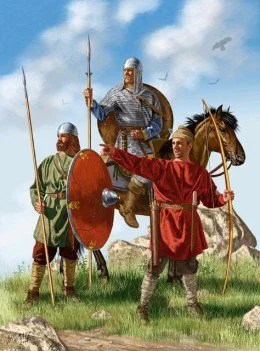
Genevieve and Otto stayed a week in Basel while the armies of Aquitaine, Burgundy, and Provence gathered in Geneva and Lausanne. It was a very different sort of honeymoon week than the week she spent with Charles. Charles and Genevieve spent much of that week in bed. Otto and Genevieve spent much of that week getting to know each other and eating. It was on the fourth day that Genevieve had to confess herself.

They picnicked on the Rhine in a secluded garden with plenty of trees and spring flowers. Captain Hector always made sure two soldiers kept an eye on the Margrave and his Lady, but they stayed out of the way. Margo and Nelly were also there, somewhere near in case they should be needed, but they did not intrude. At first, everything was quiet. Genevieve feared she might actually be running out of things to talk about. She felt the shy coming on, but that got interrupted by the sound overhead. A small Ape shuttle slowly floated over the water. It made no effort to hide. The occupants were clearly looking for Genevieve, and Genevieve had to excuse herself. She did not give herself a chance to worry about it.

M4 Margueritte: Banners of Christendom, part 1 of 3

Jennifer did not say anything for a while.  They watched the changing of the guard on the Paris gate, and some young men who were struggling with wooden practice swords and shields.  A wagon load of hay came in the Breton gate and headed for the barn, and then Jennifer spoke.

“It must be beautiful over by the Rhine,” she said.  “I’ve never been there.  Father brought us over from the new world because he felt called.  He said you were calling him, by the way.  I don’t know.  It was a long journey, but we came to Amorica, and Queen LeFleur welcomed us, so here we stayed.”

“Are you glad you stayed?”

Jennifer nodded.  “I am glad for everything, but I miss Aden terribly.  I know human life is short, and I am prepared for that, for myself, but I never thought to lose Aden so young.”

“Not so young,” Margueritte said.

“Mercy is just eleven.  She has had Sylvan for company for a long time.  I am glad she has Brittany and Grace here, and Walaric’s daughter Gertrude, who is twelve and more company for Brittany, I suppose.”

“What do you think of Walaric’s wife?”

“Alpaida?” Jennifer thought a moment.  “She seems very nice.  I can’t believe she is talking about getting pregnant.”

“I know.  I can’t believe Margo and Elsbeth are pregnant.”

“I believe it about Elsbeth,” Jennifer said.  “She lost one young.  That must have been hard.  But she says she never felt better than when she was with child.  I don’t understand that.”

“Peeing in the bed in the middle of the night, rashes and a butt bigger than a horse,” Margueritte shook her head and Jennifer covered her mouth as she laughed.

“But tell me about the Rhine,” Jennifer changed the subject.

“Well, Ingrid calls her home Wesel.  It was Horegard’s father’s name, who I never met.  But the river is about like the Loire, too wide and deep to cross without a boat.  Ingrid is building a bridge across the river there and plans to build a walled village on the other side, where the Lippe River meets the Rhine.  She says she can’t resist, now that she knows there is a bunch of undeveloped river land there that is claimed by the County.”

“But you are building a place, too.”

“Another castle,” Margueritte nodded.  “And they are cutting great blocks of stone for the walls and towers.  It is on as close as the area gets to a hill and overlooks the Rhine and all the county land that Horegard probably did not even know belonged to him.  You see, the March around Wesel, that is south and west of the Rhine stops several miles from the Meuse.  But on the other side, it is bordered mostly by rivers.  The Issel River forms the north border until it meets the Bosch.  That is where the county bubble begins as I call it.  North of the Bosch, east of the Dinkel, south of the Vechte, and then west of the Issel until you reach the place where it turns away from the Rhine.  Draw a straight line to the Rhine, and that is quite a bit of land.”

“A big bubble,” Jennifer nodded, but she could not really picture it.  “But are there not people living on all that land.  It seems to me the human race is moving in everywhere.”

Margueritte nodded.  “More people of old Frankish descent than you might imagine, But Saxons moved into the eastern part decades, maybe a century ago, and the Frisians filled up the western part.  It has been difficult claiming the land, and some Saxons and Frisians who were not Christians or not willing to acknowledge Roland and pay their taxes were moved.”

“It sounds like terribly hard work.  And how did those people take to being moved off the land?”

“No reaction yet.  They understood the rules well enough so there was no misunderstanding.  And I think it is not that many years since Charles whipped the Saxons and the Frisians, so maybe there is not enough support to go to war over it.  I hope anyway.”  Margueritte smiled for her friend who had truly become like a sister.  “You could come visit, and I could show it all to you.”

Jennifer shook her head.  “When I was Little White Flower, I could not keep still.  I wanted to go everywhere and see the world.  My father brought us all the way across the ocean because he had to move.”

“The little ones are like the wind,” Margueritte agreed.  “They carry the seeds and drive the animals to new places and help them adapt to new environments.  They fall with the rain and snow, and push the heat up from beneath the ground, and keep the earth balanced, green and growing. They keep the world turning, and the human race has no idea.”

Jennifer nodded to all that she said but continued her thoughts.  “But since I have become human, I find home is the place I most want to be, even though I cry in the night for missing Aden.”

“And you still have young ones,” Margueritte pointed out.

“Yes, but in ten years or so, when Mercy is happily married, I think I may visit Saint Catherine’s de Fierbois.  My faith is not what it should be.  I feel the nuns there may be what I need, perhaps for many reasons.”

Margueritte said nothing to argue or talk her out of it.  Mercy was eleven.  Jennifer would have plenty of time to make her own decision.

Three days later, Childemund arrived from Paris and complained.  “What happened to my quiet little farm?”  Then he asked, “Got any apple pie?”

Margueritte took him to where he could help himself, and then opened her letters.  Roland’s got opened first, and Jennifer, Margo, Elsbeth and Owien, and Alpaida were all there waiting for her to read the letters out loud, so starved were the people in those days for any such news.

Margueritte read quickly, and her face turned red from anger.  She tore open Charles’ letter and got confirmation.  Then she spoke.

“The minute I left, the minute I left!” she repeated the words.  “An army of five thousand Saxons crossed the Dinkel and began rampaging though county lands.  Bertulf quickly raised all he could get on short notice, while Theobald waited for men from Cologne and as far away as Tournai and Metz.  Bertulf had five hundred foot soldiers and five hundred lancers, mostly squires, but only those who had three or so years of training, and that included the older men.  He did not want to risk recruits on horseback.”  Margueritte let out a loud, “Grr,” and slapped the papers to her knee.  Owien took them to read for himself as Margueritte continued.

“Roland says Bertulf and the lancers drove an army ten times their size right back across the Dinkel.”  The women looked happy and Elsbeth applauded, but Margueritte made them pause.  “Wait.  They found ten thousand more Saxons and Turingians massed on the other side of the river.  Facing fifteen thousand men, Bertulf withdrew and affected a strategic retreat all the way back to the Rhine, where he crossed over to my castle and prepared to make a defense.  Fortunately, it was not much later Roland showed up with Charles and the whole Frankish army.  Right now, Charles is driving the Saxons back.  And according to Roland, he intends to crush the Thuringians, maybe as far down as the Main River.”

“But that is good news, isn’t it?” Margo asked.

“They will probably have to stop when the weather turns.  And if Charles thinks I am going to take on the work of patriating a bunch of stubborn, two-faced Thuringians, he has another think coming.”

“Roland says it was Oswald, the elf King in the area that said the Thuringians were behind it all,” Owien reported.  “Maywood confirmed it.  He says they egged on the Saxons, calling them cowards and such.”

“The minute I left!” Margueritte repeated.

“Your reputation as a witch scared them,” Elsbeth said with her best, sisterly smile.

“I am not a witch,” Margueritte yelled.  She felt obliged to respond with appropriate volume to the sisterly dig.

“Charles says he is impressed with what your lancers can do, and Roland says he is trying them in different settings and, I quote, drooling like a boy presented with a new toy.”

Goldenrod flew in the nearest window and came straight to Margueritte.  “We got mail?  I like mail.”

Owien finished reading and handed the letters to Margo.

“And where are the girls?” Margueritte asked.

“Sorry.  They had to go around the long way,” she said, even as the young girls burst through the front door.  The young women, Morgan, Lefee, Gisele and Larin came a few minutes later.

###

Margueritte sat down right away and wrote long letters to Roland and Charles.  She told Roland she missed him, and he knew where she was.  She would be returning to Wesel in the spring of 733, but she hoped to see him before then. She also said if he did not knight Bertulf right then and there, and probably several others as the campaign moved into Thuringia, she would just have to do it herself.

She told Charles that she would gladly work his suggestions into her training regime, but she did not expect a forty-five degree turn in full charge would work.  She would think of something, and meanwhile, how dare he take half-trained men and especially boys into a war like that.   He could have them to play soldier in 734, and not before.

Margueritte reminded Charles that these were still summer soldiers, who planted in the spring, came to train in the summer, but went home in time for the harvest.  True, they took their horses and equipment with them, and they were encouraged to continue their training and their learning over the fall and winter.  In some cities, like Cologne in the east and Laval in the west, the young men often gathered to continue their training together, but they were still summer soldiers.  She was glad he had found them disciplined.  They needed to be on horseback.  He needed his permanent foot army to be equally disciplined, but he knew that.

Charles brought his army to Reims after dealing with the Thuringians.  Reims was a city in Neustria, but near the Austrasian border, and not too far from Burgundy.  From Reims, he could bring his army out and be anywhere in Frankish lands, short of Provence and Vascony in less than a week.  But until Charles built his army and kept it together and quartered it for the winter, he, like every other Germanic king and lord, had to settle for summer soldiers.  Armies in northern Europe went home in the face of winter.  They might come out to fight as early as mid-March, but if the issue was not decided by mid-October, it would not be decided that year.  In general, it was not a good way to build an army.  No telling if the farmer could use his sword, or if he might run away at the first sight of the enemy.