Medieval 5: Elgar 9 Odda and Ubba, part 2 of 2

With the dawn, Ubba’s  commanders urged him to overrun the town, but at the same time, Ubba’s spies returned and reported. “They did not lay in any supplies and food. They don’t have any fresh water in the fort.”

Ubba turned to his commanders and smiled. “Why waste our men and blood? We have the gates blocked. We can wait a week and starve them out. Meanwhile, we can send out scouts to survey the area, west, south, and east. Let us see which way we can most easily move to enrich ourselves.”

“We had a good thing in Dyfed.” A man named Carlson complained. “Why did we come here?”

“Because.” Ubba retorted. “Guthrum has some five thousand men in his army. I am told Wessex can just about match that number. But an army cannot be in two places at once and right now they are focused on Guthrum. We can pick Devon clean and maybe Somerset, at least the western half of it and leave before Wessex can send any serious opposition. Then again, if Guthrum succeeds, we are safe here in the west end of Wessex to do as we please.”

“We have much to gain and little to lose if we play it smart.” One commander understood.

“Devon has not been in West Saxon hands for very long. They probably can’t raise much of an army. If we are patient, the men in this place will surrender when they get hungry enough and then Devon will be ours for the taking.” Ubba set about securing the siege on Countisbury and the fort while he selected the men to send out to scout and get a good grasp on the lay of the land. Those plans got interrupted when they saw men coming from the east.

Ubba’s men hurried to fortify that side of his camp. When he managed a count, he decided they only had three or four hundred men. “Probably the coastal watch from west Somerset,” Ubba said. “I don’t know how they knew we were here to come running, but it is a gift for us. We still have twice their number if you count them and the men in the fort together, and they are divided. It should not be hard to kill off one and then the other, and the coast of both Devon and Somerset will be ours for the taking.”

It sounded good in theory, but the dwarves picked up a second hundred coming through the Brendon Hills. Somehow, they got around Gwyn and his men and headed toward the coast and the twenty-three longships there. They had in mind first to make sure the Vikings had no means of escape. They figured with the ways east and west blocked by men, the Vikings only had the south as an escape route. They and their axes would happily chase the Vikings all the way to Dartmoor if necessary.
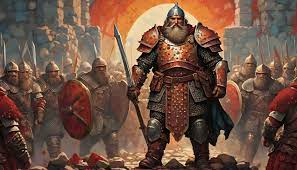
The Dwarfs with some judicious arrows from Pinoak’s people made short work of the hundred Danes Ubba left to guard the ships. Then they turned their axes on the ships themselves, though they mostly cut the anchors and shoved the ships out into the water. The water sprites in that area dragged the ships into the deep water where Ubba’s men could not get at them, and the dwarves were able to turn and face the Vikings in case Ubba sent his men to save the ships.

Ubba quickly turned his eyes toward the south, but he found no escape in that direction as the main force from Devon, about nine hundred men formed a wall and moved slowly forward. Ubba yelled. “Form up. Form the line. Make the wall. We can win this.”

“I hope,” Carlson mumbled.

Gwyn and Osfirth linked up and between them, they matched the Danes in numbers. it was a bit over twelve hundred Saxons and Celts versus a bit under twelve hundred Danes, and the Danes did not have time to set their order and keep any in reserve.

Copperhand yelled at the Vikings but he kept his dwarfs back from the men. Pinoak got the word that the Dwarves had come out of their place and what they were doing, and he told Elgar. Elgar yelled, but then he settled down and gave himself a massive headache, projecting his thoughts all that distance to Copperhand and whatever other dwarves might be listening.

You had your fun. You can stay back and prevent any Vikings that may try to escape down the shore or maybe try and swim to the ships, but let the men fight their own battle. Most of your people can’t tell the difference between Saxons and Danes, and if you start killing my Saxons I will be very angry.

Copperhand yelled back, but he kept two long ships intact as enticements to Ubba’s men, and in the course of the battle, there were some that made the attempt, so Copperhand and his got to chop up some Danes. They were not entirely disappointed.

Gwyn and Osfirth had mostly farmers and fishermen in their ranks. That just meant they had strong arms, backs, and legs. They could push a spear of swing a sword as well as any man, and hold their shields up all day long, but the Danes had mostly veterans of many battles. They had all the battle experience on their side and had learned some lessons the Saxons hardly imagined. Though the sides were about even in numbers, there seemed little doubt that the Danes would win the day, that is, until Odda moved.

Odda picked up another hundred men in Countisbury, plus he had a hundred or so men in green that he knew were Elgar’s people. They were in fact Pinoak’s fairies and a contingent of local fee, elves, gnomes, and such that manifested to help out. Odda knew if the Danes won the battle, he would be stuck with no food or water. He did not imagine he had any choice. He and his men charged out of the fort at the back of the Danes and hit them in the rear with five hundred new swords and arrows, The Danish line shattered.
Three men in their fifties ran with Odda and knocked him down. They knocked him down three times before the old man did not have the strength to get up again. He laid there in the grass and threatened the men. Those men understood, but they hovered around the seventy-year-old to protect him from the battle. In the end, Odda sat up and asked.

“How did we do?”

“Complete victory,” one of the men said. “Our losses were light. They lost their whole army. We have about four hundred prisoners.”

“Ubba?” Odda asked.

“Found. Dead,” the man said. Odda nodded, and two of the men helped him back to his feet.

************************

MONDAY

The story of Alfred and Guthrum comes to a different conclusion. Until then, Happy Reading

*

Medieval 5: Elgar 6 Wessex, Take Notes, 1 part.

In the year 850, the first wave of the Danish invasion of England began off the coast of Kent where King Athelwulf’s son, Athelstan, ruled as sub-king over Kent, Sussex, and Surrey. With his ealdorman from Kent, Athelstan defeated a Danish fleet. It was a pyrrhic victory. Athelstan died shortly after the battle, and a few months later, an ungodly number of Norse ships landed in the Thames estuary. Kent no longer had the ships to hold them off. The Danes sacked Canterbury, besieged Rochester, and overran London.  This was no simple raiding party.

When London fell to the Norsemen, King Berhtwulf of Mercia brought out his army. Berhtwulf lost. The army of Mercia was devastated and they appealed to Wessex for help. Kent, which at that time was nominally part of Wessex, also appealed to King Athelwulf. As soon as the Norsemen overran London, even before the Danes pushed up the Thames, Athelwulf sent out a call to arms. He only hoped men would come in number to at least match the reported five thousand Danes. It would have been more Danes, but Ragnar, the son of Lodbrok wanted no part in the invasion of Wessex. He took part of the army north to invade Northumbria instead.

Elgar gathered his three hundred and accepted an additional hundred from Odda in north Devon. When they joined Eanwulf’s six hundred that made a thousand men out of Somerset. The whole sub-kingdom in the east, Kent, Sussex, and Surrey only added a thousand to the number, though to be fair, Kent was already struggling for control of Rochester, Faversham, Canterbury, and Dover. For the most part, everything east and north of Watling Street was in Danish hands.

The rest of the army, the three thousand had to come from what had always been the heart of Wessex: Hampshire, Berkshire, Wiltshire, Dorset, and the Isle of Wight. Athelwulf and his Ealdormen managed it but they needed the three hundred Ceorle was able to bring from Devon to do it. They only hoped the Danes did not come up with any surprising, uncounted men at the last minute.

Elgar, now age thirty, led the men of Somerset. Eanwulf stayed home with his wife, Wulfram, who was pregnant in her mid-thirties and having a hard time of it. She was confined to her bed on doctor’s orders and Eanwulf was afraid to leave her for fear that he might lose her. It worked out, even when Elgar appointed his friends Osfirth the Saxon and Gwyn the Celt as his chief lieutenants.  They were also over thirty and a majority of the army was younger, war being a young man’s game. Besides, the older men in the army, in particular those who fought at the Parrett River knew it was Elgar who engineered the victory. Men did not mind following a winner. It gave them confidence that they would get home alive.

King Athelwulf was not entirely happy that Eanwulf stayed home, but Osric of Dorset convinced the king that he got the better of the deal getting Elgar in Eanwulf’s place. He told the king, “We matched the Danes the way they fight and our good men beat their good men.” That was not exactly true, but it sounded good.

The Danes built their line between a forest and a bend in the river so the West Saxons could not use their horsemen to strike their flank or rear. Clearly, some of the leaders of the Danes had been at the Parrett River and saw how affective a cavalry charge could be. Elgar prepared for that. He filled the forest with his men in green, all excellent archers. Then he struck the Danish line in a way to turn them, so their backs would be toward the woods. It sort of worked. Mostly the men on the riverside got pushed back, creating a space between the lines and the river.

This time, the Danes also had about two hundred horsemen. No doubt they stole the horses on their way through Kent, London, and up the Thames. They were learning. The men of Wessex also had about two hundred men on horseback, but Elgar only counted a hundred and forty worth anything. Most of the rest were servants, monks, and priests not there to fight. Elgar had to charge his men to fight the Danish horsemen in the first real cavalry fight almost since Roman times. The Saxons got the worst of it, being outnumbered, but they did keep the Danes from crashing into the Saxon line in payback for what happened at the Parrett River.

Once the back of the Danish line came within range of the woods, they began to be devastated by Elgar’s archers. They would not last long if something was not done. The Danish commander had to send his reserves into the woods to rout out the enemy there, but not many of them would come back out of the woods. There were dwarfs there, and even some dark elves in the shadows just itching to use their axes on the enemy, and the archers disappeared only to reappear as soon as the Danish reserves passed them by.

After that, the Danes very quickly began to surrender. King Athelwulf with his son Athelbald and his ealdormen deserve the credit for restraining their men, a bunch of wild Saxons filled with blood lust.

Osfirth rode up to Elgar and pointed across the river. It took a minute to see what Osfirth was pointing at. He just caught it when Gwyn rode up and turned his eyes in the direction Osfirth pointed. Then everyone looking in that same general direction caught it as the Flesh Eater mothership rose up from where it parked and no doubt watched the battle. It did not hover for long before it shot off to the east, toward Kent, East Anglia, or across the water to Danish lands. It happened so fast less men saw it than one might think.

“If you blinked, you missed it,” Gwyn mouthed the old expression.

“Where do you think they are going?” Osfirth asked.

Elgar shrugged. Reed, Pinoak, and Marsham would all find out and report.

The men of Wessex marched many prisoners to Kingston on the Thames where they would hammer out a peace treaty with the Danes. Thus, the first wave of invasion by the Norsemen petered out, though many Danes stayed in the land and settled in places like Mercia, Essex and East Anglia, and southern Northumbria, in the old kingdoms of Lindsey and Deria around York.

As it turned out, the Northumbrians also found a way to victory. Ragnar Lodbrok and his men ravaged the countryside for a time, but eventually the Northumbrians built an army that won the day. Ragnar was captured and legend says he was thrown into a pit of snakes. The legend also says he issued threats even as he died. He swore he had sons who would avenge him, but the Anglo-Saxon kingdoms would have to wait for that. In fact, they had to wait fifteen years for those sons to get old enough to make good on that threat.

~~~*~~~

Elgar went home to Watchet and his girls where he worried less about the Norsemen and more about the Flesh Eaters and what they were planning. They had been good, relatively speaking. They were not eating many people, but rather using people to further their aims of bringing the world into their orbit where they could feast at their leisure. They were experimenting, and the Norsemen were their guineapigs.

“The men around Rochester in Kent were fitted with mind control devices,” Pinoak reported. “It did not work out too well.”

Elgar understood. “Men controlled in that way, or by some enchantment, don’t respond well to changing situations. They are slow to react and in a battle situation that is a quick way to die.”

Pinoak also understood. “I believe the Flesh Eaters may abandon that idea. They brought their mothership to watch and take readings to see the results.”

“I saw,” Elgar said and turned to Marsham. “So, Northumbria…”

“Nothing I could do to stop it,” Marsham said right off. “Warthog was determined to get in on the action.”

“The son of Piebald the dwarf,” Elgar frowned.

“The same,” Marsham said. “And Hassel and Heath brought their troop to observe, but I know they got in some target practice.”

“My sister, Heath,” Pinoak said proudly before he got quiet seeing that Elgar was not pleased.

“And some of your own elf troop came up from the Coquet River, don’t tell me… They could not help themselves.”

“Lord,” Marsham said and looked down like one prepared to be punished.

“You all know the rule,” Elgar thought hard and projected his thoughts so he could include Warthog and Hassel in the message though they were miles from the Somerset coast. “You are not to mingle with humans or get involved in human squabbles or wars without permission. Lucky for you, history has accounted for this, though creating a snake pit so the humans could throw the Danish leader into the pit was unnecessarily cruel. Don’t do it again.” He cut the message and mumbled to himself. “It’s like Serket all over again.”

“Lord, your brother’s friend Ceorle, ealdorman of Devon was killed in the cavalry struggle,” Reed said to change the subject.

Elgar nodded. “Odda has been given the job. I talked with him and with Osfirth. Osfirth has been trained in the coastal watch and he has agreed to take Odda’s place between Countisbury and Pilton so Odda can move to Exeter. I am going to miss Osfirth on the Parrett River, but I have good men in Combwich since we drove out the Danes from that place, and he will have Gwyn in Carhampton as his neighbor, so all should work out well.”

“You hope,” Reed said.

“That is all we can do,” Elgar said. “Keep me informed as far as the Flesh Eaters are concerned. If they don’t soon figure out that the human race will never unite and submit to being eaten and leave this world of their own accord, I may have to pay them a visit and force the issue.” He paused and thought a moment before he added, “I especially want to know if they start breeding. We don’t need them to start a colony here.”

He walked into his house and thought he should bring Genevieve to talk to his wife and daughters. She could at least follow along with all that prattle.

“Hey!” Genevieve protested.

************************

MONDAY

Second chances matter, and the sons of King Athelwulf begin to show some promise. Untl Monday, Happy Reading.

*