Medieval 6: K and Y 4 Happy Soon, part 3 of 3

Kirstie

“It is well known that a woman warrior, a shield maiden stood alone on the field beneath Lindisfarne Abbey. She alone faced four hundred Norsemen and asked them, no, demanded that they not do any evil on that holy ground. Some say it was arrogance. Some call it hubris. But the Holy Church has determined that the angels of the Lord came around her to protect and strengthen her arm for the trial. Indeed, she fought the devil on that field and prevailed, and the Northmen, being men of honor, accepted the outcome and withdrew from that place, thus sparing the abbey and the holy island.”

“That was not exactly how it went,” Harrold mumbled.

“Near enough,” Rune whispered.

“Lindisfarne is ruined these hundred years. They have no gold, no silver, no jewels of any kind. Only a few ragged monks remain to keep the fire burning. But it does remain a symbol of peace and salvation for all the people, and this the church knows well. Therefore, they established a small purse and went to King Eadwulf II to find the woman and reward her with all of their thanks. The king was so moved by the courage of the woman who faced certain death, he doubled the purse, and we were contracted to find her and bring her the sign of our gratitude.”

“And Fairhair?” Jarl asked. “You said the king’s business.”

“Hush,” Harrold said. He liked a good story.

“Quiet,” Chief Kerga added.

“That first year we sailed to Kaupang, the chief trading town of the Norse, the king’s town. Harald Fairhair took half of our goods without compensation, and we dared not complain. Somehow, he heard about the attack on Lindisfarne and became enraged. He asked who did something so stupid without his permission. He was told Ulf Hakenson from Steinker, but Ulf got killed before there was a battle, so the others withdrew. That calmed the king a little. “That is one bad situation I don’t want to get involved in,” he said. “Let the Saxons and Danes kill each other off. I have plenty of Geats and Danes by the shipload right here to deal with.” We got out of there and said nothing about Trondelag or Strindlos. So, if the king comes here looking for the men involved in the raid on Northumbria, he won’t hear about it from us.”

“Why would you care what happens to us?” Harrold asked. It was an honest question and got an honest answer from Wilam.

“Because we want a good trading partner, and it would not start things well by pointing a finger at you. Right now, we are the only ship from Northumbria who is brave enough to dare the waters of the Norse. Others will follow soon enough, but we would like to be established and on good terms before that happens.”

“Story,” Chief Kerga said as if the interruption was rude. Brant picked up where he left off.

“In the second year, we sailed to Agden, not wanting to get tangled in Vestfold again and not wanting to give up half our cargo for nothing. We sailed the shore all spring and summer. Rogaland, Hordaland, Sogn and the great fjord there. We had to give some of our goods again for nothing, but we also made some trades, so it was not a total loss. However, we did not find Trondelag. We found many fjords, but the best information we could get about Trondelag was further north, further north. By the time we got to South Moeri and we found out Trondelag and the fjord we were looking for was in North Moeri, the weather began to turn. We headed home with little to show for two years of trade, but now we at least knew where we were headed.”

“In the third year, the king got word that Aethelwold, the son of Siefried died under strange circumstances, and Cnut of York invested his sons, Halfdan, Eowils, and young Ingwaer to follow after him. King Eadwulf kept his ships close to home that year. We did not go out. Then, this year, we came straight to this place, but we were stopped at the entrance to the fjord. We told them we were on the king’s business and looking for the village of Strindlos. They were good enough to give us directions and let us go. We got stopped a second time in the narrow place by Stadr.”

“We are on the king’s business,” we said.

“And what business is that?” the captain asked.

“It is the king’s business,” I told him. “Should I turn around and go back and tell the king one man would not let us proceed?”

“We are headed to Strindlos with word of another hag,” Wilam interrupted. “Should we tell the hag that Stadr seems a very tasty village.”

“That won’t be necessary. You may proceed.” Several of the men that sat listening laughed, nervously.

“We almost got stopped a third time, but we told Captain Jarl that we were on the king’s business. We did not, however, say which king. The box.” The two men guarding the chest set it on the table in front of Captain Olaf. “Kirstie,” Brant said. “Please accept this reward and the thanks of both the church and the king, that is, King Eadwulf II.” he opened the box and the men saw it was full of silver and some gold coins.”

Kirstie did not blink. “Please bring the box over here,” she said, and walked to the table they used when a ship returned and had to divide up their take fairly under the watchful eye of the chief and the elders. They brought her the chest and she dumped it on the table. It did not have as much in it as it appeared. The chest had thick sides. It took her a few minutes under everyone’s watchful eye to divide the contents into eight equal piles. She had two pieces of silver left over and she handed them to Mother Vrya for the Witcher Women.

“Why eight piles?” Jarl asked. “One per ship?”

Kirstie shook her head. “Njal’s ship, Odger’s ship, and the other captain I can’t remember deserve nothing. They only left when they were outnumbered. One pile is for Chief Kerga and the village of Strindlos. One is for me, captain of this ship. It is the ship’s portion. A second is my personal cut, me and Yrsa. She pushed the two piles back into the chest and closed the chest. For these last five, I need two leather pouches if there are any.” She got offered three pouches. One was clearly too small, but the other two would do well enough. “These five piles are for the ships that came to their senses and to my side of the field. You deserve a fair share of the thanks.” Kirstie filled the two pouches with a portion each and that left three portions on the table, one for Rune, one for Jarl, and one for Harrold. Each portion had a gold piece, but Kirstie picked up the gold piece off Harrold’s pile and spoke to him.

“But you already received your gold piece.”
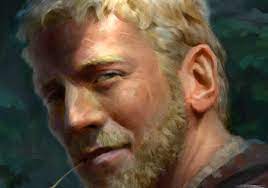
He did not argue. Instead, he reached for the inner pocket of his tunic and pulled out the little golden Cross Father McAndrews gave her. She was surprised he still had it and had not melted it down. “I have heard the story,” he said. “I think I will keep this if I may.”

“You may,” she said, and handed him the gold piece as well.

When all was done, she said, “These two bags are for Captain Erikson and Captain, the other one.”

“Roarson,” Rune said.

Kirstie nodded, picked up the chest and the two bags and juggled her way back to her seat where she tried to hide her face behind her hair.

After that, it got trade boring. Kirstie put her grain and carded wool into the pot of Strindlos trade goods, but then she and Inga snuck out. The men would have to work out the rest of it, and she felt glad to see Wilam right in there bargaining with the best of them.

Medieval 5: K and Y 1 Twins not Twins, part 3 of 3

“Where are we going?” Kirstie asked.

“You need to tell Chief Birger what you just told me.”

Kirstie nearly stumbled. She did not get dragged willingly, but she did not really resist. When they got to the big house Inga did not think twice about butting into the middle of the men. “Tell them,” Inga insisted. “Tell them what you just told me.” The older men were polite enough to listen.

Kirstie noticed the looks of sympathy that covered the men’s faces, but she quickly looked at Inga and repeated what she said, beginning with the idea that there must be a power driving the Vanlil to come and fight or otherwise they would have no reason to risk their lives for strangers. When she finished, the men nodded, like they may have been thinking something in that direction but maybe did not spell it out quite so clearly. Then Chief Birger said something to Kirstie that struck home.

“I’m so sorry.” That was all he had to say.

Kirstie felt the tears come into her eyes and she shouted for her mother. She ran out of the big house, Inga on her heels, yelling. “No. We have to go to Mother Vrya. We are supposed to stay with the Witcher Women. Kirstie! Come back.”

Kirstie ran all the way home. Inga gave up at last and walked the final leg. When Inga arrived, she found Kirstie on her knees, weeping. The house still burned. The livestock had scattered. The dead littered the ground. A dozen men, including Captain Kerga stood around staring at the destruction and talking softly about getting shovels to bury the bodies or maybe building a funeral pyre. The spring was full on, but the ground might still be too hard to dig deep. Kirstie’s mother and baby sister were gone. Dorothy was dead, her arms wrapped around Kirstie’s dead dog, Toto. The three farmhands, the lion, the scarecrow, and the tin man all died, but they took a half dozen of the enemy with them, so it was a battle.

“To make war on women,” one man yelled. “These Vanlil have no honor.”

Captain Kerga responded in a loud but calmer voice. “Their ways are not our ways.” He kicked the boot of a dead man. “But I remember this one from so many years ago. He lived in Haudr above the Skaun before King Harald came.”

“Captain,” a man interrupted. “It looks like the women picked up weapons. I would guess they tried to defend themselves.”

Kirstie sat and cried for a long time, but eventually, Inga got her to move.

Inga took Kirstie to Mother Vrya’s hut where they had a cot already made for her. The Witcher Women on that farm consisted of three older widows of the sea and the Viking lifestyle where the men lived with the constant threat that they might die on some distant shore. Sometimes, such women had no prospect of remarriage, and had no offspring to care for them. Younger women always had a chance to remarry, but some older women had nowhere else to go, and often died before their time. The Witcher Women cared for one another and stayed alive, farming a little, and making textiles for the village.

Mother Vrya was the Volve, which is the seer and something like a shaman. She had chosen Inga to teach and pass on her knowledge and skills, and Kirstie got to sit in on some of the lessons. Mother Vrya built a place on the edge of the village and invited the widows to live on her land. Kirstie was not the first orphan child the Witcher Women cared for, and she would not be the last. Caring for the orphans was another way they helped the village, and the village respected the women in return.

When Kirstie was shown where she would sleep, she fell to the cot and curled up under the blanket. She refused to get up for supper and spent most of the night in tears, eventually crying herself to sleep.

In the morning, Inga found Kirstie down by the docks. “My father should be coming home soon,” Kirstie said. “I will wait here.”

Inga frowned. “That could be months from now.”

“I will be safe here, by the fjord. There are farms and mountains with cliffs to my left. The Vanlil will not come from that direction. To my right are the docks.” She pointed to where Captain Kerga’s longship and a Karve, a fjord trading ship rested, and some men were milling about. “And beyond the docks are the ship builders. The exiled chiefs and men may come for the ships, but there are men there, workers and such to fight them while I escape. I will be safe here where the skiffs and fishing boats come to land.”

Inga put her hands to her hips and deepened her frown. “And what will you eat? And how will you shelter from the storms?”

“I will be fine,” Kirstie insisted. “You have lessons to attend and much to learn from Mother Vrya. Don’t worry about me.” Kirstie turned her head to look out on the fjord. She did not want Inga to see her tears.

Inga may have wanted to reach out and grab Kirstie’s wrist again to drag the girl back to Mother Vrya’s place, but she kept her hands to herself and opted to bargain instead. In the end, Kirstie agreed to let one of the Witcher Women bring her food in the morning, and she agreed to come to Mother Vrya’s at sunset for supper and to sleep on her cot. But otherwise, Kirstie insisted on staying by the docks and waiting for her father to return.

Yasmina

Yasmina stood by her mother looking out from the upper floor window. Yasmina waved to her father who was going to Medina, a whole host of soldiers following him. She never saw much of her father, but he was always nice to her when she did see him. She never saw much of her mother, ether, for that matter. She had plenty of duties of her own. Mother was more strict, but she generally hugged Yasmina and genuinely cared about her.

Suddenly, Yasmina began to weep great big tears. She practically wailed, and her mother was right there to say, “Yasmina, your father will be back. He has made this trip before. He is going for thirty days, and he will be right back. Why are you crying?”

Yasmina reached out and hugged her mother. “Just don’t leave me,” she said between her tears. “Don’t ever leave me.” She held on to her mother thinking Kirstie could never do that again.

************************

Monday

Kirstie is gifted by the gods and Yasmina does not know what to think about that. Meanwhile, Kirstie is told something important. It is a matter of life and death. Until then, Happy Reading.

*

Avalon 8.6 Standing Still, part 1 of 6

After 883 A.D. Norway

Kairos 104: Kirstie, Shield Maiden

Recording …

The time gate sat just off the shore beyond Bristol.  Lincoln complained.  “If Elgar stayed in Winchester, the time gate might have been in the swamps of Somerset, or maybe in Devon, but on land.

“It might not be so bad.” Sukki stayed positive as she and Boston got ready to test the gate.

“Yeah,” Boston agreed.  “Kirstie is a Viking.  She might be sailing across the Atlantic.  Too bad we had to kill so many of the local Vikings.”

“Boston,” Sukki objected.  She did not need the reminder.  She did some of the killing and found it a traumatic experience.

“Sorry,” Boston said.  “Sorry.”

“Just see where the water gate leads and come right back,” Kate told them.  “No playing around.”

“I understand,” Sukki said, and Boston nodded while she walked her horse out to where the water came up to her horse’s withers.  Her saddle got soaked, and the water felt cold on her legs, but Boston had the fairy weave she wore as thick and waterproof as she could make it.

They came out in a bay—a skinny bay surrounded by high mountains and cliffs, near a dock where people worked.  A Viking longboat sat alongside the dock, and the men and women who worked on the boat took a minute to notice.  The water was calm, but deep, so the horses had to swim, and it felt very cold, almost ice cold.

One man shouted as Boston, Sukki, and their horses struggled to swim to shore.  Another man shouted.  A woman said something and pointed.  Several men raced down the shore from the dock to indicate where the horses might find some footing.  Several people ran into the village.

Boston had to turn her heading.  Sukki already had Cocoa moving in that direction.  They quickly reached a spot where the shivering horses could climb out of the water, even as men came up with blankets.  The men went straight to the horses, to rub them down and warm them.  The few women covered Boston and Sukki in blankets and told them to walk it off.

“Keep walking until your legs don’t feel like they are about to fall off,” one woman said., but it was not so bad.  The fairy weave naturally pulled the wet and cold from their legs and expelled it.  Fairy weave was a marvel.

“We have to fetch the others,” Boston told the woman beside her.

“More?” the woman asked, not really questioning the idea that there were more.  She looked at the old man who came over to question the strange women but seemed get some sort of message.  He backed off and gathered a half-dozen more men to stand on the shore and wait for the others.  Boston ignored that whole exchange, having the others on her mind.

“Sukki, are you ready to fly?” Boston asked and Sukki nodded.  Besides the fairy weave, Doris, the sea goddess, one of the goddesses who changed Sukki from a Gott-Druk—a neanderthal—to homo sapiens, gifted Sukki with pressurized skin where the cold water did not affect her nearly as much as a normal human.  She could also hold her breath much longer than anyone else and go into the deepest parts of the ocean without being crushed.  She could also fly, but that was thanks to one of the other goddesses.

“I hope we won’t be long,” Sukki said and lifted into the air while the men and women on the shore gawked and some shouted.  She went to where the time gate still stood activated and flew closer to the sea than necessary, but just to make sure she got through.

“Inga.”  The woman who stood beside Boston introduced herself.

“Boston.”  Boston reciprocated, and sat on the shore staring at the time gate

 “Kirstie is not here,” Inga said, flatly, and sat down beside Boston.

“I know,” Boston responded.  She looked at the woman and had to ask.  “Why did you think to mention her/”

“Two reasons.  First, you appeared out of nowhere and plopped into the fjord.  Only Kirstie would know someone who can appear out of nowhere.  Besides, your friend can fly.  Second, I feel there is something different about you.  I have been to Avalon, you know.”

Boston understood.  She could not deny herself.  “I’m an elf,” she admitted, and Inga merely nodded that she understood.  “My friends are all human, mostly.  Elder Stow is an ancient one.  Sukki used to be an ancient one, but she got turned into a human several hundred years ago by a handful of goddesses.  They made her human but got a little carried away.  They gifted her with all kinds of abilities, like the ability to fly.”

“I see,” Inga said.  “But you said hundreds of years ago?  Where are you from?”

“The future,” Boston said.  “I probably shouldn’t talk about it.”

Inga looked confused, so Boston explained a little more.  “We started on Avalon eleven or twelve hundred years in the future.  We traveled into the past through a thing called the Heart of Time.”

Inga’s eyes got big.  “I saw the great crystal.  Kirstie said it remembered all of the past, but I did not know it had such magic.”

Boston shook her head.  “Not magic.  Like magic, but I think it is more a natural device, in a way.  Certain crystals have the capacity for massive memory storage…”  Boston stopped.  “Sorry.  I’m an electrical engineer.  You don’t need the specifications, which you probably would not understand anyway.  Besides, as an elf, my inclination is to say, yes, it is deep and mysterious magic, and make a spooky face, and grin.”  Boston grinned.

Inga laughed.  “I believe I understand just fine.”

“Oh,” Boston pointed.  Elder Stow and Sukki came through the time gate.  They appeared to be carrying the wagon, but Boston knew they were merely directing it to the shore.  Elder Stow had it floating along above the water, lifted by a half-dozen discs tuned to his flotation device.

Elder Stow collected the discs and flew back through the time gate before he could be introduced.  Sukki simply said, “Be right back,” and she followed Elder Stow through the air and vanished over the water.  Inga watched.  She squinted but could not say how the magic was done, or perhaps more accurately, where the people went.  Boston took a second to look at the five men and two women who stood on the shore.  They seemed to be patiently waiting for something.  She wondered if maybe they were some sort of elder council.  The rest of the crowd stood a few feet behind the council.

“Kirstie is on her way back to the village,” Inga said.  “I expect her in a week or two.”

“That should be interesting,” Boston said.  “Maybe we can stay here for a week or two and wait for her.  That would beat having to chase her all over the roads.  You do have roads?”

Inga said they did.  “But they are not especially good for a big wagon like yours.  Our road is mostly the sea.”

“So, would you mind if we stay here for a while?” Boston asked.

“That depends on how much you eat,” Inga smiled.  She did not have the lips for a good elf grin.

“Like an elf,” Boston answered with a straight face before the two laughed softly.

“There is one thing,” Inga said, and lowered her voice in a way that got all of Boston’s attention.  “There have been three unexpected deaths this season.  All three were found in the wilderness, outside the village itself, where no one else was around.  We found the bones, twice.  The third time, men rushed into the woods on the hill and must have scared away whatever it was.  We found Earika, a young wife and mother.  She had not been eaten like the others, but all of the blood had been drained from her body.”

“Flesh Eaters.”  Boston voiced her suspicion just before the others began to come through the time gate.