M4 Margueritte: Trouble All Around, part 3 of 3

That evening, she confessed to Roland.  “I have to go, but I don’t want to leave.  I just got you back.”

“Owien must be about twenty by now.  That is almost grown up, and Elsbeth is what, seventeen?” Roland asked.  “I married you when you were seventeen.  I thought you were very grown up.”

“Owien is nineteen and Elsbeth is eighteen, and I can only imagine the disaster if I left things in their hands, no offence to Owien,” she responded.

“Now, come on.  Elsbeth is a sensible young woman and probably well grown by now.”

Margueritte could not imagine it but said no more about it.  She felt worried about her father, and what her mother would do when he had gone.  She felt glad Jennifer stayed nearby.  Tomberlain told her they built a cottage beside the church, and some others had come since then and were building their own cottages there, in a place that was safe for Christians.  Margueritte thought that one day there would be a nice little town, and it already had a poor section where the serfs had their huts, just down the hill from the barn.  Sometimes she hated the age she lived in.  She rolled over to rest on Roland’s chest.  Then again, she thought, some things were very nice.  Brittany got fussy so she had to get up, and she thought, or not so nice in any age.

###

Roland gathered a hundred horsemen from the Breton side of the world to accompany Margueritte home.  Boniface would be going with them as far as Paris.  Sigisurd decided to stay on the Saxon border.  She said it felt a land like the place where she grew up, but Margueritte figured Sigisurd and Geoffry would not be single for long.  Horegard and Rosamund had already more or less given their blessing, and even Ingrid seemed to like Sigisurd, and talked to her more than she talked to Margueritte.  Aduan liked everyone, so there was no trouble there, so overall, Margueritte kissed the girl good-bye and sighed as she got up in the wagon that she christened the S. S. Black-n-Blue. 

Relii went with her for the first two days.  Count Adelard was going home, and Herlindis had the good sense to ride on horseback.  Relii bounced with Margueritte for those days, but when they reached the Abbey, Margueritte got left alone with her children.

Marigold came to visit every day they were along the Meuse River, and Tulip came twice.  After they left the River, Tulip took over the visits and stayed with her, at least during the day, every day, until they reached Paris.  

They stopped in Paris for a time.  Margueritte saw that Boniface got well taken care of, and she also got treated well, going back to the same house Charles owned on the left bank of the Seine, the house with the servants.  Rotrude, Charles wife, was not there, but the servants did not question her being there.

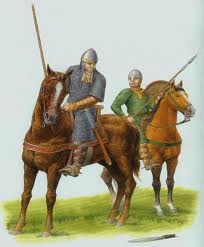
Margueritte took the time to visit several local blacksmiths and three saddleries while she was in town.  It was not easy to do with the children along, but she found a young woman to help.  Her name was Giselle, and her family came from Vascon, and came to Paris a generation ago by way of Orleans.  The children seemed to like her, so Margueritte hired her to be an au-pair, though no one knew what that was.  Then Margueritte found out what it would take to make a better saddle, one with stirrups, and how much it would cost to make real lances, a shield to balance the other side, and gauntlets to hold them.  She had samples made of each, found a horse that could carry all that weight, and made Captain Wulfram ride the horse and get used to the equipment.

“My arms will fall off by the time we reach Little Britain,” Wulfram said.

“So you know better how you need to train the rest of the men,” she answered, and she crawled into the wagon.  

For the next three days, Wulfram complained that he could see no military value in what she asked him and his men to do.  “We have horsemen who can ride around an enemy flank and strike where least expected.  All this equipment would make that impossible.  They would hear us clinking and clanking from a mile away.”

“But your horsemen dismount to fight on foot.  With this, you can fight from horseback.”

“That’s crazy.  You can’t fight a man from the back of a horse.  A man can move and turn.  A horse can’t keep up.”

“You will see, when the time comes,” Margueritte insisted.

When they arrived at Margueritte’s manor home, the spring came in full bloom, and Captain Wulfram had only one thing to say.  “Well, at least my sword doesn’t feel as heavy as it used to.”

“You will see,” Margueritte insisted, and she pointed Wulfram and his hundred horse back down the road they just came up.  “Down the hill where the grassland flattens out.  Try and keep your camp to the right side of the road.  We will need the long field for practice.”

“Sorry Margueritte.  Now that we have delivered you, we need to get back to Charles in Saxony.”

“No,” Margueritte interrupted the man.  “I stood right there.  Charles clearly said you were to stay with me until I dismissed you.  Well, you are not dismissed.  Even under the watchful eye of Charles and Roland, I have been kidnapped twice and held for hostage, and I would have been kidnapped a third time by the Saxons if I hadn’t found a way out of that dilemma.  No, captain.  You are not dismissed.  You camp right here.”  She turned away from the captain and spoke to the teamsters who were holding the wagon.  “Lambert and Folmar, just stay here and relax for a bit.  I’ll let you know where to take things in a minute.”

Margueritte’s mother, Brianna came running, Jennifer beside her, and Margueritte smiled to see them, but noticed how old Mother had gotten in the last four years.  Her hair had turned completely gray, and her skin developed some real wrinkles in her face and hands, and crow’s feet around the eyes.  Her eyes overall looked saggy and worn, like she had not slept well in months, but they still had a familiar sparkle when she held Brittany.  The sparkle said mother, or maybe grandmother.

Jennifer’s eldest, her girl named LeFee was five and said to be sweet.  Her boy, Cotton, two and a half, about Martin’s age, had been reported to be a hand full.  Margueritte talked about her own.  “Sigisurd used to call Martin the wrecker.  I hope the house is childproofed.”

“I don’t know what that means,” Jennifer said.  “But everything is put up where Cotton can’t reach it.”

“I don’t know.  Martin is a climber,” Margueritte began, but she got interrupted by a flying streak of light.

“Lady!  Lady!  Lady!”  Goldenrod grabbed Margueritte by the face and kissed her cheek over and over. Margueritte had to grab the fairy by the fairy weave that covered the girl’s butt to pull her off.

“Good to be home, but it helps to breathe,” Margueritte said.  Mother and Jennifer laughed.  Giselle’s eyes got big, but she said nothing.

The next interruption was by Puppy who came up barking and lolling his tongue, a tongue he used to lick Margueritte’s face when she got down to pet him.  “Puppy, you remember me.”  Margueritte felt happy.

“He does,” Goldenrod said.  “And so do I, and me and Puppy take good care of the sheep, we do.”

“I am sure you do.”

“Just like you taught us.  Isn’t that right, Puppy?”  Puppy barked.  Then a grown-up couple came from the barn, and Margueritte had to take a breath.

“Owien with a beard,” she said softly, and Jennifer nodded.  Mother couldn’t seem to take her eyes away from Brittany who cooed in her arms and playing with Mother’s face.  “Owien, son of Bedwin, good to see you, if that is really you beneath all that hair.”

“Good to have you home,” Owien said.

“And who is this well grown woman beside you?” Margueritte asked.

“Elsbeth,” Owien started to answer, but Elsbeth took his hand and stuck her tongue out at her sister, which made Margueritte laugh.

“I see she has matured well,” Margueritte said, and held out her arms.  Elsbeth ran into them for a big hug.  Then she backed up and had something to say.

“About time you got here.”

“It is very hard to get anything done when my workers run off.”  Another woman stood in the barn door, and Grimly stood beside her.

“Me and Catspaw and Pipes are workers,” Grimly said.

“On a blue moon,” the woman responded, with blunt familiarity to the gnome and came out to see the visitors, even as LeFee came out of the house dragging a three-year-old girl by the hand.

Elsbeth spoke.  “That’s Margo, Tomberlain’s wife, and the girls are LeFee and Larin.”

“LeFee is mine,” Jennifer said.

“I remember,” Margueritte said.  “But Tomberlain told me nothing.”  

“They married the year after you left with Roland.  She is Sir Giles’ granddaughter,” Elsbeth explained.  “They met when he went to Paris as Roland’s squire.”

“You must be Margueritte,” Margo said, as she walked up to join the group, Grimly in her trail.  “Tomberlain told me all about you.  I half expected you to fly in on a broom.”

“No.  The broom flying was my work,” Grimly said in a voice that implied it was terribly hard work.

“No, I made the broom fly,” Goldenrod objected from Jennifer’s shoulder where she had taken a seat.  She took that moment to flit to Elsbeth’s shoulder where she clearly felt most comfortable.  

Margo and Margueritte kissed cheeks like sisters, but not much more because Margo was in her sixth month and beginning to round out.

“Got any names picked out?” Margueritte asked.

“Not yet,” Margo said, but she looked like she had a few possibilities in mind.

“Me neither,” Margueritte patted her stomach.  She felt fairly sure she was pregnant, but maybe it was too soon.  Brittany was not quite past five months old.

“Me neither,” Jennifer said with a grin and pat to her own stomach. 

“Me neither,” Goldenrod said.  She thought she knew what they were talking about but did not want to be left out of the discussion.

“I want one,” Elsbeth whined to Owien, who looked like he thought he knew what they were taking about.

 “Now, let me introduce everyone.  This appendage to my dress in Martin.”  Martin, who had been staring, turned his face into his mother’s leg.  “The one holding Mother’s nose is Brittany.  And this one is Giselle, their au pair.  She is from Paris.”

“Oh?” Margo responded.  “News from home.”

These fine gentlemen are Lambert and Folmar, and they are going to unload our things in the house and take the wagon to the barn.  Grimly, show these men where to store the wagon so it is out of the way, and get the mules settled.  I am depending on you.  Meanwhile, why don’t the rest of us go up to the house?”

“Yes,” Mother spoke at last.  “You want to see your father.”

“And tell stories.  We have a lot to catch up on.”

************************

MONDAY

Margueritte returns home to The Breton March and finds trouble following her. Until Monday, Happy Reading

*

M4 Margueritte: Trouble All Around, part 1 of 3

Come the first of January, Margueritte went to Captain Ragobert with the intention of sending his troop home for the winter, since the men all lived in the general area.  The men camped by the barn and had sufficient supplies of their own so as not to burden the family.  Ragobert said his men would gladly volunteer to help around the farm, but they were charged by the Mayor Charles himself with protecting her, and they were not going to be found negligent in their duty.

Margueritte would not hear his objections, but she eventually compromised.  Half of Ragobert’s men would go home for thirty days.  The other half would take the second thirty days, so they would all get a good visit home and be back to full strength by the second week in March, well before Charles was expected.

Grandma Rosamund went wild when she heard Roland and Charles were coming.  Spring cleaning started in January, and everyone was expected to help.  Margueritte noted that Ingrid did a lot of work around the house, and Aduan acted a lot like Margueritte’s younger sister, Elsbeth.  She did not do much, messed up much of what she did, and please don’t let her cook anything, because it would likely be inedible, she would make a big mess, and then not clean up after herself.

One morning in early January, Ingrid went out to the barn to gather eggs.  Margueritte grabbed a basket and followed.

“What are we doing?” Margueritte asked.

Ingrid huffed.  “Someone has to keep this family fed.”

“Eggs,” Margueritte said.  “You know; I grew up on a farm much like this one.  I have a sister who does not do much, so I had to do many things by myself.  I remember once they kept Elsbeth by the oven for a whole week and tried to teach her to make a pie worth eating.”

Silence followed, for a minute, until they reached the chicken coop and Ingrid asked, “What happened?”

“They failed.  Please don’t let her near the oven.”  Margueritte smiled and went to work before she added a note.  “Or near the dishes, or near the laundry, or near the broom.”  Her voice trailed off and Ingrid looked back at the house and laughed.

Margueritte helped and worked around the farm, and she and Ingrid got along just fine from that morning.  Aduan was the type to get along with everyone, and even Geoffry lightened up when Sigisurd came around, Margueritte noticed.  In fact, Margueritte never felt so welcomed in her life.  In part, it might have simply been the joy of being around a farm again—the smell of the barn, the animals, the grain in the bins.  She felt at home, and they all treated her like family.  It felt wonderful, to the point where it made her homesick.

Margueritte loved Rosamund, a large and hugging sort of a woman, and she loved grumpy old Horegard in his way, but she missed her mother, Brianna and her father, Sir Bartholomew, and she worried because she knew father was not well.  Greta called it hardening of the arteries.  Doctor Mishka said he started showing signs of arterial blockages and she would have to watch for a possible stroke or heart attack.  Her older brother, Tomberlain went home, despite his protests about wanting to fight with the army.  He was needed to maintain the farm and the Frankish presence on the Breton border.  Owien was there as well, Father’s squire, though more probably Tomberlain’s squire at this point.

Deep into February Margueritte paused her thoughts to figure the year.  She decided it was 719, and she started getting ready to turn twenty-two, still young.  Owien turned nineteen.  He was easy to figure.  Tomberlain was Aduan’s age and would turn twenty-five in the summer. That meant Elsbeth had to be eighteen.  Margueritte wondered how that could be possible.  The last time she saw Elsbeth, her sister had a runny nose, still looked like a child in her fourteen years, and stayed busy spending all of her time and energy ignoring Owien.   Margueritte smiled at that thought.  She wondered if Elsbeth was still ignoring Owien now that he was nineteen and she was eighteen.  They might be married and Margueritte would have no way of knowing.  She wondered if Tomberlain ever found a good woman.  She paused.  She wondered what those men were doing, fighting down by the blacksmith shed and around the cooking fires.

“Relii,” she called.  Relii had gone to the barn with her, Sigisurd, and Geoffry, though Margueritte was the only one sifting through the potatoes while the others sat around and tried to keep warm.  “Keep everyone here,” she said.  “And if the big ugly men come, do what they say.”

“What is it?” Sigisurd asked.

“Saxon raiders,” Margueritte answered, before she slapped Geoffry and stole his knife so he could not get himself killed.

Margueritte pulled her cape around her shoulders and stepped out of the barn and into the snow.  She tossed Geoffry’ knife into a snowbank and yelled.  “Where is the chief of the Saxons.”  She shouted a second time using the Saxon words Festuscato and Gerraint gave her, though they were two or three hundred years out-of-date.  “Saxons, where is your chief?  I must speak with him now before he does something stupid.”

One of the Saxons sheathed his sword and stepped away from where two of Ragobert’s men lay dead and two were wounded and, on their knees, surrendered.  Two Saxons also looked dead; but the other six of Ragobert’s men were somewhere out in the fields with the men and the mules, despite the snow.  The Saxon stepped up to Margueritte, no weapon in his hand as if the woman posed no threat.  He looked her over, and even though she stood wrapped up in plenty of clothing, like wearing a tent, he grinned a half-toothless grin of approval.  He looked ready to do something stupid when Margueritte raised her hand and shouted, “Defender.”  The long knife appeared in her hand and went to the man’s throat before he could react.

“I am not asking,” Margueritte said.  “Are you the chief?”

“I am Chief,” a voice came from a big man on the porch outside the front door of the manor house.  He appeared, chewing on a leg of lamb leftover from last night’s supper.  “I am Gunther, and I have thirty men here, little witch.  What can you do against thirty men?”

Margueritte stepped a few feet away to be out of arm’s reach.  “I am not a witch, and you don’t really want to know.”  She held up her hand and Defender disappeared.  “But here, I just realized I am not properly dressed.”  She called for her armor and it replaced all of her layers in an instant.  With the fairy weave under her leather, she felt the cold in her knees and elbows, but that was it.  The weapons came as well, with Defender attached to the small of her back and the sword called Salvation slanted across her back.  “Now listen carefully, Saxon Chief Gunther.  You have thirty minutes to pack up your thirty men and get back across the river, and if you harm anyone here, there will be no place in the whole world you can hide.”

Gunther did not look impressed, despite the quality of what he thought were magic tricks.  Clearly, he had something else on his mind, and he spoke it.  “I had thought you were the one to be wife for my son, but you are not her.  I do not know why I thought to find a wife for my son among the Franks.”

“I know why, but the sorcerer’s life would have been in danger if he followed through.  You now have twenty-nine minutes.”

“You are still little, and yet you make jokes.”

“Maywood.”  Margueritte called, and the fairy came and circled once around the Saxon’s head before he became full sized, a fairy dressed for war.  He fell to his knee before Margueritte.

“Lady, I have men here who have been watching you, and my troop gathered as soon as we saw that the Saxons intended to cross the river.  My troop is now here.   What is more, Prince Oswald of the Elves of the deep wood has a troop that followed the Saxons when he wisely figured out their intended target.”

“Twenty-eight minutes,” Margueritte said.  “Oswald,” she called, and the Elf appeared, and like the Fairy King, he went to one knee before Margueritte, and spoke.

“Lady, it would be my pleasure to rid this world of all these Saxon men.”

“Not yet,” Margueritte said.  “Being a woman, I know how hard it can be on a woman to lose her man, and how she will weep.  On the other hand, twenty-seven minutes.”  Margueritte did not wait for the man to reply, this time.  “You better tell your people not to harm any more of my family and friends here.  Defender.”  She held out her hand and let the chief watch the long knife vacate its place and fly to her hand in case he missed it the first time.  She stepped up to the man without too many teeth who still stood there with his mouth open.  “Don’t kill him yet.”  she shouted to the wind and used the knife as a pointer.  “Here, in the leg.  One arrow to make the point, please.”  There were three arrows and they all struck more or less in the same place.  the man cried out and fell to the snow, and the other Saxons that had gathered around looked briefly toward their chief before they started toward the river.

“Twenty-six minutes,” Margueritte said nice and loud before she spoke in a more normal voice to the two little ones who were still on their knees.  “You really must teach your men to count.”  She looked up at the chief.  His mouth stood wide open now, but he wasn’t saying anything, so Margueritte turned.  “You two.”  She got the attention of two of the Saxons.  “You better help this one.”  She pointed to the man in the snow, holding his leg and crying.  The two men picked him up by the arms and carted him off, while Margueritte turned one last time to the chief.  “Twenty-five minutes,” she said, sweetly, and Gunther, the Saxon chief left without a word.

M4 Margueritte: The Saxon March, part 3 of 3

A time of silence followed, while Relii stared at the fairy, and Tulip tried to hide in Sigisurd’s long blond hair but did not entirely succeed because it was wispy hair.  After a bit, Relii looked ready to speak, but Margueritte got there first.

“So, your job was to convince me to become a nun and be locked away from the events of the world?”  It came out as a question, but Margueritte said it more like a statement.

“I guess,” Relii said.  “I didn’t know that was my job, but I think you are right.  That was what was in the back of my mind the whole time, pushing me.”

“Just so you know,” Margueritte said. “Herlindis and your father were feeling the same compulsion, and that is probably why they encouraged you to go on this little trip.”

“Yes, now that you mention it.  Father is still angry with Aduan for deceiving him.  He wants me to have nothing to do with that wicked girl, as he calls her.  And Herlindis is reluctant to let me out of her sight unless I have two nuns with me to guard me at all times.  But when the opportunity came up to go with you on this journey, they both insisted I go.  That doesn’t make sense.”

“They were enchanted,” Margueritte said.

“You were enchanted,” Tulip spoke to Relii with only her head peeking out from Sigisurd’s hair.

“I must have been,” Relii said.  “But how?”

“Like a bad cold spread from one person to the next, but you are all free now, and so is your father, so we will see if your father decides to come after you.  Meanwhile, I have something to run by you so you can keep your eyes and ears open.  Please don’t talk about this with others, but someone, some great power wants to remove me from this time and place.  I suspect great events are planned for the future and they don’t want me around to mess things up.”

“Seriously?  What can you, a woman, do to mess things up?”  Relii asked.

“Roland said you were responsible for making Charles into a hard taskmaster,” Sigisurd offered a thought.  “He said you kept annoying Charles about training the men to follow orders and hold their position at all costs, and after the defeat at Cologne, he finally took you seriously.  He said you were the one who first suggested the need for a standing army that was there all year to train and be the best, instead of a called-up army of untrained farmers and fishermen.  Roland said you told Charles to select his battleground, to take the advantageous position, to add the element of surprise to his bag of tricks, as you called it.  He said you told Charles about that eastern trick of pretending to retreat and pulling an enemy into a trap.  Roland said you are the reason Charles prevailed in this civil war.”

“These things are just common sense,” Margueritte said, with a shake of her head.  “But I will admit common sense has always been in short supply in the human race.  But here is the thing.  I don’t know what the future holds, exactly, or what my part in it might be, but the fact that someone wants me out of the way is clear.”  She gathered her thoughts and began at the beginning.  “First, it was probably not an accident that Ragenfrid’s men picked me up outside of Cologne.  As far as I know, Ragenfrid did not send any men around to the hill, but suddenly, there they were.  I think whoever is behind this hoped Ragenfrid would just kill me and be done with it, but Ragenfrid thought hostage and Radbod encouraged that thought, and I feel Boniface argued mightily on my behalf, I should say on our behalf, so we survived.”  Relii looked embarrassed so Margueritte asked, “What?” 

“I know the bishop argued several times for us.  I spoke with him several times while we were there, you know.  I was not always sneaking off to get into someone’s bed.”

Margueritte nodded as if not surprised.  She continued.  “Then I think the castor seeds were meant for me, but maybe they were too easy to trace and point a finger, so at the last there came a change of mind.  Something blunted my appetite that night, and Sigisurd’s appetite, so we didn’t have any soup, but then plan B was to have us captured by soldiers from Aquitaine.  If the Neustrians and Frisians failed to kill me, maybe the men from Aquitaine would.  That did not work either, because the hostage idea was too good an idea.  So now whoever it is has to get creative.”

“If you went into the Abbey, you would leave the word behind,” Relii nodded.

“But wait, before the Abbey idea, he tried to get me into a Muslim harem.”

“What is a harem?” Sigisurd asked, not having understood the full story when it was going on.  Margueritte explained and Sigisurd and Relii both got big eyes and said, “Oh.”

“But why are you speaking of this now?” Relii asked.

“Because I want you to look out for whatever the next attempt might be.”

“Why doesn’t this power just kill you himself?”  Relii wondered.

“Oh no,” Tulip joined the conversation.  “To kill the Kairos is very bad Karma.  A sin of all sins.  Even the gods of old were prevented from killing the Kairos outright.  Our Lady might die of natural causes, and those causes might even include an enemy sword, but for any power it would be an invitation straight to Hell for the killer.”

“So, they are trying to manipulate me into a position where someone does the killing for them, or where I voluntarily remove myself from the playing field, like to the Abbey, or involuntarily get removed, like to a harem.”

“So, what will be the next move?” Sigisurd asked.

“So, what is the big coming event where you will play such an important part?” Relii asked.

They were both good questions.

###

Near the end of December, about the twenty-fifth, Captain Ragobert, his twenty men and two overloaded wagons showed up at a farm which sat on a rise above a wide river.  Margueritte thought the manor house looked huge, almost as big as the barn.  An elderly man with a limp came out of the house, stopped when his leg would not go further, and he frowned.  An elderly woman came up to the captain, spoke briefly, and then ran to the wagon.  Grandma Rosamund took baby Brittany in her arms and looked very happy.  Martin went with his mother to confront the old man.  A woman, only a couple of years older than Margueritte came running out of the house and gave Relii a big hug and kisses.  Margueritte thought it looked more than just friendly, but what did she know?  A younger man also came out of the house and stopped to stare at the strangers and imitate his father’s hard glare.  Margueritte guessed the woman was Aduan, Roland’s younger sister, and the young man, about nineteen, was the baby of the family, Geoffry; but first Margueritte had to confront Grandpa Horegard.

Margueritte said nothing.  She had no doubt this was Horegard since he had been described to her in such detail. She stepped up and kissed the man on the cheek, and then brought Martin up to her hip, though at two, he started to get big and heavy.  She spoke to Martin and pointed at the frowning face, turned curious.

“Martin.  This is your grandfather.”  Martin took his cue from his mother and reached out for the old man.  

Horegard looked at Margueritte and asked.  “Margueritte?”  She nodded, and he put his hand out for the boy.  “Let’s go inside.”

Martin took his grandfather’s hand and at two years old, he walked about as well as the man limped, and as long as his mother was right there with him, they went inside to the big open rooms, downstairs in the manor.  Festuscato and Gerraint both said it looked a bit like a great hall in a Roman fort, and the table looked big enough for a family of twenty, which they nearly were.

Ingrid, the eldest, about age thirty, and with her husband Theobald, had two girls and a boy.  Clara was eleven, Thuldis was eight, and the boy Childebear was six.  Roland came next in line at twenty-seven, going on twenty-eight, and Margueritte had two and already started thinking about three of her own.  Aduan and her Gallo-Roman husband Cassius also had three; boy, girl, boy.  Dombert was six, the girl Corimer was three, and Lavius was one.  Then there came Geoffry.  He was not married and said he was not going to get married.

Theobald and Cassius came in from the fields at dark, exhausted.  They welcomed Margueritte almost in passing and reported that they got a good start on clearing the far corner, wherever that meant.  Horegard said they better get it cleared by spring, the way the family kept growing.  Margueritte got an idea of the land in her mind, where the serf houses were, filled mostly with some combination of Gallic and Roman people, and where the dependent free Franks lived, the ones who would make the bulk of Horegard’s fighting force if they should be needed.

Supper became a madhouse.  The kitchen, out back, included two big brick ovens and a fire pit for the pig, lamb or occasional deer or beef.  Most of the time, they ate vegetable stock soup with some eggs, with chicken, or fish from the river.  Not a bad diet overall, but everything had to be cooked in bulk and the washing up took forever.  After supper, as the children slowly dropped off to sleep, the exhausted adults went with them.  Every family had their own room, and they were big rooms, like families were anticipated in the building, and there were eight bedrooms in that big house. Margueritte and her children got Roland’s room, and it felt more than adequate.  They even moved in a small bed for Martin, though he preferred to sleep with his mother.

After the Master bedroom, Ingrid, Roland, Aduan and Geoffry all had rooms.  The sixth room, one of the biggest, was for the servants, which presently consisted of only one very old woman named Oda who did not actually do much of anything as far as Margueritte could tell.   Margueritte guessed the woman might be something like Grandma Rosamund’s nanny, and that had to make her very, very old, like close to seventy if not already arrived.

Relii got the seventh room, with Sigisurd, though Sigisurd got offered a bed in the servant’s room with the old woman.  Sigisurd slept mostly in the room with Relii, though occasionally she preferred to stay with Margueritte and the children.  She said sometimes Relii got carried away with her prayers and devotions and more devotions, and Sigisurd was more comfortable with the children.

************************


FREE

Between today and the end of the year, you can get Avalon, the Prequel, Invasion of Memories, Avalon The Pilot Episode, and all six seasons of the Avalon series in e-book format for free.

The free e-books are only available from Smashwords year end sale:   https://www.smashwords.com/shelves/promos

They can be formatted to your needs, including for the Kindle.  Look for the author M. G. Kizzia (mgkizzia).

Happy Holidays, and Happy Reading.

************

MONDAY

Margueritte settles in, but it is not so easy. There is trouble all around. Until Monday. Happy Reading

*

M4 Gerraint: The Frankish Peace, part 4 of 4

“Lord Birch.” Gerraint turned to the fairy.

Lord Birch made a short bow.  “I have people ready to move as soon as they get the word.  When Chlothar leaves Soissons, they will bring him and his select retinue here in a day.”

“That is five or six days before his army gets here,” Gerraint pointed out.

“Well, that should shake him up, anyway,” Percival said.

“And there is this,” Gerraint smiled.  “I hesitated to say this, because I don’t want him to get a swelled head, but I have talked to quite a few Franks in the past weeks, antrustiones and pueri, and I would not underestimate the name of Arthur.  Saxons talk, you know.  And here, the Franks thought they had you with a two to one advantage and an easy road to victory, but Arthur shows up and the Franks end up running for their lives.”

“Uh, Lord Birch.  Any chance you can get us back to Amorica in a day should that become necessary?” Bohort had to ask.

Gerraint looked at Percival and they shouted together, “For Arthur!”  All the men in that tent echoed the shout, and Arthur gave Lancelot and Bohort a strange look.  Lancelot answered the look.

“Old habits are hard to break.”

The Bretons arrived at the gates of Paris on the next day.  Childebert made a show of drawing his horsemen up in front of the gate, but then he waited.  He was not going to start anything, at least not until Chlothar came to back him up. He expected that would be a few days.

Chlothar himself arrived the next mid-afternoon at about three o’clock.  He just appeared suddenly in front of Gerraint’s tent with twenty men on horseback who looked very confused.  Gerraint sat, relaxing on a chair, waiting.  Gerraint’s men were all around, watchful, but he told them to make no hostile moves.  He hoped Chlothar’s men reciprocated.

“Chlothar,” Gerraint stood up and smiled.  “I’ll be with you in a minute.”  He practiced his Saxon as he imagined it was a language Chlothar would know.  He knew, the gifts his little one’s gave him so long ago included the gift to understand and be understood, no matter the language, but like the little ones themselves, he refused to depend on those gifts, though he was grateful at times when the little ones were willing to help.

Lord Birch’s seven fee came in their hunter’s outfits and knelt to Gerraint.  “Lord,” they called him.

Gerraint shook his head and said, “Please stand.  I want to thank you for this special work in bringing our guests here safely.  Now, I know it goes against etiquette, but please get small and return to Lord Birch for whatever other instructions he may have.

“Lord,” they repeated the phrase, and got small and fluttered off.  Some of Gerraint’s own men raised an eyebrow at that.  Chlothar’s men became more confused than ever, but Chlothar, and a few merely nodded.  Chlothar dismounted, so the rest followed.

“Allow me to introduce myself.  I am Gerraint, son of Erbin.”  He reached out and Chlothar reluctantly shook Gerraint’s hand as a man behind whispered in Chlothar’s ear.  Chlothar gripped a little harder before he let go and spoke.

“I have heard of you.”

“Only good, I hope.”  Gerraint smiled.  “But come, I have others I want you to meet.”  He began to walk while the man at Chlothar’s ear continued to whisper.  The Franks led their horses, as long as no one came to take them.  Gerraint hated himself for doing it, but he listened in to what the man was whispering.  The man was a Gallo-Roman and filling Chlothar in on his estimation of the disposition of Gerraint’s troops.

“We are your prisoners?”  Chlothar brushed the man from his ear.

“You are our guests.  Your brother Childebert is lounging around in front of the gate to Paris with about two thousand horsemen.  I imagine he is waiting for your army to show up.  He doesn’t have much initiative, I would guess.”

“No,” Chlothar admitted.  “But tell me, if we are your guests, what if we decide to ride out and visit my brother?”

Gerraint stopped and faced the man. “No one will stop you.  We can fight, if you want to waste your men and ours.  But at least come and listen first to what my friends have to say.  I think you will find it worth your while.”

“And what do you have to say?” Chlothar looked hard at Gerraint, no doubt a practiced look, but it did not faze Gerraint.

“Larchmont!” Gerraint called.  The fairy appeared, full sized, but Gerraint tapped his shoulder.  “Come and sit.  I have to ask you some questions.”

“Lord.”  Larchmont, a good looking, blond headed young man got small and took a seat on Gerraint’s shoulder.  Chlothar and the others looked surprised again, as if they had forgotten.

“Right now, I am just an observer,” Gerraint told Chlothar.  “The two you need to talk to are in here.”  He pointed to the tent as Uwaine and Bedivere stepped up and opened the tent doors.  “Only four, please.  The tent is not too big.”

Chlothar stopped and pointed to four men, one of which was the Gallo-Roman.  They entered and Gerraint introduced the others.  Bohort, King of Amorica and Lancelot, his right hand.  Arthur, Pendragon of Britain, Wales and Cornwall, and Percival, his brother.

The eyes of the Franks got as big on the word Arthur as they did on seeing the fairies.  Chlothar stuck out his hand.  “It is an honor.”  After that, the ideas were presented in short order, and as Gerraint had suggested, every advantage of a friendly neighbor got underlined while the disadvantages of conquest were plainly stated.

Gerraint stood up and went to the door and Chlothar stood as well.  “You must wait,” Chlothar said.  “My brother must hear this.  You talk to my men.”  He followed Gerraint outside and gave a command.  “Conrad.  Take three men and fetch Childebert, alone.  No, he can bring that dotty old priest with him, but no more.”  He paused.

A jousting pole had been set up not far away.  Chlothar’s men were fascinated.  The Cornish were using the lances with the cushioned ends, since they did not want men injured who might need to go into battle, but it made a rough sport all the same.

“Two coppers on Marcus,” Uwaine said.

“Taken,” Bedivere answered.  He pulled out two coins and groused when Marcus unseated his opponent.  A couple of Chlothar’s men saw and laughed.  Chlothar, being of a military mind, instinctively saw the benefit of such training.

“You have well trained men,” he commented.

“Yes,” Gerraint agreed.  “But I am more interested in the women.  I was just about to ask Larchmont what the women were like in Paris.”  Chlothar looked, like he had forgotten Gerraint had a fairy on his shoulder.

“Dull and mindless,” Larchmont said.  “They spend all of their time in fancy dress and parties, like the world is no bigger than their boudoir.  I think there is only one female brain in all of the city and the women take turns using it.”

Chlothar laughed.  “Exactly my thinking.”

Gerraint laughed as well, but then said, “I think you better go see what Birch is up to, and tell Galoren, Baran and Gemstone to stand down for now.  I hope these men will be able to work things out for everyone’s benefit.

“Very good, Lord.”  Larchmont sped off.

“These others?” Chlothar asked.

“Elf King, dwarf King and goblin King.”

“How is it that you…”

“They are friends.  Sometimes I have an opportunity to ask them for help, and they are good enough to oblige.  But I have a feeling you really want to ask me something else.”

Chlothar looked up.  “The Lion of Cornwall.  I should have guessed from your height, you know.”

“I am, but I have gotten old now.  It is something we all do, even kings.”

“Yes, but Arthur?”

“He brought just a few men to help a friend.  That is something you must also consider, but if you decide on peace and friendship, it is Bohort with whom you must speak.”

“I understand.  But I will say this.  Arthur is the only man on earth I would not like to fight.”

Gerraint smiled.  “I think you will find friendship with Great Britain and Little Britain is much better.”

Chlothar nodded and remained silent for a minute.  Then he turned and pointed at the joust.  “Tell me about this game your men are playing.”


M4 Gerraint: Old Men, part 3 of 4

Gerraint thought about Uwaine’s wife.  Uwaine brought her home not long after that business with the Graal cleared up.  She was a Saxon, a buxom blond with just the right amount of freckles, as like to Greta as one might find.  Neither Gerraint nor Uwaine ever said anything about that.  Uwaine’s mother never got used to her as long as she lived, but their neighbor, Morgana was good to her, and she and Morgause became friends.  Odd how things sometimes worked out.  The girl, fifteen years younger than Uwaine, but in the last thirteen years or so she gave him two sons and two daughters so Gerraint supposed there were no complaints.

“George.”  Gerraint said suddenly, as he brought up the rear, leading his charger with the wrapped hoof.  “Seems to me I recall a George in British history.  Can’t remember any details, though.  I suppose that chapter is not yet written.”  He got silent for a moment before he shouted.  “For England, Saint Michael and Saint George!”  He quieted.  “No idea what that means.”

They arrived at the village of Swindon the following evening.  Constance made them as welcome as she could.  She turned the servants toward a flurry of activity which Gerraint called unnecessary.

“Majesty,” Constance said.  “I had no word you were coming.”

George looked up at the word “Majesty,” but he said nothing.

“I wasn’t,” Gerraint admitted.  “You know at my age I would rather be home with Enid, or out fishing, but Arthur called, and I thought to take the long way around to visit my old friend.”

Constance looked pained.  She looked away and nearly let go of some tears.  “My Lord passed away last winter,” she said.  “It was a mercy.  He stayed helpless in bed for too many years.  He begged me not to tell anyone or send word.”

Gerraint reached out and held the old woman, and she did let out a few tears.

“I’m very sorry,” Bedivere said.

Shortly, Constance led them to the graveside to pay their respects.  “The swiftest of men.  Steadfast as a rock.”  Gerraint named him, while George got the little cross his mother had worn around her neck out of his pouch and spent a few moments in silent prayer.  After, as they returned to the house, George turned to Bedivere.

“The famous Bedwyr of Arthur.”  He was just checking.  Bedivere affirmed.  “And Gerraint, King of Cornwall, the terror of Badon and the Lion of Cornwall,” he finished.

“Exactly,” Bedivere said.

“Praise God’s good hand for placing me in your company,” George said.  “I could not have asked for more.”

Gerraint overheard, but he chose silence.  He did not act as such a terror anymore, and he never was as much as the tales said.  He wondered, looking around the village of Swindon, seeing mostly old men and women, what would become of Britain after his days?  Loth had gone, and now Bedwyr.  What would come when Arthur died?  He wondered if that might have been why Arthur sent for him.  Perhaps Arthur was dying.  He tried not to think too hard on that.

After two days of good food and two nights of soft beds, with Bedivere no longer in danger of opening his wound, provided he behaved himself, the three travelers continued toward Bath and Badon where they would ride around the point of the channel and head for Caerleon.  George rode most of the way in silence and only asked once why Gerraint insisted on stopping every couple of hours to walk around.

“Because if I don’t,” he explained.  “I’ll stiffen up and you will have to carry me on a stretcher.”

They spent the evening in the wild some distance from Bath as they found no convenient village inn.  Gerraint wanted at least one night under the stars, and besides, Constance, or someone, had ridden out in advance and told people that he moved on the road.  He all too constantly got stopped and awed.  It was not like the old days when people would ask, Gerraint who?  Heck, in those days they asked, Arthur who?

That evening, they had a visitor.  He came right after sundown, glowing in elfish armor, and standing tall as a man, though Gerraint knew it was not his natural look.  His helm looked plume encrusted in the Roman style, and his weapons appeared all gold and jewel encrusted as well.

Bedivere and George had their swords out, hearing the intruder before seeing him.  On first sight, however, Bedivere put up his sword and instructed George to do the same.  He did, but he could not resist staring.  Meanwhile, Gerraint snored.  It took a bit to get him awake.

“Great Lord.”  The warrior bowed, deeply.

“What news, Lord Beechworth, and what brings you to Britain on this side of the Channel?”  Gerraint asked as he rubbed his eyes.  This time he was talking about the English Channel.

“The Lady Viviane has seen this young one in her heart and she knows there is greatness in his days to come, though she cannot say what that work may be for the clouds that cover those days,” Beechworth said.

“Yes.”  Gerraint started coming awake.  “I felt the same when we picked him up some days ago.  But what does Rhiannon want?”

“Lord, you know she has left the lake across the sea and moved court to the British Highlands since Meryddin passed over.”

“Er, yes.”  Gerraint nodded but he sounded hesitant.  He had not really thought about it since Macreedy informed him all those years ago.

“The lady has sent me to ask if she may train the youngster as she once trained Lancelot and Galahad.”

“Young man.”  Gerraint turned to George.  “This concerns you.  What have you to say?”

“I, I.”  George did not exactly know what to say.

“Spit it out,” Gerraint insisted.

George swallowed.  “I stopped believing in elves and fairies when I came to faith in the Lord.  How?”  He stumbled on what to ask.

“God works though all that he has made to affect all that he will.”  Gerraint said.  “There are more things in Heaven and Earth than you or I can dream or imagine, and don’t underestimate the creativity of the Almighty, or anything else concerning the Almighty for that matter.”  He shook his finger at the boy.  “But the question is, will you learn the way of the chiefs of this world, what soon enough they will call Knighthood?  Here are teachers offering to teach you.”

“Yes.”  George yelped lest the offer vanish.  “Only I promised my mother that I would first seek Arthur’s court.”

“There you have it,” Gerraint said to Beechworth, who did not understand exactly what he had.  He looked at Bedivere, but Bedivere merely shrugged.  “George will go with us to Arthur,” Gerraint explained.  “Then I will bring him to the highlands myself.”

“Very good, my Lord.”  Beechworth offered another bow, but he did not otherwise move.

“My best to your Lady and tell Brimmer the Dwarf to get cracking.  The boy needs armor that will fit him,” Gerraint said.

“Very good.”  Beechworth repeated himself again, but still did not move.

“Good to see you again,” Gerraint added.  “Go on, now.  Get small.”

“Lord.”  With that permission, Beechworth did get small, fairy that he was, and flew off at such speed, for all practical purposes he vanished.

George looked full of wonder, but before he could begin to ask questions in earnest, Gerraint already started snoring.

They arrived at Caerleon in due order.  Gerraint and his party were hustled into the Pendragon who sat at the Round Table looking morosely at all of the empty seats.  He got up when Gerraint came in and they embraced and passed pleasantries.  Then Gerraint introduced his party.

“Bedivere, you know,” Gerraint said.  “And this is young George, a Saxon we picked up under some rather unusual circumstances.”

“God’s providence.”  George announced and he fell to one knee.  Such formalities were rarely seen in the room of the Round Table, but George felt acutely aware that he was a stranger in a strange land.

Arthur’s face turned.  “You know no pagan has ever been allowed in this room.”  He shot at Gerraint, though the accusation was not strictly true.

“And still hasn’t,” Gerraint returned in kind.  “George is a confessing Christian.”

Arthur looked up.  He stepped forward, helped George to his feet and looked long and hard into the boy’s eyes.

“Great majesty.”  George mumbled and attempted to turn away, but the eyes of a great man are hard to turn from once they are fastened on you; and especially those of Arthur.

“I believe you are right,” Arthur announced at last and let go of the boy.  “This means something, I am sure.  But what?”

“It means, if nothing else, the Saxons are beginning to receive the word of hope for all men.”  Gerraint spoke plainly.  “This is another great victory for Arthur, I would say.  These years of peace have not been fruitless.”

“Perhaps,” Arthur said, returned to his morose attitude, and retook his seat at the table.  “My knees, you know.  Sitting is more comfortable these days.”

“Though the younger man,” Gerraint teased, and grinned broadly.  “Still, I seem to know what you mean, if I don’t sit too long.”

“Yes,” Arthur started, but Bedivere interrupted.

“Lords.”  He spoke up.  “Perhaps George and I could see to our rooms and leave you two to talk over old times.”

“Yes, yes,” Gerraint verbalized while Arthur waved them off.  Then Arthur had a thought.

“Big feast tonight,” he said.  “Seats of honor and all of that.  Don’t disappoint the lady.”  Bedivere bowed slightly in acknowledgement, and they left.

************************

MONDAY

Arthur is set on fetching Lancelot, but first Gerraint has to keep his promise and take George into the British Highlands which are not exactly the British lands they expect. Until then, Happy Reading

*

M4 Festuscato: Saxons and Franks, part 2 of 3

Two days later, Festuscato, Heinz, Bran and Tulip sat on the edge of a short cliff, looking down on three Hun scouts who were camped in the valley.  They appeared to be taking only minimal precautions against being found.  Either they thought they were in Hun land, or they thought Saxony was well under their thumb, or both.  Yet they were scouts, so they were looking for something.

“They are too close to the village,” Heinz whispered.  “If we take them here and men come to look for them, they will surely find us.”

Festuscato grinned.  Heinz had started learning.  Sadly, not everyone did.

“There are other men down there,” Tulip said, quietly, and pointed, not that anyone could follow her little finger.

“Morons,” Bran used Festuscato’s word.

“Hey.  No.”  Heinz tried to stand and shout, but Festuscato put his hand over the man’s mouth and they waited.  Six Saxons surprised three Huns and the final score was Saxons three, Huns two, though when Greta examined one of the Saxons back in the main camp, she pronounced the score three to three.  The man did not live two days.

“And that was taking them by surprise,” Festuscato said calmly.

“You idiots.”  Heinz did not sound so calm.  “Now when the Huns send out a whole troop to look for them, how will we avoid being found?”

“Morons,” Bran repeated.

“I like that word,” Festuscato said.

“Morons,” Heinz repeated.  “And I don’t even know what it means, but you are it.”

They got the Hun camp cleaned up and brought the bodies in with the horses and all the equipment.  Festuscato had an idea, but he waited until Gregor got back that evening.  Gregor came in smiling, his whole troop intact.  Luckless got down and spoke first.

“Didn’t hardly need to sniff out the boy,” he said.

“We caught them unprepared,” Gregor boasted.  “The terrors of the wilderness, and we caught them flat footed.  Let me tell you, it was fierce.”

A young man stepped up.  “I went to relieve myself at the edge of the camp.  There were only two guards.”

“We snatched him up and ran,” Luckless finished the story.

Gregor stared at the two with his one eye and made an expression like they were no fun.  “But it was fierce running,” he said.

“Okay!  Listen up!  Here’s the plan.”  Festuscato got everyone’s attention, and after two days of fairies and miracles, the Saxons learned to listen, even if he was a Roman.  “Gregor.  You need to leave Egbert in charge here so you can go with us.”

“Etheldrood,” Etheldrood corrected.

“But I like Egbert,” Gregor said with a laugh.

“Etheldrood.  You need to take these people to the new site.  We know the Huns have scouted all in that area, so you should be safe for a time.  You need to get word to all the other people, the ones in hiding and the ones still at home.  Don’t trust anyone with your location but tell them to be ready to turn out when the Huns pull out to go to war.  I’m guessing a year.  Tell them they will also be going to war and joining Roman and other allies to kill the Huns.  Anybody want to kill some Huns?”

“Yea.  Aye.  Aye.”  At least some of the men were ready.

“Heinz.  You know what to do with the bodies.  Are you up for it?”

“I will do my best for my king,” he said.  “Even though it cost me my life.”

“Not me,” Gregor said.  “I’m retired.  I would move to Florida if I knew where that was.  Lord Agitus says it is a warm, sandy beach and has scantily clad women who bring you drinks while you relax in the sun.  Sounds to me like that place, Heaven, that those Christians talk about.”

“Retired?”  Etheldrood got stuck on the word.

“It means you get to be king with all the headaches now and I get to go play and have fun.”  Gregor said more quietly, and Etheldrood thought that was still strange.  “It’s the least you could do for your old man.”

“All right,” Festuscato took back the conversation.  “So Etheldrood, you know what to do.  Make sure they are ready when the call comes.  And Heinz, you have your assignment.”

“And what will you be doing?” Heinz asked.

“Gregor, Bran, Luckless, Tulip and I will be talking to Merovech, King of the Salian Franks about that alliance, and if the Ripuarian Franks want to join with us in going after the Huns,” Festuscato shrugged.

“You are a scoundrel,” Heinz said.

“He doesn’t like to leave things to chance,” Gregor said and poked his son in the chest with a big finger.  “A trait you would do well to learn.”

“Every little bit helps,” Tulip gave it a positive spin.

“He doesn’t start the trouble,” Luckless chimed in.  “But he is good at ending it.”

“Cad,” Festuscato said, and when Bran looked at him, he said, “I’m a cad, not a scoundrel.”  Bran nodded.

###

Two days later, Heinz of the Saxons with four men rode somberly into the Hun camp.  They had three dead Huns on their horses, and the Huns were not pleased to see them.

“What is this?  What is this?”  Dengizic, Attila’s second son came racing out of his tent while the Huns grabbed and threatened the Saxons.

“We found them and thought you might like them back.  A kindness,” Heinz said.  Dengizic took a moment before he waved off the men who were holding the Saxons.  Those men only backed up one step.

“What happened?” Dengizic asked.

“Ripuarian Franks.  They crossed the river in the night and attacked us, looking for easy loot.  I guess they heard we were hiding from the terrible Huns and they figured we took our loot with us.”  Heinz grinned a very Festuscato grin.  “They must have found your men.  They carried off their dead and wounded from the attack so as not to leave evidence, but they had to be the same Franks who attacked us.”

“So, you bring them here with this tale and think we will believe you?”

“With this message.  Not everyone supports Etheldrood.  There are many of us who hate the Romans and are willing to fight, but you need to give us time to convince Etheldrood or remove him.”

Dengizic would have to think about that.  He considered his dead men.  “Thank you for returning our men.  You will have some time, I think.  We will be busy for a time paying the Franks a visit.”

Heinz nodded.  “I am Heinz.  I will see you again,” he said, and he and his men mounted, rode out, and tried hard to keep their horses at a steady pace and not look like they were running away, because, as Festuscato said, the dog will not attack until you turn your back to run.

###

Festuscato rode into the city of Tournai, the capital of the Salian Franks with all eyes watching him.  Luckless the dwarf could be seen as a short man with too much beard.  Gregor the Saxon looked like a Saxon, and while he might have gotten mixed reviews from the people, he was not an uncommon sight.  Bran the Sword, also not an unusual sight, apart from his size.  The Salian Franks had a good trade with Britain.  But Festuscato not only looked like a Roman, he looked like a rich Roman, and whenever such a man showed up it inevitably meant trouble and annoyance for the people.  When Tulip abandoned the horse’s mane to hide in Festuscato’s hair and sit on his shoulder, the people looked twice.

“Here we are.  Home at last,” Festuscato shouted when he came to a tavern and got down from his horse.  “The Dragon Inn.”  Festuscato read the sign and added, “Go out in the street and drag ‘em in.”  No one understood a word since he said that in twenty-first century English, but they joined him on his feet.  “Tie them off and let’s see if the ale is dragon strong.”

“Gotta be better than the last place,” Gregor said, and nodded when Luckless added his note.

“Piss water.”

“About time you got here,” someone spoke from the porch.  Festuscato took a close look before he shouted.

“Felix.  What brings you here?  You are about the last person I expected to see.  Still trading in wool and silk?”

“No, no.  I own this place.”

“Hope the ale is better than the last place,” Gregor said.

“Piss water,” Luckless added.

Bran followed them in but Festuscato turned to his childhood friend.  “So, any word from Father Gaius or Dibs?  I seem to recall telling them I would meet them here.  I suppose I’ve taken longer than planned.”

“About nine years longer,” Felix said, before he amended his statement.  “Make that ten years.  Anyway, a bit more than the three years you said.”  Felix grinned, like he had several jokes prepared, but an interruption came bursting out the door.  Father Gaius grabbed Festuscato in a big hug and Festuscato responded with a serious face and a word.

“Forgive me Father for I have sinned.”

“I look forward to hearing all about it,” Gaius said, and he and Felix brought Festuscato into the inn.

“Lord Agitus,” Luckless spoke right up.  “Dibs is apparently with his troop down around Soissons.”

“Where is Tulip?”

Bran pointed up while Gregor spoke.  “Can’t get the little lady to come down from the rafters.”

Festuscato sat and thought about it while Felix brought a mug of ale.  He tried it and protested.  “Felix.  This is good.  I know there is no way you made it, Roman that you are.”

“Murgen’s recipe,” Felix confessed.  “The Brit has his brewery out back, and in case you forgot, most of my neighbors back home were Brits as well.”

“True,” Gaius agreed.

“So, what is the next step?” Gregor sounded impatient, but not complaining.  He may have been uncomfortable being the lone Saxon in the midst of all the Franks.  Then again, Festuscato was not sure that was right because he could not remember ever seeing Gregor uncomfortable.  Festuscato nodded.

“All right,” he said, and thought a second.  “We find Merovech, king of the Salian Franks”

“That’s easy.  He went with Dibs to Soissons to meet with the new Magister Millitum, Aegidius,” Felix said.

“Now wait.  I know that name.”  Festuscato was still thinking.  “Wasn’t Aegidius General Aetius’ aid de camp?”

“He was,” Gaius confirmed.  “But what of it?”

“I have to write some letters.  Too bad Seamus isn’t around.  He always had parchment and ink handy.”

“Letters?”

“Thorismund of the Visigoths, Budic of Amorica, Sangiban of the Alans down in Orleans.  You remember him from our time there.  Let’s see.  Aetius in Italy, and I guess Aegidius in Soissons or Paris or wherever he ends up.  Then I need to write to Merovech and his brothers, wherever they are.  We need to gather what men we can, and then the hard part will be holding them back until the opportune time.  When Attila is ready, he will strike hard and fast and cities are going to burn, maybe this city.  We need to gather, to be ready to strike when the time is right and not spread ourselves out trying to defend every city.  If we spread out like that, Attila will have us for breakfast, lunch and dinner.”

“That will be hard for the Franks,” Gregor said.  “They are not known for patience.  They will defend their crops and homes, and you won’t be able to stop them.”

“They will get themselves killed and not stop the Huns,” Bran decided.

“We will see,” Festuscato said.  “A lot will depend on the Visigoths and Aetius and what they come up with and are willing to risk.  I can see Theodoric sticking to his own border and maybe trying to buy off Attila.  That would be like trying to buy off a lion with a steak.  The steak, once eaten, might just whet the lion’s appetite.”

M4 Festuscato: Saxons and Franks, part 1 of 3

Festuscato, Last Senator of Rome

After 416 AD Gaul, Kairos 96

“Festuscato Cassius Agitus, Vir Ilistrus, Comes Britannia, Legatus Augusti pro Praetore and chief cook and bottle washer, at your service.”  Festuscato bowed low and smiled.  This had to work better than it did for Margueritte.  She got tied and gagged.

“We don’t like Romans in our land,” the big man growled from his horse, and had a dozen men to back him up.  His Latin did not sound bad, but clearly the big man did not understand most of what Festuscato said.

“I don’t blame you.  I don’t like many Romans either, although I would not mind another tussle in bed with Honoria.  That girl knew more like a hundred shades of gray.”

“The emperor’s sister?”  One man asked and looked shocked, but Festuscato figured these Saxons did not know many Romans by name.  Honoria’s name got bandied about lately, and it had something to do with the Huns.

“The very same.  Ah, Bran.”  Bran stepped from the woods into the small clearing where the company camped.  He looked wary and fingered his belt where his big sword waited, but Festuscato remained friendly, and Bran took his cue from that.  Festuscato introduced his big British friend.  “Bran the Sword meet—” He could not finish the sentence and looked to the original speaker for a clue.

“Heinz,” the man said.  “Chief of my village.”

“Heinz,” Festuscato repeated.  “I was just about to invite Heinz and his men to join us.  A hundred pounds of deer meat is more than even Luckless can eat.”

“We might just take the deer,” Heinz said.  “We don’t like Brits either and don’t like strangers hunting on our land.”

“Got any gold?”  One man asked.  “We might not kill you if you have enough gold.”

“No one ever has enough gold,” a voice spoke from the woods before Luckless the dwarf made his appearance.  “I found some spice.”  He added it to the pot and totally ignored the tension in the air.  “Are your friends ever going to get down off their high horses and join us for supper?”

On sight of a real, live dwarf, Heinz and his men looked hesitant.

“Heinz, chief of your village, please, you and your men join us.  I want to ask you about your village, because the last two villages we found were burned and uninhabited.  I hope it wasn’t Romans.  I would hate to have to crucify some over eager centurion.”

Heinz got down slowly but waved to keep his men up.  “You could do that?”

“As a Roman Senator and Imperial Governor, Lord Agitus can do pretty much what he wants,” Bran said.   It was more than he said in days.

“Maybe you could be a ransom.” Heinz started thinking.

“Maybe,” Festuscato nodded.  “But I would rather be friends and find out about the villages.  Maybe I can do something about that, and that might be worth more than ransom.”

“What can you do about the Huns?” Heinz asked.

“We drove them out of Britain,” Bran said.

Festuscato paused and looked Heinz in the eye.  “Threw them right off my island.”

“Your Island?  Britain?”  Men doubted.

Heinz quieted them.  “I heard about Meglas’ humiliation.  I heard Attila cut the man’s head off.”

“My island.”  Festuscato nodded.  “I tied him up like a pig for slaughter and sent him back, but I take no responsibility for what happened after he got back to this shore.”  He took a moment to apply his sauce to the deer.  “Probably poison,” he said to Bran.  Bran touched it with his finger and licked it.

“Tastes okay to me,” he said.

“Me too.  I’m starving,” Luckless said.

“You’re always starving,” Festuscato countered, and then paused while he watched Heinz stick out his finger to try it.  Heinz clearly approved as he turned and yelled at his men to gather around.  The Saxons tied off their horses and came clinking and clanging in their armor and dragged up lumber for chairs.

“Nice horses,” one man said in halting Latin as he examined the company’s horses.

“Danish,” Bran said.

“A gift from Wulfgar of the Danes,” Festuscato added.  “After leaving the Eastern Empire and traveling back through the Germanies, we stopped in Copenhagen again to see how things were going before finally heading west, and he insisted.”

“I heard the Danes are beset by a terrible monster,” one man started, friendly enough, but paused when he looked at the dwarf.  He thought it best not to offend.

“They were,” Luckless said.  “Let me just say, the Danes were grateful.”

“Big monster, too,” Festuscato added.  “So, tell me about the Huns.”

Heinz finally sat and looked hard at his three prisoners, as he imagined them to be.  Then again, he was not sure what to think.  “You are like a dog with a bone,” he said at last.

“I am,” Festuscato agreed.  “Last time I talked to Attila, that was more than fourteen years ago, it sounded like he had big plans.  What is it now, four-forty-nine, four-fifty AD?  I want to know what he is doing in case I have to stop him.”

“How do you propose to stop anything Attila does?” Heinz asked.

“You are not a superstitious man, are you?  Attila is a superstitious man, but you aren’t, are you?”  Heinz shook his head.  “Good,” Festuscato smiled and looked up a tree.  “Tulip.  You can come down now.  These are not bad men.  They are husbands and fathers and good sons concerned about their homes and families, as they should be.  Miss Tulip, please come to my shoulder.”  Something fluttered in the leaves before a streak of light raced to Festuscato’s shoulder to hide in his hair.

“I am asking,” Heinz said, as he and several of his men tried to get a glimpse of what it was.

“A bird?” one man wondered.

Tulip stuck her little face out from Festuscato’s red strands and shouted.  “I am not a bird.”  She disappeared again and tickled Festuscato’s ear.

“What?  Oh.  She says if you try to hurt any of us she will get her big brother to beat you up.”  Festuscato smiled and reached over to give Heinz a friendly pat on the shoulder.

“Is she?”

“A fairy.”

Heinz laughed.  “Never fear, Miss Tulip?  I mean your friends no harm.”  Most of the men were smiling by then, but it all stopped when they heard a voice in the distance.

“Yahoo! Wait until you see what I found.”  Gregor one eye came riding up pulling a mule with two kegs of ale balanced over its back.  Gregor paused when he saw they had company, and Heinz and his men stood and stared until Heinz spoke.

“Lord Gregor?”

“Heinz, isn’t it?  You are all grown up.  After all these years, I can see I have some catching up to do.”

“Lord Gregor?”

“Lord Agitus.  Are these young boys bothering you?”  Wait.”  Gregor got down from his horse and stopped a few feet from the fire.  “Where is my little lady?”

“Hiding,” Festuscato said, and at the same time Tulip stuck her head out and gave Gregor the raspberries.  That set Gregor to laughing, and he slapped one of the Saxons hard on the shoulder.  The man had to catch himself to keep from falling.  He resumed his seat with a look of pain on his face and rubbed his shoulder.

“Lord Gregor?”

Luckless walked to the mule and interrupted.  “Human ale.  It’s better than piss water, but not by much.”

Bran finally asked.  “Lord Gregor?”

Heinz answered.  “Our king.”

Gregor sat by the fire.  “I went back to check out something in that last village we came through.  I was right.  The mule and the ale were just a bonus.”

“Right about what?” Tulip could be heard if not seen.

“Well, little lady, there was the mark of one of Attila’s sons left as a warning for others to find.  What game is Attila playing?”

“That is what I keep asking,” Festuscato admitted, and he stared at Heinz who appeared uncomfortable with the turn of events.  He sat and opened up.

“The talk is of war, and the Huns want to force all the Germans to fight for them.  They have cowed some of the tribes, but some are holding out.  I think they plan to invade Gaul.  They have it on good authority that General Aetius is in Italy and the one he left in charge in Gaul has just three legions available, and maybe half that in Auxiliary troops.  That is about twenty thousand men.  Attila can bring thirty thousand men by himself, maybe more, and if they can get that many Germans from the various tribes, they can go into the province with perhaps three times the Roman numbers.  But many of us are resisting.”

“My son?” Gregor asked.

Silence followed, for a moment, before Heinz pleaded.  “Forgive us, Lord.  Your son is a prisoner of Attila, a hostage, but when he was taken, he ordered us to resist, and we have resisted, though it has cost us in our homes.”

“Lord Agitus?”  Gregor did not hesitate to turn to Festuscato.

“Well, we will just have to get him back.  Tulip?”

“Maywood is my uncle and a king not far from here,” she said.

“There are two things we need to do right away,” Festuscato said.  “Maywood.”  He called in the right way, and the fairy king appeared out of thin air.  After a second to get his bearings, he approached Tulip and bowed in mid-air to Festuscato.

“Lord,” he said.

“Maywood.  I do not want you to put any of your people in danger.  We just need information.  If you would not mind, I would appreciate it if you would send out fliers to all of the Hun camps.  Anything they overhear about war objectives and Gaul would be helpful, but mostly I would like to know where Lord Gregor’s son is being held prisoner.  After that, I may need you and yours to carry some messages for me, to Thorismund, to some of the tribes that I know are not friends with the Huns, like the Samartians and Scythians, the Alans and so on, and Aldrien in Amorica.  I assume he is king now.”

“Aldrien passed away after ruling for twelve years,” Maywood said.  “His son, Budic is king now for these last two years.”

“Time has gotten away from me,” Festuscato admitted, and added quickly.  “That means fourteen years ago I was a brash youth who confronted the old king and took his younger brother on an adventure to Britannia.  Fourteen years.”  He repeated and shook his head until Tulip tugged on his hair and protested.

“And fifteen years since I have been in Saxony,” Gregor mused.

“Only about ten since you found me in Wales,” Luckless said as he struggled to open one keg.  “Most of that has been spent here, on the continent though, among the Jutes and Danes, Goths of all sorts and Germans of more types than can be counted.”

“You forgot all the different Iranian types and the Slavs,” Bran noted.  “And I was thinking when we left the Holy Land to return to the west, we might get back to civilized lands soon.”

“What is the second thing?” Heinz asked.  “You said there are two things we need to do right away.”

“Enjoy this venison, the veggie pot and the ale.  We can’t make good plans on an empty stomach.”

“Ha!” Gregor agreed.

M3 Margueritte: Counting the People, part 3 of 3

“If your majesty would be so kind,” Brianna added with a slight bow of her head.  Lord Bartholomew caught that note and realized his presumption.

“If we may,” he said with a slight bow of his own head.

Lady LeFleur ignored them all and went straight to Jennifer, kissed her on both cheeks and spent a precious moment admiring the baby.  “Most fortunate of men,” she said to Aden as she smiled.  “And have either of you scamps seen my daughter?”  She turned to Elsbeth and Owien.

“No, ma’am,” Owien said with a big bow which only looked a bit awkward because he was still rather young and unpracticed.  He had gotten used to having Goldenrod around, but this was something quite different.

Elsbeth watched him bow and then thought it best to add a curtsey of her own.  “And I am getting worried about her,” Elsbeth said.

“As am I.”  Lady LeFleur responded before she turned to Margueritte and Brianna.  Margueritte felt a curtsey of her own was not out of place.

“I tried calling to her,” Margueritte said.  “But I can’t seem to get through.”

“And you might not have gotten through to me if I had not been calling to you,” Lady LeFleur said, and turned to Margueritte’s mother and father.  “Most of Amorica has not yet turned to the Christ Child,” she explained.  “The old ways are falling, but not yet gone.  Most of the people are in between, not knowing what to believe anymore.  Even Urbon and his queen have been divided for years over David-Judon.  The Lord of Light and Dark has stepped into the gap.  He is presently bringing the whole nation under his thumb.  What his intentions may be, I cannot say.  My powers are small.  I would not presume to read the mind of a god.”

“Seven-eighths god.”  Margueritte corrected without thinking through what she was saying, exactly.  “Abraxas is one eighth greater spirit on his mother’s, mother’s side.”

“All the same.”  Lady LeFleur smiled.  She was not insulted.  “He is as far beyond your little ones as you are from Puppy.  Puppy may obey your commands, but do not presume he understands them or their purpose.”

“I see what you mean,” Brianna said.

“This does not sound good,” Barth said over her words.  “Not good at all.”

“Will you stay with us for a while and be refreshed?”  Brianna asked.

“I cannot,” she said, and turned last to Margueritte.  “I have my troop to consider, and Goldenrod to find, but do not worry.  None of us will cooperate, whatever his design.”  Lady LeFleur flickered once again like a bad movie and vanished.  She had not really been fully there to begin with.

“This is bad.”  Thomas of Evandell mouthed what Barth and the others were thinking.

“Powerful bad,” Grimly said as he became visible again, having decided that it hardly mattered at that point.

The talk went on late into the night, especially after Constantus and Lady Lavinia arrived around midnight.  Morton said they should send a rider to Paris to inform the king.  Peppin knew better and insisted the rider be sent to Charles.  Lord Bartholomew kept putting them off.  “And tell him what?  We don’t know where this is going.  We don’t even know exactly what is happening.  Is it a threat to the peace?”

“Most likely,” Father Aden said.

“But we don’t know that for sure,” Barth responded.

Margueritte went to bed, and Elsbeth was not far behind.  Owien wanted to stay up with the men, but he fell asleep after a time and Brianna covered him with a blanket and Redux carried him to Tomberlain’s room.  And so, they talked, and they were asleep all over the house when Margueritte got up in the morning.

Margueritte tried to be as quiet as she could as she left the Manor house and headed toward the barn.  She worried about Goldenrod and did not think very hard about what she was doing.  She got Puppy and the sheep and headed toward the pasture.  This felt like at least one job she could do for her father.

When her parents were awake, Brianna became immediately concerned.  Barth seemed less concerned, not knowing what to think, but he sent Elsbeth and Owien to fetch her.  They rode out right away.

“But shouldn’t you send soldiers?”  Brianna asked outright.

Barth looked at her, and almost had a change of heart, Margueritte having gone missing twice already; but at the last he assured her Elsbeth and Owien would do.  “They are just meeting first,” he reminded her.  “That will likely go on for a few days.”  He tried to reassure her, but he honestly needed the men to help turn the triangle into a better defensive position.  He would have liked to turn the whole thing into a fort, but they had no time for that.  The women and children would be coming up from the south March by the next afternoon, and he wanted things as ready as he could make them.  The barn needed to be emptied for use as quarters, and the road needed to be cleared for some distance in case men should come at them from Vergen.  The only question seemed what might be the best use for the lumber?

“And let me know as soon as the men get back from DuLac!”  He shouted at Peppin who nodded before they both moved off in different directions.

Brianna also got busy.  She had to check their food supply and she had a great deal of cooking to do.  Maven and Lady Lavinia were a help, as well as some of the wives of the free Franks who had been brought in, but she missed Marta.  Marta disappointed her, and she wished more than once that Lolly was still there.

Elsbeth and Owien dismounted in the hollow.

“Why are we stopping?”  Owien asked, knowing full well that the pasture sat just up the ridge.

“I want to surprise her,” Elsbeth said with a wicked grin.

“You’ve been hanging out with the little ones too much,” Owien said.

“Hush,” Elsbeth said, and she grabbed his hand, which he did not mind.

They began to sneak up, side by side, but then they heard Margueritte scream, “Ow!  Not again!”  Elsbeth tried to pull away.  Owien would not let go.  He pulled her back and quieted her until they could get a look.

This time the men did not bother being careful with the net.  They cut her hair off boy length, at the neckline, and tied and gagged her, and she could not stop them.  Half a dozen men were unconscious and scattered about the field, but Margueritte had worn herself out and had no more charge in her at the moment.  She had called for the armor of Gerraint and Festuscato, and that protected her from the worst of it, but she got bound all the same and tossed over the back of a horse as she had been once before.

“The army is in the south, by Aquitaine.”  Owien whispered.

Elsbeth whispered in return.  “You go get Roland and Tomberlain.  Ride south fast as a fee.  I’ll go tell Father.”  She had decided.  Owien knew there was no point in arguing, so he nodded, and they snuck back to where they tied the horses.

Owien got right up.  He had become quite a horseman since he got a real horse to ride.  “I’ll be back before you know it,” he said, and Elsbeth could not help smiling as she felt her heart flutter a little when he raced off in one direction.  She turned and headed the other way.  As she rode carefully through the woods, there were men waiting so she did not get very far.

************************

MONDAY

Even after a lifetime of unusual events, Margueritte is hardly prepared for what lies ahead.  Until then.

*

M3 Margueritte: Counting the People, part 2 of 3

Roan and Morgan did not argue further or say anything about what Margueritte did to them.  That alone felt strange enough to raise Margueritte’s curiosity, but before she could think much about it, she had to help Elsbeth to her feet.

“Are you all right?”  Elsbeth nodded while Margueritte shouted up the ladder.  “Owien.  Stay where you are until they are gone.”

Owien wanted to rush down to Elsbeth, but he gritted his teeth.  “As long as Elsbeth is all right,” he said.  “Otherwise, I would cut the man.”

“Don’t let the small insults rule your knife.  That’s what Father says.”  Margueritte reminded Owien of something he had undoubtedly heard a hundred times.  Owien showed his gritted teeth but said no more as Marguerite and Elsbeth went to the door.

The serfs lined up outside with blankets and such small possessions as might be important to them.  It indeed looked like they were leaving for a week, if not much longer.  Brian stormed out of the house and mounted his horse.  Bartholomew followed and protested all the way though Brian looked equally determined to ignore him.

Brian and Canto lead the procession.  Roan and Morgan followed with a half dozen men, all armed, who brought up the rear.  The peasants walked in the middle as they headed off down the road to Vergen.  Bartholomew threw his hands up, and Brianna came out to stand beside him and watch.

“How can I run a farm without laborers?”  Lord Barth asked no one in particular.  Brianna just took his hand until the procession moved out of sight.  Moments later, Father Aden came out of the chapel, and Jennifer followed, the baby in her arms.

“I don’t like this,” Aden said when he came close.

“Me neither.”  Margueritte added her voice to the mix.

“I should have cut the man.”  Owien rushed up.

“No, son,” Bartholomew told him, but he appeared thoughtful, and added, “Not yet.”

A moment after that, Thomas of Evandell came up, and Grimly rode with him.  Everyone waited to hear what he had to say, and he did not waste words.  “I had to wait until they were gone.  It would not have been safe while they were here.”  He got down and Grimly took the moment to speak.

“Powerful enchantments about,” he said.  “The whole country is in a fog.  Hard to tell what is going on.”

“I felt it myself,” Thomas said.  “I was with Constantus practicing my Latin when the strangest feeling came over me.  I felt that I needed to attend to the king.  Now, as the king’s bard, I have felt that feeling before, but never like this.  It was more than a feeling, if you know what I mean.  Constantus wondered if I had taken ill.  I could not say.  As time passed, the feeling grew.  I became agitated.  I said I had to go.  I went to ride out, and curiously, I knew exactly where the king was at that moment, and thinking about it after, I know how curious that was.  You see, he was not in his home.  He was in a village by the sea, but I knew he was there, though there is no way I should have known.  I would be there now if Grimly had not found me on the road.”

“Things are afoot,” Grimly said.  “And I know Sir Thomas has been a great help in the past.  I thought we might need him, but it was powerful hard to break the spell that had come over him.  It took me and Catspaw and Pipes altogether to set him free.”

“Yes,” Thomas said.  “And even now I feel it a little.

“Aden?”  Jennifer looked at him.

“Nothing,” Aden said.

Elsbeth looked at Owien, but Owien shook his head.  “I don’t have a king, not with what he did to me and my mother.  Sir Barth is my master, and he is going to teach me to be a knight, and I’ll be a good one, I will.”  Everyone smiled, but this felt like serious business.

“Come inside,” Brianna said.  “We can talk just as well when we are comfortable.”  She took Bartholomew’s arm and brought him to the house, the others following.

Elsbeth nudged Margueritte and whispered.  “Maybe now the rest of us can get some adventure.”

Margueritte shook her head.  “I don’t know what is going on, but I don’t think this is a good thing.”

The free Franks came in all evening as their Breton serfs and servants deserted their homes.  Some Franks came all the way up from the south mark.

“I don’t know what to make of it.”  Sir Morton, Baron Bernard’s former Master at Arms spoke for the southerners.

“None from the north at all,” Sir Peppin, the man who took Sir Gile’s place beneath Bartholomew explained.

“I don’t know why Giscard should not be here.  Morton came,” Barth responded and patted Morton on the shoulder.

“Unless he has the men fortifying the Manor house,” Peppin responded.

“Yes, I thought of that.”  Barth shook his head.  Morton looked like he had not thought of that.  “It doesn’t look good.”

“Some Breton haven’t been taken in by the spell,” Morton said, changing the subject.  Besides Thomas and Father Aden, Andrew and James-John remained.

“And all committed Christians,” Aden pointed out and Brianna agreed.

“But I don’t know what that means,” Brianna added.

“Peppin.  Send two men up to the north March and see what is happening at Curdwallah’s old place.”  Bartholomew ordered, just before Margueritte, Elsbeth, and Maven began to bring in the food.  Marta had gone with the Potter and her baby.

“I apologize for the poor fixings, my lady,” Maven spoke to Brianna.

“Don’t,” Brianna said.  “In fact, let me help.”

“Me, too,” Jennifer said, though she held her baby so her hands were already occupied.  The truth was she remained uncomfortable around large groups of humans, especially when many of them were strangers.

Once outside, Brianna immediately turned to her daughter.  “Margueritte, could you call to Goldenrod?  Maybe she would know something.”

“Doubt it.”  Grimly came up from where he had been hiding out back with Owien and Redux the blacksmith.

Margueritte looked hard at Grimly.  “I already tried,” Margueritte said.  “It’s like she can’t hear me or something.”  Margueritte shook her head.  “But maybe,” she had a thought.  “Lady LeFleur!  Your majesty, I need you.”  She put every ounce into the call that she could muster.  The Lady came, but she came like a bad piece of film at first, no more than a flickering image.  “Lady LeFleur!”  Margueritte called again, and the fairy became like a ghost before she solidified, ever so slowly.  She took a deep breath as soon as she fully manifested, and that was just when Father Aden, Thomas, Barth, Peppin, and Morton came out the back door.

“Oops.”  Grimly quickly went invisible.

Lady LeFleur, however, stayed visible, for a moment in fairy form before she got big.  She looked fairy beautiful.  Aden stood beside Jennifer and stared.  Peppin and Thomas went to one knee.  Morton looked afraid and wanted to run, but his feet felt planted like lead.  Barth spoke right up.

“Maybe now we can find out what is going on,” he said and put his hands together.

M3 Margueritte: One Happy Ending, part 2 of 2

Father Aden and Lady Jennifer held hands, and Margueritte felt warmed by that sight.  Father Stephano came a moment behind them, and they crossed the road, and headed straight for Margueritte.

“My lady,” Jennifer said, and nodded her head slightly toward Marguerite as they came within range.

“Dear Margueritte.”  Father Aden began immediately.  “I do not know if you are well enough or strong enough for this yet,” he apologized.  “But Father Stephano has been recalled to Rome and I am afraid the matter must be settled quickly if things are going to be done properly.”

He did not have to say wedding.  That was understood.  Margueritte just stared for a moment.  She had researched this as well as she could, gathered as much information from her other lifetimes as possible, but that only assured her that there was no absolute answer.  She still felt undecided as to what she should do, or even if she could do anything; so she just stared for a minute before she spoke.

“For my part.”  Father Stephano filled the gap.  “I will say I have never seen two human beings before who were so right for each other.  I would be honored to do the service.”

“But that’s just it…” Margueritte said, and she let the sentence trail off.  She did not say that one of the two was decidedly not human.

“Yes,” Father Aden understood.  “But it is our tradition that a Priest marry and be faithful to one wife rather than subject to daily temptation.”

“Now, let’s not start that again,” Father Stephano said, to one he had evidently taken as a friend.  “We have agreed to disagree.”

“Quite right,” Father Aden said, and he turned his eyes back to Margueritte.

“I do not understand, though, why you must seek the permission of this young lady.”  Father Stephano went on.  “That is one tradition that makes little sense to me.”

“Because I am pledged to her,” Jennifer said, plainly, and she lowered her head a little as if to indicate that she was ready to listen and accept, no matter what.

“Precisely.”  Father Stephano shook his head.  “I would think the younger would be pledged to the older.”  He shrugged, as if to indicate that it was something he might never understand, but it was not that important.

Margueritte knew Father Stephano did not have all the facts.  It was that important, and, like it or not, she was the one had to decide if they could marry.  That one thing had been made most-clear to her.  No matter how many other lives she lived, this one belonged to Margueritte, and so it was up to her how she would live it.  This became her responsibility, not a decision to be made by Gerraint, Festuscato, or even the goddess, Danna.  Margueritte shook herself free of her stare.

“And what has your father to say?” she asked Jennifer.

Jennifer looked up, but not at Margueritte.  Instead, she looked to the manor house where several people came out of the front door, a sure example of the impeccable timing that the little ones so often show.  Lord Barth, Lady Brianna, Elsbeth and Owien, came out with Lord Yellow Leaf, Jennifer’s father, full sized of course.

“My lord.”  Margueritte said to the fee as he approached.

“My lady.”  He bowed to the invalid wrapped in her cloak and blanket as a man might bow to a Dowager Empress.  “We have spoken long and hard these past several days.  We have taken much counsel.  And I have concluded that I will not stand in the way of my daughter’s happiness.”

“You understand if she does this there may be no going back,” Margueritte said.

“I understand.”  Lord Yellow Leaf nodded, but he seemed to be at peace.

“Father Aden?”  Margueritte felt curious, though she did not exactly ask a question.

“I have no reservations, and no doubts.”  Father Aden answered plainly.  Margueritte did not have to ask, exactly.

“Little White Flower?”  Margueritte prompted, deliberately using the Lady’s true name.

“With all my heart,” Little White Flower responded.  “His God is my God, and because of that I know, whether we are apart or together, I will be his, always.”

“His God is my God, too,” Margueritte said, and only then did she understand what she would do.  “Jennifer, please come here and kneel because I do not know if I have the strength to stand and do what I must.”  She did not really intend to do anything, but she honestly did not know what might happen.

Jennifer stepped forward and went to her knees.  She clasped her hands, lowered her head and closed her eyes like a woman in prayer.  She took a deep breath and let it out slowly as if to say she was ready.  Margueritte leaned forward and placed her hands on Jennifer’s head.  Then she took a breath of her own and said what she decided.

“You have my permission, and my blessing.”

They stayed that way for a moment.  It seemed hard to tell, outwardly, if anything much happened.  Jennifer’s appearance hardly changed at all, and she never looked more beautiful, but from the inside-out she got transformed. Neither she nor Margueritte had any doubts.  She became fully human, and the proof came in the tears that began to stream down her face.  As for Margueritte, she felt something like a conduit as the power of creation flowed through her.  It felt a heady, and draining experience, though she lost nothing of herself in the process.  Then she removed her hands and Jennifer went immediately to Aden to hold him and cry on his shoulder.

After a moment, Jennifer turned to cry on Lady Brianna’s shoulder, the Lady having a few tears of her own.  Then she cried on her father, and Yellow Leaf, being as empathic as fairies are, cried with her.  Margueritte saw Elsbeth and Owien standing side by side, touching hands, though not actually holding hands.  Elsbeth had teary eyes herself, but Owien asked a question.

“Why is she crying?” he wondered.  “I thought she would be happy.”

Margueritte looked up.  She had slumped down low on her seat and her mother looked concerned.  “Bartholomew,” she said.  “Help me get your daughter to bed.”  Lord Bartholomew did not just help; he picked Margueritte up and carried her himself all the way to her room and mumbled as he went so Brianna would not hear him.

“I’d kill that hag for hurting my Margueritte so, if she wasn’t already dead.  Made you weak as a kitten.”  Margueritte smiled, but she fell asleep almost before she touched her pillow.