Medieval 5: K and Y 5 The Norwegian Hag, part 1 of 2

Kirstie

There were no incidents in the night, and Kirstie actually slept well when she did not expect to sleep at all. Mother Vrya and one of the Witcher Women came with her so she would not be the only female among so many men. Who knew what the men were told, but they kept away from her in the night as well. Rune and his number one, Frode kept a good watch, so that may have had something to do with it.

The men gathered even as the sun first touched the horizon. They moved on the town as quietly as a bunch of clunky men could move, and as far as they knew, they would surprise the enemy. Thus far, neither the people of the town, who were likely under house arrest, nor the Vanlil nor the exiles showed any sign that they knew an army was on their doorstep. Kirstie, however, got a different word.

Svator came to her first thing and said the hag must have discerned their plans. She had men in the houses, the ones they had not burned, and they were prepared to repel the attack. Kirstie took a moment to hear from Elgar, Diogenes, and the Princess about what to do.

“Halt,” she said and sent Rune’s men to get the advance to halt because otherwise they would not see in the dim light. They made a ragged line, but Chief Birger and a couple of other chiefs at least came to Kirstie to ask why they halted.

“They are prepared for us, thanks to the hag. I’ll be sending the fairies in to try and route out their defenses and at least throw them into some confusion. Chief Birger, you need to take about forty or fifty men, about a full shipload to the east side. Don’t worry, the elves there will let you in and keep the dwarfs away.” She spoke to the Chief of Oglo. “You need to take about forty or fifty men to the west side. I want you to attack them from the side before the main army arrives. If you hit the sides, maybe even get a bit around to their back, they should feel like they are in a trap and need to escape. I do not want you to try and trap them. They do outnumber us two to one. I just want them to feel like they are being trapped when the main army comes up in front of them. They should pull back, and hopefully begin the exodus toward the docks and the fjord. Is that clear?”

The chiefs nodded and Chief Birger paused to say, “When did you get so smart?”

Kirstie smiled a little. “I have good teachers, Elgar included.”

“I figured there was more than one in there,” he said and left, and Kirstie did not feel obliged to correct him. The others were not in her. They were in their own time, living their own lives. When she borrowed them, they traveled through time to take her place in the present. Where she went at that time was a mystery, but in any case, that was more or less how it worked.

“Should we start moving?” Rune asked, but Kirstie shook her head. She looked at Svator who got big to present himself around the humans as a hunter dressed in his green outfit. Svator looked at the sky, but Kirstie knew he was not looking at the sky. He was listening for the reports from the fairies watching over the Chief of Oglo and Chief Birger and waiting to first tell the fairies on the edge of town to start the bombardment of the enemy positions, and then tell the humans to resume their slow march to the town. All of that did not take very long. It was all rather sloppy work, but by the time the hundred and fifty with Kirstie reached the town, the enemy had abandoned their positions and headed toward the docks.

The fairies hidden around the docks had to send the message to Buttercup and the waiting ships. Lord Amber moved a few elves in toward the docks as well to alert Yrsa when the time was right to make double sure the message got received by Captain Kerga. Those fairies and elves had to work hard to make sure the enemy did not escape aboard the ships before the trap could be set. Even so, fifteen men, twelve of whom were exiles who knew how the ships worked, made it to one karve and got it out into the deeper water. Captain Kerga on the lead ship caught them in the river delta.

The struggle in the delta did not last long. Kerga had some forty-five men aboard his longship. His longship was not damaged, though the karve burned. Kerga lost five men in the mele, and seven were wounded. None of the fifteen were allowed to surrender. Captain Kerga himself took an arrow in his thigh, but he ignored it and got his ship back out into the fjord and into position before anyone else could escape.

The other two longships sent longboats with men to take the actual docks. Shortly after that, two of the karve pulled up to the docks and unloaded. That put about seventy men on the docks itself, and the fairies and elves continued to strike at whatever enemy stuck his head up. Of course, they had to be careful not to shoot any of the men from Kerga’s little fleet.

There were some face-to-face fights in the streets among the mostly burned buildings. The Vanlil were not sailors, and besides, they were being driven by the will of the hag who herself did not have a very good military mind. Any human commander would have sued for peace almost from the start, at least as soon as their plan to repel the invaders went bust. Certainly, when Captain Kerga’s fleet arrived to blockade the town, even Lord Cornwallis would have surrendered. But the hag seemed to enjoy the death and killing, and seemed willing to sacrifice every life she controlled, even if and when she realized she was not going to win.

Soon enough, Kirstie knew she had to confront the hag, like it or not. She called to her armor and weapons and made a side comment to Mother Vrya. “The men will need healing hands when this is over,” though she supposed Mother Vrya was thinking the same thing. Kirstie turned to Frode who looked surprised when she became clothed in her armor. Frode was the one Rune commanded to stay with her and keep her safe. “I’ll square things with Captain Stenson when I get back.” Kirstie squirted away from the men and ran toward the docks.

Medieval 5: K and Y 4 Battle Plans, part 1 of 2

Kirstie

Word came from the fairies Eik and Svator that the enemy overran the king’s house on the sixth day, even as the ships from Olvishaugr arrived in Strindlos Bay with a hundred men from the north. The enemy burned the king’s house to the ground. Svator was surprised that even at that distance the people in Strindlos could not see the great cloud of black smoke that wafted into the sky.

 Chief Birger’s spies arrived in the morning. They traveled through the night to get back first thing in the morning and reported that there were about four hundred men gathered to attack the town. By the fourth hour, about ten o’clock, the chiefs from Oglo, Frosta, and further north arrived in the big house and Captain Kerga took the lead in explaining the situation as well as he knew it. They began to argue about the best way to attack the enemy and drive them back into the mountains.

When the women arrived outside the big house, Inga asked. “Are we ready?”

Yrsa and Buttercup both nodded. They spent the night avoiding the widows, though Mother Vrya saw Buttercup fluttering around twice, and saw Yrsa once. Mother Vrya did not appear surprised on seeing the fairy in Kirstie’s company. Yrsa, of course, wore a glamour that made her appear human, and there were plenty of strangers in Strindlos by then, though not many women. In any case, Mother Vrya said nothing and left before dawn to take her place in the big house council chamber.

Kirstie thought to say something. “Buttercup. You better ride on Inga’s shoulder. I’m going to have to let Elgar talk to the men.”

Buttercup did not mind, and Inga positively smiled, like she got excited. Kirstie thought that was odd. She was not sure she ever saw Inga excited before. Buttercup and Yrsa knew Inga by then. Kirstie could hardly avoid introducing them to her watcher. They all seemed to get along well and talked into the night about many things. Kirstie mostly kept quiet and worried when the word came that the hag had moved down from the mountains to join the men.

If the Vanlil got a foothold on the Nid River, it would not be hard to cross over the fjord and overrun the hamlet of Stadr on the narrow place. They could block the whole fjord from there and cause the villages all the way up to Steinker to surrender. At least that was likely what they had in mind. Kirstie imagined them pushing west from Stadr to Hof, the place where the fjord and North Sea met. Kirstie also imagined the hag had some of the Vanlil and maybe some of the exiled men primed to invite the god Abraxas to come to their shores. Abraxas got told that putting his foot on the ancient land ruled by Aesgard would be instant death, but an invitation by the people might negate that threat. In fact, once he got a foothold in Norway, he might easily arrange an invitation to Denmark, and anywhere on the continent where the Danes and Norwegians went would be open to him. Abraxas was supposed to be confined to the British Isles, but it seems he found a way to get off the islands. He probably already had Jutes, Angles, Saxons, and Danes working for him, and they all had cousins on the continent.

Kirstie shook her head and said, “Ready,” and the four women trooped into the big house totally interrupting the argument. Kirstie yelled, in case any of the men were not paying attention. “How many men do we have to march and how many ships have we gathered?” When most of the eyes glared at this rude young girl, Kirstie traded places through time with Elgar, and he came dressed in his armor and decked out in weapons. He spoke to Chief Birger in a softer voice. “I said, how many men do we have to march and how many ships have we gathered?”

Chief Birger smiled, having seen Kirstie change into this man before. Most of the outsider chiefs shouted from surprise before they quieted to listen. Captain Kerga answered the question.

“We have three longships, one of which is mine, and seven karve which are smaller but perfectly good transports in the fjord.”

“Saxon,” Chief Birger said. “What have you to say?”

“They attacked and burned the king’s house to the ground and captured the king’s monstrous ship you call a skied. They are preparing to attack the town, and I expect them to concentrate on taking the docks, which is good for us because we want them to back up to the fjord. They will try to capture the longships and karve in the docks. They will need all the ships they can get to cross over and take Stadr and to block the narrow place. We will need our ships to block the town docks and not let them escape on whatever ships they capture. Fortunately, the Jamts are not sailors, though they are excellent horsemen. How many horses do we have?”

Men began to shout until Chief Birger and some of the older village men got the others to be quiet. Captain Kerga picked up the telling. “We have two hundred and fifty men ready to cross overland to the king’s place. Not many on horseback. We have about as many that will sail to block the port in the third hour tomorrow.”

“Yes. Why wait?” Chief Birger asked. “We could block them in tonight.”

“No.” Elgar shook his head. “If we move before the men on foot can get there, they can escape with their whole army intact, and hide in the wilderness where they will just come up with a new plan. We have to trap them in the town and push them to the water. Some will have to engage face to face, but we mostly need our bows and arrows to drive them to the shore. When our ships come up, they will be surrounded and will only survive if they surrender.”

One of the northern chiefs stepped forward with a question. “How do you know they burned the king’s house? The spies we sent only returned a few hours ago. They said some four hundred are gathering outside the town but made no mention of any attack on the king’s place.”

“My spies,” Elgar said. “They have more recent information, but I hesitate to introduce them because I don’t want to frighten you.”

Men grumbled angrily at the implication that they might be afraid of anything, especially having that suggestion come from a Saxon. but Chief Birger asked, not too sharply, “What spies?” At least he could imagine.

Elgar nodded and called to the rafters overhead. “Svator, please come down here. The chiefs here want to know the source of my information.” Svator fluttered down from above but stayed facing Elgar the whole time. The men gasped, a few screamed, but only one ran screaming from the big house. “Please get big,” Elgar said, knowing that men, on first meeting a fairy, found it more palatable meeting them in their big size. When big, fairies lost their wings and appeared human enough. Svator obliged, appeared dressed in hunter green, and grasped tight to his excellent bow. He offered Elgar a bow.

“Lord.” he said. “There are five hundred Jamts—Vanlil, and fifty exiled men who once took refuge in Jamtaland. Fifty and five have been left to guard the longship in the king’s dock. Five hundred face the town, which is as many as live in the town, men, women, and children. They are negotiating a surrender, but some in the town want to fight. They have seen that the Vanlil are under the sway of the hag and are slow to react when confronted in a battle situation.”

“To be expected,” Elgar said and looked around the room to hear objections or thoughts. Only one man spoke, and not too loudly.

“They have twice our number on foot.”

“Not twice,” Elgar responded. “I have mountain dwarfs who will keep the men they left at the king’s house busy, so we won’t have to worry about them. When the Jamts-Vanlil and exiled men came over the mountains, they disturbed the dwarf home, and a dwarf child was killed. The dwarfs are anxious for pay-backs, as you might imagine.” Elgar paused and saw heads around the room nod. The men there likely never saw a real dwarf, but they all heard stories from their childhood and understood revenge was what they did when disturbed. He hated to bring a living nightmare into their midst, but the chiefs needed to see the reality of what they were dealing with, and they needed to be warned.

************************

MONDAY

Kirstie, Elgar, and the Vikings settle some details but some decisions about the coming battle will have to wait until they get there. Until then, Happy Reading.

*

Medieval 5: K and Y 3 Little Ones, part 2 of 2

Kirstie

All three fairies seemed disoriented at first, but sight of the elves helped to steady them. “Amber?” the older, male fairy asked what was up by saying the elf’s name. Lord Amber merely pointed at Kirstie. Kirstie did her best to sound grown up.

“Lord Bjork. Do you know the disposition of the Vanlil—the Jamts and the exiled men around the king’s house and the town on the Nid River?”

Lord Bjork looked at Kirstie, Yrsa beside her, and back at Amber who waved toward Kirstie as if to say he should answer her. “We saw the men come down from the mountains and thought no good would come of it. We saw many villages on this side of the Trondelag fjord be attacked in the outlying farms. We know the men have moved on to the king’s house and the town, but we do not know how they are disposed.”

“I need to know how they are arrayed,” Kirstie said, or Elgar said it in her head. “Do you have any that can fly there and bring back numbers and maybe give an idea of their plan of attack? I see that you do. Eik and Svator,” she called, and the two younger fairies appeared as if out of nowhere. It took Kirstie a little time to explain what she needed, but she knew they would fly to the river, check on the enemy, and be back by the night meal, possibly before the men from Oglo and Frosta arrived.

Kirstie looked again at the patient dwarfs, a most unusual sight, and the elves that might stand there for days if needed. “I don’t know if it is right to ask for your help. I don’t even know what the men will be facing. I do not know how the battle may shape up, but if there is a place for you, I will not forget you.”

Lord Amber nodded that he understood. “The gods don’t make promises,” he said to Booturn who reluctantly nodded and let out a great sigh.

“In the meantime, Lady Bellflower, may I borrow your daughter for a while? Buttercup, would you like to be friends with me and Yrsa?”

“Yes,” Buttercup said quickly and a bit loud.

“With your mother’s permission, of course. You girls can meet my human guardian, Inga. She is very nice. You will like her. And we can stay among the Witcher Women tonight if you don’t mind.”

“And Mother Vrya will be there?” Lady Bellflower asked.

“Yes. Certainly, for the night,” Kirstie answered.

“Then I am sure it will be all right. Lady Kairos.” Bellflower offered a mid-air curtsey, and Kirstie noticed understanding came to Lord Bjork’s face, like he was not sure.

Kirstie stood in leggings and did not know how to curtsey, so she bowed. “And thank you Lord Amber and you too, Booturn for saving our lives.”

Booturn groused. “We would have if the skinnies had not interfered.”

“Well, thank you anyway. Meanwhile, we need to get back. Inga is probably worried about me. Buttercup.” Kirstie tapped her shoulder and Buttercup shouted, “Yes!” and Kirstie imagined this time the fairy pumped her little fist in the air as she zoomed up and took a seat, tugging only slightly of Kirstie’s hair to get comfortable. Of course, it was impossible to tell with a small fairy seen from a bad angle.

Yasmina

Yasmina spent that whole week moping and worried. She mostly stayed in her rooms and in her bed. Sometimes, she walked in the garden. Sometimes she went up on the wall to look down on the town and the marketplace, what she could see of it. Sometimes she went to the latticed windows and watched the soldiers and the comings and goings in the courtyard of the palace. Sometimes she wandered the halls of the harem looking sorry and lost. Mostly she stayed in her rooms and moped and worried.

She made a couple of friends among her father’s concubines, but they were mostly older, like Inga’s age, and hardly friends with a ten-year-old. They were good to ask what was wrong, but she could not tell them. Sometimes the slave girls who served in the kitchens and brought food to her room, and the maids who cleaned and straightened all the rooms asked, but she stayed silent. Every day after working out with the harem guards and assigning their duties for the day, al-Rahim asked what was troubling her. She just shook her head against unauthorized ears.

“Princess. I will be here if you need me or wish to talk about it.”

Yasmina knew that and hugged the man for his faithfulness.

Yasmina’s mother came twice at the end of the week. But it was no good. Yasmina would not snap out of her mood, and she would not explain it.

Finally, a young maid came to her with a snack for the afternoon. She placed the snack on the table and did something most unusual. Instead of offering a bow and exiting to return to the kitchen, or even asking what had Yasmina so worried and anxious, she quietly sat on the floor, lowered her eyes, and waited for Yasmina to speak.

Yasmina looked before she stared and squinted at the girl. When she spoke, it was one word. “Yrsa?”

“I am Aisha,” the maid said. “Yrsa is my distant cousin.” Yasmina sat up and her eyes went wide as Aisha began to tell her story. “One day, there were two brothers in a place called Kyiv. One felt the call of the cold, snowy north. He loved the winter, and he wanted to find the source of the Amber he cherished. The other felt the call of the warm, dry south. He loved the summer, and he sought after the emeralds that fascinated him. The brothers also loved each other but they heeded the call on their lives. They hugged and one went north while the other went south.”

“Wait a minute,” Yasmina made her pause. “When are we talking about? Kyiv has not been there that long.”

“Not as Kyiv,” Aisha agreed. “But there has been a village of one sort or another there for ages. I am speaking of the days when the Kairos Flern first brought the bronze making to the steppes.” She paused to let Yasmina process what she was saying. “The brothers left the area around the Caspian Sea and followed the army of the east when it invaded the west.”

“But…” Yasmina paused to calculate, and she heard for the first time from the Storyteller who estimated the year. “But that was 4400 years ago, SE—Storyteller’s estimate.”

“It was,” Aisha agreed, and smiled her relief. She would have been in terrible trouble if she mentioned something from the Kairos’ past that the Kairos herself could not remember. That was the law from ancient times. “Yrsa and I are the tenth generation since the brothers went their separate ways. I did not know I had a cousin in the far north, but Yrsa put together the clues in Kirstie’s early years. When Kirstie left… When you were born, Yrsa reached out to this place and confirmed her feelings. Her father, Lord Amber, and my father, Lord Emerald made contact over that long distance. The blood ties are still strong. And at that time, I came to work as a maid servant in this house, though this is the first time I have had a chance to see you with my own eyes.”

“Well…” Yasmina did not know what to say and could not speak through her sudden tears in any case except to say, “I am so afraid for Kirstie.” She began to weep.

“Lord al-Rahim,” Aisha called, and the man came from the other room where he listened behind the crack in the door while Aisha moved to sit on the bed, hug Yasmina, and cry with her.

“Princess. Why are you so afraid for Kirstie?” Al-Rahim asked kindly, no longer questioning the connection between his princess and the yellow-haired girl from the land of the Vikings. He certainly knew who the Vikings were.

Eventually, Yasmina got out the words. “She is my age, just ten, a young girl, and she is going into battle. Her home is invaded. She is leading the men. Things got complicated. She has weapons but does not know how to use them. She has no teacher. And worse. She is the one who has to fight the hag. A terrible monster. Tall and wide as that doorway. Strong as an ogre from the mountains. Faster than the imps of the desert. More powerful than the great genie, the marid of all genies. I am afraid she is going to get herself killed. She thinks that too, and there is nothing I can do to help her.”

“We can pray for her,” al-Rahim suggested.

Hours later, well after the sun set, Yasmina, Aisha, and al-Rahim sat around the table eating and laughing. Yasmina’s mother and father entered the room to this pleasant scene and stopped in the entranceway with questions on their faces.

Al-Rahim jumped to his feet and stood at attention. Aisha slipped to the floor and got to her knees her eyes humbly lowered in the presence of the Lord of Mecca. Yasmina also jumped up and ran to hug her father. She hugged her mother while her father spoke.

“Captain?” he looked at al-Rahim.

“We have resolved the princess’ troubles for the moment, but there are a few conditions.”

Yasmina let go of her mother, took two steps back and spouted. “I want a horse, two horses, me and Aisha. I have taken Aisha as my personal maid and companion, and we want to learn how to ride.”

“Baby.” Mother called her that sometimes when she got all parental and Mother knows best. “Girls do not ride horses. They are carried in a proper litter.”

“I want a horse,” Yasmina raised her voice, but just a little. “What is more, al-Rahim has promised to teach me and Aisha to defend ourselves. You know, a girl can’t be too careful in this world.” Mother was not buying it, so Yasmina looked at her father. “Please, daddy.”

The Lord of Mecca glanced at al-Rahim who nodded slightly. He turned to his daughter. “I’ll see what I can arrange,”

“Baby…” Mother started in again, but Father took her hand and dragged her from the room before she could say anything. Aisha and al-Rahim both exhaled.

Medieval 5: K and Y 3 Little Ones, part 1 of 2

Kirstie

Kirstie spent the week climbing the nearby hills and walking through the edge of the forest. Inga stayed with her most of the time and would not let her go too far into the woods, but sometimes Kirstie escaped so she could spend some time alone. She had a great deal of grief to work through and could only imagine that once again men were going to get killed on her insistence.

Kirstie also spent some of that week beginning to familiarize herself with the various weapons that came with her armor. She did not think good thoughts about the Vanlil or the exiles leading them. She decided that having weapons was a good thing because she would not have to beg someone to make her weapons. All she would have to do is beg someone to teach her how to properly use those weapons.

The sword Salvation was a bit heavy, but she liked the long knife, Defender. She found she also had a spear, a shield, a helmet, a beautiful bow with plenty of arrows, some of which were silver tipped, and some other odd weapons of every sort. She also had a small knife that fit down alongside her boot, and a hatchet she called her tomahawk. Best of all, she had a genuine Viking battleaxe she could take into battle. It was a one-handed axe. She needed to be able hold her shield with her other hand, but honestly, at her young age, it took both of her hands to hold the axe steady. She also needed to learn how to swing it less wildly. Inga made her walk down the road to practice, far away from the house and the old women in case it slipped out of her hands, which it did a couple of times.

On the morning of the fifth day, Kirstie escaped her watcher and headed for the woods. Men from Varnes came the night before. Men from Oglo and Frosta were on the road and expected in by nightfall. There was much excitement in the village, and Inga with the Witcher Women and plenty of volunteers had to work hard to see all those men housed and fed. The report was men from Olvishaugr, and even further north were coming by boatload. Clearly, all the villages along the east side of the fjord had been raided, and Strindlos was not the only place where women and children had been killed.

Mother Vrya, Chief Birger, and Captain Kerga, with the future Captain Rune Stenson were all needed to see all those men were properly taken care of, so Kirstie was able to sneak out. She felt nervous, knowing the men were all there because of her, well, because of Elgar. It was his plan, and the spies sent to the river Nid were not due back until morning. If the exiles and Vanlil were not gathered there, she would be in big, big trouble.

Kirstie came to a small clearing near the edge of the woods and only realized when she sat down that it was the place Father Fryer met her. The ash that had been trees had all blown away on the wind. The ground was hard since it had not rained all week, but here and there it showed signs of grass and weeds growing. Kirstie began to cry. She cried for her own father, buried in some distant land where she would never see him again. She cried for her mother, and her baby sister who would never grow up. She cried for Dorothy, and her farmhands who were such kind and hard-working men, and always good to her. She cried for her puppy.

“Why are you crying?” Kirstie heard and looked, half expecting to see Edelweiss. Instead, she saw a young woman about Inga’s age of eighteen standing in the shadow of the trees. The woman had small tears in her own eyes. Kirstie looked closely and realized this was one of the little ones Father Fryer mentioned. Then she knew the girl’s name, though she could not say how or why she knew.

“Yrsa,” she said. “You can sit with me and cry with me if you want.”

Yrsa looked startled that this human should know her name, but quickly she decided, “I will.” She sat next to Kirstie and they both cried while Kirstie tried to explain the reason for her tears.

“My father and mother are dead. My baby sister who barely knew three years of life is gone. My friends, the thralls who worked so hard on the farm got killed, and my house burned down, and the barn. I don’t know where the livestock has gone. I have nothing left.”

Yrsa hugged her and said, “I can be your friend, so you won’t be alone.”

Kirstie nodded and wiped her eyes. “Come on,” she said. “We will go to my home to see what has become of it.”

“Oh, but I am not supposed to leave the woods. Father said so.”

“Your father Lord Amber?” Kirstie knew. “I’ll explain it to him. I am sure it will be all right.” She took Yrsa’s hand and brought her to her farm wondering the whole way how she knew their names. Greta spoke to Kirstie in her heart that she was the Kairos, and they all belonged to her.

“What do you mean, belong?” Kirstie wondered out loud. “People belong to themselves, don’t they?”

“You are responsible for the elves light and dark, and the dwarfs in between. The sprites in the sky, in the sea, and in the fires under the earth.” Greta answered. That did not really explain it.

Kirstie could only think, I’m too young. At my age I’m not even allowed to be responsible for myself.

They arrived. It was not that far away since Kirstie had been thinking of going there when she found Fryer instead. She saw three men poking around the ruins, and thought to hide behind the bushes, but Yrsa shrieked on the sight of the men, and they noticed.

“You there. Come out from the bushes.”

Kirstie came slowly, still holding the older girl Yrsa’s hand. Kirstie knew these were men from Trondelag, not Vanlil, because she understood their words. She imagined they were from Varnes or further north.

“What are you doing here?”

Kirstie squeezed Yrsa’s hand and felt bold. “This is my farm. What are you doing here?”

The man smirked. “We left some prime livestock here when we came before. We came to fetch it to feed the men. We figured no one would be here after a week. I though we killed all the people here.” The man pulled a big knife and the other two joined him.

“Father!” Yrsa called to the wind. The call would have traveled for miles, but Lord Amber was closer than she knew. He came from one direction with several undisguised elves. A true mountain dwarf came from the other direction with a good dozen dwarfs, all hefting weapons, hammers, and axes, that looked too big for them.

The men’s eyes grew wide as they looked in one direction than the other. They started to run in the only direction not covered. They did not get far. The dwarfs roared and attacked, but the elves were quicker with their bows. The men all fell with several arrows in each.

“Damn it, Amber.” The chief dwarf, Booturn yelled. “They were ours.” One dwarf chopped a head off a dead man just on general principle.

“Just protecting my daughter,” Lord Amber said, and pointed at Yrsa.

Booturn tipped his hat. “And a human friend, I see. Surprised you let her be friends with a mudder.”

Lord Amber gave Yrsa a hard but curious look and Yrsa got ready to explain in good daughter to father fashion when Kirstie interrupted the father-daughter game. “Yrsa has said she will be my friend and I have taken her up on that offer. We are going to learn our weapons and in particular the bow and arrows. We may even go hunting. I will undoubtedly go hunting in a few years, but that will be aboard a ship, so she can come home then, for a while, if she wants. Meanwhile, what are you doing here?”

Lord Amber raised one eyebrow while the dwarfs stared, a couple with their mouths hanging open. “And who are you to be asking?” Booturn spouted.

“This is my farm, or it will be when I fix it up. I will rebuild the house and the barn, get some new livestock, and harvest the field which is already planted.” She paused to look at Yrsa and scrutinized Lord Amber’s face. “Yrsa and I can put a target on that tree there for target practice. I’m sorry, but it is the duty of certain elf maids to become good with a bow and arrows. Now, be good and maybe someday you will have a son to go with your daughter.”

Lord Amber looked surprised, then shocked, and finally resigned. He went to one knee and the elves with him followed his example. He said, “Lady Kairos.” Booturn and a couple of dwarfs who were more with it whipped off their hats, and Booturn spoke right up.

“So, you are gathering fighters in the village. I’m guessing you are going after the Jamts and escaped men that came over the mountains and have been attacking places, like your own farm.”

Kirstie nodded but kept her mouth closed.

“Er… So, any chance you might have a place for a few dwarfs in your battle. We could stay hidden and maybe back you up some if you wouldn’t mind. We would not mingle with your men. No need to even be seen. We would be careful.”

“Dwarfs, careful?” Kirstie, young as she was knew that was a fib. Lord Amber had to cover his smile and one elf let out a small laugh.

“Well, we would not get in the way, and you can count on us. No tellin’ that maybe the humans might run away once the fighting starts, no offence.”

“I’ll think about it,” Kirstie said, and felt she had to acknowledge the elves. “Please get up. I’m just a young girl and much too young for all this responsibility.” Kirstie could not keep the worry from coming to her face.

Lord Amber stood, but being empathic as elves are he asked, “What is troubling you?”

“I wish I knew what was happening in Hladir and Nidarosss. I guess it isn’t called Nidarosss yet, but I don’t suppose you know.”

Lord Amber shook his head. “Bjork might know,” he said.

Kirstie nodded. She suddenly knew who Bjork was, along with Missus Bellflower and their daughter Buttercup. She knew Buttercup and Yrsa knew each other and might be friends if given a chance. She called all three at once, and the three fairies vanished from wherever they were and appeared on the farm. Kirstie felt shocked by that. The elves and dwarfs less so.

Medieval 5: Elgar 9 Odda and Ubba, part 2 of 2

With the dawn, Ubba’s  commanders urged him to overrun the town, but at the same time, Ubba’s spies returned and reported. “They did not lay in any supplies and food. They don’t have any fresh water in the fort.”

Ubba turned to his commanders and smiled. “Why waste our men and blood? We have the gates blocked. We can wait a week and starve them out. Meanwhile, we can send out scouts to survey the area, west, south, and east. Let us see which way we can most easily move to enrich ourselves.”

“We had a good thing in Dyfed.” A man named Carlson complained. “Why did we come here?”

“Because.” Ubba retorted. “Guthrum has some five thousand men in his army. I am told Wessex can just about match that number. But an army cannot be in two places at once and right now they are focused on Guthrum. We can pick Devon clean and maybe Somerset, at least the western half of it and leave before Wessex can send any serious opposition. Then again, if Guthrum succeeds, we are safe here in the west end of Wessex to do as we please.”

“We have much to gain and little to lose if we play it smart.” One commander understood.

“Devon has not been in West Saxon hands for very long. They probably can’t raise much of an army. If we are patient, the men in this place will surrender when they get hungry enough and then Devon will be ours for the taking.” Ubba set about securing the siege on Countisbury and the fort while he selected the men to send out to scout and get a good grasp on the lay of the land. Those plans got interrupted when they saw men coming from the east.

Ubba’s men hurried to fortify that side of his camp. When he managed a count, he decided they only had three or four hundred men. “Probably the coastal watch from west Somerset,” Ubba said. “I don’t know how they knew we were here to come running, but it is a gift for us. We still have twice their number if you count them and the men in the fort together, and they are divided. It should not be hard to kill off one and then the other, and the coast of both Devon and Somerset will be ours for the taking.”

It sounded good in theory, but the dwarves picked up a second hundred coming through the Brendon Hills. Somehow, they got around Gwyn and his men and headed toward the coast and the twenty-three longships there. They had in mind first to make sure the Vikings had no means of escape. They figured with the ways east and west blocked by men, the Vikings only had the south as an escape route. They and their axes would happily chase the Vikings all the way to Dartmoor if necessary.

The Dwarfs with some judicious arrows from Pinoak’s people made short work of the hundred Danes Ubba left to guard the ships. Then they turned their axes on the ships themselves, though they mostly cut the anchors and shoved the ships out into the water. The water sprites in that area dragged the ships into the deep water where Ubba’s men could not get at them, and the dwarves were able to turn and face the Vikings in case Ubba sent his men to save the ships.

Ubba quickly turned his eyes toward the south, but he found no escape in that direction as the main force from Devon, about nine hundred men formed a wall and moved slowly forward. Ubba yelled. “Form up. Form the line. Make the wall. We can win this.”

“I hope,” Carlson mumbled.

Gwyn and Osfirth linked up and between them, they matched the Danes in numbers. it was a bit over twelve hundred Saxons and Celts versus a bit under twelve hundred Danes, and the Danes did not have time to set their order and keep any in reserve.

Copperhand yelled at the Vikings but he kept his dwarfs back from the men. Pinoak got the word that the Dwarves had come out of their place and what they were doing, and he told Elgar. Elgar yelled, but then he settled down and gave himself a massive headache, projecting his thoughts all that distance to Copperhand and whatever other dwarves might be listening.

You had your fun. You can stay back and prevent any Vikings that may try to escape down the shore or maybe try and swim to the ships, but let the men fight their own battle. Most of your people can’t tell the difference between Saxons and Danes, and if you start killing my Saxons I will be very angry.

Copperhand yelled back, but he kept two long ships intact as enticements to Ubba’s men, and in the course of the battle, there were some that made the attempt, so Copperhand and his got to chop up some Danes. They were not entirely disappointed.

Gwyn and Osfirth had mostly farmers and fishermen in their ranks. That just meant they had strong arms, backs, and legs. They could push a spear of swing a sword as well as any man, and hold their shields up all day long, but the Danes had mostly veterans of many battles. They had all the battle experience on their side and had learned some lessons the Saxons hardly imagined. Though the sides were about even in numbers, there seemed little doubt that the Danes would win the day, that is, until Odda moved.

Odda picked up another hundred men in Countisbury, plus he had a hundred or so men in green that he knew were Elgar’s people. They were in fact Pinoak’s fairies and a contingent of local fee, elves, gnomes, and such that manifested to help out. Odda knew if the Danes won the battle, he would be stuck with no food or water. He did not imagine he had any choice. He and his men charged out of the fort at the back of the Danes and hit them in the rear with five hundred new swords and arrows, The Danish line shattered.

Three men in their fifties ran with Odda and knocked him down. They knocked him down three times before the old man did not have the strength to get up again. He laid there in the grass and threatened the men. Those men understood, but they hovered around the seventy-year-old to protect him from the battle. In the end, Odda sat up and asked.

“How did we do?”

“Complete victory,” one of the men said. “Our losses were light. They lost their whole army. We have about four hundred prisoners.”

“Ubba?” Odda asked.

“Found. Dead,” the man said. Odda nodded, and two of the men helped him back to his feet.

************************

MONDAY

The story of Alfred and Guthrum comes to a different conclusion. Until then, Happy Reading

*

Medieval 5: Elgar 5 The Parrett River, part 1 of 2

Osfirth and Gwyn had the men of the coastal watch, nearly three hundred, spread through the woods around the Danes where the Danes were building earthworks against the expected enemy. One hundred of the three hundred were on horseback so they could be moved rapidly to different sections of the line and hopefully appear like more than they really were. Their job, with Deerrunner and Pinewood and their people all dressed in hunter green, was to keep the eighteen-hundred Danes in forty-two longships bottled up in the Parrett River mouth where it ran to the bay in the Bristol Channel. The old Romano-British hamlet of Combwich was held by the Danes at the back of the Danish line, where they also controlled the ford they might use at low tide, if needed.

The Danes built an earthen work wall as a redoubt against the Saxons, especially if they came up with those men in green cloaks who were remarkable archers. The leader of the Danes was no fool. Lodbrok barely survived Hingston Down and lost nearly half his men. He respected the Saxons on horseback, as well as the men in green. He would strengthen his position and wait for the Saxon foot soldiers to come whom he did not respect at all.

Some believe the Danish invasion of the Anglo-Saxon kingdoms began with the arrival of the Great Heathen Army in 865, and especially after the Great Summer Army reinforced them in 871, but most believe it started earlier, in 850 when the exaggerated number of 350 longboats arrived at the estuary of the Thames, and with the advent of Ragnar Lodbrok. But the truth is the landing on the Parrett River in 848 was the test case. The Danes, and Lodbrok’s son learned some things there and came away with respect at least for the army of Wessex, a lesson that got underlined in 851, in Surrey. That allowed King Alfred, years later, to pay off the Danes and negotiate a withdrawal from Wessex Territory which gave Alfred enough breathing room to eventually win the war. But that came later. In 848, about the time Alfred was born, the Heathen Danes came to the Parrett River, and something else came with them.

“Flesh Eaters,” Elgar named them.

“They are not even making an effort to hide,” Marsham said.

“They have an invisible shield around them, er, screens,” Reed explained. “I can sense them and the others who have been watching have mentioned it. It is strong enough to stop arrows and javelins and can even stop men and horses from getting at them.

Elgar pushed up to look from behind the bush. “You know, we had five years of peace and quiet. Too bad it could not last.”

“I understand your wife had another girl.” Pinoak, Pinewood’s son said.

Elgar rolled his eyes. “We had a son, but he died at two months when I was down in Carhampton checking on the fleet of longboats that eventually turned north toward Gwent and Cardiff. Nothing anyone could do.” Elgar sighed. “We had the girl after that. Alfflaed. So now I have four little Alfs. Wynn, Swip, Swith, and Flaed, that is Joy, Strong, Swift, and Beauty.”

Marsham interrupted with a thought. “They are an ugly people.” Elgar almost made a quip about Marsham insulting his daughters, but he knew what Marsham meant. He was talking about the Flesh Eaters.

Elgar examined the Flesh Eaters as well as he could from his distance and finally figured out what looked so wrong. “Their heads are too big for their bodies. Their bodies are skinny as an elf if you will pardon the expression. It is a wonder their little necks can hold up such big heads. And their mouths are too big for their big faces. They have almost no noses between the eyes. Just mouths.”

“And their tongues keep shooting out like a snake,” Pinoak added. “Why is that?”

“Smelling what is in the air,” Reed told him.

“Little noses,” Elgar thought to explain a bit. “Much of their sense of smell is in their tongues, as you said, like a snake. They can smell when there is blood nearby. They suck the blood first before they eat the flesh. I’m surprised they have not smelled me.”

“No, Lord,” Reed answered. “We are downwind.”

Elgar nodded as he said, “We should go before the Danes find us here behind their line.”

They returned to their horses that were tied in a small wood where they hopefully would not be found. They rode along a narrow path just over the rise in the land where the Danes would not see them, and got back to their own line without trouble, but Elgar had a thought.

“Pinoak. You need to keep your young fairies on the rise in case Lodbrok figures out we can get around behind his earth works and sends men to get around behind our line instead.”

“Lord,” Pinoak agreed and flew off to organize the watch. Marsham and Reed reported back to Deerrunner, but Reed shared a thought first.

“Copperhand and his dwarfs from the Polden Hills are not happy at being left out of the battle order.”

Elgar nodded but said, “I need them on the other side of the river so when we drive the Danes in that direction, they will be able to stop the Danes from escaping across the water. Copperhand and his people need to stay away from the longboats, but they can take any men foolish enough to try and swim the river.”

Elgar and the men of the watch kept the Danes in Combwich for three days before Eanwulf and Osric showed up with the army. Eanwulf and Osric brought six hundred men each and plenty of wagons to supply the men. The Bishop of Sherborne came along with an additional three hundred men, and mostly soldiers this time, not just monks and priests. With Elgar’s men from the coast, they matched the Danish numbers, but no more. Only Elgar’s nearly two hundred men in green gave the Saxon side the advantage, but Eanwulf and Osric knew them as men from the wilderness, excellent hunters with a bow, but not inclined to go face to face with the Danes.

It was late in the afternoon and the Bishop wanted to attack right away. Fortunately, common sense prevailed when Elgar spoke. “Your men are tired. They need a good night’s rest and good food in the morning so they have the strength to fight for as long as it takes. The heathen men will not attack until they send out scouts and spies to get an estimate of our numbers. They will wait the night and prepare for an attack in the morning.” Then Elgar put his brother on the spot. “Have you found men willing to hold back in reserve when the lines first meet?”

Eanwulf frowned and looked at Osric who added his frown. “We have each ordered a hundred men to wait. That is two hundred and the best we can do. You know, it is unnatural for good men to wait when the fighting begins.”

Elgar understood. “But twice we have seen it is what the Danes will do, and twice at Carhampton they have broken our line with their fresh men. Unless we have men to strengthen our line when the Danes send in their reserves, we will just find our line broken a third time.”

“I understand,” Osric said. “And how many of your three hundred will you be holding back?”

Elgar had to think how to say it. “My men know their homes and families are in the most immediate danger if the Danes gain a foothold in this place. They will not hold back but will fight like berserkers, but then, I have something special in mind. They know the land and have spotted a weakness in the Danish formation. I plan to take the hundred men on horse along the ridge above the Danes and fall on their flank—their side and back corner at the right time, much like we did at Hingston Down. I also have some men in green, hunters, who have agreed to drive the Heathen men from Combwich, and with whatever men they can get from the village come up behind the Danes with their arrows.

“That will still leave the river as a way of escape,” Eanwulf was thinking.

Elgar shook his head. “Any who swim the river will not survive on the other side. Trust me on that. Their only hope will be to go back to their ships and leave this land. Assuming everything goes to plan. Your job will be to hold the line. If our line collapses before we are in position to attack, this won’t work. Let Lodbrok throw his reserves in first and wait. That will be the most difficult time but keep the line. Deerrunner and Pinewood both have a good sense of how this works having seen it work in many battles. Wait and push in on the river side with the reserves when we are ready.”

“On the river side?” Osric asked. “Won’t that make the other side weak, especially if they are ready to pull back.”

“It will,” Elgar said. “But that is the side where we will hit them with our cavalry. Hopefully the Danes will be thrown into confusion and that should encourage our men to hold. That is the plan, anyway.”

Medieval 5: Genevieve 7 Happily Ever After, part 4 of 4

Genevieve’s Latin was reasonably better than most of the people, but not great. Leibulf and her children were much better at the language because they had a teacher. In fact, most of the children of the nobility were reasonably versed in Latin by then thanks to Alcuin and the palace school Charles made. Teachers came from there, and at least the nobles had their sons, and often their daughters educated. The common people, however, were already losing the tongue if they had not already lost it.

Genevieve looked around. Attendance was picking up, but she had other things to worry about other than the people not being able to honestly hear or understand the gospel. She prayed and thought. She did a lot of praying. Surely, the masters would not let something as momentous as the coronation of Charles happen. The Holy Roman Empire, for all its faults and failings and all its wars, brought a level of general peace and security to Central Europe and it allowed the church to grow strong. The Masters would not want that. But where is the enemy?

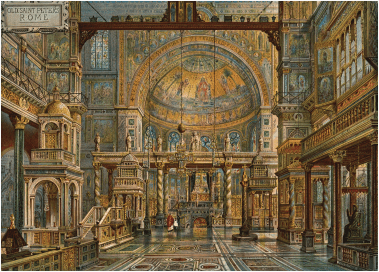
Genevieve looked up when she heard some commotion outside. She looked back. Charles had arrived. She looked to her right at the aisle he would march down to get to his front row seat, but she only saw church goers and penitents there, all except the remarkably beautiful young woman beside her. The woman sat still and looked down at her lap like she was contemplating something serious.

“Rose,” Genevieve spoke softly to the woman because it was one of her fairies and she knew the woman’s name.

“Lady.” Rose spoke very softly and never looked up.

“Are the fairies of the gardens of Saint Peter’s volunteering to help?”

“Yes, Lady. We know who you are looking for and we are looking everywhere.”

“No need to look everywhere,” Genevieve said. “Antonio is probably somewhere around the church today waiting for the chance to attack Charles, only I don’t know where. He is probably disguised and ready to strike, but everyone in this place seems ordinary enough, and we have a ring of guards all around the church. No one can get in or out without being seen. I don’t understand where he might be, only I can’t imagine he is not here.”

Rose pointed up and tapped her chin with her finger. “There is one inside your ring of guards, but he is not here, in the church, so maybe he doesn’t count.”

“What do you mean?” Genevieve asked. She was fighting back tears of desperation at that point, ready to grasp at anything.

“Just a workman,” Rose said. “He said there were a few loose shingles on the roof and he went up there to nail them down. He is on the roof.”

Genevieve sat still for a minute before she shouted. “Open Windows.” She stood, ran to the front of the church and outside, calling her armor at the same time so she would not trip over her dress. Rose could not move that fast until she reverted to fairy form. Then she raced out ahead.

Charles stood in the doorway and watched her rush outside. He stopped two soldiers from following her. “She is on a hunt. Pray for her success,” he said, and began the long, slow march to the other end of the Basilica.

“This way,” Rose shouted and led the way. They found a guard there near a rope that hung down from the gabled roof.

“Who is up there?” Genevieve yelled.

“Just a workman,” the guard said. “Hammering down a couple of shingles.”

“Do you hear hammering?” Genevieve yelled louder, grabbed the rope, and began to climb. It was too much for her at forty-five years old. She traded places with a young man named Elgar, someone she did not even know yet. He got all the way up to the gabled roof, and it was a long way down from there. Elgar looked down once at the stone walkway far below and swallowed. He traded places with Diogenes of Pella, Alexander the Great’s chief of spies, because Diogenes knew all about sneaking up on an enemy and not being seen.

“Of course, on a wide open roof there won’t be much sneaking,” he mumbled. He did his best.

Antonio, and Diogenes did not doubt who it was, kept his head covered with a hood, dyed his hair yellow, dirtied his face, and gave himself a scar that appeared to go through one eye and down his cheek. He dressed like a workman, and a poor one at that, but the crossbow he cupped in his hand as he looked through the open window looked like an expensive and excellent weapon.

The angle of the roof was not too bad. Diogenes got closer to his man than he expected. Antonio concentrated on the scene down below. Charles walked slowly and reverently up the aisle, a perfect target except he was flanked by too many priests and soldiers to get a clear shot. When Diogenes got noticed, Antonio quickly fired. He was aiming for Charles’ chest. The shaft caught a priest in the throat.

Antonio turned and swung the crossbow at Diogenes. Diogenes pulled his sword and caught the cross part of the bow. He pulled the weapon from Antonio’s hand and sent it through the window where it fell and clattered on the floor below. Diogenes had to let go of his sword to catch his balance. The whole roof was slippery and slick with patches of ice, and the sword slipped down and off the edge.

Antonio wiggled a little like he was not quite steady. Both men reached for the rope, but neither got it. They nearly bumped heads. Diogenes grabbed for the windowsill as Antonio threw his knife. It scraped Diogenes’ arm and made Diogenes back up from the window. Diogenes began to swing his arms wildly in an effort to regain his balance. He nearly swore but traded places with the Princess instead.

The Princess did not immediately feel like she was slipping, though she was. She felt stable enough to let her foot kiss Antonio’s face. A flock of fairies flew in the man’s face, following the foot, and Antonio threw his hands up to protect himself even as he slammed to his back and began to slide down the roof. He tried and failed to get a grip on the shingles. The rope was too far away. He rolled on his side a couple of times before he shot off the end of the roof. He went out of sight headed for the cobblestone walkway below.

At the same time, the Princess tried the wild arm swinging, but ended up falling on her rump, hard. She moaned and traded places again with Genevieve who twisted her ankle as she rolled to her belly. She managed to avoid rolling further but also began to slide down the roof. The rope was unreachable. She counted her life over but was glad at least that she finished her work. When she shot off the edge of the roof, however, the fairies caught her and brought her to a gentle landing.

Her two guards were climbing the rope, nearly at the roof edge, and Gottard was there about to follow them. But it was over.

Gottard said to her as he offered his hand to help her up, “He will give his angels watch over you lest you dash your foot against a stone.”

Genevieve curled her lip, waved off his hand, and rubbed her hurting ankle before she crawled to Antonio. He appeared to have broken his neck. He certainly broke his back. Charles and his soldiers raced up. Antonio still had a spark of life, and he tried to talk.

“The Masters don’t want…” Genevieve hit the man in the mouth so the message never got delivered, and the man died.

“Antonio,” Charles guessed, or maybe he saw through the disguise and recognized the man from his memory.

“Antonio,” Genevieve nodded and mothered her poor hand before she moaned because of her ankle.

Charles reached down and picked her up. She put her arms around his neck for stability, but he began to kiss her, passionately. He slowly let her slide to the ground to stand on one foot while he squeezed her tight. She kissed him right back. When they finally separated, she had something to say.

“History does not need to know what happened here. You need to not write about this or let anyone write about the dark one, Blondy, Baldy, or Signore Lupen. You especially need to leave me out of it. The Masters know they failed, but it is better that they do not know the details, especially about me. I am best not to be mentioned at all, ever.”

“You hear her Einhard?”

“I hear,” one of the young men said.

“Can I take you inside?” Charles asked kindly.

Genevieve almost said yes, but at the last decided otherwise. “I have been here praying and worshiping since eight this morning. I need to go home, all the way home. My maids are packing for the trip back to Provence as soon as we can get a ship to take us.” She poked Charles in the chest. “You, mister, need to go hear what the Pope has to say. And it is like I told you back when you invaded Italy. When you beat the Lombards into submission, you take the crown. Don’t leave it lying around for someone else to take. Now, that is all I am going to say. Boys.”

Her two guards came right up and each put an arm around her waist. She threw her arms over their shoulders. “We are going back to Provence where I will limp around like Otto for the next twenty years and then die peacefully in my sleep and that will be the end of it.

And she did. Of course, that was not the end of it. Among other things, in her last days she had a terrible nightmare about Flesh Eaters invading her happy home. She had to learn to use that sword and use it against Flesh Eaters and Saracens alike. No, not Saracens. Vikings. And she would be a he. His hands would use that sword. She knew she was never the same sex three times in a row. She had been Margueritte, and now Genevieve. Next time she would have to be a man, strange as that might seem. That was as far as her thoughts went. When she died, she found herself floating around in a mother’s womb, slowly growing into a new person of the Kairos.

************************

MONDAY

For the second story in this medieval tome we go to Wessex, Ano Domini 820 and the Story of Elgar, king’s man from Somerset. Until Monday, Happy Reading

*

Medieval 5: Genevieve 7 Happily Ever After, part 2 of 4

“Lady,” Margo got her attention. “Edelweiss might help. She was always very good at picking out the people with evil intent a mile away.”

“The old gang back together,” Genevieve said as she, Margo, and Nelly all smiled at each other. “Edelweiss,” she called, and the fairy appeared hovering in midair and confused until she saw Margo and Nelly, and then saw Genevieve and she let out a small gasp, not that anyone heard her over the men. The officer let out another shriek over top. Gottard gasped with some volume, though he may have guessed from his youth after Genevieve told him Margo and Nelly were elves. One of the two guards screamed, loudest of all, and ran out of the room. Genevieve’s two guards that came with her and waited out front came crashing in.

“Lot of good you guys are,” Genevieve scolded her guards as she tapped her shoulder where Edelweiss came to hide in her hair.

Her two guards looked briefly at each other before one spoke. “We figured if you were hitting the officer on duty, we would rather not interfere.”

Genevieve did not pursue that line of thinking. Instead, she explained their predicament to Edelweiss, The fairy hardly had to think about it before she said, “Maybe my father or mother have seen them recently.”

Genevieve sighed and called Lord Evergreen. He did not know what they might look like, but he did know a fairy named Cherry who knew a fairy named Acacia who lived near the Lupen farm and might know what they look like. Lord Evergreen explained. “We tracked them when they came and went from your home and that way we found out where they live.”

Genevieve understood but she thought the small room was getting full. Fortunately, fairies did not take up much room. She called Cherry and Acacia, both, so they would not totally freak out. After explaining the situation, Acacia said he knew exactly what they looked like. “Can you picture them?” Genevieve asked and Acacia nodded. “Wait,” she said and went to the one window in the little room. “Sky babies come down. I need you.” she called to the clouds. It took a minute or two, but two sprites of the air, Teether and Soove, came floating up to the window.

“We are here,” said Teether.

“Ready to help,” said Soove.

Genevieve nodded and told Acacia to picture Antonio in his mind. He did, and she duplicated his thought in the minds of her cloud babies before she projected the picture on to a piece of blank velum on the officer’s desk. It came out looking like a poor photograph but clear enough. She found another piece of velum and said, “Now, Berlio.” She repeated her steps and turned to her sprites. “Spread these pictures to all the sprites of the air over Rome, please. We need these men found, and when they are found, come and tell me.”

“We will,” said Soove.

“Most certainly,” said Teether.

“Thank you Lord Acacia, Lord Cherry, Lord Evergreen. Hopefully, this will be the end of it.”

“Let us know if you need any further assistance,” Lord Evergreen said.

“Glad to help,” Lord Cherry added as Genevieve clapped her hands once and the three fairies vanished.

Edelweiss spoke up at last. “Lady, your golden hair has turned all gray.”

“And my perfect skin is getting all old and wrinkly.” Genevieve responded, and every man in the room said that was not so. She imagined that was kind of them.

The officer in the room finally found his voice again when he examined the pictures imposed on the velum in front of him. “I don’t know how you did that, but with these, my men could find the men within the week.”

“Yes,” Genevieve agreed. “But we don’t want them alerted. We want to surprise them and catch them unprepared. If they get the idea we are looking for them, they might leave the city altogether, do their planning elsewhere, and wait until they are ready to come back and start killing people.”

“People?” Gottard asked. “Who besides the Pope?”

“Charles,” Genevieve told him plainly. “Charles has always been the main target. The attack on the Pope might have been a ruse to get Charles to come here. We already stopped the dark one, Blondy, and Signore Lupen from assassination attempts. Baldy and Antonio the son are the only two left.”

Gottard nodded. “I know who you mean.”

Genevieve told them they had to wait, though the room was getting rather stuffy. While they waited, she turned to the guards, pausing to note the one who showed enough courage to stay in the room before staring down her own guards. “You boys did not appear to be surprised by anything so far. Why is that?”

The two looked at each other before the same one spoke that spoke before. “Captain Hector told us all about it and then threatened us to keep our mouths shut. He said he wanted to prepare us just in case something like this came up. I must say, though, seeing it in person is different than hearing about it.”

“Did a hundred dwarfs, ogres, and trolls tear over two hundred pirates to pieces?” The other guard asked suddenly. He sounded like an excited teenager.

“Only three ogres and a mountain troll,” Genevieve said. “And they did not get them all. Of course, the pirates that escaped begged to be taken prisoner, so you can imagine.” Suddenly, a ding went off in Genevieve’s head. She smiled, put up a finger to indicate they should wait, and turned back to the window. Teether and Soove returned, not that anyone else but Genevieve would know it was the same two as before.

“They are in an inn,” said Teether.

“An inn by the river,” said Soove.

“The sign has a fish,” said Teether.

“Maybe a dolphin,” said Soove.

“They got six men with them,” said Teether.

“Six bad men,” said Soove.

“Thank you,” Genevieve interrupted lest they go on for a while. She turned her head to the officer but Gottard spoke first.

“I know the place.”

Genevieve returned to look out the window. “Thank you Teether. Thank you Soove. It was very good of you. You have been a big help. Now you can go back to your very important business, and I will remember you. Good-bye.”

“Good-bye, so long, see you later…” They kept up the litany until they got out of ear shot.

“So we go,” Genevieve said. “Bring the men from Breisach. I want the place surrounded before we move in so none of them escape.”

“Should we fetch Captain Hector and the men?” one of her guards asked.

“No,” Genevieve said. “We have no authority in this city. We need to let the garrison here make the arrests. Your job is to assist Margo and Nelly in guarding my person.”

“What is my job?” Edelweiss asked nice and loud.

“Your job is to stay on my shoulder, not pull on my hair, and be cute.”

“I can do that.”

Medieval 5: Genevieve 7 Happily Ever After, part 1 of 4

Genevieve interviewed a hundred people that were present at the time the Pope got attacked. Most claimed to be in the crowd that lined the street and were reluctant to admit anything more, but they did not mind when she gave them a chance to cast the blame on others. No doubt they claimed their unruly neighbors were right there in the thick of the rioters, whether that was true or not.

She got the ringleaders of the mob to interrogate, and only added a few names when the Council released the names of who they planned to interview. From her notes, she found the name Antonio came up three times, and the name Berlio came up seven times. Somehow, she suspected, and that was probably in the back of her mind and probably the reason she came. Signore Lupen’s son Antonio and Berlio, alias Baldy were in the middle of it.

It took two weeks at that point to figure out where they were staying. She had three maids with her, women that later in the Middle Ages would be called ladies in waiting, but they were all young humans so of little value in detective work. Likewise, Old Captain Hector, now in his mid to late fifties and who probably should have retired, was not a great help. His ten soldiers made good guards but they did not have the run of a city that they knew nothing about.

Genevieve checked. A small group of fairies lived around Saint Peter’s and visited Rome’s churches and open spaces where the flowers grew. There were gnomes of a sort that could be found scattered around, even as they might be found around any human city, town, village, or habitation, but they mostly worked invisible and only occasionally had fun getting the dogs in the evening into a barking and howling contest. The elves, light and dark, and the dwarfs in between all abandoned the city ages ago. The sprites still swam in the water of the Tiber, and the sky sprites still floated overhead, but between them, only the sprites in the sky might be able to see a couple of men on the ground if they knew what to look for.

Eventually, Genevieve figure she had no other choice. She visited Charles’ garrison of Swabians and wondered how she could explain it to them. She got surprised when she stepped into the office of the officer on duty. An old sergeant immediately recognized her and came to offer his most sincere bow.

“Genevieve, Countess, how may we serve you?”

Genevieve looked at the officer behind the desk but spoke to the sergeant. “Do I know you?”

“Not likely,” the man said. “I am Gottard from Breisach, and I was the miller’s son. I remember growing up and watching you grow up. I knew your stepmother and both stepsisters, Gisela and Ursula, and I remember how sorry I was and how angry I got sometimes at the way they treated you, if I may say so.”

Genevieve’s face brightened. “A friend from home,” she exclaimed, and hugged the man.

“There are seven of us from Breisach, but the others are too young to remember,” he said.

“And what news from home, because I have heard nothing in years?”

“Ah,” he drew out the sound like he had to think. “I came here some five years ago but let me see. Your stepmother passed away a few years before I came. I am sorry if you did not know. They said her heart stopped. But both of your stepsisters married. Ursula married a freeman, the son of a knight down in your stepmother’s old home ground around Hapsburg. When I met him that one time, he did not seem to me to be the brightest light, but I heard they have three children, so I assume they are not unhappy. Your younger stepsister, Gisela, married a good man and has taken the house and the title for herself, since your stepmother passed away. They have two sons, and the farm now has some animals and is much improved. Gisela is tolerable as a countess, much better than your cruel stepmother, if you will forgive me saying so.”

“Forgiven,” Genevieve said, but by then the officer in charge had enough.

“Who are you? What are you doing here?” He stood and looked mean and put his hands hard on the desk. “This is a military barracks where women don’t belong. Gottard, this is not a social club.”

“Me?” Genevieve looked coy. “I am the Margravine of Provence, and I have just come from speaking with Charles. I am going to need you and your men to arrest some men when I find where they are.”

The officer sat down and swallowed. “What men? Where?” he asked in a completely different tone.

“They are the men who planned the attack on the Pope, and I am sure you will want to get them locked away.” Genevieve turned to the Sergeant. “Do you remember Signore Lupen’s son, Antonio, and his worker Berlio, the bald one?”

“Yes,” Gottard said. He hardly had to think about it. “But it has been years since I saw them. I am sure they have aged since then, even as I have. They might be hard to recognize.”

“We have all aged,” Genevieve said. “And hard to recognize was just as I was thinking, but you recognized me quick enough.”

“That was easy,” he said. “You are as beautiful as ever. And may I ask how are your maids, Nelly and Margo?”

Genevieve smiled at the sudden memory of Gottard as a young man trying to get Nelly’s attention. She remembered having to tell the young man that they were elves and not available to court, whether he believed her or not. She said they could only be appreciated from afar. “They have not aged one bit, as far as that goes,” she said. “Elves, you know.” She called out in her way, and Margo and Nelly appeared in the midst of them. The officer kindly only screamed a little.

“I believe you,” Gottard said as he got a good look at the two elves in the room with him.

“Sorry to disturb you,” Genevieve said, as two guards came rushing into the room wondering what was the matter. Margo and Nelly put on their old glamours of humanity once they got their bearings and realized where they were, and Nelly smiled for Gottard, whom she recognized. “I have to find a couple of men, Baldy and Antonio. The thing is, I assume they have aged so I am not sure what they look like now,” she told them.

Margo responded. “It would help to know where we are.”

“Rome,” Genevieve answered. “We are in Rome.”

“Going to be hard to pick out two people among so many even if we know what they look like,” Nelly said and smiled again for Gottard.

Genevieve stepped between them. “Don’t get any ideas.” She turned on Nelly. “Don’t go there. That will make me very cross, and that is not why you are here.”

“Yes lady,” Nelly dropped her eyes and Genevieve turned on Gottard.

“I was just thinking they have not aged one bit,” he said.

“Be sure that is all you are thinking,” Genevieve responded.

************************

MONDAY

Genevieve searches for that elusive happily ever after, but first she has to find the masterminds of the assassins. Until then Happy Reading.

*

Medieval 5: Genevieve 4 Troubles Averted, part 3 of 3

Margo and Nelly ran up to distract Otto while Genevieve went away and Amphitrite took her place. The old soldier saw anyway, not being so easily distracted. Amphitrite reached out to the shuttle pilot and showed him where she was. She helped guide the shuttle safely to the riverbank, where it set down and took a minute to shut down before opening the door. In that time, Amphitrite reached out to the Ape ship and reviewed the repairs. She let Martok, her mathematical engineer lifetime from the far future look through her eyes. He was not sure one relay on the navigation coupling would hold up under use. Amphitrite held out her hand, and with Martok directing her thoughts, she fabricated the part out of nothing. When the shuttle door opened, Genevieve was back, holding the delicate relay.

Captain Grawl exited the shuttle as Otto came to stand beside Genevieve. Margo, Nelly, and the two soldiers stood behind, the soldiers in particular not knowing what else to do.

“Captain Grawl,” Genevieve identified the Captain for Otto and had to wait a few seconds for the translator to work. “Your relay on the navigation coupling does not look very good. It might burn out under pressure. You might try this one. Hopefully it will work better.”

“Yes, thank you,” Captain Grawl said and carefully handed the relay to the soldier that stood behind him.

“I see you have finished the repairs to your ship. I wish you the best of luck in your struggle against the Flesh Eaters, but now you must leave this world and hopefully not come back. The chances of messing something up that I can’t fix are too great.”

“I understand.” Captain Grawl offered a bow. “Thank you for all you have done.” He turned and went back into his shuttle and closed the door. It rose slowly at first, without too much wind in the faces of those watching. When it got high enough, it shot off toward the horizon.

Otto had to sit down.

Genevieve’s worry caught up with her at that point, and she sat carefully, wondering what she could say. Otto spoke first.

“Leibulf told me you are friends with the elves and fairies. Of course, I did not believe him.”

“It is true,” Genevieve said softly, her voice full of uncertainty. She took a deep breath. “I am responsible for many of the little spirits of the earth, not just elves and fairies. I also watch over the little ones in the air, the water, and the fire.”

“Fire?”

“Mostly the fire beneath the earth where the rocks themselves melt and run in red rivers of lava and only occasionally pour out of the tops of mountains, like Mount Etna or Pompeii.”

“I have read about such things, er, volcanoes I believe.” Genevieve nodded to say that word was correct, but kept her mouth closed until Otto had another question. “In what way are you responsible for these spirits?”

Genevieve first took another deep breath, glad that Otto did not immediately declare her insane. “In the old days, when they messed up like the flowers came up wrong, the trees did not bloom right, the fruit turned sour, the fox got in the hen house, or something, I got yelled at and told to fix it. Let me tell you, escorting the spirits of the dead to the right holding place was a hard one. The cathartic gods as a class had no tolerance and no patience for screw-ups.” She looked at Otto and felt emotional wreckage coming on.

“How old are you?” he asked.

Genevieve raised her eyebrows at that question. She had to think about what he was asking. “I am an ordinary mortal human girl of eighteen years who did not know I had any other lifetimes until a few years ago, when I was fifteen.” She paused to count and hear from the Storyteller. “According to the Storyteller, I am the one hundred and second life since the beginning. My first life was roughly five thousand two hundred and seventy-three years ago. Nimrod was building a tower in an effort to reach the throne of God. But my life—my lives don’t add up that way. I am eighteen, not five thousand years old.”

“I see,” Otto said. “You realize I would not believe a word of it if I had not just seen that you are friends with strange beast creatures.”

“They are people,” Genevieve corrected him. “They are just Ape people, not human people.”

“And the Flesh Eaters?”

“They are people, too, but I try not to think of them. Their name says exactly what kind of people they are.”

“I see,” he repeated himself. “I must say, not exactly what I had in mind when the Lord said you must be born again,” he smiled, and that helped calm Genevieve a bit. “So, it seems you can bring a past person into the present at will. That was the case with the woman I saw that you briefly became, is it not so?”

Genevieve nodded and sniffed. “The Storyteller keeps track, but I don’t remember most of my lives, past or future. And the ones I do remember won’t trade places—I call it trading places—unless there is some immediate need for the person’s skills or training, or whatever that might be.”

“Future lives?”

Genevieve nodded again. “Apparently, my main job is to watch over history and make sure it comes out the way it has been written.”

“How do you know? Of course, future lives.” Otto understood immediately, and Genevieve kept nodding.

“Don’t misunderstand. The next fifty to a hundred years are just as much a mystery to me as they are to anyone else. That is because they are not written yet. But I know when something comes along that threatens to throw everything off track. And I can always look back on these days from further in the future and get a general idea of how things go. Like I know Charles—Charlemagne is destined for great things and making sure he is not assassinated in imperative. Him being killed at this relatively young age would ruin the future.”

“Charles the Great?”

“That is how the future knows him.” She smiled.

Otto nodded that time, but then he got serious. “But say, in order to be reborn, don’t you have to die? I thought when we die we go to heaven. Is this not so?”

Genevieve frowned again. “Once to die and after this the judgment. It is so as far as I know. And I do die, or at least I feel all the pain and loss and separation from everything dear to me, but I am not allowed to go to heaven.” She sniffed again. “I keep getting shoved back into a new womb of a new mother and get born nine months later in a new world as a know-nothing baby. It is years and I become my own person before I have any inkling that I lived before, and even that only happens when something important rears its head.”

“I see,” he said again as Genevieve began to cry softy.

“I am sure Heaven must be wonderful.” She wept. “Sometimes, I get so tired.”

“There, there.” He held her and comforted her.

They truly slept together for the first time that night. Genevieve thought it was good. She was happy. She hoped he was happy, though she certainly gave him a lot to think about.

Three days later, they headed out for Lausanne and Geneva, where Bernard picked up his army, including the men of Provence. The most difficult thing for Genevieve was saying good-bye to Margo, Nelly, and Edelweiss. Edelweiss chose to stay with her flower and the fairies in the mountains around Basel. Margo and Nelly decided they needed to stay with their families and the elves in the Black Forest where they could keep one eye on her home and the county of Breisach. There were plenty of tears, but they were not unhappy. Margo and Nelly said that now, since Genevieve married and had a son and would soon have a baby of her own they knew she would be happy. Genevieve blessed them and could not thank them enough for being there when she so desperately needed someone. After that, Captain Hector loaded Otto, Genevieve, and Leibulf with their men on three barges near the edge of the lake of Geneva, and they floated all the way down the Rhone River, mostly through Burgundian territory, to Arles where they received a hero’s welcome.

“Like Constantine returned,” Genevieve said as she got into the carriage.

“Any reason to celebrate these days is taken full advantage of,” Otto explained as he waved to the crowd.

“I can see that,” she said. “Provence is not exactly rolling in riches.” She practiced her own Queen Elizabeth sort-of-a-wave.

“The ground is difficult soil,” he continued to explain. “And the maritime trade that once made the county rich is all but dried up. Between the Vandals at first, and now the Saracens and pirates, there is not much room for legitimate merchants.”

“Then that is what we need to work on,” she said. “We strengthen the ports, get city walls started where needed, and build up the fleet. Then get Charles to take Corsica, and maybe Sardinia, assuming he will be successful against the Lombards.”

“What you say sounds very expensive,” Otto fretted for a minute.

“Think positive,” she said. “People will contribute to defending and protecting their own homes. Local men build city walls and fortify ports, and they will even build ships if there is a real chance for trade. I am not suggesting building a series of fortifications along the coast, and manning them with soldiers, all of which we would have to pay for. We may have to raise the taxes a bit, but people don’t mind paying taxes when they can see the money being used for their own benefit.”

Otto looked skeptical, but by then they arrived at the Archbishop’s palace where they would sup and stay the night before heading out for Aix in the morning. Aquae or Aix as Genevieve called it was roughly three days to Avignon, four days to Nice, two days to Arles or Toulon in opposite directions, and one day due north of Marseille. As such, it was about as centrally located as could be found in Provence. Otto could send troops to wherever there might be trouble on the coast within a few days, that is, if his troops were not all presently in Lombardy.

Otto, who could sit a horse just fine, rode the two days to Aix. Genevieve and Leibulf had to ride in the wagon. The Roman roads were well kept, but even so, they both got banged up traveling the road over those two days and agreed to get horses and learn to ride as soon as possible.

************************

MONDAY

Provence faces external attacks. This is why Provence was made a Mach on the southern end of the Frankish Kingdom. Until Monday, Happy Reading.

*