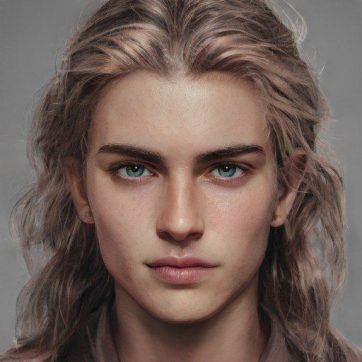
Two years later, Elgar and his friends turned eighteen and felt grown up, even if they were still kept back from the face to face fighting the men on foot engaged in. They were not kept back simply because of their ages, however. They were on horseback, and all the horsemen were kept back, including the King’s retinue which he had beefed up to a hundred men. The king learned all about the importance of cavalry during his time in exile at the court of Charlemagne. He did not think that would matter so much in his Anglo-Saxon kingdom given the fens and marshes, the number of thick forests, and the many hills and rock-strewn highlands. He got reminded at Carhampton how valuable horsemen could be, even given the obstacles. Thus, between his beefed-up retinue and his thegns (king’s men) including his ealdormen and their sons and guards, he had over three hundred men on horse that he kept back until he determined how best to deploy them.
The year was 838, and both the king and Father were getting rather old to be out fighting a war. Athelwulf, the king’s son came over from Kent, and Eanwulf led the men from the north, from Bath and around Wedmore. They were both in their early to mid-thirties and helped carry the load for the old men, but to be honest, they did not listen very well. They certainly did not listen to Elgar.
The Celtic king in Cornwall, who still held most of the authority in Devon, thought he had a chance to take back some land where the Saxon settlers had encroached on his territory. He thought if he made a pact with the Danes, together they could secure Devon and might even drive the West Saxons back to the Parrett River. It was a slim but real hope, provided that in the end the Danes did not turn on the Celts and bite the hand of Cornwall. It was a risk.
Of course, the West Saxons knew none of this before Elgar’s father sent out the call to arms, and that did not happen until after two strange events occurred on the same day. The first event was brief and brought Genevieve to mind.
Elgar sat quietly in his usual spot by the barn, only making sure first that he was not sitting in the mud. He learned that much. He had a pile of pebbles that he tossed one at a time into a small pool of water that had filled a depression a few yards away. He had much to think about, and he named them in his mind.
He thought about the Princess, the premier hunter and archer in her generation, and the Storyteller, who was always available to look things up concerning the history of Elgar’s time and place, what he could find of it. They go together for some reason, he thought, and threw one pebble into the pool.
 Diogenes, the best warrior, cavalry commander, and chief of spies for Alexander the Great, seemed partnered in the same way with Doctor Mishka, the doctor who struggled through two world wars. He had not had any need to call on the good doctor thus far in his life, and hoped he never would, but that seemed unlikely given the culture he lived in and the advent of the Danes. He tossed another pebble to splash in the water.
He sighed, and heard Mishka speak through time and into his mind. “We go with our strengths,” she said, and Elgar nodded as he tossed another pebble.
For some reason, those four seemed to be available to every lifetime. He figured it was because the Storyteller was tasked with keeping track of his many lifetimes and the Princess was his partner in time. He did not know what else to call it. Partners in time. Likewise, Mishka and Diogenes were also partners and genetic reflections of the Princess and the Storyteller, so it was like they came with the package.
Beyond that, there were four others to complete the set. Alice of Avalon. She went with the Captain in the far future. Elgar thought, maybe Alice stood right beside him and infinitely far away at the same time. She lived in Avalon, in the Second Heavens, that dividing line between Earth and the Throne of God. Avalon was that mysterious island in the sea of eternity where the Kairos made a home for all the little spirits on the earth, a place where they could rest from their labors. He shook his head at the mystery of it all and considered Martok and Gallena. They were the last two. They were two alien lifetimes he did not like to think about. They lived so far in the future he could hardly imagine it.
Elgar pulled his thoughts back to his own time. He wondered who his partner in time might be. He decided it had to be Genevieve of Breisach, Margravine of Provence, his immediate past life. He smiled at a couple of memories before he found himself drawn back a bit earlier when there were several in the most recent past with only a couple of gaps in his memory between the boys and the girls. The boys that he lived back-to-back were Festuscato, the last senator of Rome, and he called himself. He was the one who put the sword in the stone. And Gerraint, son of Erbin, King of Cornwall, who was there when Arthur pulled the sword out of the stone. He threw another pebble into the water, but this one did not make much of a splash.
The girls were Greta, a healer in her own way, from the mysterious land of Dacia, a place where haunted forests were the rule, and Margueritte, a friend of Charles Martel. Genevieve came immediately after Margueritte, and she was a friend of Le Martel’s grandson, Charlemagne. Genevieve was more than just a friend of Charlemagne, but Elgar did not want to think about that. He much preferred to think of his friend Osfirth’s little sister, Alfpryd, even if she was just fourteen and hardly old enough to think of in that way. But she was nice. She was developing nicely, and in a couple of years she might be the kind of girl he might like to marry. He smiled again and then backtracked with another pebble in the water. Not that he planned on getting married any time soon. Maybe when she is sixteen, he thought, and his eighteen-year-old imagination ran away with him.
“Ha!” Genevieve’s laugh echoed in his head. “You have no business giving me a hard time. At least I was seventeen.”
“Do you mind?” He snapped at her. “I would appreciate some privacy when I’m thinking my sinful and utterly human thoughts.”
“I am sure,” she responded.
Elgar picked up the last few pebbles and planned to throw them all at once, but something in the sky caught his eye. He squinted, before the thing zoomed up close and stopped to hover close enough to read some symbols on the outside of the craft, and he thought, Please be Apes. He thought about the visitors in Genevieve’s day, and repeated, Please be Apes. The Apes were kind and friendly and cooperative and vegetarian.
 He heard a voice in his head, probably Alice of Avalon. “They are not apes.”
“Then maybe some other species, some new and different people, one not given to conquest or wanting to eat the human race…”
“Flesh Eaters,” Alice named them.
“Damn!” Elgar cursed with several words and threw his handful of pebbles at the craft, though it was impossibly far away. He thought, at least the Danes don’t want to eat us. The Flesh Eater ship flew off rapidly to the east before Elgar heard his brother’s call.
************************
MONDAY
Eanwulf, Elgar’s brother catches up with him and they watch men coming from the distance. They bring bad news. Until Monday,

*
 Storyteller Tales & Thoughts