M4 Gerraint 2: The Dragon Slayer, part 2 of 2

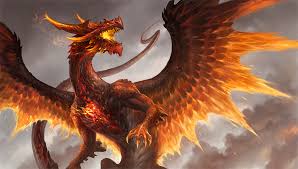
They ran out in time to see the dragon land in the village square.  It looked like a big, old worm, and looked mean.  Gerraint found the horses where they left them, no doubt waiting for a decision to be made concerning the strangers.  Gerraint knew better than to get up on a horse liable to panic any second.  Bedivere figured as much, but George did not know better.  He mounted and then struggled to get his horse under control.

The dragon flamed a house and then tore at the wood until it collapsed, no doubt looking for something edible. Gerraint ran out, Bedivere on his heels, though Gerraint doubted his words would have an effect on such a mature beast.  “No fire,” he shouted all the same.  “Do no harm.”  The dragon certainly heard.  It turned, and its tail struck Gerraint and Bedivere and knocked them some distance where they crashed into the side of a house and slipped down, badly shaken.

George saw, pulled up the lance he had been given in Caerleon, and let his horse have the reigns.  The horse, in a panic, actually ran straight at the beast as animals sometimes will.  George lowered his lance, aimed for the dragon’s mid-section, but the dragon saw and began to lower its head with the intention of plucking the rider right off the beast, and no doubt going back for the beast after.  George raised his lance without realizing it.  He simply wanted to ward off that head and those terrible teeth.  The lance entered the dragon’s head in a soft spot just below the jaw where the impenetrable scales were more flexible to allow the worm to swallow.  It broke out the top of the dragon head, and the worm immediately began to thrash about.  The horse threw George, and he barely avoided being crushed by the worm as it finally collapsed to the ground.

Gerraint got up and arrived at George’s side just after Heingurt.  Heingurt picked up the boy to take him inside, thinking the boy might be unconscious.  George opened his eyes and spoke.  “Not bad for a dragon that doesn’t exist.”  Gerraint said nothing.  He let Bedivere give the boy his verbal lashing.  Everyone started laughing, a release of tension, when the same man came again to the door and yelled.  “Another one.”

This time, they got outside to see it circling.  As it came down, Gerraint noticed it still had some feathers that clung to its head and around the front and back claws, which were not fully grown.  “This one is young, a female.  I may be able to talk to this one.”  Gerraint grew his cloak to cover himself completely if necessary.  Athena called it fireproof when she gave it to him.  “Bedivere, stay here with George,” Gerraint commanded, and he stepped out to where the dragon, clearly smaller than the first one, set down beside the great worm.

“No fire.  Do no harm.”  Gerraint repeated the Agdaline phrases over and over.  The Agdaline bred the beasts to respond to verbal commands, and the dragons usually listened when they were young enough.  “No harm. Friend.”

The dragon turned its big head without turning the rest of its body, as only a serpent can do.  “No fire,” it repeated, and Gerraint got a look at the particular coloring and pattern of scales on the beast.  All at once, Gerraint no longer stood there.  Margueritte stood in his place and smiled.  She knew this beast.

“Mother,” Margueritte called.

“Mother,” the dragon repeated in a forlorn wail that could not help but let out a touch of fire.  It went over Margueritte’s head.  The dragon turned its head back to look at the dead monster and might have let out a tear.

“No.”  Margueritte was firm.  “You are mother.  I am baby.”  She repeated, “I am baby.”

“Mother?”  The dragon looked again and then turned enough to comfortably face Margueritte.  

“You are mother.  I am baby,” Margueritte said, not quite certain how much verbal information the beast could actually grasp, but they were clever when they were young.

The dragon put its nose to the ground and came right up to Margueritte.  It sniffed, and the wind almost knocked Margueritte off her feet.  “Baby?”  It sniffed again, and whether it smelled hints of the gods, or the fairy weave of the little ones, or simply Margueritte, it suddenly became excited.  “Baby.”  If dragons could smile, this one did.  “Mother.  Baby.”

“Mother, fly.  Fly south.”  Margueritte knew compass points were part of the programming, but she could not be sure if that would translate to Earth directions.  Earth was definitely not the Agdaline home world where dragons were first born and bred.  “Fly south,” she repeated.  “Over the great water.  New home.  New nest.  Mate.  Male is south.  Over great water.  Mate.  Make babies.  Fly mother.  Fly.”

“South.  Over water.  Mate, make babies.”  The dragon appeared to be getting it, but there was no telling what the dragon honestly understood.

“Fly south.  Over water.  Mate.  Make babies.”  Margueritte repeated once more, and the dragon also repeated.

“South.  Make babies.”  Then it stuck its head down to sniff Margueritte once more before it spoke again.  “Baby, come.  Fly south.”

“Mother.”  Margueritte dared to reach out and touch the dragon’s nose.  The dragon purred, a sound much deeper and stronger than any cat could ever hope to make.  “South.  Make babies. I will find you.”  Margueritte was not sure if the dragon understood that last phrase.  She was also not sure if she could extract herself from this awkward position, but then she found herself fading from sight until she became invisible.  She shouted once more.  “Mother.  Fly south.  Make babies.”

“Baby.”  There was a moment of panic on the part of the dragon, but dragons routinely deal with the loss of babies.  Sometimes, if the mother does not play black widow and eat the father after mating, the father will certainly eat the babies.  Margueritte imagined it was part of their breeding. As big as the Agdaline spaceships were, there was only so much room on a ship flying a thousand years through the void.  She imagined papa dragon made good eating.

“Fly south.  Over water.”  The dragon said and lifted its head.  Flame shot out into the sky and the dragon lifted from the ground and circled several times to gain some height before it headed off in a southerly direction.

Margueritte turned.  Rhiannon stood there, grinning.  “So now you are getting yourself adopted by dragons?  That is new even for you.”

“Thanks,” Margueritte responded happily.  “I wasn’t sure how I was going to get out of that one.”

“Yes.  I could just picture baby you in a claw being carted off by mother, south over the big water.”

“Not a pretty sight,” Margueritte laughed and Rhiannon agreed.  “Wait.”  Margueritte stopped so Rhiannon stopped.  Rhiannon looked curious, because even the gods could not read the mind of the Kairos, even when she was someone as plainly mortal as Margueritte.  Margueritte surprised her as she bent over and gave Rhiannon a kiss on the cheek.  Then Gerraint came back and as he did, he became visible.  The Lady became visible with him.

“How sweet,” Rhiannon responded to the kiss.

“From Margueritte,” Gerraint said.  “Not from me, you naughty girl.”

Rhiannon made a face at him, and they stopped at the front of the house.  Bedivere and Hans Bad-Hand were the only ones still standing.  Everyone else was down on at least one knee.  “Good to see you again,” Rhiannon acknowledged Bedivere.

“My pleasure,” he responded.

“And Hans Bad-Hand.  Do not be afraid.  I am only here for George.”  Rhiannon stepped up and put her finger under the boy’s chin to make him stand.  Then she walked around him and examined him like one might examine a horse.  She even spoke that way.  “He is rough clay, but of good stock.  I think I can train this one to good purpose.  George, the dragon-slayer.”  She smiled at the nickname.  “I think I can teach you so next time, you do it right and don’t get yelled at by your Master.”

“Next time?”  Gerraint caught it, and so did Hans by the look on his face.

Rhiannon nodded.  “There are two more, male and female, moving down into the Midlands.  They are, what do you call it, a different species?”

“Same species.  Different breed,” Gerraint said.  “Like dogs.”

“Yes, breed.  They have more leg and fat middles.  More like lizards, I suppose, even if they are still essentially worms.”

“Male and female?” Gerraint did not really ask

“Yes, I’m afraid the land will be dragon infested for some years to come.  A few hundred years, at least.”

 Gerraint sighed.  “Okay.”  There was no helping it, so he stepped up to George and shook his finger.  “Now son.”  He got in the boy’s face.  “You listen to the Lady and do what she says.  I don’t want any teenage backtalk.  Mind your manners and be gracious with please and thank you.  Now, remember the ideals of the Round Table.  Defend the weak, the fatherless, the widows and orphans.  Do good and live an honorable life, and you will be fine.  Oh, and Rhiannon is not an angel, but she is near enough, sometimes.  Is that clear?”

George said nothing.  He simply threw his arms around Gerraint for a big hug.

“Uh.  Bedivere.”  Gerraint called him over, and he took over giving the boy a hug.

“Near an angel?” Rhiannon said.

“I said sometimes, maybe.  But why should I tell you?  It will just swell your head.”

Rhiannon leaned over and this time she kissed Gerraint on the cheek.  “You are the mother.  I am the baby,” she whispered.  He said nothing, but she reached for George’s hand.  “Are we ready?”  George nodded.  “Then let us begin.”  Rhiannon and George and George’s horse and all his equipment vanished with a snap of Rhiannon’s finger.

Gerraint looked up at the clear sky.  The sun would set in an hour or two.  “I wouldn’t cut up that beast until morning,” Gerraint said.  “They have a bladder that runs the whole length of the body and collects gas.  Foul smelling.  And no torches because it will explode if you are not careful.”

Hans Bad-Hand looked up at Gerraint as most men did.  “These are good things to know.  I believe I may have a few more questions for you.”

“I thought you might.”

Heingurt looked at Bedivere with an amazed, slightly dumbfounded look.  Bedivere waited until Heingurt spit it out.  “All on one day.  A real, actual dragon.  Two of them.  And the Lady of the Lake.  And she knew you.  And your Lord, it was like the Lady was bowing to him the whole time.”

“It is like that sometimes with Gerraint,” Bedivere said.  “These kinds of things do tend to follow him around.  Why do you think I travel with him?”

“It must keep life interesting.”  Heingurt grinned at the thought.

“No, it is to keep the old man out of trouble,” Bedivere said, and Heingurt laughed, some genuine and only some nervous laughter.  “Come along, Brennan.”  Bedivere picked the man up off the ground.  He spent that whole time, prostrate, with his hands over his eyes and ears.

************************

MONDAY

Arthur and Gerraint take what men they have to Brittany to fetch Lancelot, only to find they have to deal first with the Franks. Until then, Happy Reading

*

M4 Gerraint 2: The Dragon Slayer, part 1 of 2

Gerraint, Bedivere and young George looked down on the village in the next valley.  It looked remarkably like the village in the last valley, but appearances can deceive.  The former was pure British.  This one was a Saxon transplant.  Arthur was not going to like Gerraint’s report.  

Fifty years of shortened growing seasons left the nation starving and weak, and the flu that never seemed to go away took too many of the young.  Twelve years of infighting coupled with Pict, Norwegian and German raids further reduced the population.  It became a mix of many things, but if Arthur had not pulled the sword when he did, there might not have been a Britain left to defend.  Cornwall still had some strength, but the loss of Lyoness proved devastating, and Devon east of Exeter seemed questionable.  Wales still held fast.  Arthur held the eastern line at Caerleon, and the Welsh coastal watch drove off Saxon settlers as easily as Irish pirates.  But Britain had all but gone already.

They stopped in the Midlands to visit Percival.  His position remained strong because many British flocked to his land as a safe haven.  But Pelenor’s family had accommodated to the Saxons so there were as many Saxons on the land as British.  Ederyn’s old place had been completely taken over by a Saxon Chief who now declared himself Lord of that land, and the British did not have the strength to throw him out.

Even up here, in the wilds of the British Highlands, the Germans were moving in.  A couple of generations and inter-marriages and an outside observer won’t be able to tell which is which.  Gerraint did not want to be the one who told Arthur that thirty years of war defending the land actually killed the land.  The seventeen years of peace that followed might have helped if Bohort and Lancelot had not stripped the land of her youth for war on the continent.  Then to see those youth bring their families to Amorica seemed too much.  Little Britain might be repopulated, but big Britain got depopulated to do it.  Britain, as far as Gerraint could tell, had already been lost.  It already became an Anglo-Saxon world.

They were seen coming down the hill.  Several men on horseback came to either welcome them or challenge them.  One never knew.

“Heingurt is the one to speak to,” their British guide from the last village spoke up.  “Though Hans Bad-Hand is the village chief.  The Saxons do things differently, you know.”

“I understand,” Bedivere responded.  He took it upon himself to make nice with the various guides they got to help them at one point or another through the Highlands, which suited Gerraint just fine.  He kept back, next to George.

“Of course, you have to expect them to be a little jumpy, what with the dragons about.  I heard one of the outland farms got attacked a month back.  Heingurt wanted to blame us.  He doesn’t believe there are real dragons about, but enough of his own people saw it to make him quiet, for now.”

“Thank you.  That is good to know.”  Bedivere sounded too smooth.

“Do you think we will ever see the dragon?” George asked.  Gerraint stayed lost in his own thoughts so George had to ask twice and had learned to raise his voice a little on the second asking.

“I hope not,” Gerraint said.  “They are like me.  When they get old, they don’t always hear when you talk to them.”

“You talk to them?”

“Sure.  Dragon speak, a strange and mysterious tongue.”

“Now, Lord.”  The British guide leaned back.  “I have never heard anyone say they heard a dragon speak.”

“Doesn’t mean they didn’t,” Gerraint said with a grin.  “Maybe they heard the word lunch right before they were swallowed.”

The guide stared, slack jawed.  Bedivere covered his grin, but he knew the truth.  He heard Gerraint speak some sort of words to the dragon all those years ago when they were on the continent and headed for the lake.  The guide looked at Bedivere and saw the grin beneath his hand and threw his own hand out.  

“Daft,” he said.

There were five Saxons on horseback, but they looked like ordinary enough farmers, not much different from their guide, apart from the one that Gerraint took to be Heingurt.  Heingurt had some semblance of armor underneath his coat.

“Heingurt.”  The guide gave a friendly wave before the riders arrived.

“Brennan, with what have you come to burden us with this time?”  Heingurt eyed the strangers to judge if they might pose a threat.  They all knew the look well by then.

Brennan introduced them.  “Bedivere of Lyoness is a Knight of the Round Table.”  The men looked impressed.  “The Lord is Gerraint, sometimes called the Lion of Cornwall.”  Two of the men backed up, but Gerraint spoke up.

“Please.  At my age I am more like the house cat of Cornwall.”  Heingurt grinned at that image.

“And the squire?” Heingurt asked.

“George,” Gerraint practiced his Saxon.  “Son of Elrod, Chief of Wessex, and Prince among the Saxons.”  Gerraint did not get surprised.  They all seemed to know who Elrod of Wessex was.  This was not the first time it came up.

“And you travel with these men of Britain.”

“I am squired to Lord Bedivere until we reach the Lake of the Moon,” George said.

Heingurt shook his head.  “A daft quest,” he used the British word.  “The lake is full of strange people and nightmare creatures.  They say men who have gone there go mad or never come back.”

“The Lord is my shield and strength.”

“Ugh.”  Heingurt made a sound of disinterest before he confessed.  “We have some Christians in the village.  Come.”  They turned and rode into the village, Brennan with them.

“It would not be neighborly to come this far without paying my respects to Hans Bad-Hand.”

“My Lord once told me it is always wise to pay respects to the king when you come into a new country,” Bedivere said.

“Did I say that?” Gerraint joked.  “I must have had a daft day.”

Heingurt took them straight to Hans Bad-Hand.  It was obvious where the name came from.  The old man’s left hand looked shriveled, like a birth defect.  His right hand looked strong enough, and no doubt in his youth it more than made up for the deformity.  In his age, though, he looked like he had arthritis in his knuckles and at least one knee, and the belly suggested serious stress and possibly some lower back problems.  Gerraint well understood.

“So, you are the Lion of Cornwall.  Tell me why I should not take your head?  My brother fought among those you slaughtered that day by the hill called Badon.”

“Because it was a fair fight, and your brother lost.  I can tell you this; the men I faced on that day fought bravely and well.  But here, you are no fool.  You lead your people all the way up to this fertile valley and settle in peace.  You make friends with your neighbors where you can trade and receive help when the winter grows long.  You built this village up from nothing and you have seen it prosper.  Your women grow fat and your children grow strong.  Why, in the name of God, would you be willing to throw that all away?”  Without anything even approximating a threat, Hans Bad-Hand understood that the price for harming Gerraint would be terminal, for him and for his people.

 Gerraint fidgeted.  “Do you mind if I sit?  This old body cannot stand like it used to.”  He began to sit even as Hans waved at the chair.  “I make poor Bedivere listen all day to my aches and pains.   My knees don’t like to bend.  My back doesn’t like to turn, especially down low.  My hands stiffen if I grip something for too long.  I am sure you understand.”

Hans glanced at Heingurt.  “My right hand and right arm are still plenty strong.”

Gerraint caught the idea.  If Hans showed weakness, he would be challenged for his leadership.  He sighed.  “Let me tell you, it is like this in Cornwall.  I worked hard all my life, building, weeding, making things work, and why?  So, my sons and grandsons can reap all the benefits.  It hardly seems fair, don’t you think?”  Hans nodded.  “But the thing is, my sons won’t let me step down.  They say there is more to be done, and they trust me to do it right.  So, they guard me and watch over the workers to make sure it gets done the way I say.  I suppose after I am gone, they will have their turn, but between you and me, I am half tempted to go home and retire.  I should force Peter to be king so I can go fishing.”

“That is for some thought.  Don’t you think, Heingurt?”

Gerraint interrupted.  “I think Hans is a smart man who has made smart decisions and brought prosperity to the people.  As I said, why, in the name of God, would you risk that?”

“It is true, what you say about the knees and the back,” Hans smiled as he whispered, but there was no telling if Heingurt honestly got the message or not.  “But here, you say this is George, son of Elrod, Chief of Wessex.  I knew your father well.  In truth, when he was killed, I brought my people here.  Did they catch the killer?”

“Mother thought it was Ethelgard himself.”

“Stabbed in the back,” Hans told Gerraint.

“By a coward,” Gerraint understood.

“And how is your mother?”

“Dead,” George said, and pushed his chin up.  “Dead at the hand of Red Ulf.”

“That is where we found him,” Gerraint said.

George was not slow to praise Gerraint and Bedivere in his rescue, but he insisted it was the angel of Saint Michael that drove off the murderers.  

“That Red Ulf is a bad one,” Heingurt interrupted.

Hans nodded and then smiled.  “Stay the night.  You should have at least one good meal before you ride off on your fool’s quest.”

Gerraint got ready to say yes when a man ran into the house, yelling.  “Dragon.”

M4 Gerraint: Old Men, part 4 of 4

“And how is Gwynyvar?” Gerraint asked.

“Good.  Fine.  Gray and inclined to spend most of her time in prayer these days,” Arthur said.

Gerraint nodded.  “Enid much the same.  But she rides and gets about better than I do, truth be told.”  Arthur looked long at his friend.  In many ways Gerraint was like his first real friend, after Percival who was something like a younger brother.  He turned, then, and looked at his own hands, as if seeking some insight into his future.

“I used to have a grip,” he said.  “With Excalibur in my hands I used to think I was invincible.  Now, I imagine I can barely lift Caliburn, the sword I used as a squire and young man, like that George of yours.”  Arthur more or less pointed to the door.  “And that would probably come loose in my hand soon enough.”

“With me, it’s my eyes.”  Gerraint admitted.  “I used to be able to count the feathers on an eagle’s wings and now I am doing good to know who the person is across the room.  And my hair, quite obviously.”

Arthur grinned.  “And what are we old men supposed to do now?”

“About what?”  Gerraint wondered.

“About Lancelot, damn him.”  Arthur said, a touch of the old fire in his voice.  “He and Bohort and Lionel have taken the flower of our youth and squandered it across the sea in Amorica.  They say the sons of Claudus made peace with the Franks and the Franks promptly swallowed them and then pushed them until King Howel was backed up to one city and a small strip of coast.  They slaughtered whole villages; I am told.  The natives, the survivors, were reduced to refugees before Lancelot came.”

“I understand why Lancelot and the others would want to help.  It was the land where they were born,” Gerraint said.

“Yes, damn it, but he did not have to take half the kingdom to do it!”  Arthur clearly sounded upset.  “Worse, they repopulated the land with Britons loyal to the old ways.  They took advantage of the churches being burned, not that the church made much headway in Amorica.”  Arthur punched the table.   “I should be grateful they took so many druids from our shores, but Bohort, Lionel and Lancelot were good Christian men, especially Lancelot.”

Gerraint chose to change the tone a little.  “I still remember when old King Hoel, Howel’s father asked for our help against Claudus.  Claudus and his Romans had already killed Bran and Bohort the elder by then.”

“Yes, but we got there in time to stop Claudus in his tracks,” Arthur said.

“Yes, and you killed Claudus himself, or Bedwyr did.”

“I thought it was you.”  Arthur looked up.  “Or Pelenor.  I’m not sure.”

Gerraint shrugged.  “Even so, I can understand why Lancelot would not be fond of the sons of Claudus, and the Franks.  Claudus killed his mother and father Bran, and now the Franks are pushing Claudus’ sons to finish the job.”

“Oh, I understand,” Arthur said.  “And now that Howel has died without an heir I understand all the more.  Bohort has been proclaimed king, and out of deference to the people, he has decided they don’t want anything to do with Rome, or even anything associated with Rome”

“I thought Howel had a daughter,” Gerraint said.

“Belinda.”  Arthur nodded.  “But that unhappy affair with Tristam.”

“Oh, yes.  I had forgotten.”

“The point is, I did not expect Lancelot to take the flower of Britain with him, and he has decimated Wales as well.”  Arthur said.  “Many have even taken their families and peasants with them.  Whole villages have crossed the channel to help repopulate Amorica.

“You know they are calling it Little Britain now.”  Gerraint interrupted.

Arthur nodded.  “And I understand that after twelve years you can hardly get along in the countryside there unless you speak Welsh, or British.”  Arthur added, then he looked cross.  “But you are getting off the point.”

Gerraint was not yet sure what the point was.  “But look,” he said.  “I thought Medrawt was at least working on holding Wales together.”

Arthur rolled his eyes and let out a few soft invectives.  “Medrawt has kept some of the Lords in Wales by granting them the land of those who left.  He has no authority to grant land and I see civil war if those Lords ever do decide to come home.”  Arthur grew in steam again.  “The land was not his to give!  Those chiefs who are with Lancelot are losing their land without knowing it.”  Arthur stood and turned to the wall where Excalibur hung for seventeen years, since Badon.

Gerraint also stood because his knees needed it.  “Surely it can’t be as bad as all that.”  Gerraint spoke hopefully.

“It is,” Arthur said calmly.  “We have been at peace too long.  A whole generation, the young generation has abandoned Britain and the half of Wales to fight across the sea and search for adventures.  Meanwhile, there is blond hair as high as York.  Gerraint.”  Arthur whipped around, grabbed his friend by the wrist and looked up into his eyes.  “When I die, what will stop the Saxons from overrunning the whole of it?  There is nothing left but old men and defenseless villages.”

“If Britain falls, Cornwall might not be far behind.”  Gerraint confirmed.  “But Wales, too?”

“Oh, Medrawt may hold Wales for a time,” Arthur said in echo of Gerraint’s own thoughts.  “He can have the Welsh, but the rest cannot stand.”

“But still.”  Gerraint held back just a little.  “Can it be that bad?”  He wondered.  He knew he stayed out of touch, in his own little realm on the edge of the world, but still.

It is!”  Arthur fairly shouted.  “Gwalchemi says the Scotts have concluded a peace and you know they will be looking south.  Gawain says there have been renewed landings along the Norwegian shore, hard against the Midlands.  And in the south, in East Anglia there is much stirring, and the Saxon Shore is even worse.  Don’t you understand?  Don’t you see?  It might have been different if my son, if Gwynyvar’s and my son, Llacheu had lived, but Kai lost him for me so long ago.  Now, when I die, there will be no one to fill the gap.  What good is life if on my death everything unravels?  I will have wasted my days.  Everything will have been for nothing.”  Arthur had to pause then to catch his breath.  Gerraint thought Arthur’s grip seemed just fine, and he extracted his wrist carefully from Arthur’s clutches.  Arthur went on more softly.

“We have been at peace too long.  Lancelot must come home.  I will make him Pendragon before I go and he will hold the realm together.”

Gerraint thought long about that.  Lancelot was not young, himself.  He turned maybe fifty-two or fifty-three.  Gerraint guessed.  But the people would listen to him.  They had already.  And they would accept him in the role.  And he would have the strength to tell Medrawt and his Welsh supporters to stick it.  It might work.  Still, he had to ask.

“What of your nephews?”

Arthur’s look turned sour and then softened.  “My sister Morgana’s sons have little in the way of leadership skills.  Gawain does well watching the Norwegian Shore, but that is about his limit.  The only other choice there is Garth, and I will have to ask him to take over for Bedwyr.  Gwalchemi, in the North has no leadership skills to speak of.  And Medrawt.”  Arthur paused for a few chosen words before he explained.  “Medrawt is only interested in Medrawt.  He says what he thinks people want to hear, and makes a great show, but his only real interest is to steal from people to benefit himself.  He would be the death of the realm, that devil’s son.”  Arthur shook his head and once more reached for Gerraint’s hand.  “Lancelot must come home.”  He emphasized his words with his touch.

“But why me?”  Gerraint got short with his words, but Arthur understood what he asked.

“Because he respects you.  He may come home if you ask him,” Arthur said.

“And you haven’t asked?”  Gerraint was just getting things straight.

“Of course,” Arthur said, once more getting hot.  “I’ve told.  I’ve ordered.  I’ve asked.  Gerraint, I’ve done everything except beg.”

“And so?”

“And so, I intend to bring together what loyal men are left to me and go and, by God, make him come back,” he said.  Gerraint felt dubious, but he held his tongue.  “You have some time,” Arthur explained.  “I don’t plan to sail until August.  I will be counting heavily on the men of Cornwall.”

Gerraint nodded.  “Uwaine will raise the men,” he said.  “And I will write letters to Gwillim and some others.  What of Ogryvan and the north of Wales?”

“Can’t be counted on,” Arthur admitted.  “But Uwaine?”

“He will do it,” Gerraint assured Arthur.  “I have another duty to attend.”

“August, no later.”  Arthur became adamant.  “My friend.  I won’t live forever.”

“Is my husband being morbid?”  A woman’s voice came from the doorway.

“Gwynyvar,” Gerraint responded.

“My dear.”  Arthur acknowledged his wife.

“Pay him no mind, Gerraint dear.”  She stepped up and they kissed cheeks.  “He speaks of dying all too often these days.”

“Don’t we all?” Gerraint asked.

M4 Gerraint: Old Men, part 3 of 4

Gerraint thought about Uwaine’s wife.  Uwaine brought her home not long after that business with the Graal cleared up.  She was a Saxon, a buxom blond with just the right amount of freckles, as like to Greta as one might find.  Neither Gerraint nor Uwaine ever said anything about that.  Uwaine’s mother never got used to her as long as she lived, but their neighbor, Morgana was good to her, and she and Morgause became friends.  Odd how things sometimes worked out.  The girl, fifteen years younger than Uwaine, but in the last thirteen years or so she gave him two sons and two daughters so Gerraint supposed there were no complaints.

“George.”  Gerraint said suddenly, as he brought up the rear, leading his charger with the wrapped hoof.  “Seems to me I recall a George in British history.  Can’t remember any details, though.  I suppose that chapter is not yet written.”  He got silent for a moment before he shouted.  “For England, Saint Michael and Saint George!”  He quieted.  “No idea what that means.”

They arrived at the village of Swindon the following evening.  Constance made them as welcome as she could.  She turned the servants toward a flurry of activity which Gerraint called unnecessary.

“Majesty,” Constance said.  “I had no word you were coming.”

George looked up at the word “Majesty,” but he said nothing.

“I wasn’t,” Gerraint admitted.  “You know at my age I would rather be home with Enid, or out fishing, but Arthur called, and I thought to take the long way around to visit my old friend.”

Constance looked pained.  She looked away and nearly let go of some tears.  “My Lord passed away last winter,” she said.  “It was a mercy.  He stayed helpless in bed for too many years.  He begged me not to tell anyone or send word.”

Gerraint reached out and held the old woman, and she did let out a few tears.

“I’m very sorry,” Bedivere said.

Shortly, Constance led them to the graveside to pay their respects.  “The swiftest of men.  Steadfast as a rock.”  Gerraint named him, while George got the little cross his mother had worn around her neck out of his pouch and spent a few moments in silent prayer.  After, as they returned to the house, George turned to Bedivere.

“The famous Bedwyr of Arthur.”  He was just checking.  Bedivere affirmed.  “And Gerraint, King of Cornwall, the terror of Badon and the Lion of Cornwall,” he finished.

“Exactly,” Bedivere said.

“Praise God’s good hand for placing me in your company,” George said.  “I could not have asked for more.”

Gerraint overheard, but he chose silence.  He did not act as such a terror anymore, and he never was as much as the tales said.  He wondered, looking around the village of Swindon, seeing mostly old men and women, what would become of Britain after his days?  Loth had gone, and now Bedwyr.  What would come when Arthur died?  He wondered if that might have been why Arthur sent for him.  Perhaps Arthur was dying.  He tried not to think too hard on that.

After two days of good food and two nights of soft beds, with Bedivere no longer in danger of opening his wound, provided he behaved himself, the three travelers continued toward Bath and Badon where they would ride around the point of the channel and head for Caerleon.  George rode most of the way in silence and only asked once why Gerraint insisted on stopping every couple of hours to walk around.

“Because if I don’t,” he explained.  “I’ll stiffen up and you will have to carry me on a stretcher.”

They spent the evening in the wild some distance from Bath as they found no convenient village inn.  Gerraint wanted at least one night under the stars, and besides, Constance, or someone, had ridden out in advance and told people that he moved on the road.  He all too constantly got stopped and awed.  It was not like the old days when people would ask, Gerraint who?  Heck, in those days they asked, Arthur who?

That evening, they had a visitor.  He came right after sundown, glowing in elfish armor, and standing tall as a man, though Gerraint knew it was not his natural look.  His helm looked plume encrusted in the Roman style, and his weapons appeared all gold and jewel encrusted as well.

Bedivere and George had their swords out, hearing the intruder before seeing him.  On first sight, however, Bedivere put up his sword and instructed George to do the same.  He did, but he could not resist staring.  Meanwhile, Gerraint snored.  It took a bit to get him awake.

“Great Lord.”  The warrior bowed, deeply.

“What news, Lord Beechworth, and what brings you to Britain on this side of the Channel?”  Gerraint asked as he rubbed his eyes.  This time he was talking about the English Channel.

“The Lady Viviane has seen this young one in her heart and she knows there is greatness in his days to come, though she cannot say what that work may be for the clouds that cover those days,” Beechworth said.

“Yes.”  Gerraint started coming awake.  “I felt the same when we picked him up some days ago.  But what does Rhiannon want?”

“Lord, you know she has left the lake across the sea and moved court to the British Highlands since Meryddin passed over.”

“Er, yes.”  Gerraint nodded but he sounded hesitant.  He had not really thought about it since Macreedy informed him all those years ago.

“The lady has sent me to ask if she may train the youngster as she once trained Lancelot and Galahad.”

“Young man.”  Gerraint turned to George.  “This concerns you.  What have you to say?”

“I, I.”  George did not exactly know what to say.

“Spit it out,” Gerraint insisted.

George swallowed.  “I stopped believing in elves and fairies when I came to faith in the Lord.  How?”  He stumbled on what to ask.

“God works though all that he has made to affect all that he will.”  Gerraint said.  “There are more things in Heaven and Earth than you or I can dream or imagine, and don’t underestimate the creativity of the Almighty, or anything else concerning the Almighty for that matter.”  He shook his finger at the boy.  “But the question is, will you learn the way of the chiefs of this world, what soon enough they will call Knighthood?  Here are teachers offering to teach you.”

“Yes.”  George yelped lest the offer vanish.  “Only I promised my mother that I would first seek Arthur’s court.”

“There you have it,” Gerraint said to Beechworth, who did not understand exactly what he had.  He looked at Bedivere, but Bedivere merely shrugged.  “George will go with us to Arthur,” Gerraint explained.  “Then I will bring him to the highlands myself.”

“Very good, my Lord.”  Beechworth offered another bow, but he did not otherwise move.

“My best to your Lady and tell Brimmer the Dwarf to get cracking.  The boy needs armor that will fit him,” Gerraint said.

“Very good.”  Beechworth repeated himself again, but still did not move.

“Good to see you again,” Gerraint added.  “Go on, now.  Get small.”

“Lord.”  With that permission, Beechworth did get small, fairy that he was, and flew off at such speed, for all practical purposes he vanished.

George looked full of wonder, but before he could begin to ask questions in earnest, Gerraint already started snoring.

They arrived at Caerleon in due order.  Gerraint and his party were hustled into the Pendragon who sat at the Round Table looking morosely at all of the empty seats.  He got up when Gerraint came in and they embraced and passed pleasantries.  Then Gerraint introduced his party.

“Bedivere, you know,” Gerraint said.  “And this is young George, a Saxon we picked up under some rather unusual circumstances.”

“God’s providence.”  George announced and he fell to one knee.  Such formalities were rarely seen in the room of the Round Table, but George felt acutely aware that he was a stranger in a strange land.

Arthur’s face turned.  “You know no pagan has ever been allowed in this room.”  He shot at Gerraint, though the accusation was not strictly true.

“And still hasn’t,” Gerraint returned in kind.  “George is a confessing Christian.”

Arthur looked up.  He stepped forward, helped George to his feet and looked long and hard into the boy’s eyes.

“Great majesty.”  George mumbled and attempted to turn away, but the eyes of a great man are hard to turn from once they are fastened on you; and especially those of Arthur.

“I believe you are right,” Arthur announced at last and let go of the boy.  “This means something, I am sure.  But what?”

“It means, if nothing else, the Saxons are beginning to receive the word of hope for all men.”  Gerraint spoke plainly.  “This is another great victory for Arthur, I would say.  These years of peace have not been fruitless.”

“Perhaps,” Arthur said, returned to his morose attitude, and retook his seat at the table.  “My knees, you know.  Sitting is more comfortable these days.”

“Though the younger man,” Gerraint teased, and grinned broadly.  “Still, I seem to know what you mean, if I don’t sit too long.”

“Yes,” Arthur started, but Bedivere interrupted.

“Lords.”  He spoke up.  “Perhaps George and I could see to our rooms and leave you two to talk over old times.”

“Yes, yes,” Gerraint verbalized while Arthur waved them off.  Then Arthur had a thought.

“Big feast tonight,” he said.  “Seats of honor and all of that.  Don’t disappoint the lady.”  Bedivere bowed slightly in acknowledgement, and they left.

************************

MONDAY

Arthur is set on fetching Lancelot, but first Gerraint has to keep his promise and take George into the British Highlands which are not exactly the British lands they expect. Until then, Happy Reading

*

M4 Gerraint: Old Men, part 2 of 4

The pace felt leisurely and Bedivere stayed quiet most of the time, fighting his allergies.  That seemed one reason Gerraint allowed him to tag along.  His first squire, Uwaine, finally taught the young Bedivere to keep his mouth closed unless there was something worth saying.  Mostly Bedivere stayed good, so in all, it became a pleasant journey, apart from the occasional sneezing.  The days were warm, but not too hot.  The spring rains were mostly over.  The evenings were still cool through the hundred and fifties of the Julian calendar which made it roughly the end of May or early June.

They traveled across the south road along the coast for most of the way, only turning inland at the last as they came to the edge of the Shores of Wessex.  The nights also felt pleasant, devoid of rain, and the air, full of the fragrance of blooms.  Gerraint was glad not to have any allergies.

“Apples.”  Bedivere named the culprit.  “I would die in Little Britain.”

“Amorica.”  Gerraint insisted on the older name.  Bedivere nodded and sneezed.

After a time, they came into woods and immediately heard the sound of clashing weapons and men, shouting.  Bedivere hesitated and attended to his Lord.  “Aw, hell.”  Gerraint swore and nudged his horse forward.

A young man of about fourteen or fifteen, in armor too big for him, stood with his back to a tree.  A dozen men, Saxons, had him hemmed in, but one man looked cut and another appeared dead beside the body of a woman.  They were wary of the boy, though he hardly knew how to hold his weapon.

Gerraint did not hesitate.  He drove his charger through the Saxons, knocked several aside and several to the ground.  Bedivere came up behind with his lance and drove through one so deeply it wrenched the spear from his hand when the man fell.  Gerraint turned around by then and charged again, but a Saxon stabbed at his horse and Gerraint lost his grip.  Bedivere got pulled from his horse when he sneezed.

Gerraint got up, but he had no time to pull his sword as two of the Saxons grabbed him and held him.  Bedivere got a sword in his shoulder for his trouble and collapsed.  In the confusion, though, the boy tried to run.  He got caught and held for the chief of the Saxons, an ugly red headed man.

“You have caused us enough trouble,” the chief said.  He tore the helmet off the boy’s head and gave the boy a slap across his face.  “You and your mother.”  He stepped back and pointed.  The two men holding the boy shoved him to his knees and a third exposed the boy’s neck while everyone stood in silence and watched.

“No!”  Gerraint yelled and suddenly paused the action as he struggled to get free.  Then the Nameless one welled up inside him.  Gerraint did not resist the god he had once been, and in an instant, Gerraint no longer stood in the arms of the Saxons.   Nameless stood in Gerraint’s place, and he looked ticked.  He hated the cowardice of beheading.

He waved, and the Saxons found themselves huddled in a group twenty yards away from Bedivere and the boy.  The god of old took one step toward them and the earth shook beneath their feet.  “Tell Ethelgard, your Lord, that I have chosen the boy.  He is under my hand, and Ethelgard will be happy one day when the grown boy saves him from the fire.  Now, Go!  And do not look back.”  Nameless let out a small touch of his awesome nature and the Saxons trembled.  They did not dare stand but were afraid to fall to their knees and not obey the god.  The chief only got out one word.

“But the boy is a Christian.” 

Nameless smiled.  “And so should you be,” he responded.  “Go!”  He gave them a head start.  He sent them and their horses, save two horses, a mile from that location.  He sighed as he made three holes in the earth, three plain crosses, and then he left the Saxon language of the boy behind as he traded places in time with Greta, the Dacian Woman of the Ways.  Her healing hands were needed, and Nameless felt sorry he was not allowed to heal by divine fiat.  Greta’s armor adjusted automatically to her new height and shape.  She knelt beside Bedivere who knew the armor well even if he did not recognize her, exactly.

“That was stupid of me,” he said.  “I should learn to time my sneezes better.”

“Ha!”  Greta humored him while she loosened his hauberic.  The wound appeared not too deep, and well away from the heart, but she imagined some blockage needed to be cleaned out.  Bedivere would live, but he would need a month or so to heal properly.  “Boy.”  The Saxon, the Nameless’ gift, came to her tongue.  “Get me a cloth of some kind.  Clean as possible, and water.”  The boy stared at her.  “Hurry, hurry, hurry.”  Greta said and shooed the boy toward the horses.  He went but paused a long time near the bodies of the dead Saxons and the woman.  In that time, Greta found the sliver of metal she looked for.  It made the wound bleed all the more, however.  “Hurry,” she repeated, and the boy brought what she needed.

“Hold it here.”  She showed the boy and gathered the moss she needed which would act as an antiseptic cover for the wound.  When Bedivere got bandaged, Greta asked about the woman.

“My mother.”  The boy confirmed, and she held the boy and let him cry on her breast for the longest time.

“Water.”  Bedivere interrupted at last.  He struggled to his feet, but Greta had the skin handy and got up to give it to him.  The boy went to his mother’s side, his eyes were very red, but his tears were dry for the moment.  The three graves sat nearby.  Greta took another look at Bedivere’s shoulder, removed the bloody cloth, rinsed it and wrung it out, and tied it tight with the cleanest part she could find against the wound.

“What is your name?” she asked the boy as she came up beside him and hugged him again.  She gave him every ounce of maternal love and care in her.

“George,” the boy said.  He stayed on his knees.  He looked up.  “But I thought you were different.” 

Greta nodded.  “I am.  I’m just visiting here.  These are Gerraint’s days.”  She did not explain any further than that.  “I will not be far away,” she said, and stepped back before she left and brought Gerraint back into his own place.  Gerraint moaned a little and rubbed his arms.  Those Saxons had not been gentle on his old bones.

“Sixty equals eighty,” he told Bedivere.  “Three years in this world is like four in the Storyteller’s day.”

George looked up.  He understood the Cornish dialect and also the common Gallic of Arthur’s court.  Gerraint felt glad he thought of that, too, or rather, Nameless thought of that.

“I understand,” George said with sheer amazement.

“I don’t,” Bedivere confessed.  “But Lord Gerraint talks like that sometimes.  You get used to it.”

“No, I mean the words, the very words I am speaking.”  George touched his lips as if searching for the magic.

“A gift,” Gerraint said and laid his hand on the boy’s shoulder.

“Praise the angel of Saint Michael,” George said.  Gerraint raised his eyebrows.  The Nameless god was neither angel nor saint, but he said nothing.

“Better take care of business and move on,” Bedivere suggested, as he walked to the first body.  Gerraint nodded, but he had the boy help and made Bedivere stand aside.  
“Yes.”  George understood perfectly well.  “Red Ulf is no believer in the Lord.  I doubt he will be frightened by the angel.  He may come back.”

Gerraint shook his head as they lowered the Saxons in their graves.  The dirt automatically came back, pressed down tight, and the crosses set themselves in place, dug deep and immovable in the ground.  “I doubt he will be back today,” Gerraint said.  “But all the same we should move on.”

They lowered George’s mother last of all.  “But why did the angel make three crosses?” he asked.

“Mustn’t assume,” Gerraint said.  “No telling how deep the word has gone across the Saxon Shore.”

“Oh, very much,” George confirmed.  “And into Anglia and even Kent, but the chiefs are still mostly pagan and want to keep to the old ways.”

“So, why were they after you?” Bedivere asked the obvious question.

George looked away.  A long silence stretched out before he answered.  “My father was a chief who spoke for the Lord.  Ethelgard killed him, at least Mother thought so.  He was afraid, I think, that we might expose his murder.  The people would kill him.  My father was well loved.”  George got down by his mother’s grave to pray, but Bedivere had another question.

“But what brought you into Britain?  Were you running away?”  Gerraint took Bedivere aside to give the boy some space.  He checked Bedivere’s shoulder to be sure it had not started bleeding again and then they rounded up the horses.  Gerraint’s horse had escaped the sword thrust but became hobbled, having torn a hoof in flight.  Bedivere’s horse seemed fine, and with the two Saxon horses, they would do well.

George got up after a while, but he had not forgotten the question.  “I was on my way to the court of King Arthur to see if I could train to be a Knight of his Round Table.  It was not safe to stay among the pagans.”

Gerraint nodded.

“What will Arthur say of a Saxon?”  Bedivere whispered.

“Not unprecedented.”  Gerraint responded.  “Consider Uwaine’s wife and the love Gwynyvar and Enid have lavished on her.”  He turned to George and smiled for the boy.  “You may as well ride with us.  That is where we are headed.”

The boy looked hopeful.  “But what happened to the Lady?” he asked.  He looked around and seemed to miss her for the first time.

“Greta?”  Gerraint knew to whom he referred.  “She’s gone home,” he said, as he helped Bedivere mount.

“Does she live around here?” the boy asked.

“No.”  Gerraint shook his head.  He stepped over to help the boy up.  “Dacia, just north of the Danube.  But the important question is when, and the answer is roughly four hundred years ago.”

George swallowed.

“Not a ghost,” Bedivere said, quickly.  “She was really here in flesh and blood.”

“But?”  George got confused.  He looked at Gerraint, at Bedivere, and back to Gerraint before he finally settled on Bedivere.  “I see what you mean about the way he talks, but I can’t imagine getting used to it.”

Bedivere merely shrugged, and it hurt, so he started out at a leisurely pace and hoped he did not run into too many painful dips and bumps in the road.  At least his sneezing temporarily stopped.

M4 Gerraint: Old Men, part 1 of 4

Gerraint:  The Last Days of Arthur

After 479 A. D., Britannia

Gerraint watched Belle tug open the heavy drapes that covered the window.  They were almost too heavy for her, but Coppertone helped, and between them both, the girls managed.  The sun would be up soon.  Normally elves and pixies did not get along well, but these two at least made some sort of peace between them.  Gerraint felt glad for that.  The older he got, the more he appreciated peace.

“Your thoughts?”  Enid turned to him and snuggled for a minute into his shoulder.  He looked at her and loved her as much as he did the first time he saw her.  He kissed the top of her head before he answered.

“I was thinking what it would be like to grow up a young girl.”

“Not much different than a young boy.”  Enid smiled up at him.  “Why?”

“A stray memory,” Gerraint said.  “A life I won’t live for two hundred years.  And my best friends will be my older brother and my little sister, even though my little sister will be much prettier than I will be.”

“Every girl thinks that of her sister,” Enid said.  “Otherwise, they would have no reason to fight.”

Gerraint raised his brows.  “Fighting is something I try to avoid these days.”

“I bet you will be plenty cute,” Enid said.  “I am just sorry I won’t be around to see.”

“You, my dear, will be in such heavenly bliss I doubt you will even remember.  I am the one who will have to continue to toil in this hard and cruel country,” he said.

“So you say,” she answered.  “But I am still sorry.”  She pulled herself up for a proper kiss and Gerraint paused before he swung his legs to the side of the bed and sat up.  A slight moan escaped his lips.  He rubbed his shoulder where he once took a wicked wound.

“And to think, I have to get old like this over and over again,” he said, before he stood.  His knees creaked a little, but he knew they would unstiffen soon enough.  He threw on his doublet, tightened his belt and stepped barefoot to the door.  “Get big,” he said.  The Pixie, Coppertone did so with a nod.  The elf maiden, Belle looked for all the world like a beautiful young woman, early to mid-twenties, though she was three hundred years old.  The Pixie became only four feet tall, not inhumanly short, and looked more like a mature middle-aged woman, though she was also three hundred years old.  Her green and copper skin color faded when she got big.  “Help your mistress dress,” Gerraint said, and pointed to Enid who already started pulling back her long silver hair.  How black it had once been!

“I’ll get her shoes.”  Coppertone cried and skipped happily to the closet to retrieve them.  She did not act much like a matron, but Gerraint supposed he could not really do anything about that.

Gerraint headed toward breakfast where he got waylaid by his daughter of age, Guimier. She was born the day after Gerraint turned forty-three, a month after the battle at Badon finally brought peace to the Saxon Shores.  Gerraint wondered briefly if Margueritte bothered her father when she fell in love with Roland.  He thought, Well, at least Guimier was not locked in a tower with her memory wiped, and no one tried to feed her to a dragon, or burn her at the stake for being a witch.

“Father,” she said.  “Caradoc is still not found and Cador is searching everywhere for him.”

“No.”  Gerraint said the word before he heard any more.  Guimier, sixteen, going on seventeen, looked beautiful, like her mother.  Gerraint, nearly sixty, found he had even less patience than when he was young and brash.  Besides, they already had this conversation several times.

“But I don’t understand,” she whined.  “It would be so easy for you to ask your little ones to look.”

“No, that is not their job,” Gerraint said.

“But if you ask them.”

“No,” he repeated.  He really wanted breakfast, not an argument.

“It’s not fair.”  Guimier stomped her feet and pouted.

“Look.”  Gerraint spoke more sweetly to his daughter whom he hardly had the will to resist.  “Caradoc’s father knows full well where his son is, and Caradoc will be found if and when he wants to be found.  He is his own man and will be twice as unhappy as you if I interfere with his own decisions about his own life.”

“But.”

“Guimier.”  Gerraint put his arm around his daughter and gently guided her toward the breakfast table.  “If he loves you, he will be found by you when he is ready, and not before.  Now, let this be the end of it.”

Guimier found a tear but said no more.  She quietly accepted the plate her father fixed for her and ate in silence. Gerraint felt glad this so-called great love of hers had not had an ill effect on her appetite.

After breakfast, Gerraint dressed and found his horse already properly saddled and his bags properly packed.  Gerraint checked everything anyway.  Arthur’s summons had said nothing of urgency, and Gerraint was not of the age to hurry in any case.

“Must you go?” sweet Enid asked, already knowing the answer.

“The Pendragon has called,” Gerraint said.  “Cornwall is secure.  Peter has it all in hand, and he has James and John and a good mother to keep him straight.  But this kingdom has known peace these last seventeen years because of Arthur.  He calls now.  I must go.  I will take my nephew, Bedivere”

“But what of Arthur’s nephew?”  She avoided calling the man Arthur’s bastard son.  “Men are clamoring for Medrawt to take over.”

“The north, mostly.  Some Welsh.”  Gerraint said.  “But I have a suspicion that old Arthur may have one more great deed in him before that day.  Who knows how it will turn?”

“Memory?” Enid asked, wondering if he might have had a glimpse of the future.

“No, my dear,” Gerraint said.  “You know tomorrow and the next hundred years are always a blur.  I do not know what will happen tomorrow.”

“Because tomorrow has not been written.”  Enid interrupted him with the words he had spoken so many times before.  He kissed her forehead before he reached out with his heart to Avalon, the island of the Kairos.  He called to his armor.  He became clothed instantly in his chain and leather, his long boots, fingerless gloves, and the cloak of Athena which covered over all.  He left his helmet on Avalon, but brought his sword to him, the sword he called Wyrd, the Sword of Fate.  It fit across his back, and Defender, his long knife, stayed across the small of his back where it could come quickly to hand.

“Surely you won’t need these.”  Enid touched the weapons.

“Not likely,” Gerraint responded, but he could hardly ride without them.  He would have felt naked.  “God keep you,” he said, and turned to her and kissed her properly.  She began to cry and spoke softly.

“I feel as if I will never see you again.”

“You will,” he assured her.  “No matter what happens, as long as there is breath in me.”

“Daddy.”  Guimier cried with her mother and hugged him, all quarrels forgotten.

Gerraint climbed quickly on his steed.  Many of the men wanted to go with him, but he would have none of it and only allowed young Bedivere to tag along.  Young!  Gerraint thought to himself with a chuckle.  Bedivere was married and in his thirties.  All the young ones were at or over thirty, including his own sons.  Soon enough, they would become the old men, and Arthur and Gerraint and Percival would be gone.

Kai had already gone.  But Gwalchemi had Caerlisle well in hand.  Sadly, he became the kind of man who would seek peace through compromise rather than through strength.  Looking at the horizon, maybe that was wise.  Gawain had Edinburgh and rumor had it that he married his daughter to a Scottish Prince.  What could be more compromise than that?

Bedwyr remained ancient and bed ridden.  He had moved his family some years ago to Swindon and left Oxford in capable hands, but it probably would not last after Arthur.  Already, there were Saxon families moving into the empty and deserted lands in the Midlands.  They did not come as an invading army, though it became an invasion in a sense.  But the men, mostly farmers, came with women and children, and how does one fight that?  As long as they settled down and became good neighbors, what was there to complain about?  Gerraint knew it would not be long before the Saxons finally overran the country.  Once Arthur had gone, only the old men could stop them.

Gerraint rode out of the main gate with his head up.

Perhaps the northerners were right, Gerraint thought.  Medrawt seemed a relatively young thirty-five or so.  He might make a difference if invested now.  But then he shook his head.  The Angles and Saxons would find only old men in the north standing between them and York.  Cornwall would stand, but for how long?  Medrawt might be able to hold on to Wales, but that seemed about it.  Things were even worse, now, than in the days when Ambrosius and Uther had to wrench the leadership from Vortigen’s hands.

There were great men in those days, like Budic of Amorica and his son Hoel, Evrawk and Nudd, Laodegan, Gwynyvar’s father, and Ynywl, Enid’s father.  And then Arthur had his peers.  A whole host of names and faces came to Gerraint’s mind, though most were now gone.  Then Gerraint’s sons followed in the generation that included Lancelot.  But who follows Lancelot?  Galahad was already gone.  Caradoc was missing.  Gerraint could only name a few, most of whom he only heard of from Guimier and her friends.  There had been seventeen years of peace, and the young men were not turned to war as they had once been, and those who were had gone with Lancelot to fight in Amorica against the Sons of Claudus and the Franks. Then again, perhaps Gerraint simply got old and out of touch with the younger generation.

M4 Festuscato: The Last Gasp, part 3 of 3

They had two soldiers there to row, and the centurion insisted on coming.

“Poemon,” Festuscato called, though he thought the sprite’s name should have been Pokemon.  A gelatinous blob that looked otherwise like a gingerbread man came up out of the water.  “Can you make a bridge so Dibs and I and the four horsemen can walk across the river?”

“Who is the boat?” Poemon asked in a sweet voice.

“Pope Leo, meet Poemon the water sprite, Prince of the Po River.”  The pope stared.

“Hello, your holiness,” The water sprite waved.  “Wonderful to meet you.  Sure, we can make a bridge, but only if the four horsemen behave.  They are very scary.”

Pestilence chuckled.

The boat started out, and Festuscato stepped on the water with complete confidence.  He took Dibs by the arm and brought him along.  The horsemen followed.  Gaius looked over and objected, because it looked like Festuscato walked on the water.

“That’s cheating.”

“Not,” Festuscato answered.  “I am just using the natural gifts that God almighty has placed in my hands.  There is no magic or witchery or any such thing here.  Anyone can do this, if the spirits are willing.

Pope Leo remained calm about it. He talked to Gaius.  “Apparently, the maker of heaven and earth made more things than I ever knew about.”

“There are more things in Heaven and earth than are dreamt of in your philosophy,” Festuscato shouted.  “Those words were written by a playwright that will be born about eleven hundred years in the future.”

“Like I said,” Gaius spoke to the pope.  “Sometimes you just have to ignore him when he says things like that.  He has been doing that since he was a child, or at least since I was three and my father moved us from Tivoli.”

“I see.”

By the time they reached the other side of the river, a great crowd had gathered on the shore.  Attila stood there, surrounded by his generals and his shaman.  Attila looked old, his face covered in wrinkles of age and worry.  He looked stressed, and Festuscato wondered if the man’s left eye was perhaps a bit crooked.

“Dragon,” Attila said.  “I knew it was you.  Only you would have the audacity to walk across the water.”

Festuscato smiled.  “I am not the messenger this time.”

“You haven’t come to offer me my own life for a third and final time?”  Attila pulled a necklace from beneath his breastplate.  It had two rings on it, one big ruby and one diamond.

“Not this time,” Festuscato said.  “But in keeping with tradition,” he said as he pulled a ring off his finger.  It had a gaudy emerald in it.  “For your losses.” he handed it over and stepped back as the Pope finally got up the embankment.  Festuscato did the introductions.  “May I present his holiness, Pope Leo, Bishop of Rome and primate of the catholic church.  Attila the Hun.”

Both men looked at each other for a long time before Attila broke.  “So, what do you have to say, holy one?”

“I am here to tell you to leave Rome alone.  In the name of God, Father, Son and Holy Spirit, you shall not enter the city.”

“And I should listen to an unarmed old man in a robe?”  Attila laughed.

“Rome has been claimed by the one, eternal, ever living God as a holy city and his own possession. Do not desecrate the holy city with the spilling of blood or your blood may be required of you.”

“Are you threatening me?  I have been threatened by the very best and they all fill their graves, but two.”  Attila looked down at the emerald ring in his hand.

“I am not threatening you.  I am calling you to give up your pagan ways and recognize the one God who made heaven and earth.  It is to him that we will all have to answer in the end, whether we are destined for Heaven or for Hell.  Take care what you do, lest you end up where you do not wish to go.

Attila looked up and his eyes got big.  He saw something, and Festuscato had nothing to do with it.  “Your Peter and Paul,” Attila said.  “The one above wields the sword.”  Attila put his face in his hands and wept, and Festuscato, Gaius and Dibs knew enough to turn his holiness back to the boat, even if the centurion did not understand what was happening.

Festuscato whispered in Pope Leo’s ear.  “You are supposed to bang your staff and say, you shall not pass.  Next time.”  Then he let Gaius hand the pope to Father Falius.

Attila turned away from the riverbank, but Dengizic caught up with Festuscato before they left.  Gaius still stood on the shore with Dibs, and they listened in.

“Father is seeing things that are not there,” Dengizic said.

“I give him about a year, tops,” Festuscato said.  “You can waste your men on the walls of Rome where Aetius is dug in, or you can prepare for the future.”

“I can see why father fears you,” Dengizic said.  “You speak sense, and you speak truth, and he does not know how to handle that.  Plus, you see things that other men cannot see.”

“Sometimes men don’t want to see,” Festuscato said, and he shoved off the boat.

Dengizic nodded and left as Gaius protested missing the boat.  “Walk with me,” Festuscato said.  “Poemon, one more for the return journey.”

“Right you are.”  The water sprite head stuck up from the water, but nothing else.  “A pleasure to take the cardinal.”  The head burst back into water.

“There is no telling what Attila saw,” Festuscato said as he gently took Gaius’ arm.  “It may have been his sickness.  It may have been real.  But, you know, even if it was his sickness, it was mighty well timed.”  Festuscato took the first step.

“It feels squishy,” Dibs warned Gaius, and Gaius stepped out, but he looked down at his feet, expecting to fall through any minute.  He later castigated himself for his lack of faith.

###

Festuscato cried two years later when Aetius got murdered right in front of Emperor Vaentinian.  He cried again a year later when Vaentinian got murdered by Hun friends of Aetius.  That happened in 455, the year the Vandals sailed into Rome and sacked the city.  Festuscato tried to stay out of it and avoided the Vandal King Geiseric, but for the two times.

In truth, he avoided Ricimer, who became the general in chief in the west after Aetius.  He avoided all the subsequent western Roman emperors, as they came and went almost too quickly to keep up.  And he avoided the church, but that became difficult, because Hillarius became pope after Leo and Festuscato laughed and laughed.  Then Gaius had the bad sense to take the position and chose the name Simpicius.

“Simplify, simplify,” Festuscato told him, but he groused, because Hillarius spent all his time worrying about controlling the church, like who was bishop here and who was in control over there.  In Gaius’ mind, that was not what was important.

“Petty bureaucrat,” Festuscato called the man.

“He missed the forest for the trees,” Gaius explained with one of Festuscato’s expressions.

“I prefer, Lord, what fools these mortals be, these days.  That was penned by the same playwright fellow who will be born one thousand and eighty years from now.  My, how time flies.”

“But seriously.  All the Germans, the Vandals, Goths and even the Franks are Arian heretics.  And in the east, there are Monophysites heretics, and they all want to take over and ruin the true faith.”

“Not even poly-physites?”

“Be serious.  The true faith is at stake.  Chalcedon is in the scales.”

“A fish scale.  I was at Nicaea, I think.  I’m not sure if I was at Chalcedon.”

Gaius nodded, ignored Festuscato, and continued on his thought.  “There are some Arians and Monophysites among the cardinals.  The only good thing is they hate each other worse than they hate us Catholics. “

“You got Childeric,” Festuscato pointed out.  “I remember how excited you got when you showed me the letter.  That young fellow in Reims, the one you recommended for bishop despite his youth.”

“I worked with Childeric and his family during all those years we were waiting for you to show up.”

“Yes, well, wait long enough and maybe your heretic cardinals will die off.”

“I should live so long.”

“My wife keeps me young,” Festuscato said, as Morgan came in and sat beside him.  She just turned fifty and Festuscato thought she was as lovely as ever.

“It isn’t fair, you know,” she said.  “Sibelius looks as young as the day I first met her.”

“I remember the way you looked the day I first met you, with your knife, ready for action, and the sweat on your brow.”  Festuscato made a couple of stabs at the curtain with his empty hand.

“And you.  I thought, here is an arrogant fellow.”

“Cad,” Festuscato said.  “Arrogant cad.”

“If you’ll excuse me,” Gaius said and stood.  “I must be getting back to work.  Thanks for straightening out that little misunderstanding.”

Festuscato heard, but as he looked at his wife, he already had other thoughts in mind.  Morgan caught the look.  “We have a daughter and four sons.  Isn’t that enough?”  She was past the point of having children, but that did not deter Festuscato one bit from trying anyway.

************************

MONDAY

We move about sixty years into the future for the final tale of Gerraint, son of Erbin in the days of King Arthur.  It will post over the next six weeks.  To tide you over until Monday, have a Dragon Tunic, worn by Festuscato and all Pendragons everywhere.

Happy Reading.

*


M4 Festuscato: The Last Gasp, part 2 of 3

An hour later, Festuscato found his rescue party.  Dibs and six of his men were escorting Morgan and Macy, who were riding on horseback and showing that they knew how to ride well.  They were headed and followed by twenty light elves, also on horse, including the four horsemen of the Apocalypse.  Festuscato said nothing, but he understood there was a very large party of gnomes, dwarfs, and others all around, hidden, including one determined ogre who was going to be disappointed at not having the chance to smash some Hun heads.

Morgan spurred her horse to ride up to meet him, but the horse balked when Clugh and Rhiannon appeared at Festuscato’s back.  Festuscato had gotten down to wait for the group to catch up, and his Hun horse bolted.  Fortunately, an elf was not far and able to catch it.  

Morgan kept her seat when her horse bucked, but she could not get her horse to go closer, so she got down, then wisely decided not to get closer herself until invited.  That dragon looked full grown.

“I thought you might like to say good-bye,” Rhiannon said.

“Have you decided to go over to the other side?  You are only four hundred and fifty years late.”  Festuscato smiled while Rhiannon frowned.

“I meant to Clugh.”

“Clugh.  Brother.  No fire.  No harm,” Festuscato shouted in dragon-speak.  He could not be sure the dragon heard him as its eyes were trained on the troop of horsemen, but it leaned down and sniffed, and then it got excited.  “Aha!  You remember me,” Festuscato shouted, and when Clugh’s head stopped bobbing up and down, Festuscato petted the beast and scratched behind the ear, which made Clugh purr, now a deep bass rumble.

“Ank!” Clugh said in something like a roar and raised his head.  Morgan started inching up, but she stopped at the sound.

“Tell your wife I am proud of her and happy for her,” Rhiannon said with a broad smile.  “She succeeded where all of the rest of the women in the world failed.”

“I didn’t sleep with every woman in the world,” Festuscato protested.

“Just about,” Rhiannon said through her grin.

“We will meet again,” Festuscato said quickly, as he sensed his audience with the goddess was finished.  “But maybe not in this life.”

“I know,” Rhiannon said.  “I wish you hadn’t said that.  And I lost Greta already.”  Rhiannon showed a tear in her eye and gave him a hug before she and Clugh vanished, and Morgan ran.  She tackled Festuscato and landed on top of him in the grass.  She started kissing his face all over while the words tumbled out.

“You are the best husband.  You have given me the best wedding present, ever.  All the fairies and elves and dwarfs and even the big ugly one, and the spooky ones all listen to me.  And the sprites in the sky and the rivers and the fire all pay attention.”  She took a breath. “Of course, they don’t do what I tell them, oh but they are wonderful, and I love them, and they love me, and I know it.  I really know it.”  She took another breath and her eyes went to tears.  “And I was so afraid I was going to lose you before I ever had you.  Sibelius, your house elf maid pulled me through the wall at the house, so I escaped the Huns, but then I kept crying, and they kept telling me that you were still alive, and here you are.” Her smile came back.  “And I love you so much.”  She hugged him and grinned an elf worthy grin as she laid her head on his chest.

Festuscato knew she was suffering from what he called elf overload.  He remembered Greta’s husband, Darius suffered from it when they were engaged, but he soon settled down, and so would Morgan.  Meanwhile, she excited him, terribly, and she seemed to know it, so he thought to say something.

“Wouldn’t you rather enjoy telling me all this without so many clothes getting in the way?”

Morgan pulled up her head, her eyes got big, and her cheeks turned red.  “Oh, I hope so,” she whispered, and kissed his ear.

###

Late in August, Gaius came to fetch Festuscato.  Morgan, three months pregnant, became happy all the time.  Festuscato stayed happy as well, but he also felt exhausted.  The only thing he could not figure out was if he or she was responsible for not letting the other get any rest.  He decided they were both responsible, and he could not prevent the smile that came to his lips, thinking about it.

“Father forgive me for I have sinned,” Festuscato said, as soon as he saw Gaius.  “I can’t think of a good one to tell you right now, but I must have done something.”

“I guessed from the smile on your face,” Gaius nodded.

“This?  Oh, this has nothing to do with sin for once.  I am a happily married man, you know.”  He looked up as Morgan came in, patting her belly.

“I’m happy too,” she said.  Festuscato looked at her with love in his eyes, and she finished her thought.  “Sibelius has finally mastered unburned toast, and she makes such great ham sandwiches.”

Festuscato stood and got in her face.  “I see.  You’re happy about ham sandwiches.” 

“I am eating for two.”

He put his hand on her tummy.  “Your mama likes to play.  She can’t fool me.”

“I don’t play.  I take it serious,” Morgan protested.  “You are the teacher.  I am the student.”

“And an excellent student you are.” He pulled up close and ran his fingers up her back which made a soft sigh come out of her lips.

“Got any more lessons?” she asked.

“Ahem.”  Gaius interrupted.  “And for once I don’t want to hear about it.  I just came to fetch you.  Are you ready to go?”

“Am I ready to go?” Festuscato asked his wife.

“Yes, you are ready,” Morgan said, but she moved in to hug him and squeeze him.  Then they kissed, and Gaius spoke again.

“I’ll wait outside.”

Pope Leo waited by the gate.  Dibs stood there, and the four horsemen came for a reunion trip, so at least six of them would wear the dragon tunic.  Aetius arrived, but only to try to talk them out of it.  The Pope did not listen, so Aetius turned to at least seeing them off safely.  He had brought his little army into Rome to man the walls when Attila turned and appeared to be headed for the city.  Aetius offered Festuscato good luck and went back to work.

“Hillarius will stand in my place while we are out of the city,” Leo explained to Felix, who had found his place at last, supplying all of the ecclesiastical robes for the priests, bishops, cardinals, and the Pope himself.  He had what Festuscato called his sweatshop down by the docks to be close when his imported silk came in.  “He will pay the agreed upon price or hear about it when I get back.”

“Very good,” Felix said, and bowed.  He really was a first-class salesman.

“Felix, Dibs, Gaius,” Festuscato got their attention.  “Who would have thought four grubby kids would go from stealing oranges to this?”

“We didn’t steal the oranges,” Gaius said, in a moment of selective memory.

“You were the grubby one,” Felix insisted.

“Too bad Mirowen couldn’t be here,” Dibs said, and they all agreed with that.

“She is happy where she is,” Festuscato said, though he had no way of knowing for sure.  “Queen of the Geats.  Of course, about now they ought to be fighting their own dragon.  Seamus knows some dragon-speak, and he should get the story down on paper.  We will all be able to read about it in about a hundred years.”  He mounted up, so they all mounted.  The Pope, naturally, had a hundred men under the centurion Abelard, going to protect him in the wilderness.  They kept their distance from the dragon and his men, having heard stories, and they gave Pope Leo plenty of room, and tried not to crowd him as well.  It became an easy thing for Festuscato to push through the dozen priests and scribes and ride beside Leo.

“So, your number two man is named Hillarius?”  The pope nodded and Festuscato said, “That’s hilarious.”  He laughed hard, and Gaius had to interject.

“Just ignore him when he says things like that.”

It took more than a week to get to the Po river.  Everyone kept thinking that Attila would cross over, and they would meet him on the way, but he seemed to be stuck on the far bank.  No one, except Festuscato, and maybe Dengizic, had any idea why he got stuck.

When they came to the river, they found it wide and deep.  That should not have mattered to the Huns.  If they had no bridge or boats, they were adept at making things like simple rafts, and their horses could swim well enough. 

“Why is he just standing there?”

Festuscato explained.  “Attila is a very superstitious man.  He is a pagan believer in the old ways, even though he is educated in the new ways.  He lives by the omens.  He had his shaman sacrifice before the battle of Chalons, and the man read the entrails and told Attila that a great leader would die in the battle.  Attila hesitated, but when he came out to fight, I believe he hoped Aetius would die, or maybe me, though I wasn’t the leader.”

The Pope waited before he said, “And?”

“Theodoric, King of the Visigoths died, but when you think about it, it would have been strange in a battle like that for every leader to come through unscathed.”

“I’ll take your word for it,” Leo said, and Gaius helped him down into the boat where Father Falius waited.  

M4 Festuscato: The Last Gasp, part 1 of 3

Festuscato shoved Morgan into the small room beside the entranceway, before he got grabbed.  Festuscato prayed, and when one of the Huns burst the door to that room, he found the room empty and yelled.  Two more Huns followed and banged around on the walls and floor, but the room proved solid and the woman had gone.

“Where did she go?” The chief Hun yelled and slapped Festuscato, hard.

“In that room,” Festuscato responded through his bloody lip. “I don’t know, unless the goblins took her.”

The chief Hun hit him again, but the two who held his arms lightened their grip and another stared at the floor, like he expected something to rise up any minute.  No matter.  Festuscato would not escape.  They tied his hands and feet, dragged him outside, and threw him over a horse, Margueritte style, he thought to himself.  They rode through the night and arrived at a Hun camp just before sunrise.  

Festuscato felt dizzy and half-conscious when they threw him into a tent and posted several guards.  The tent looked like some sort of command tent, with a table and stools, and a cot behind a curtain.  Festuscato hit the ground near the spot where a fire had burned, recently, but he felt too dizzy to look around much.  He slept for a while, now that he was not being jostled about.  When he awoke in the early afternoon, his stomach remained queasy, but his head felt better.  He just started thinking a bit of food might help his stomach settle down, when his visitor arrived.  Dengizic, Attila’s middle son.  Festuscato made the effort to sit up—not an easy thing with his hands and feet still tied.

Dengizic entered the tent with two others, no doubt his captains, and he slapped Festuscato, hard.  Festuscato’s lip began to bleed as the slap shoved him back to the ground.  He groused because he had to make the effort to sit up again.

“Dengizic,” Festuscato said as he spat blood.  “I heard your father was in Italy.  Did you come for the warm weather?”

Dengizic raised his hand to slap Festuscato a second time but changed his mind.  “At last, the dragon is bound,” he said in a triumphant voice.

“What?  You came this far south just for me?”

Dengizic shook his head.  “We got the word that Valentinian abandoned Ravena and made a dash for Rome.  I was sent to intercept him, but somehow, he slipped past us.  I heard he was dressed as a woman.”  Dengizic and his captains thought of that as terribly funny.

“So, you got me instead,” Festuscato concluded.

“Father will not be unhappy.”

“But what do you expect to gain by invading Italy?” Festuscato asked, seriously.  “The empire in the west is all but gone.  The gold is all spent, and Rome is ready to crumble with nothing to be gained by it.”

“We will be the end of you Romans.  We have utterly destroyed Aquileia and your legion on the Adriatic.  Attila is marching on Padua, and men are scouting as far away as Milan.  Now that the weather has turned, Aetius is seeking to come back from Gaul, but he has no army to reckon with.  The Franks and Visigoths have abandoned him.”

“So, Italy is wide open, waiting for you to take whatever plunder there is.  I hope you won’t be too disappointed.  Besides, Italy has had some bad harvests these last couple of years.  You may find it hard to keep your great army fed as well as paid.”

“We will take the food of the people,” Dengizic said calmly, quite certain that he had the upper hand.  “What do we care if you Romans die by the sword or by starvation?”

“People die of many things,” Festuscato responded.  “How is your father holding up by the way?  His circulation must be getting pretty bad.  Has he shown any signs of bleeding?”

Dengizic paused in his own thoughts and stared at Festuscato.  Clearly, he had seen some things.  “What do you know?” he asked.

Festuscato looked at the others in the tent as he spoke.  “Maybe this needs to be private, for your ears only.”  Dengizic also looked at his captains before he ordered them to leave.  He took a stool and sat facing Festuscato while he waited to hear what Festuscato had to say.

“I imagine he has a couple of years, at most.  The consensus is he has circulatory problems, may be developing blood clots, and may have a stroke or heart attack in the next year or so.  Doctor Mishka thinks he may have a brain tumor, but it is impossible to be certain without examining him with equipment that hasn’t been invented yet.”

Dengizic struggled to understand.  “I know what a heart attack is.  Are you saying my father will have a heart attack?”

“Or a stroke or seizure of some kind.  A stroke is where one whole side of the body dies.”

Dengizic’s eyes got wide.  “I have seen such a thing.”

“Of course, if it is a brain tumor, he could die at any point.  Look for bleeding from the nose, or worse, from the ears.  Look for erratic, that is, strange behavior.  Look for him to behave like a completely different person.  He might go along seeming normal for days or weeks, and then have an episode where he starts to act strange, and then after a time he seems normal again.”

“This will kill him?” Dengizic asked.  He looked at the ground, thinking hard.

“A year.  Maybe two.”  Festuscato paused before he asked a question.  “Tell me about Ellak.  He is your older brother, right?”

“Ellak is not so smart.  You see, father did not send him on this errand.”

“So, when your father dies, you are going to let Ellak take over and rule?”

Dengizic’s eyes got big.  “What are you suggesting?”

“I am not suggesting anything.  I am telling you that you have a year or two to get your house in order and build support if you don’t want not-so-smart to take over.  I am telling you to watch out for Emak, your younger brother.  I hear he is a clever one.  I would not be surprised if he started reaching out to supporters years ago.  I don’t think it will take him long to build an army.”

Dengizic stood.  He looked like a man for whom the universe just made sense and he did not know what to do about it.  Festuscato had a different thought, about something he could do.

“Rhiannon,” he called.  Then the goddess Amphitrite spoke into his mind from her time in the deep past, and Festuscato amended his statement. “In Amphitrite’s name, I give you permission to come into the jurisdiction of Olympus and Saturn.”

Rhiannon appeared, meek and unsure, looking around as if she expected Zeus or someone to show up any minute and start yelling.  When she caught sight of Festuscato all tied up and on the ground, she covered her mouth to hold back her laugh.  She paid no attention to Dengizic, who took a step back and opened his mouth.

“Mother, you look like that pig, Megla.”

“If you don’t mind,” Festuscato said and held out his hands.  “And your mother Danna says she does not want to get involved.”

Rhiannon raised one hand and the ropes that bound Festuscato fell away. He got up stiffly and rubbed his back as he did.  “But what are the Huns doing here?” she asked. “I saw your battle, by the way.  You just sat on your hill and didn’t even draw your sword.  Tsk, tsk.”  She shook a finger at him and scolded him.

Festuscato rolled his eyes.  Most Celtic goddesses were a bit bloodthirsty.  He got to the point.  “How is my dragon?”

“My dragon,” Rhiannon said, possessively.  “You gave him to me.”  He nodded but looked for his answer.  “Well,” she said softy before her face lit up.  “He is really growing.  He has learned to cut a deer in half so the whole thing doesn’t get stuck half-way down.  He is really very clever, you know.”

“Smarter than your average bear,” Festuscato nodded.  “I was wondering if you would mind bringing him here for a bit.  These Huns captured the dragon and I want them to think twice before trying it again.  Besides, I need something to cover my escape.”

Rhiannon curled her lip.  “I have really been good and steered Clugh away from people.”

“The Huns have horses,” Festuscato suggested.

Rhiannon’s lip stayed curled. “Horse gives him the burpies.  He ate a whole horse once and stayed up all night burping flames in his nest.”

“He doesn’t have to eat any. Just crisp a few and cause some panic so I can get away.”

“All right,” Rhiannon agreed, and her smile returned.  She stepped out of the tent with a word to Dengizic.  “Close your mouth.”

“Close your mouth,” Festuscato agreed as he followed Rhiannon outside.  He found a horse there ready to ride.  Whether it was Rhiannon’s doing or not seemed unclear.  Festuscato gave the cheek of the goddess a quick peck, said, “Thank you,” and mounted.  As he rode off, the dragon flew over his head and started burning tents, men and horses.  Rhiannon rose happily in the air and helped Clugh practice his aim.
M4 Festuscato: A Little Romance, part 3 of 3

Morgan still had her hand covering her mouth.  “This is you in another lifetime, isn’t it?”  Gerraint nodded.  He had already breached the subject.  “When did you live?”

“Oh, it’s worse than you know,” Gerraint said with a sly smile.  “I haven’t even been born yet.”

Morgan laughed and put her hand on his arm.  “I love it.”
“Move on,” Gerraint said, and Clover got the oxen moving again.  Mercedes crawled up into the wagon and kept shaking her head.  Ironwood stayed big and talked quietly with Macy.  And she talked with him, more conversation than Festuscato got from the girl.  He looked again at Morgan who kept staring at him like she was waiting for the next chapter in the saga.

“Festuscato is thirty-five.”

“Just right.  Well matured, and I assume I won’t have to teach him manners.”

“True, but I’ve lived some lives as women.”

“I expected as much.”

“But I am the only one.  No one else has other lives like that.”

“I have no other lives, but I like what I have seen of him so far.  I like red hair.  It is exciting.”

“You have no idea,” Gerraint said.  “My life is usually like a tornado, like a hurricane.  Sometimes I can stand in the eye of the storm, but those around me often get caught up in the madness and danger.  I have been ninety-five people before Festuscato, though I don’t remember them all, or close to it.  Right now, all I know are the Princess and Diogenes before Christ, Greta, Festuscato, myself and Margueritte in these several hundred years, Doctor Mishka and the Storyteller in the future, oh and Alice who is the creator and caretaker of Avalon in the second heavens.  Worse than that, I have been a god, four gods, four different times in the deep past, and when I have to reach out to one of them it is because something so horrible is happening, the whole word is in danger. Enid, my wife, keeps begging me to stay home, but I have to do my duty, and she is a real help and a real trooper.”  Gerraint paused and took a breath.  “Still interested?”

“More than ever.”

Gerraint glanced back to be sure the Visigoths were well out of sight before Festuscato returned.  He came back and immediately caught Morgan in his arms and kissed her, passionately.  He couldn’t speak for her, but he felt the fireworks go off in his head.  When they stopped, and turned, they saw they had some catching up to do.  They held hands as they ran, then let go when they walked.

“Yes,” she said.

“Yes what?”

“I’m just practicing for when you ask me to marry you.”  

“You realize, no one knows all this, and maybe I didn’t explain the worst part.  I never get to go to heaven.  I try not to dwell on that fact, but sometimes I get depressed about it and then I am not fun to be around.  I just keep getting to start all over again from scratch, as a baby.”

“And a very cute baby, I am sure.”  Morgan took Festuscato’s arm, and Festuscato knew that this was one woman he could not just slip into bed.  With Morgan, it would be all or nothing, but as he thought about it, he didn’t mind.  “So, tell me about the fairies,” she said.

###

Once they got to Arles, they had some negotiating to do with the merchant and his son.  The boy and Mercedes looked happy with the arrangement, but the dowry did not seem right.  Festuscato felt afraid the man might try to back out of the deal, but then the chief Roman military man in the province, the Dux of Provence found out Lord Agitus, alias the dragon was in town, and the whole city turned out to guide him to the palace, like it was the return of Constantine himself.

Morgan walked beside him and asked softly.  “Is it always like this?”  She was not used to being a public spectacle.

“No,” Festuscato said through his grin as he waved at the people like a conquering hero.  “Sometimes they just arrest me and throw me in prison.”

When they got back to the merchant, three days later, he seemed more than happy to accommodate them.  The bishop of Arles himself offered to perform the wedding, and the merchant’s wife kept fainting.  It became a lovely time, but in the end, Festuscato had to dig out the last of his gold coins from the secret pocket in his armor and pay for passage for four to Rome.  Clover and Heather decided to stay in Provence and promised to look in on Mercedes now and then.  They found May’s family and the fairy troop that roamed the fields and forests of the region and fit right in, as fairies do. Ironwood decided to go with Macy, and he stayed big as much as possible, and maybe more than he should, but sometimes he got small, sat on her shoulder and hid in her hair, which made her very happy.

###

Festuscato spent a lot of time on deck, fretting and bored.  Someone said the Huns had crossed the Alps into Italy and that did not sound good to him.  Morgan comforted him as well as she could, and they hugged and kissed plenty, but then Festuscato would just berate himself for stupidity.  Why did he ever imagine he should wait for Gaius to marry them.  His only consolation was by the end of the voyage, she seemed as frustrated as him. 

When they sailed in on the morning tide, they found everyone there, waiting for his arrival.  The elf Lord Atias stood with the four horsemen decked out in their dragon tunics.  Dibs and all ten of his men were present with Marcellus and a well-worn woman who had to be Marcellus’ wife.  She stood next to Emma, and Felix and the children were with them.  Gaius, it appeared, had been elevated to cardinal, the Abbot of Marmoutier, the name given to Saint Martins looked happy, and Pope Leo himself stood with them.  Festuscato kissed the Pope’s ring and the Pope hugged Morgan and whispered, “Thank you, thank you.”

At the pope’s insistence, they were married that day in Saint Peters Basilica, the one commissioned by Constantine, the Pope himself presiding, and all Leo could say to Morgan was “Thank you, thank you.”

Gaius explained to the bewildered woman.  “Festuscato’s indiscretions are legendary.  Three popes, Celestine, Xystus, and now Leo, could only look at me and shake their head,” he spoke brightly.  “We started to fear no woman would ever get him to marry and settle down, so congratulations.”

“He is all I want,” she confessed quietly.  “But I know he has work to do that the rest of us can hardly comprehend.”

“A little advice,” Gaius confided.  “Sometimes it is better not to ask.”

Festuscato bundled Morgan up on a carriage and they headed for his home. Morgan finally got to ask something when she caught her breath.  “Are you rich or something?”

“Very,” he said.  “Want to spend it all?”

She just grinned.

Everyone went elsewhere so the couple could reach the Agitus house on the Appian Way and have the night to themselves.  They all had plans to call within the next week, but for the present, they left the couple alone.  It turned March, the spring started blooming, and though the couple had only known each other for six months, both felt it more than enough time and they were beyond ready.  As they entered the house, they found men with knives waiting for them.  Huns, Festuscato thought.  Morgan looked to be in shock.

************************

MONDAY

Romance is nice, but Attila is not finished with Rome. Monday, The Last Gasp.

*