M4 Gerraint: The Frankish Peace, part 4 of 4

“Lord Birch.” Gerraint turned to the fairy.

Lord Birch made a short bow.  “I have people ready to move as soon as they get the word.  When Chlothar leaves Soissons, they will bring him and his select retinue here in a day.”

“That is five or six days before his army gets here,” Gerraint pointed out.

“Well, that should shake him up, anyway,” Percival said.

“And there is this,” Gerraint smiled.  “I hesitated to say this, because I don’t want him to get a swelled head, but I have talked to quite a few Franks in the past weeks, antrustiones and pueri, and I would not underestimate the name of Arthur.  Saxons talk, you know.  And here, the Franks thought they had you with a two to one advantage and an easy road to victory, but Arthur shows up and the Franks end up running for their lives.”

“Uh, Lord Birch.  Any chance you can get us back to Amorica in a day should that become necessary?” Bohort had to ask.

Gerraint looked at Percival and they shouted together, “For Arthur!”  All the men in that tent echoed the shout, and Arthur gave Lancelot and Bohort a strange look.  Lancelot answered the look.

“Old habits are hard to break.”

The Bretons arrived at the gates of Paris on the next day.  Childebert made a show of drawing his horsemen up in front of the gate, but then he waited.  He was not going to start anything, at least not until Chlothar came to back him up. He expected that would be a few days.

Chlothar himself arrived the next mid-afternoon at about three o’clock.  He just appeared suddenly in front of Gerraint’s tent with twenty men on horseback who looked very confused.  Gerraint sat, relaxing on a chair, waiting.  Gerraint’s men were all around, watchful, but he told them to make no hostile moves.  He hoped Chlothar’s men reciprocated.

“Chlothar,” Gerraint stood up and smiled.  “I’ll be with you in a minute.”  He practiced his Saxon as he imagined it was a language Chlothar would know.  He knew, the gifts his little one’s gave him so long ago included the gift to understand and be understood, no matter the language, but like the little ones themselves, he refused to depend on those gifts, though he was grateful at times when the little ones were willing to help.
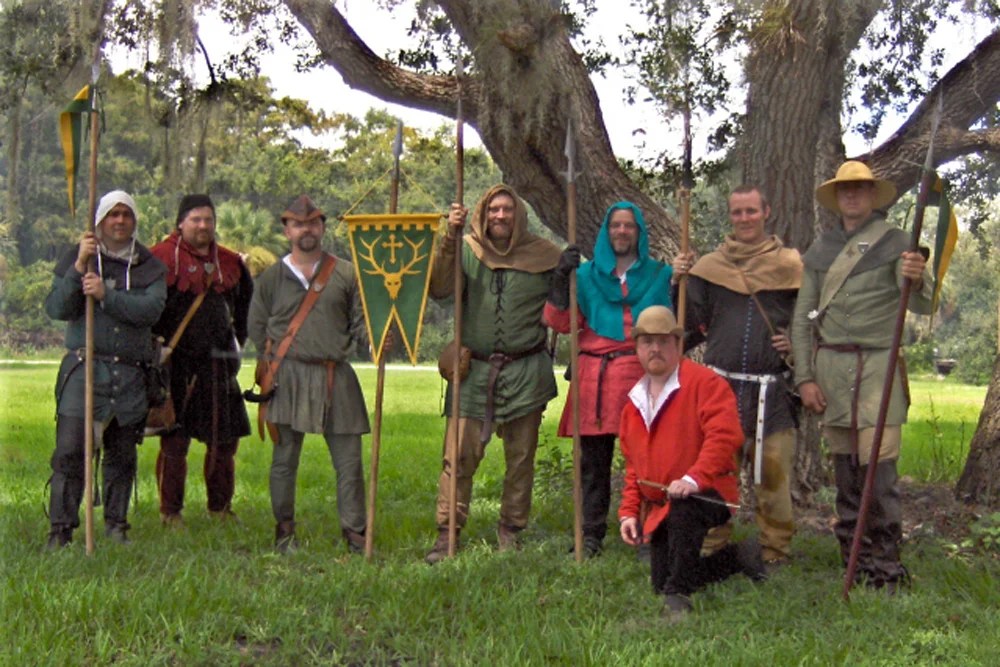
Lord Birch’s seven fee came in their hunter’s outfits and knelt to Gerraint.  “Lord,” they called him.

Gerraint shook his head and said, “Please stand.  I want to thank you for this special work in bringing our guests here safely.  Now, I know it goes against etiquette, but please get small and return to Lord Birch for whatever other instructions he may have.

“Lord,” they repeated the phrase, and got small and fluttered off.  Some of Gerraint’s own men raised an eyebrow at that.  Chlothar’s men became more confused than ever, but Chlothar, and a few merely nodded.  Chlothar dismounted, so the rest followed.

“Allow me to introduce myself.  I am Gerraint, son of Erbin.”  He reached out and Chlothar reluctantly shook Gerraint’s hand as a man behind whispered in Chlothar’s ear.  Chlothar gripped a little harder before he let go and spoke.

“I have heard of you.”

“Only good, I hope.”  Gerraint smiled.  “But come, I have others I want you to meet.”  He began to walk while the man at Chlothar’s ear continued to whisper.  The Franks led their horses, as long as no one came to take them.  Gerraint hated himself for doing it, but he listened in to what the man was whispering.  The man was a Gallo-Roman and filling Chlothar in on his estimation of the disposition of Gerraint’s troops.

“We are your prisoners?”  Chlothar brushed the man from his ear.

“You are our guests.  Your brother Childebert is lounging around in front of the gate to Paris with about two thousand horsemen.  I imagine he is waiting for your army to show up.  He doesn’t have much initiative, I would guess.”

“No,” Chlothar admitted.  “But tell me, if we are your guests, what if we decide to ride out and visit my brother?”

Gerraint stopped and faced the man. “No one will stop you.  We can fight, if you want to waste your men and ours.  But at least come and listen first to what my friends have to say.  I think you will find it worth your while.”

“And what do you have to say?” Chlothar looked hard at Gerraint, no doubt a practiced look, but it did not faze Gerraint.

“Larchmont!” Gerraint called.  The fairy appeared, full sized, but Gerraint tapped his shoulder.  “Come and sit.  I have to ask you some questions.”

“Lord.”  Larchmont, a good looking, blond headed young man got small and took a seat on Gerraint’s shoulder.  Chlothar and the others looked surprised again, as if they had forgotten.

“Right now, I am just an observer,” Gerraint told Chlothar.  “The two you need to talk to are in here.”  He pointed to the tent as Uwaine and Bedivere stepped up and opened the tent doors.  “Only four, please.  The tent is not too big.”

Chlothar stopped and pointed to four men, one of which was the Gallo-Roman.  They entered and Gerraint introduced the others.  Bohort, King of Amorica and Lancelot, his right hand.  Arthur, Pendragon of Britain, Wales and Cornwall, and Percival, his brother.

The eyes of the Franks got as big on the word Arthur as they did on seeing the fairies.  Chlothar stuck out his hand.  “It is an honor.”  After that, the ideas were presented in short order, and as Gerraint had suggested, every advantage of a friendly neighbor got underlined while the disadvantages of conquest were plainly stated.

Gerraint stood up and went to the door and Chlothar stood as well.  “You must wait,” Chlothar said.  “My brother must hear this.  You talk to my men.”  He followed Gerraint outside and gave a command.  “Conrad.  Take three men and fetch Childebert, alone.  No, he can bring that dotty old priest with him, but no more.”  He paused.

A jousting pole had been set up not far away.  Chlothar’s men were fascinated.  The Cornish were using the lances with the cushioned ends, since they did not want men injured who might need to go into battle, but it made a rough sport all the same.

“Two coppers on Marcus,” Uwaine said.

“Taken,” Bedivere answered.  He pulled out two coins and groused when Marcus unseated his opponent.  A couple of Chlothar’s men saw and laughed.  Chlothar, being of a military mind, instinctively saw the benefit of such training.

“You have well trained men,” he commented.

“Yes,” Gerraint agreed.  “But I am more interested in the women.  I was just about to ask Larchmont what the women were like in Paris.”  Chlothar looked, like he had forgotten Gerraint had a fairy on his shoulder.

“Dull and mindless,” Larchmont said.  “They spend all of their time in fancy dress and parties, like the world is no bigger than their boudoir.  I think there is only one female brain in all of the city and the women take turns using it.”

Chlothar laughed.  “Exactly my thinking.”

Gerraint laughed as well, but then said, “I think you better go see what Birch is up to, and tell Galoren, Baran and Gemstone to stand down for now.  I hope these men will be able to work things out for everyone’s benefit.

“Very good, Lord.”  Larchmont sped off.
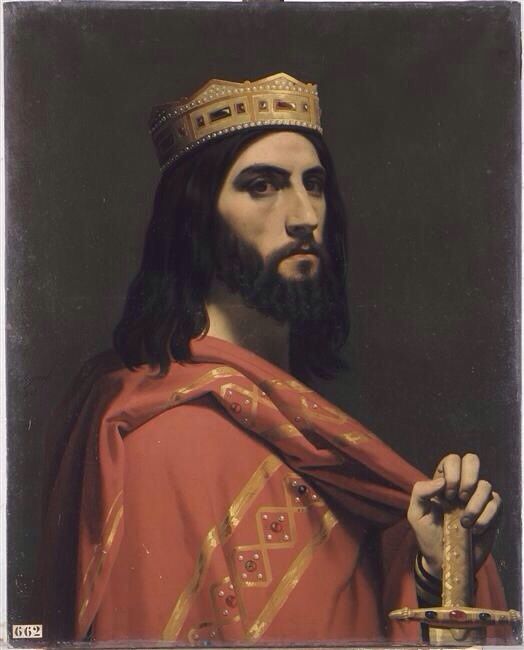
“These others?” Chlothar asked.

“Elf King, dwarf King and goblin King.”

“How is it that you…”

“They are friends.  Sometimes I have an opportunity to ask them for help, and they are good enough to oblige.  But I have a feeling you really want to ask me something else.”

Chlothar looked up.  “The Lion of Cornwall.  I should have guessed from your height, you know.”

“I am, but I have gotten old now.  It is something we all do, even kings.”

“Yes, but Arthur?”

“He brought just a few men to help a friend.  That is something you must also consider, but if you decide on peace and friendship, it is Bohort with whom you must speak.”

“I understand.  But I will say this.  Arthur is the only man on earth I would not like to fight.”

Gerraint smiled.  “I think you will find friendship with Great Britain and Little Britain is much better.”

Chlothar nodded and remained silent for a minute.  Then he turned and pointed at the joust.  “Tell me about this game your men are playing.”


M4 Gerraint: The Frankish Peace, part 3 of 4

Someone, not Charles because he died in the first strike, got to his horse and decided the battle had been lost.  He rode off, and near two thousand Franks followed him. Arthur and Bohort met in the center, and Arthur said something that raised Bohort’s eyebrows.

“Now we chase them.”

“What?  For how long?”

“All the way to Paris if necessary,” Arthur said.

“They will never stop unless they are forced to sit and make peace,” Gerraint added.  He and Arthur discussed it.  Arthur had been against it at first until Percival pointed out that if Amorica had a guarantee of peace, Lancelot might be willing to lead some of his men back to Britain.

“But who will hold the land and defend the border?” Bohort asked.  He felt trapped in the idea of defending the land and could not see alternatives.

“The best defense is a good offense,” Gerraint said.

“Can I quote you on that?”  Bedivere asked.  He and Uwaine had come up to join the conference.

“The Franks have two armies on the German border, north and south, in Swabia” Arthur said, having already talked to Lord Birch.  “They have more men in the Atlantique province and an army down in Aquataine, by the Burgundian border.  It made good sense for the Franks to let the sons of Claudus do the hard work against Amorica.”

Gerraint looked at Bohort, his friend.  “My scouts tell me the road to Paris is wide open and undefended.”

“Your scouts?” Bohort asked, and then remembered.  “Oh.”

“We go,” Arthur said, and he started out at a trot.  His men turned with him.  Only Gerraint, Uwaine and Bedivere waited on Bohort to make a decision.  They listened to the man swear, before he shouted.

“Bedwin.  You and your men bring the prisoners up to Lionel and then you can follow.  Tell Lionel to hold the line and kill any Franks who try to escape.  We will be a week.”  He saw Gerraint shake his head and hold up two fingers.  “Make that two weeks.”  He turned to Gerraint and could not help the sarcasm.  “After you, your majesty.”

“Thank you, your majesty.”  Gerraint returned the compliment, and the sarcasm, but with a smile.

Lancelot was not content with holding the line with the foot soldiers.  They had plenty of serviceable horses taken from Charles and deGuise.  He found seven hundred men who were reasonably good on horseback, and that gave him and Bedwin a thousand to follow Arthur.

Lionel spent the time grousing.  He did not want to have to guard three thousand Franks for the next two weeks. Arthur’s men had no interest in doing that, either.  Lionel spent a week carting all the Frankish leaders and chiefs to the nearest jails and prisons.  The rest of the Franks he kept there, on the fields, in the open.  He let them build fires, put up tents and gave them blankets.  He also gave them food to cook, once a day at noon.  But that was it.

The elves Ringwald and Heurst found Lionel early on and offered to hold the line at the trees in case any Franks got the idea that sneaking off into the woods as a way of escape.  Lionel was grateful, but he had to ask, “Does Gerraint know you are volunteering?”

“We don’t have to ask permission,” Lupen, the grumpy old fairy King said.  “We might get in trouble if we overstep our bounds, but I have met you, and you seem a reasonable man for one so very young.  I am sure you can keep this between you and me.  I mean, he can hardly complain.  He has Birch and young Larchmont flying all over the countryside.”

Lady LeFleur stepped up and spoke more to the point.  “Manskin, the King of the dark elves will watch the Frankish perimeter between sundown and sunrise.  Best you keep your men back in the night.  Ringwald and Heurst will stay in the trees during the day.  I understand your orders are to kill any who try to escape.”  Lionel nodded.  “I can assure you; none will escape by the forest or in the night.  Come along, Lupen.”

“Dear.”  The fairies left, and Lionel got down to planning.

Arthur’s foot soldiers pushed as far into Frankish lands as was reasonable, about half a day’s march.  They found a place where they could ambush the enemy on the road, and they waited in case Arthur reached a point where he had to make a hasty retreat.

Lionel kept the men in the center, to guard the prisoners, certainly, but also to guard the border.  He sent five hundred men to the lake, with orders to secure the road that lead to the port town, and also to patrol the coastal road.  DeGuise found a way down that coastal road with a thousand horsemen.  Lionel did not want any repeats.  Lionel also sent five hundred to the base of the Bringloren, the forest of the Banner Bain, to keep an eye on the Atlantique province and to hold the southern coastal road.  The Franks in the Atlantique were still an occupation force and that meant they pretty much had to stay where they were, but Lionel imagined they might try an end run in the south the way deGuise did in the north.  Then all of those men waited for Bohort, their King to return.

Gerraint lead the way down the Paris road, having done something similar back when they faced Claudus.  He drove the Franks ahead of him as refugees and burned the villages.  He only killed a few of the men who resisted.  Most of them he disarmed and drove off with a warning that they should be grateful being let go this one and only time.  The few he killed made the point.

There were two towns with walls on the route, but he bypassed them, not wanting to slow things down.   He gave warning that if they did not get satisfaction from the Frankish Kings, they would be back to burn the town and kill any who resisted.  He left them alone, but he set Larchmont as rear guard to watch for any enterprising young Lord or townspeople who might be tempted to come out and follow them.  At the same time, Gerraint hoped word that they wanted to talk with the king went ahead of him.

The two thousand Franks who escaped and rode away from the battle, and sometimes some locals with them, set numerous traps and ambushes along their route.  Lord Birch did not get fooled.  Those traps and ambushes were invariably turned on the Franks with dire consequences for the Franks.  Gerraint hoped that word went out front as well, and apparently, some information went ahead of them, because as they approached Paris, they found the villages deserted by the time they arrived.

While Gerraint watched over their progress, Bohort and Arthur argued until they hammered out an acceptable peace.  Arthur insisted they have some negotiable points where they could be seen giving the Franks some of what they wanted.

“The object here, as I see it,” Lancelot mused out loud.  “Is to get a peace agreement that both sides will keep, not to make a stone around the neck where one side has all the advantage over the other.”

“Border watch is sensible,” Arthur insisted.  “Representatives of the Franks that regularly renew the pledge of peace.  I would not suggest it, but I imagine they will insist on something.”

“I’m not sure I can be comfortable having Frankish Lords on my border, looking over my shoulder,” Bohort said.

“We have to be honest about this,” Lancelot continued.  “The Franks would leave their other borders at risk, but they could call up twice what the Saxons brought to Badon if they wanted.”

“There are ways to work things out, especially if there are men committed to peace on both sides of the border,” Arthur said.

“Marriage is a classic way to peace,” Uwaine said, and all eyes turned to him.  “Or so Gerraint tells me.”

“Saxon wife,” Percival pointed at Uwaine.

“Oh?” Bohort was interested.  “Does she?”

“Yes,” Uwaine said.

“Two sons and two daughters,” Percival added, and then Bohort had to think through some options.

“Gentlemen.”  Gerraint stuck his head into the big tent.  “We have news from Lord Birch.”  He got followed by a man dressed in plain hunter’s fare, but everyone knew he was not a plain hunter.

“Childebert, King in Paris has appealed to his brother Chlothar in Soissons for help.  The army in Austrasia is on the Frisian border, but Chlothar has some five thousand men at his call, mostly antrustiones with their pueri and they will be at Paris in about a week.”

“He has what?”  Bohort did not understand the terms

“Aristocrats, lords and rich men, often on horseback, with their peasant soldiers.” Percival explained.  He had taken the time to discuss thing with Gerraint who understood these things.

“The trustees are the king’s personal bodyguards.  They don’t have near the training, but you might think of them as Frankish RDF,” Uwaine added.  He listened when Gerraint talked.

“I don’t know,” Arthur said. “Childebert already has a reported four thousand men and another two thousand on the walls of the city.  That is already a match for our numbers.”

“By himself, Childebert might be able to turn us away from Paris,” Lancelot concurred.

“No.  You are missing the point,” Gerraint said.  “Chlothar is the brother you want to make peace with.  Theudebert, his son. rules Austrasia with Chlothar’s blessing.  Chlothar has already taken Orleans, since the death of his brother, Choldomer.  Childebert rules Paris and the immediate area, but he is surrounded by land ruled by Chlothar, and he knows it.”

“But with five thousand men added to what Childebert already has and we don’t stand much of a chance,” Bohort sounded calm about it.

“If we turn back now, the Franks will see that as weakness,” Lancelot countered.

“We have made our point, that we can hurt them,” Arthur said.

“You are still missing the point,” Gerraint interrupted.  “We talk to Chlothar.  Tell him we only want to make an acceptable peace.  As long as the Franks leave us alone, we will leave them alone.  Look at the advantages for him.  He will have one border he won’t have to waste men defending.  In fact, as a friend, Amorica can open up trade for the Franks with Cornwall, Wales, Britain, even Ireland.  That can bring riches to his lands.  Amorica still has a fine fleet.  It can help guard the Atlantique against Visigoths and Vandals, and the Channel against Saxons, Frisians, and Picts.  Look, with Amorica as a friend, he has everything to gain and nothing to lose.  You just need to explain that in a way he will understand.”

“But so many men,” Bohort did not sound convinced.

************************

MONDAY

First, they have to make peace with the Franks.  Then Arthur and his men are stuck in Little Britain for the winter, and find no help for the home-front.  Until then, Happy Reading

*

M4 Gerraint: The Frankish Peace, part 2 of 4

“Larchmont!”  Gerraint called.  “Birch!”  The two fairy Lords appeared, because they had to, but they came disguised as hunters so the other men present might not flinch too badly.  “What resources do we have?”

“The usual,” Birch said.  “Not too many spooks, the soil being what it is.”  By spooks, Birch meant goblins, trolls and the like who lived underground and avoided the sun.  The granite and thick, sandy soil of Amorica did not lend itself to underground living.

“How about in the Banner, er, the Bringloren?”

“There are some.  What do you have in mind?”

Gerraint outlined his ideas and ended with, “Of course, Arthur may adjust things when he gets here, but this is the plan for now.  As for me, I am going to spend the next three days in prayer that this plan might actually work.”

It took a week to get everything set, but that was because the signal stayed in the hands of the Franks.  DeGuise got his men to the hill called Bain Rock.  When ready, he was supposed to light a smudge fire on the rock, one with lots of smoke that could be seen for miles.  That would be the signal for the Franks, and also for the British and Amorican soldiers.  But then it rained for three days and remained overcast on the fourth day.  Gerraint spent the time wondering how badly deGuise cursed the initiative of the young Lord who attacked the port.  If he tried to do an end run and surprise the Amorican army, that move ruined that option.  DeGuise, no doubt, feared that enough delay would allow Arthur to unpack and join the fray.  Gerraint wondered how badly deGuise cursed the weather over those four days.

Gerraint also wondered how much those days put deGuise’s men on edge.  They were behind enemy lines and every day increased the danger of being found.   Plus, Gerraint had some special things he activated just for the Franks.  There were bumps in the night, strange noises, lights, always in the distance, and men who ventured too far from the camp always disappeared.  DeGuise shortly stopped sending out scouts.

Meanwhile, Lancelot’s men abandoned the center without making it a show.  Gerraint had goblins with fires in the night and elves in the day, so from a distance it would look like the army still camped there.  In fact, while the northern half gathered by the lake and the old burned down fort that Arthur built, the southern half gathered just above an old, Roman style house where the occupants still spoke Latin and went daily to mass.

The battle would be on Margueritte’s farmland, a mere hundred and fifty-eight years before Margueritte got born.  In that place, the old Roman improved road came from Paris and cut through the Vivane forest on its way to the point end of the peninsula where Bohort had his residence.

Bohort came out from his capital and brought an additional five hundred horsemen, his version of the RDF, which Gerraint saw as his personal guard.  He kept them, and Lancelot’s horsemen, about fifteen hundred altogether, up the road, ready to ride to battle on the signal.  Lancelot himself had the fifteen hundred-foot soldiers north of the Roman house, about an hour’s march below the expected battle.  Lionel had the other fifteen hundred Bretons, as they called themselves, up by the lake, well hidden in the woods.  Arthur’s footmen, a final fifteen hundred, settled in behind deGuise and prepared to follow them through the woods to the battle.  Arthur himself, with Gerraint had the rest of Arthur’s men, about twelve hundred horsemen, by Arthur’s fort, on the road that came down from the port town.

The trap was set, now all they needed was clear weather.  It came, by Gerraint’s count, on the fifth day.  The sun topped the eastern horizon and there did not appear to be a cloud left in the sky.  The heavy smoke that went into the sky from Bain Rock became easily visible from the field.

The Frankish commander, a man named Charles, moved his men sooner than Gerraint expected.  He imagined the man would wait a couple of hours to be sure deGuise got in position, but he did not.  He had three thousand men on horse and two thousand on foot, which Arthur pointed out was a great investment in horse flesh for the Franks.  The time was coming when the only men who could afford to fight from horseback would be the Knights and Lords who had the means to keep riding horses.  Soon enough, armies would again be a preponderance of foot soldiers.  But these Franks were still coming out of their Hun influenced Germanic roots where tribes bred horses and some young men were raised on them.  They were only, slowly becoming a nation of farmers and Lords.

Charles brought his men up the road and spread them out to charge.  The horses thundered, right up to the edge of the forest, but they found campfires burning, tents set in order, all the signs of a military camp except men or weapons.  Arrows came from the woods, shot with deadly accuracy, but only one or two hundred.  Charles quickly backed his horsemen out of range.

“Bring up the footmen,” he yelled, and he sent them into the forest, knowing horses were no advantage among the trees.  Then Charles and his sub commanders conferred about what to do.  Some probably wanted to go ahead and invade down the Roman road as planned, but Charles likely felt concerned about leaving the bulk of the Amorican army at his back.  No doubt, many said wait until deGuise arrived, and in typical German manner, like the Saxons and Angles in Britain, the argument went on for some time.

Gerraint, of course, knew none of this.  All he could do was speculate, worry and pray.  They never had a plan where everyone got so spread out and where a timely arrival felt so crucial.  Even with the smoke fire to start the action, it would be hard to get so many men coming from so many directions, coordinated.

“We need some radios,” Gerraint mumbled.

“This will work.”  Percival leaned over Arthur’s horse to reassure Gerraint.

The look on Arthur’s face said, “Maybe.”

They found Lionel and his footmen moving into place.  Arthur and his men also moved up to be ready to charge, but they had to wait for Bohort to be in position to charge from the other angle.  Their twelve hundred horse against three thousand would not end up pretty.

“Lancelot will be there,” Percival said.  “He is probably already there if I know Lancelot.”

Gerraint nodded, but he became worried about the woods.  The elves and fairy Lords whose arrow fire drew half of the Frankish foot soldiers into the woods worked well enough, but then they were supposed to get out of the way and let Arthur’s men deal with the rest.  Fifteen hundred was probably not enough against deGuise’s thousand horsemen and the thousand footmen in their path.  the other half of the Frankish foot soldiers stayed in the fake British camp and kept low in case there were more arrows from the trees.

What Gerraint did not know was his little ones overstepped their orders, not that he got surprised.  A great mist—a thick fog came up in the woods and confused the Franks on foot as well as deGuise and his men who were leading their horses through the trees, coming from the other direction.  They dared not ride in the fog, and the horses by then were just as spooked as the riders by the noises and lights around them, and occasional animal roars that did not really sound quiet like animals.

When the line of horsemen and footmen met in the fog, there were several incidents and several killed before they figured it out.  DeGuise knew they had to get out of the fog and into the open.  He turned the footmen and they began to hurry.  That was a good thing, because, Arthur’s men were keeping back about twenty or thirty feet from the shrinking line of fog.

The instant the Franks began to come from the woods, Lancelot charged from one direction and Lionel charged from the other.  Some Franks tried to stay behind the trees, but they were easily taken by Arthur’s men coming through the woods.  Plenty of Franks died that day, but the most, by far, surrendered, including deGuise.  They no longer had the nerve.

One enterprising young Lord under deGuise managed to gather a hundred horsemen and rode off to help the Frankish cavalry who were being pummeled.  It didn’t help.

As soon as Lancelot’s men crossed the road, Bohort decided he could not wait for the Franks to get organized and up on horseback.  He charged, but since his men were in a line and strung out down the road through the forest, he was slow to impact the Franks.  Arthur, on the other hand, looked only once at Gerraint.  Percival lowered his lance and the men behind them followed suit.  Then Percival and Gerraint shouted, “For Arthur!”

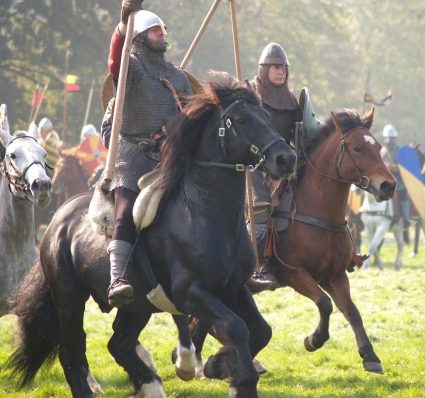
The men responded with a deafening shout, “For Arthur!” and they charged, led by three old men, Arthur at sixty-one, Gerraint at sixty, and Percival, the youngster, at fifty-eight.  Their troops poured from the northwest and hit the Franks when many of the Franks were still on their feet.  They made a crushing blow that busted open the Frankish ranks and made a hole straight through to the other side.  And then, Bohort got at them from the southwest.  His strike, not quite as telling, but by the time he bogged down as the Franks got to horseback, Arthur had turned and came in this time from the southeast.

M4 Gerraint 3: The Frankish Peace, part 1 of 4

Gerraint went reluctantly to Amorica.  Arthur had gathered roughly twenty-five hundred men willing to make the trip, a far cry from the thousands that used to gather.  Six hundred were from Cornwall, and most of the rest were from Wales.  Not many came from Oxford or Leogria or the Midlands.  A few traveled from York, but none at all from the north.  Some came from the Summer Country and Southampton, but it was not like it used to be.

If Arthur was unhappy, he did not show it.  His face showed a hardness that he never had in his youth.  Gerraint chalked it up to age, but he suspected it had to do with the house tumbling down.  Britain turned out to be a house of cards.  Arthur kept it as long as he could, but one strong wind and it would all collapse.

Enid, on the other hand, became very unhappy, and she had no qualms about expressing her unhappiness.  They had children and grandchildren to care for, and Guimier, who kept busy ignoring all of the boys who were interested in her, pining away for a boy who did not seem to care about her one bit.  Gerraint had done his time.  It should be time for the younger men to take over.  Gerraint deserved to live the rest of his days in comfortable surroundings and should not have to gallivant all over the world.  It was not right, and it was not fair.

All Gerraint could say was, “I have to go because Arthur says Lancelot won’t listen to anyone else.  Sadly, I think that may be true.”

“But what if I lose you?”  Her lovely old eyes became moist, but she did not cry.  “We have come this far together, I want to finish the journey, together.”

“As do I,” Gerraint said, but he left anyway.

The crossing in late September went surprisingly well.  Later in the fall and winter could be rough in the Channel.  Gerraint hoped they could wrap things up quickly so they could get back home before the winter storms settled in.

Uwaine leaned over the railing for most of the voyage.  It comforted Gerraint to see it.  It seemed like old times, even if it did not do Uwaine any good.  Bedivere spent the day making friends with the crew, and only once remarked how he hoped they did not get squid-stopped this time.  Gerraint had to take a moment to remember.

Gerraint spent the time pondering the future.  He caught a glimpse of jungle, but he had no idea where in the world that might be.  He also tried to imagine a woman, because he had been male, with Festuscato, twice in a row, and whoever controlled his rebirths had figured out, early on, that three times in a row as the same sex made things too complicated.  So Gerraint thought of Margueritte and of women in general, caught a glimpse of skin a bit darker than his own, and tried to imagine what it might be like to be a woman.  It eluded him.  It all eluded him, but he figured he would get there soon enough.

Gerraint had turned sixty.  Historically, that seemed about the longest he lived.  For millennia, if he didn’t die young for one reason or another, he died at fifty-eight to sixty, which was actually longer than most people lived on average.  It presently seemed about as long as a man tended to live in Western Europe, provided he did not die in childhood, or get killed in some conflict, or have some sort of accident while hunting, or simply while toiling away at his regular job, invariably his farm, or die from some disease.  Geraint thought they had too much toil in his day and age.  But barring some early death, for all of those who died of natural causes, as they called it, sixty seemed about it.  Seventy would be a venerable old age.  And if, by reason of strength, one should live four score years, Gerraint thought, that would have to be an act of God’s grace.  Gerraint shifted in his seat because he stiffened up and thought further that maybe 80 would be a sign of God’s displeasure.

Theirs had been the first ship from Cornwall, by design.  They docked in the port they visited years ago, the one just up the road from the Lake of Vivane, inside the old border of Amorica.  Arthur chose it because it was familiar.  He used that port to bring his army back to Britain after the defeat of Claudus.

Percival had already arrived with men from the Midlands.  The son of Urien, the Raven, arrived there as well, the one whose name Gerraint could never remember.  There were men there from Somerset, Dorset and the south coast of Britain, with sons and a couple of grandsons of Gwillim and Thomas, brought by ships from Southampton.  All of that only added up to about six hundred men, a pittance, a token of days gone by.  Gerraint thought when his men arrived from Cornwall and Devon, they would at least double their numbers.  Arthur would be a few more days to arrive.  He had the farthest to go.

“Cousin,” Percival called.  They weren’t really cousins, but it seemed an easy term.  “Lionel is here, around somewhere.”

“I suppose he has come to ask our help somewhere,” Gerraint guessed.  After ten or twelve years of skirmishes, tit-for-tat, what Gerraint called guerilla warfare, the sons of Claudus were finished, and Lancelot had just about pushed the Franks back to the original border line.  Gerraint felt glad to hear that Lancelot, or rather Bohort who had been proclaimed King when Howel died, did not have any ambitions beyond a secure border.  Keeping it secure, though, would be tricky, at least until certain ambitious Franks dropped out of the picture.

“I don’t know where he could have gotten to.”  Percival craned his neck to give a good look around, over and through all the boxes, bags and whole wagons being unloaded.

“Have you set up a watch on the perimeter of the town?”  Gerraint changed the subject.

“Surely not.  We are in friendly territory.”

“Surely so,” Gerraint said, feeling a bit like Kai in the face of Bedwyr. “We are too close to the border to be truly safe, and the way Lancelot and the Franks have been playing cat and dog these twelve years.”  He shook his head.  “If Lionel knew we were coming and to what port, you can be sure the Franks know.  Such secrets are hard to keep, and I would not be surprised if the Franks tried to stop us before we start.”

Percival needed no other encouragement.  He started yelling.  “Get those boxes open.  I want everyone armed.  Owen, get your men out to the perimeter of the town and keep your eyes sharp.

“My lord?”  Uwaine stepped up.  Gerraint pointed.  “Get two watchmen up in the old church tower.  I remember there being a bell up there that can give warning but be careful.  It looks burned and ready to fall.  Let me know if it is untenable.”  Uwaine moved like he already had a couple of men in mind.

“Uncle?”  Bedivere stood right there.

“You just need to get our ships and men unloaded and ready.  I can see three more ships on the horizon.”

Bedivere gawked a moment.  “You have the eyes of a hawk.  You complain about losing your vision, but you can still see further than anyone alive.”

“And ears.”  Gerraint looked up.  “I hear horses, maybe a hundred, coming on strong.”  Gerraint stuffed the port papers back into the hands of the bureaucrat and yelled.  “Bows and arrows.  Now.  Get under cover.”

Lionel chose that moment to ride up with some twenty men.  “Franks!”  His word got the townspeople to scatter for cover.  Then the church bell began to ring.

Even with the bell, men yelling, people running like mad people, some still got caught and speared, and some died.  Gerraint stood, defiant in the open.  Bedivere grabbed him to drag him behind some crates, but he raised his sword and shouted, “Now.”  It seemed a pitiful few arrows, maybe forty altogether, but about twenty of the hundred or so Franks went down.  “At will.”  He shouted and finally allowed himself to be dragged to cover.  Perhaps ten more Franks hit the cobblestones before they turned and rode out as fast as they came in.  Uwaine later reported that a half-dozen more were taken out on the way out of town by the men setting up the perimeter watch.  All told, that became some thirty-five out of a hundred, and if the ones down on the ground and left behind were not yet dead, they did not last long.  Nearly a dozen townspeople got speared, including several women, and most of them died.

Gerraint’s, or rather Percival’s losses were less than a handful.  Bedivere said he would take thirty-five to five any day.  Gerraint pointed out it was more like twenty than five.  And defenseless people should count double.

Gerraint did manage to save two Franks from the slaughter, and he questioned them at length.  Lionel filled in the gaps of information until Gerraint had a good picture of events.  Lancelot had some thirty-five hundred men, but they were spread out from the lake to the Atlantic.  Lionel had some two hundred and fifty men camped in the woods by the lake.  He was afraid the Franks might march down the coast road in an effort to get behind Lancelot.  His fears proved true.

One Frankish Lord by the name of deGuise brought a thousand men down the road.  There were five thousand more Franks ready to burst through the center of Lancelot’s spread out position, but it would come when the signal was given—the signal that deGuise and his thousand were ready to pounce on Lancelot’s rear.

Lionel could not imagine how deGuise learned Arthur was coming, but from the attack, he obviously knew something.  Lionel felt relieved to see eight hundred men in the port town, with more on the way.  He knew his troop alone did not have the strength to hold back a thousand Franks.

“We don’t want to hold them back,” Gerraint said.  “We want them to give the signal, and then drive them from behind right into their own oncoming troops.  If nothing else, it should confuse the Franks long enough to fall on them and drive them right back to Paris.  That is where there is peace to be brokered.  As long as you stick to the border, the Franks will never stop knocking on your door, and it is too early in history for trench warfare.”

“I was with you until the last part,” Lionel said.

“It was clear to me,” Uwaine responded.  “Schrench warfare.”

“I thought it was wrench warfare,” Bedivere said, as an aside.